Planning a trip to Yellowstone comes down to five decisions made in the right order: the season, the number of days, the side of the park you enter from, where you sleep and what you book before it sells out. Pick the season first, allow at least three full days, reserve beds the moment your dates are fixed, and plan each day around one region rather than the whole park.
That’s the short version. The long version is this page, and it exists because Yellowstone punishes a particular kind of planning. People plan it like a city break: a list of famous sights, a hotel, a few restaurant ideas. Then they arrive and discover that the famous sights are 20 to 50 miles apart on two-lane roads with a 45 mph ceiling, that a herd of bison has stopped traffic for twenty minutes, and that the “hotel near Old Faithful” they booked is in West Yellowstone, an hour’s drive away.
None of that is a reason to stay home. Yellowstone was the first national park anywhere, created by Congress on March 1, 1872, and it still has no real equal: more than 10,000 hydrothermal features, the greatest concentration of active geysers on Earth, a canyon with a 308-foot waterfall, and bison, elk, wolves and bears that you can often watch from the side of the road. It is simply a place where the order of your decisions matters more than the amount of effort you put into them.
This guide takes those decisions one at a time, with everything that changed in 2026 folded in: the new $100 surcharge for visitors who live outside the US, the bridge work that has turned part of the North Entrance road into a one-lane crawl, the geyser basin that has been closed since it exploded in 2024, and the move of five big campgrounds to Recreation.gov for 2027. Every price and date carries the month we last checked it. Each section also hands you on to the page on this site that goes deeper, because one page that tried to hold everything would be unreadable.
Yellowstone trip planning in ten steps
If you read only one part of this guide, read this table. Each step depends on the ones above it, and almost none of them depend on the ones below.
| Step | Decision | When to settle it | Go deeper |
|---|---|---|---|
| 1 | Season and dates | 9 to 13 months out for summer | Best time to visit |
| 2 | Number of days | With the dates | How many days you need |
| 3 | Where you arrive (airport or road) | With the dates | Getting to Yellowstone |
| 4 | Which entrance, and which way round you’ll loop | Before you book beds | Entrances, fees and passes |
| 5 | Where you sleep each night | Up to 13 months out for in-park lodges | Where to stay |
| 6 | Campsites, if you’re camping | About 6 months out | Camping in Yellowstone |
| 7 | Rental car and flights | 4 to 9 months out | Car rental |
| 8 | Budget and park pass | Once beds are booked | Trip cost |
| 9 | Day-by-day route | 1 to 2 months out | Itineraries |
| 10 | Gear, apps and offline maps | The final two weeks | Packing list |
A confession before you start: steps 1, 2, 4 and 5 are the ones that make or break a Yellowstone trip. Get the season, the length, the direction and the beds right, and a mediocre lunch or a forgotten rain jacket is a minor irritation. Get them wrong and you will spend your holiday looking at the back of an RV. If you’d like the booking side of this laid out as a calendar, our Yellowstone trip planning timeline turns the table into dates.
What Yellowstone is actually like to visit
Most first-time frustration comes from one mismatch: the park is far bigger, and far more car-based, than it looks on the brochure map.
Yellowstone covers about 2.2 million acres. Roughly 96% of it lies in Wyoming, with thin strips in Montana and Idaho, and most of it is a high volcanic plateau more than a mile above sea level. Yellowstone Lake sits at 7,733 feet. You experience the park through one road system, the Grand Loop, a figure eight of about 140 miles with five spur roads running out to five entrances. Almost everything that first-time visitors come to see sits on that loop or a short walk from it.
It helps to think of the park as six neighborhoods strung around the figure eight:
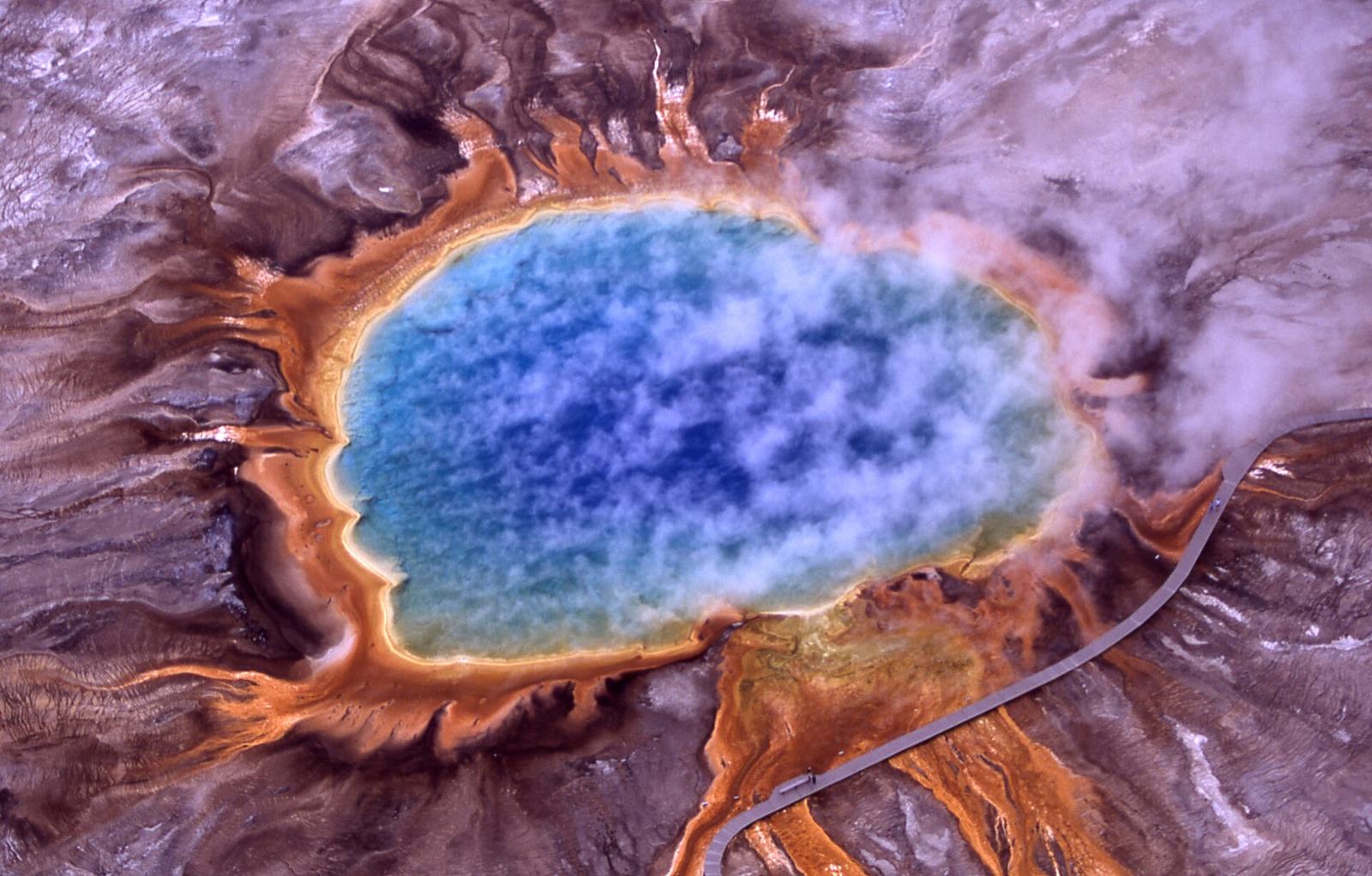
- Geyser Country (southwest): Old Faithful and the Upper Geyser Basin, Grand Prismatic Spring in the Midway Geyser Basin, and the Lower Geyser Basin. This is where most people spend most of their time, and it is the busiest part of the park. Start with our guides to Old Faithful, Grand Prismatic Spring and the wider geyser basins.
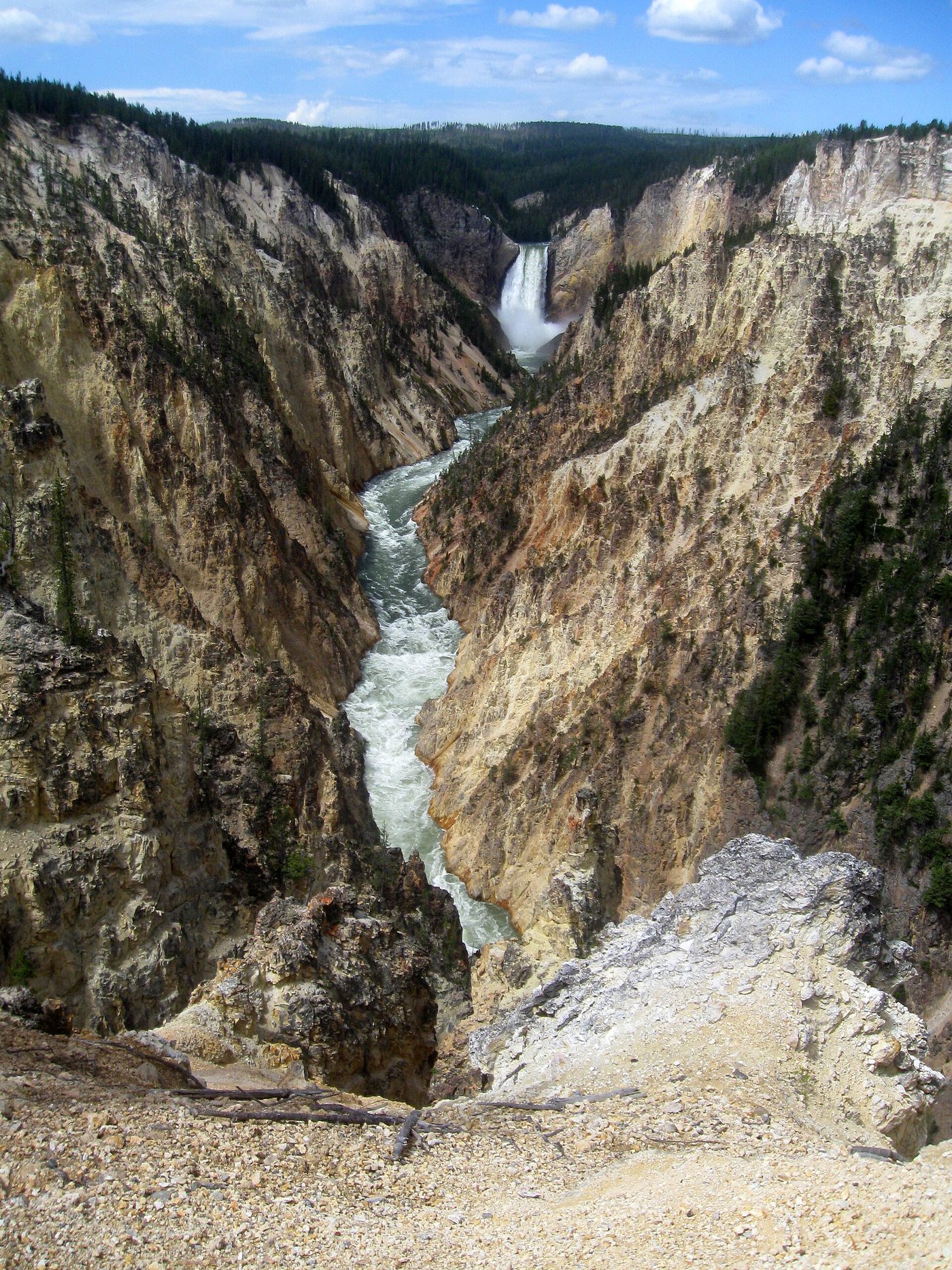
- Canyon Country (center): the Grand Canyon of the Yellowstone with its 308-foot Lower Falls, plus Hayden Valley just to the south, the easiest place on the loop to find bison herds in summer.
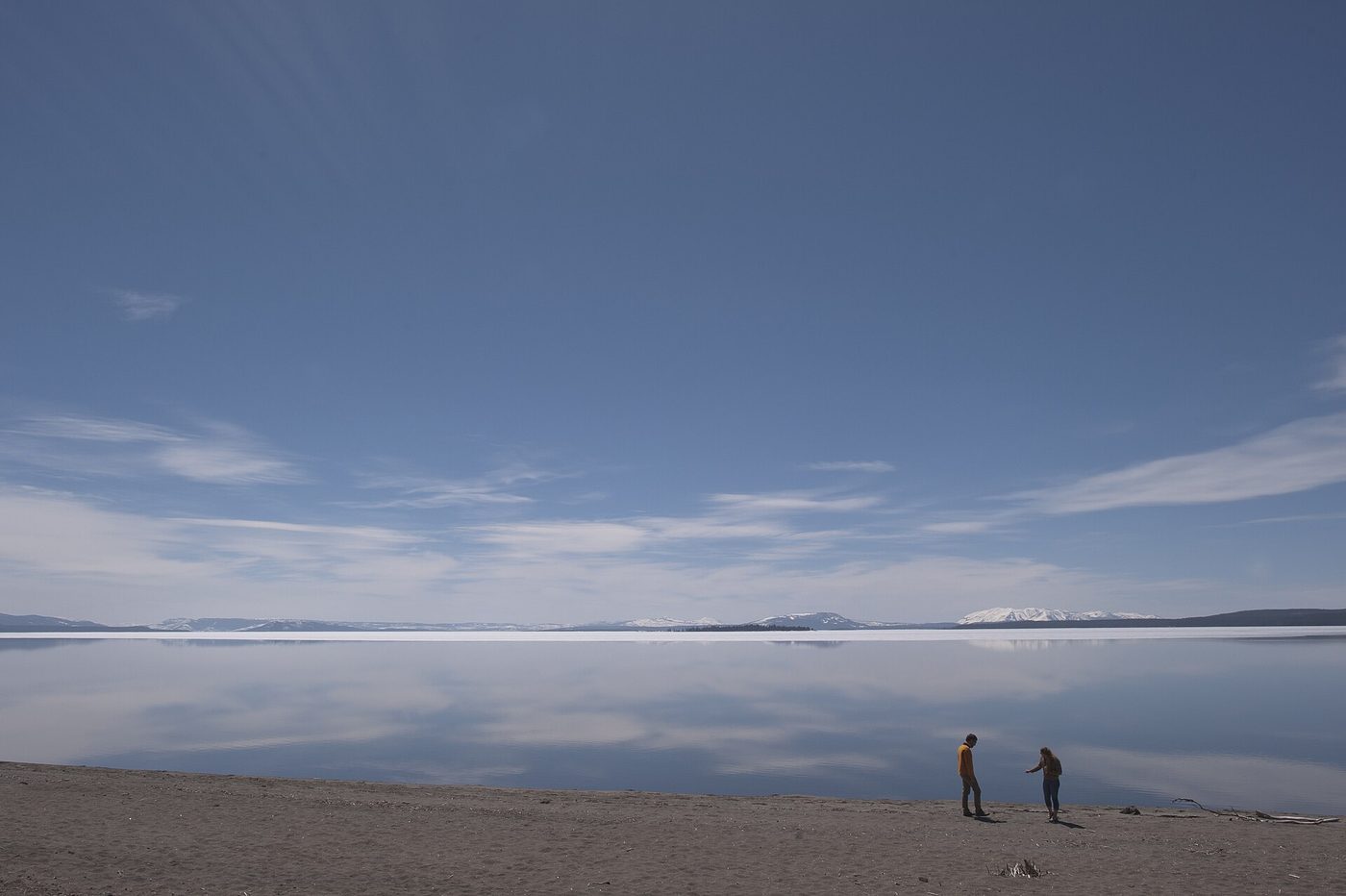
- Lake Country (southeast): Yellowstone Lake, the West Thumb Geyser Basin on its shore, Fishing Bridge, Lake Village and Grant Village.
- Mammoth Country (northwest): the travertine terraces of Mammoth Hot Springs, the old stone buildings of Fort Yellowstone and the park headquarters.
- Roosevelt and the Northern Range (northeast): Tower Fall, Tower-Roosevelt and the Lamar Valley, the best wolf- and wildlife-watching country in the park and possibly in the lower 48.
- Norris (west-center): the hottest and most changeable geyser basin in the park, and the junction between Mammoth, Madison and Canyon.
The practical consequence is drive time. The park’s top speed limit is 45 mph, lower around villages and thermal areas, and summer traffic moves slower than that. On the Grand Loop it is about 34 miles from Mammoth to Madison Junction and about 50 to Old Faithful. From the West Entrance to Old Faithful is about 30 miles, which takes close to an hour once you’ve queued at the gate. Add wildlife jams, full parking lots and the 15- to 30-minute construction delays that have been running all through 2026, and a day that looked like “see four famous things” on paper becomes “see two famous things properly.”
That is why the rest of this guide keeps returning to direction and bases. A good Yellowstone plan cuts down the number of times you drive the same stretch of road. Our Grand Loop Road guide has the junction-by-junction mileage, and upper loop vs lower loop shows how to split the figure eight across your days.
If you’re still at the “where exactly is it?” stage, where Yellowstone National Park is covers the geography and the nearest cities, and our Yellowstone facts page collects the numbers worth knowing before you go.
When is the best time to visit Yellowstone?
For most people the best time to visit Yellowstone is mid- to late September: every road is still open, the summer crowds have thinned, the elk rut is under way and the days are mild. June is the pick for families tied to school holidays, and winter suits a completely different kind of trip.
Yellowstone has four seasons that behave like four different parks. The table gives you the summary. The month-by-month detail, with visitor numbers and road status for each month, lives in our best time to visit Yellowstone guide.
| Season | Access | Typical weather (lower elevations) | Crowds | Best for |
|---|---|---|---|---|
| Spring (mid-April to May) | Roads reopen in stages from mid-April; the full loop usually by late May | Highs about 49°F in April and 60°F in May, nights below freezing, snow is normal | Light until Memorial Day, then climbing fast | Bears leaving their dens, bison calves, waterfalls at full flow |
| Summer (June to August) | Everything open, including Dunraven Pass and the Beartooth Highway | Highs about 70°F in June and 80°F in July, nights in the 40s, afternoon thunderstorms | Peak; July is the busiest month of the year | Hiking, full access, school-holiday trips |
| Fall (September to October) | Everything open until mid-October; high passes close first, most roads at the end of October | Highs about 68°F in September and 56°F in October, frosty mornings | Busy until mid-September, then noticeably quieter | Elk rut, fall color, photography, fewer people |
| Winter (mid-December to mid-March) | Only the North-to-Northeast road is open to cars; the interior by guided snowcoach or snowmobile | Highs around 30°F, lows near 10°F, subzero nights common | Very light | Steaming geysers, wolves in the Lamar Valley, near-solitude |
The weather column uses the National Park Service’s monthly averages, which match the lower, warmer northern side of the park around Mammoth. Old Faithful and Canyon are colder, and snow can fall in any month. The NPS notes that a foot of snow in 24 hours is not unusual in spring and fall. Our Yellowstone weather by month page has the full climate table, and what to wear in Yellowstone turns it into clothing.
Spring: great for wildlife, awkward for a first visit
The park reopens to cars in stages. In 2026 the roads from the West and North sides opened on April 17, the East Entrance on May 1, the South Entrance on May 8, and Dunraven Pass and the Beartooth Highway on May 22. Spring is superb for wildlife. Grizzlies are out of their dens and feeding in the open, and the rust-colored bison calves that locals call “red dogs” turn up in Hayden and Lamar valleys from late April. But the weather swings from sunshine to snow within a day, and some lodges, campgrounds and trails don’t open until late May or June.
Our verdict: spring is a fantastic second visit and a slightly risky first one. If you want everything open, wait until the first week of June. If you want bears and baby bison and don’t mind packing a winter coat, late May is hard to beat. More in Yellowstone in spring and Yellowstone in May.
Summer: everything is open, and so is everyone’s calendar
Summer is the only season when every road, lodge, campground, boat dock and trail is open at once, and the weather is at its kindest. It is also when most of the park’s visitors arrive. Yellowstone recorded 4,762,988 recreation visits in 2025, the second-highest total ever, and the bulk of them came between June and August. July is the busiest month of the year.
In practice that means full parking lots at Old Faithful and Grand Prismatic Spring by mid-morning, long waits at the West Entrance, and restaurants that are either booked or queued. None of that ruins a trip if you plan around it: be on the road by 7 a.m., do the headline geysers early or after 5 p.m., and spend the middle of the day on a hike or at a quieter corner of the park. Summer evenings are long, with light until after 9 p.m. in June and July.
Our verdict: if school holidays tie you to summer, choose June over late July. Early June still has snow on the high trails, but the crowds are thinner and the wildflowers are starting. Read Yellowstone in July for peak-season tactics and Yellowstone crowds for the time-of-day strategy that makes the biggest difference.
Fall: the season people who know the park choose
September has become the season that people who know Yellowstone pick, which means it is no longer a secret. The first two weeks are still busy. After that the crowds fall away, the aspens and cottonwoods start to turn, and the elk rut fills Mammoth with bugling bulls. The bulls are genuinely dangerous during the rut, so treat the ones lounging on the Mammoth lawns as you would a moose, not a lawn ornament.
In 2026 Dunraven Pass and the Beartooth Highway close for the season on October 12, and the NPS lists October 31 as the last day for most other interior roads. Lodges and restaurants begin closing from late September. October can be glorious, with empty boardwalks and geysers steaming in the cold, but a single storm can shut roads for a day or two, and more services close every week.
Our verdict: the second half of September is the best balance of access, weather, wildlife and crowds in the whole year. See Yellowstone in September and Yellowstone in October.
Winter: a different trip entirely
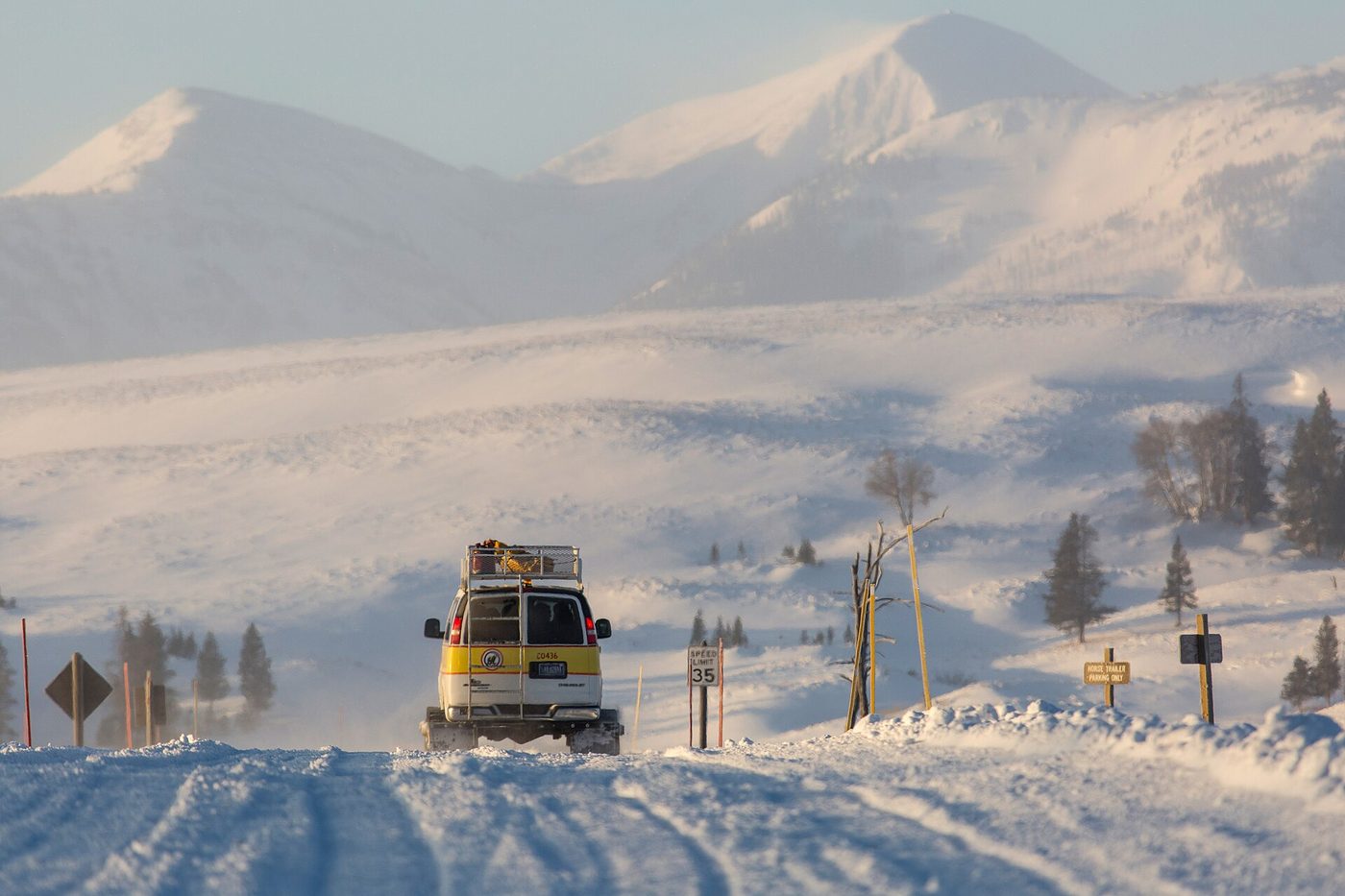
Winter is not a quieter version of summer. It’s a separate trip with its own logistics. The only road open to regular cars runs from the North Entrance at Gardiner, Montana, past Mammoth and through the Lamar Valley to Cooke City, just outside the Northeast Entrance. The rest of the interior opens to guided snowcoaches and snowmobiles from December 15, 2026 until somewhere between March 7 and March 15, 2027, depending on the road. Only two lodges operate: the Mammoth Hot Springs Hotel and the Old Faithful Snow Lodge, and the Snow Lodge can be reached only by snowcoach or snowmobile.
Between those windows (from early November to mid-December, and again from mid-March until the April reopening) the interior roads are closed to almost everything while crews prepare them for oversnow travel or plow them. The northern road stays open. If you’re wondering whether the park is open on a particular date, is Yellowstone open? answers it by season and entrance.
For everything about the cold months, from what’s open to where to sleep and how to book a snowcoach, start with Yellowstone in winter and our comparison of snowcoach vs snowmobile.
How many days do you need in Yellowstone?
Plan on at least three full days inside the park, not counting travel days. Three days covers Geyser Country, the Grand Canyon of the Yellowstone and Mammoth without rushing. Four or five adds the Lamar Valley at dawn, Yellowstone Lake and a couple of good hikes. One day is a drive-through, not a visit.
| Days in the park | What fits | Honest verdict |
|---|---|---|
| 1 | One region, usually Old Faithful, Grand Prismatic Spring and the Firehole River from the West or South Entrance | A taste. Don’t try to drive the whole loop |
| 2 | The lower loop: geysers on day one, Hayden Valley and the Grand Canyon of the Yellowstone on day two | Workable, but you’ll skip Mammoth and the Lamar Valley |
| 3 | Both loops’ headline sights plus one early wildlife drive | The minimum we’d suggest for a first visit |
| 4 to 5 | Adds the Lamar Valley at sunrise, Yellowstone Lake, Norris, Mammoth and two or three hikes | The sweet spot for most first-timers |
| 6 to 7 | Repeat wildlife mornings, longer hikes, a boat or horseback trip, a day in Grand Teton or on the Beartooth Highway | Relaxed; the week that feels like a holiday |
Three days is the floor for one reason: the park’s two biggest draws, the geyser basins and the wildlife valleys, sit at opposite corners of the map, and both are best at the start or end of the day. With two days you have to choose. With three you can give each a morning.
Four or five days is where Yellowstone starts to feel generous. You can build in a dawn in the Lamar Valley, when the wolf-watchers set up their spotting scopes along the road, and still have time for an afternoon on the shore of Yellowstone Lake or a walk to a waterfall nobody else seems to know about. It also lets you split your nights between two bases, which saves hours of driving. A common and good split is two nights near the geysers (Old Faithful or West Yellowstone) and two or three near Canyon, Mammoth or Gardiner.
If you’re driving through between other destinations and really only have a day, commit to one region and enjoy it. Our one-day Yellowstone itinerary shows how, and the three-day itinerary is the plan we’d hand most first-time visitors. The full set of plans, for one to seven days and by entrance and season, is in our Yellowstone itinerary hub, and the reasoning behind the day counts is in how many days in Yellowstone.
What belongs on a first-time list
You cannot see everything, and you shouldn’t try. These are the places we’d build a first trip around, roughly in order of how much they reward the effort:
- Old Faithful and the Upper Geyser Basin. Watch one eruption from the benches, then walk the boardwalks to Morning Glory Pool while the crowd heads back to the parking lot.
- Grand Prismatic Spring. See it twice if you can: from the Midway Geyser Basin boardwalk, then from the overlook above, which shows the colors properly.
- The Grand Canyon of the Yellowstone. Artist Point and the North Rim viewpoints for the Lower Falls. Most viewpoints are a short walk from the parking area.
- Hayden Valley. Bison, often by the hundred, and a fair chance of grizzlies in spring and early summer.
- The Lamar Valley at dawn. The best chance in North America to see wild wolves, plus pronghorn, bison and bears.
- Mammoth Hot Springs. Travertine terraces unlike anything else in the park, and elk wandering between the buildings.
- Yellowstone Lake and West Thumb. Hot springs on the shore of a huge high-altitude lake.
- Norris Geyser Basin. Otherworldly and acidic, and home to Steamboat, the world’s tallest active geyser, which erupts rarely and unpredictably.
For the complete list with drive times, see things to do in Yellowstone, and for time on your feet, our best hikes in Yellowstone and Yellowstone waterfalls guides. If animals are the point of your trip, Yellowstone wildlife explains where and when to look for each species.
Which Yellowstone entrance should you use?
Use the entrance that matches where you arrive and where you want to spend your first day. West is fastest to the geysers, North is the only one open to cars all year, South connects to Grand Teton, East comes in from Cody over Sylvan Pass, and Northeast is the Lamar Valley and Beartooth Highway route.
Here is how each one fits a plan:
- West Entrance (West Yellowstone, Montana). The busiest gate, about 30 miles from Old Faithful and a natural start for Geyser Country. The town has more beds than any other gateway. Summer queues at the gate can be long after 9 a.m.
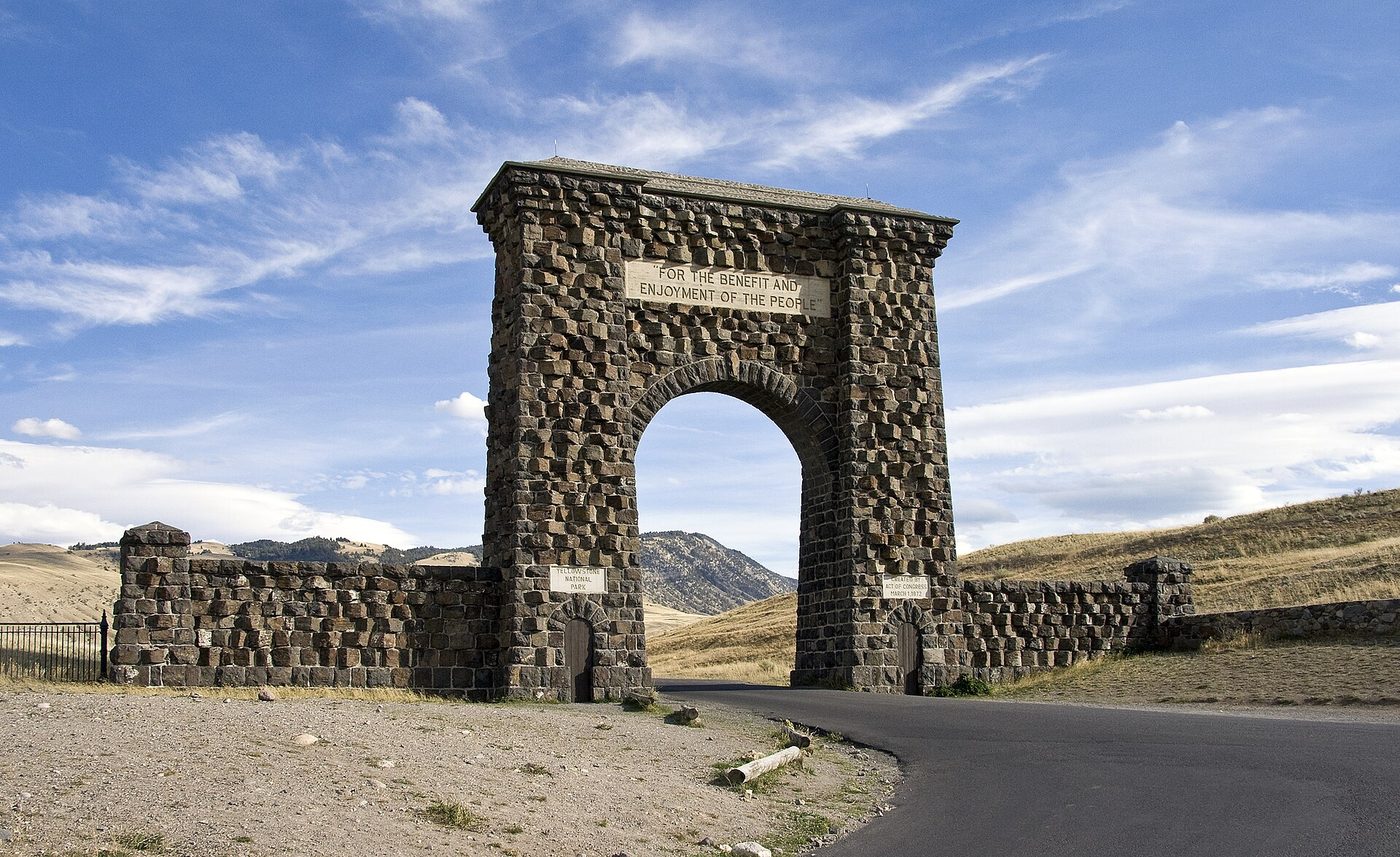
- North Entrance (Gardiner, Montana). About 5 miles from Mammoth Hot Springs, the closest entrance to Bozeman’s airport and the only one open to cars all year. The Roosevelt Arch is here. In 2026, bridge work on this road means a single lane and up to 15-minute delays until late October.
- South Entrance (from Jackson and Grand Teton). About 22 miles from West Thumb on Yellowstone Lake, and the obvious choice if you’re combining the two parks.
- East Entrance (from Cody, Wyoming). About 27 miles from Fishing Bridge over Sylvan Pass, through some of the park’s wildest scenery. It opens later in spring and closes earlier in fall than West and North.
- Northeast Entrance (Cooke City and Silver Gate, Montana). The quietest gate, closest to the Lamar Valley, and linked in summer to the Beartooth Highway, one of the great mountain roads in the US.
The most useful planning trick is to enter through one gate and leave through another. Fly into Bozeman, enter at West or North, work your way round, and leave through the South Entrance into Grand Teton and on to Jackson. You never drive the same miles twice, and you get two parks for the price of two entrance fees. One-way car rentals cost extra, so compare the drop fee against the hours of driving it saves.
The park itself is open 24 hours a day, and when an entrance is seasonally open it isn’t gated at night: you can drive in at 5 a.m. to beat the crowds. There is no timed-entry or vehicle reservation system in 2026. The fee (see the cost section below) is paid at the gate or bought ahead online.
Gate-by-gate details, opening dates, wait times and which entrance is closest to what are all on our Yellowstone entrances page, and the decision itself is walked through in best entrance to Yellowstone. Everything about paying at those gates is on our entrance fees and passes guide.
How to get to Yellowstone
Yellowstone has no train station, no in-park public transport and only one small, seasonal airport at its edge. Almost everyone arrives by car, either on a road trip or in a rental picked up at an airport one to three hours away.
The National Park Service lists five airports with year-round commercial service around the park (Bozeman, Billings, Cody, Jackson and Idaho Falls) plus the seasonal airport at West Yellowstone. Big hubs such as Salt Lake City and Denver are further away but often cheaper.
| Airport | Natural entrance | Rough drive to the gate | Worth knowing |
|---|---|---|---|
| Bozeman, MT (BZN) | North or West | About 1.5 hours to Gardiner, about 2 hours to West Yellowstone | Montana’s busiest airport, the most flights and rental cars; our default pick |
| Jackson Hole, WY (JAC) | South | About 1.5 hours through Grand Teton | Inside Grand Teton National Park; pricier fares; ideal for a two-park trip |
| West Yellowstone, MT (WYS) | West | A few minutes | Seasonal, limited flights and very few rental cars |
| Cody, WY (COD) | East | About 1 hour | Small; the East Entrance is summer-only |
| Billings, MT (BIL) | Northeast or North | About 3 hours | Good for a Beartooth Highway arrival in summer |
| Idaho Falls, ID (IDA) | West | About 2 hours | Often cheaper than Bozeman or Jackson |
| Salt Lake City, UT (SLC) | West or South | About 5 to 6 hours | Major hub with cheaper fares and more cars; common for international visitors |
| Denver, CO (DEN) | South or East | 8 to 10 hours | Realistic only as part of a longer road trip |
For most first trips, Bozeman is the answer: frequent flights, the biggest rental fleet in the region, and short drives to the two entrances that make the most sense for a first loop. The open-jaw version (fly into Bozeman, out of Jackson or the other way round) is the best plan for anyone adding Grand Teton. Our guides to the closest airport to Yellowstone and the best airport to fly into compare every option, and the drive guides from Bozeman, Jackson Hole, Salt Lake City and Denver cover the routes.
Book the car early. Summer rental fleets around Yellowstone are small relative to demand, and a mid-size SUV picked up in Bozeman in July can cost more per day than a hotel room. Our car rental guide explains which airports have the most cars and when prices spike. If you’d rather not drive at all, it is possible, using guided tours from the gateway towns, but it is limiting; Yellowstone without a car sets out what works. And if the park is one stop on a bigger drive, our Yellowstone road trip planner has the classic multi-park routes.
The full comparison of every way in, from flights to shuttles, is in our how to get to Yellowstone guide.
Where to stay: inside the park or a gateway town?
This is the decision that shapes every day of your trip, so it’s worth getting right before anything else is booked. You have three real options: a lodge inside the park, a hotel or cabin in a gateway town, or a campsite.
Lodges inside the park
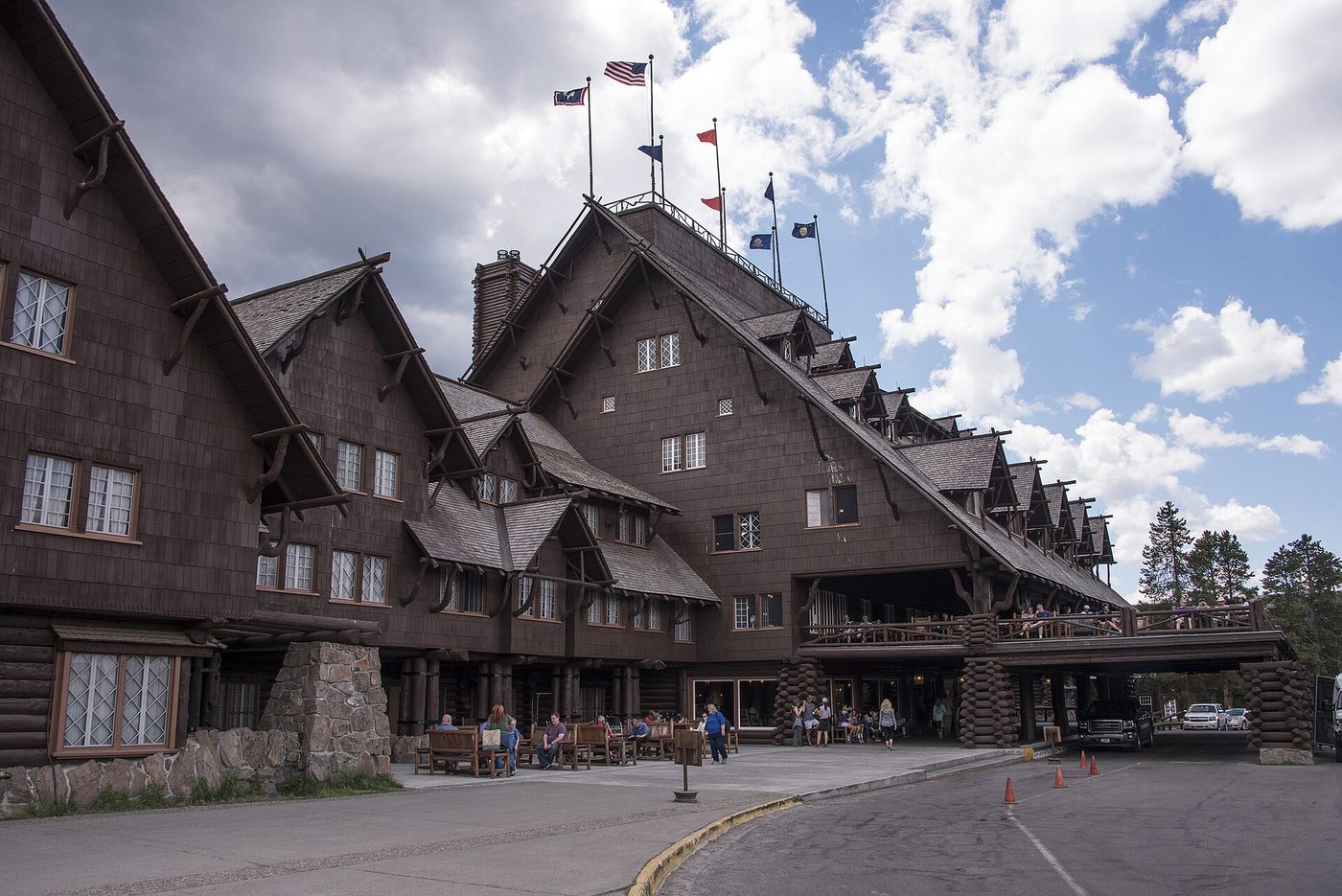
There are nine lodges inside Yellowstone, all run by the park’s concessioner, Xanterra: the Old Faithful Inn, Old Faithful Lodge, Old Faithful Snow Lodge, Lake Yellowstone Hotel, Lake Lodge, Grant Village, Canyon Lodge, the Mammoth Hot Springs Hotel and Roosevelt Lodge. They range from the Old Faithful Inn, a vast 1904 log building that is one of the great hotels of the American West, to simple cabins with a shared bathhouse.
The case for staying inside is location. Sleep at Old Faithful and you can watch an eruption at 7 a.m. with a few dozen people rather than a few thousand. Sleep at Canyon and you’re in the middle of the figure eight, 30 minutes or so from most of the park. You also skip the entrance queue every morning and get the park’s best hours, dawn and dusk, without a long drive either side.
The case against is honesty about the product. In-park rooms cost more than equivalent rooms outside, many have no air conditioning, TVs are rare, Wi-Fi is limited or absent, and the older cabins are, charitably, rustic. They also sell out months ahead for summer. If you care about a modern room and a choice of restaurants, a gateway town suits you better.
Our lodging inside Yellowstone guide compares all nine lodges on season, rooms and price, and Yellowstone lodging prices shows what a night actually costs. If there’s one in-park stay to try, make it the Old Faithful Inn.
Gateway towns
Five towns sit at or near the five entrances, and a few more are within an hour. Which one suits you depends on which part of the park you’ll spend the most time in.
| Base | Best for | Distance to the park’s highlights | Season |
|---|---|---|---|
| West Yellowstone, MT | Geysers, Grand Prismatic, first-time visits | About 30 miles to Old Faithful | Busy May to October; winter snowmobile hub |
| Gardiner, MT | Mammoth, the Lamar Valley, winter trips | About 5 miles to Mammoth | Year-round |
| Cooke City and Silver Gate, MT | Lamar Valley wolf-watching, the Beartooth Highway | Right at the Northeast Entrance | Mostly summer; reachable in winter only from Gardiner |
| Cody, WY | The East Entrance, rodeo and Western history | About 50 miles to the East Entrance | Year-round town; the east road is summer-only |
| Jackson, WY | Combining Grand Teton and Yellowstone | About 60 miles to the South Entrance | Year-round town; the south road is seasonal |
West Yellowstone is the default for good reason: it’s closest to the geysers and has the widest choice of beds. But staying there for a five-day trip means a 1.5- to 2-hour drive each way on your Lamar Valley and Mammoth days. The better plan for longer trips is to split nights between two bases, one in the southwest and one in the north or center. Our comparison of West Yellowstone vs Gardiner shows how the two most popular towns stack up, and the gateway towns hub covers all of them. For the town guide, see West Yellowstone.
Camping and RVs
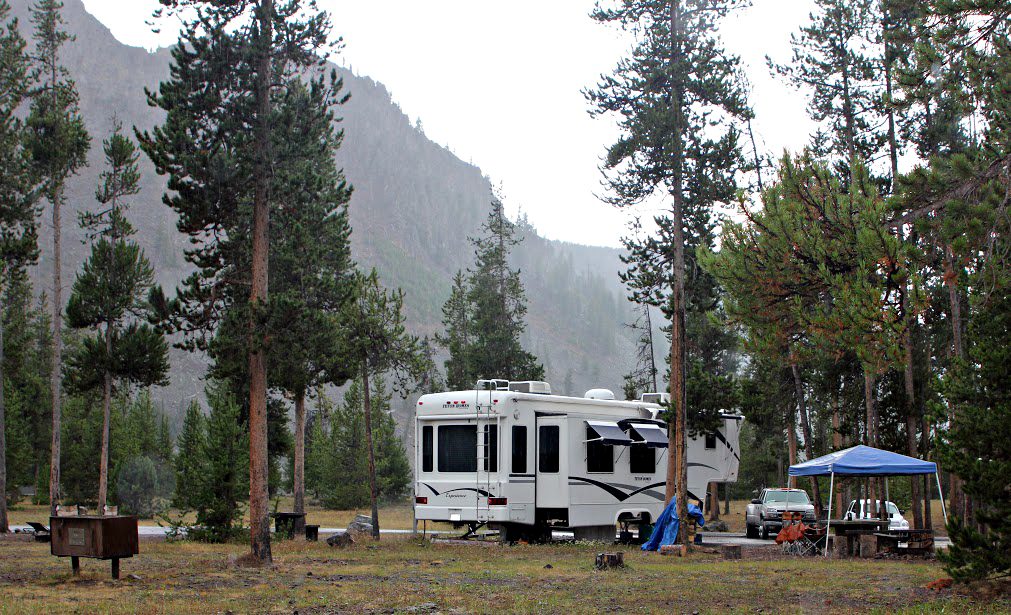
Yellowstone normally has a dozen campgrounds. Two are out of action in 2026: Pebble Creek is closed and Norris doesn’t appear on the 2026 list. The five large campgrounds that Xanterra has run (Bridge Bay, Canyon, Grant Village, Madison and the Fishing Bridge RV Park) move to Recreation.gov from the 2027 season, with reservations opening about six months ahead. The smaller NPS-run campgrounds are already on Recreation.gov with a six-month window. Mammoth is the only campground open all year, and Fishing Bridge is the only one with full hookups, for hard-sided RVs only.
Camping inside the park is the cheapest way to sleep close to the sights, and some sites book out within minutes of release for peak summer. Our camping in Yellowstone guide has the full campground table, Yellowstone campground reservations explains the 2027 switch, and RV drivers should read Yellowstone RV camping and the Fishing Bridge RV Park guide before choosing a rig.
Our honest summary: for a first trip of four or more days, stay inside the park for at least two nights, ideally at Old Faithful or Canyon, and fill the rest from the gateway town nearest your other focus. The full reasoning, with the best base for every kind of itinerary, is in where to stay in Yellowstone and staying inside vs outside Yellowstone.
What needs booking, and when?
You do not need a reservation to enter Yellowstone. There is no timed entry and no vehicle permit in 2026: you drive up, pay and go in. What you do need to book, often a long way ahead, is somewhere to sleep, and in summer also a rental car and any guided tour you care about. Our do you need reservations for Yellowstone? page covers each piece.
The key date is the in-park lodging window. Xanterra accepts reservations up to 13 months ahead, and on the 5th of each month it releases the whole of the same month in the following year, online from midnight Mountain Time and by phone from 7 a.m. Mountain Time (checked September 2026). That has a consequence people miss: as of September 2026, every date in summer 2027 is already on sale, because May to September 2027 were released between May 5 and September 5 this year. If you’re planning a 2027 summer trip and haven’t booked a lodge yet, you’re not too late, but you’re choosing from what’s left and from cancellations. The next release, on October 5, 2026, opens October 2027.
Cancellation terms matter because they drive when rooms reappear. A deposit of the first night is taken at booking. Cancel more than 30 days out and you get it back. Cancel within 30 days and you lose the deposit plus a $25 fee (checked September 2026). So some people drop rooms they no longer need just before that 30-day line. If you missed out, checking the booking site repeatedly in the five weeks before your dates is the most reliable way to pick up a room.
| When | What to book | Why then |
|---|---|---|
| 13 months out, on the 5th | In-park lodges | Old Faithful and Canyon rooms for July and August go first |
| 9 to 12 months out | Gateway-town hotels for July and August, especially West Yellowstone | The best-located rooms go early |
| About 6 months out | In-park campsites on Recreation.gov | Popular sites go within minutes of release |
| 4 to 9 months out | Flights and rental car | Small regional fleets and airports; summer prices climb |
| 2 to 4 months out | Guided wildlife tours, horseback rides, boat trips, winter snowcoach packages | Small groups and limited departures |
| 2 weeks out | Bear spray rental, app downloads, offline maps | Easy, but easy to forget |
The full calendar, including winter packages and the first Recreation.gov release dates for 2027, is in our Yellowstone trip planning timeline. For the mechanics of booking a lodge, see when Yellowstone reservations open and how to book Yellowstone lodging.
Should you book a tour?
For most visitors with a car, a general sightseeing tour of the park isn’t worth it: the roads are easy, the signage is good and you’ll see the same things at your own pace. The exceptions are real, though. A guided dawn wildlife tour in the Lamar Valley, with a guide who knows where the wolf packs have been and carries a spotting scope, can turn a morning of distant dots into the best hour of your trip. A snowcoach is the only practical way into most of the park in winter. And if you’d rather not drive at all, a multi-day tour from a gateway town removes the hardest part of the logistics. Our Yellowstone tours hub compares every type, Yellowstone wildlife tours covers the dawn safaris, and are Yellowstone tours worth it? gives the straight answer for each kind of traveler.
How much does a Yellowstone trip cost?
For two adults, a mid-range four-night summer trip typically costs $2,100 to $3,400 before flights, on our estimates. Lodging is the biggest line, followed by the rental car and food. The park entrance itself is cheap, at $35 per vehicle for seven days, unless you live outside the US and owe the new $100-per-person surcharge.
Entrance fees and passes (checked September 2026)
The headline numbers from the National Park Service’s Yellowstone fee page:
- Private vehicle: $35, valid for seven days and covering everyone in the car. Motorcycles are $30, and visitors on foot or bicycle pay $20 each (16 and over).
- Yellowstone annual pass: $70, for US citizens and residents.
- America the Beautiful pass: $80 a year for US residents and $250 for nonresidents. It covers entrance fees at every national park and many other federal sites.
- Senior, military and Access passes: the senior annual pass is $20 for US citizens and permanent residents aged 62 and over (a lifetime version is $80); the military, Access (for permanent disabilities) and 4th-grade passes are free.
- Nonresident fee: since January 1, 2026, each non-US resident aged 16 or over pays a $100 fee on top of the standard entrance fee unless admitted with an annual or America the Beautiful pass. The same fee applies at Grand Teton and nine other busy parks.
- Fee-free days: the three left in 2026 are September 17, October 27 and November 11, and they apply to US citizens and residents only. Nonresidents pay the normal fee and the surcharge on those days.
- Payment: all entrance stations take cash and cards.
The surcharge maths is worth doing if you’re visiting from abroad. Two adults from the UK in one car, visiting Yellowstone and Grand Teton, would pay $35 plus $35 in entrance fees and $400 in surcharges: $470. The nonresident America the Beautiful pass costs $250 and, per the NPS wording, admission with it waives the surcharge. Even for Yellowstone alone the pass is roughly break-even ($250 against $235), and it covers any other parks on your route. The details, including how the rule is being applied at the gates, are in our Yellowstone nonresident fee guide and America the Beautiful pass for Yellowstone. The complete fee table is on our entrance fees and passes page, and the two-park question gets its own answer in one pass for Yellowstone and Grand Teton?. Free-day dates for 2027 will be on Yellowstone free days as soon as they’re announced.
A sample budget
These are our own estimates for two adults spending four nights in and around the park in July and flying into Bozeman, as of September 2026. They’re meant for planning, not quotes, and summer prices move.
| Item | Budget trip | Mid-range trip | Notes |
|---|---|---|---|
| Entrance fee | $35 | $35 | Per vehicle, seven days |
| Nonresident surcharge | $0 or $200 | $0 or $200 | Only if you live outside the US and have no annual pass |
| Four nights’ accommodation | $100 to $180 | $800 to $1,400 | Campsites vs in-park cabins or gateway motels in July |
| Rental car, five days | $350 to $500 | $500 to $750 | Book early; SUVs cost more |
| Gas | About $100 | About $150 | 500 to 700 miles of driving is typical |
| Food | About $250 | $500 to $700 | Groceries and picnics vs cafeterias and dining rooms |
| Extras | About $20 | $150 to $300 | Bear spray rental vs a guided wildlife tour |
| Total before flights | About $850 to $1,100 | About $2,100 to $3,300 | Add the surcharge if it applies |
The single biggest lever is where you sleep. Camping, or a motel in a less fashionable gateway town, can cut the total by more than half. The second is when you go: a September trip after mid-month can shave 20% or more off lodging compared with July. The line-by-line version with per-person and family scenarios is in how much a Yellowstone trip costs, and our Yellowstone on a budget guide collects 25 ways to spend less. For eating in the park, from cafeterias to the Old Faithful Inn dining room, see where to eat in Yellowstone.
What’s closed or changed in 2026?
The big changes are a $100 surcharge for non-US residents aged 16 and over, one-lane bridge work on the North Entrance road until late October, the continuing closure of Biscuit Basin, no swimming at the Firehole River swim area or Boiling River, and five campgrounds moving to Recreation.gov for 2027.
Here’s the full list we’re tracking, checked against the National Park Service’s roads and conditions pages in September 2026:
- The nonresident fee. Announced by the Department of the Interior on November 25, 2025 and charged since January 1, 2026. Details above.
- Gardner River High Bridge. On the road between the North Entrance and Mammoth, expect a single lane of traffic and up to 15-minute delays, 24 hours a day, from April 13 until late October 2026. Vehicles wider than 8 feet 6 inches or longer than 75 feet are not allowed through during the work, which matters if you’re towing or driving a big RV.
- Other roadwork. Chip sealing around the park brings delays of up to 30 minutes, and bridge projects at Bridge Bay, the Firehole River and the Yellowstone River bring up to 15.
- Biscuit Basin. Closed since a hydrothermal explosion on July 23, 2024 threw rock and destroyed part of the boardwalk. The parking lot and boardwalk are closed until further notice, and there’s no reopening date. That also removes the usual trailhead for Mystic Falls.
- Swimming. The Firehole River swim area is closed, with the NPS giving an estimated reopening no earlier than late summer or early fall. Swimming isn’t possible at Boiling River after the 2022 flood.
- Uncle Tom’s Trail. The steep stairway to the base of the Lower Falls remains closed.
- Campgrounds. Pebble Creek is closed for 2026 and Norris is not on the 2026 list. From 2027, Bridge Bay, Canyon, Grant Village, Madison and the Fishing Bridge RV Park are booked through Recreation.gov.
- The North Entrance road. Since the June 2022 flood destroyed the old canyon road, traffic between Gardiner and Mammoth has used the rebuilt Old Gardiner Road. The NPS published an environmental assessment for a permanent replacement in January 2026.
- Fire danger. Rated high at the end of August 2026. Smoke from regional fires can haze late-summer views.
Two things did not change, despite what you may have read. There is still no entry reservation, and during the 43-day federal government shutdown in the fall of 2025 the park stayed open, with reduced services. If a shutdown threatens your dates, is Yellowstone open during a government shutdown? explains what closes and what doesn’t.
Closures change with little notice, so check the NPS conditions page and the NPS app the week before you travel and again each morning. Our Yellowstone road closures hub has the season-by-season schedule, and Yellowstone road construction tracks the current projects and delays.
How to plan your days inside the park
Once the big decisions are made, a Yellowstone day comes down to rhythm. These are the habits that separate a good day from a frustrating one.
Start early, and mean it
The two best hours in Yellowstone are the first two after sunrise. Animals are active, the light is soft, the air is cold enough that the thermal features steam properly, and the parking lots are empty. In summer the lots at Grand Prismatic Spring, Old Faithful and the Canyon viewpoints fill by mid-morning, and the last reliable window for a spot is often before 9 a.m. They empty again from about 5 p.m., and summer evenings are long. A day that starts at 6 a.m., takes a long break in the middle and finishes after dinner beats a 9-to-5 day every time.
Let the geysers set the schedule
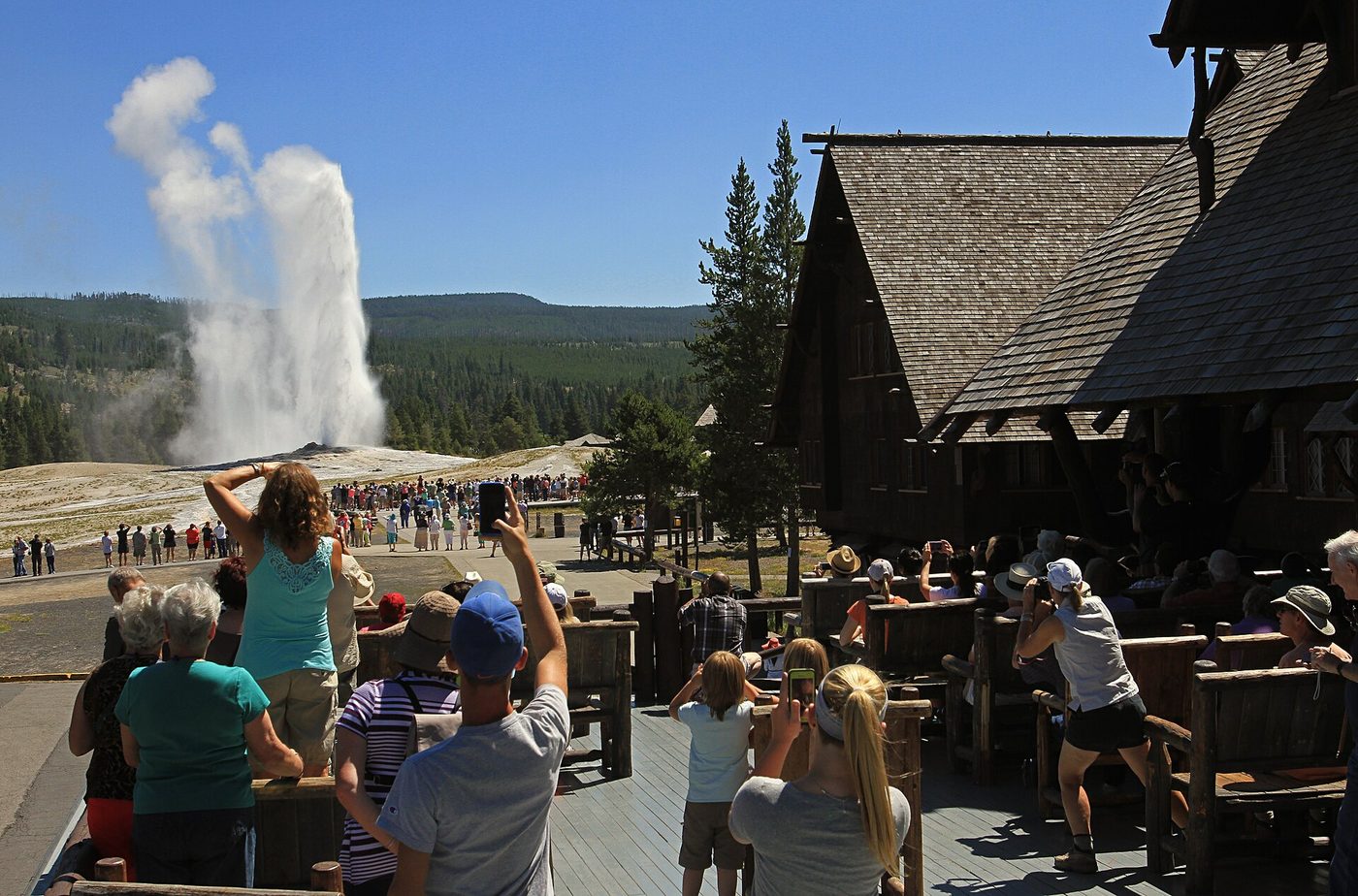
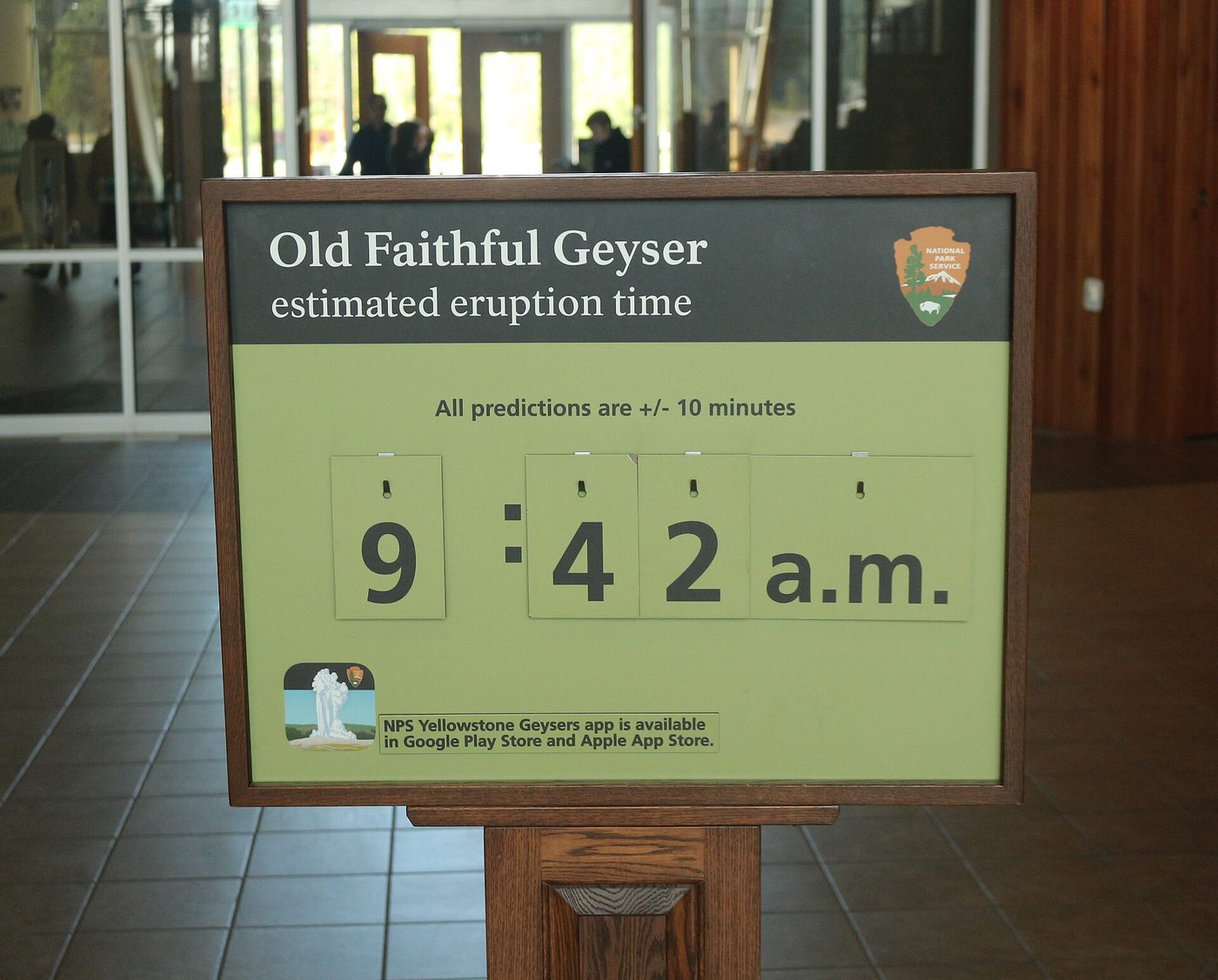
The National Park Service predicts eruptions for Old Faithful and a handful of other large geysers, and posts the times at the Old Faithful Visitor Education Center and in the official NPS Yellowstone app. Old Faithful’s prediction is usually good to about 10 minutes either side. Build your Geyser Country day around those times: arrive, check the board, watch an eruption, then walk the Upper Geyser Basin and come back for the next one or for one of the less predictable big geysers. Our guide to Yellowstone geyser predictions explains which geysers are predicted and how, and Upper Geyser Basin maps the walk.
Driving, parking and bison jams
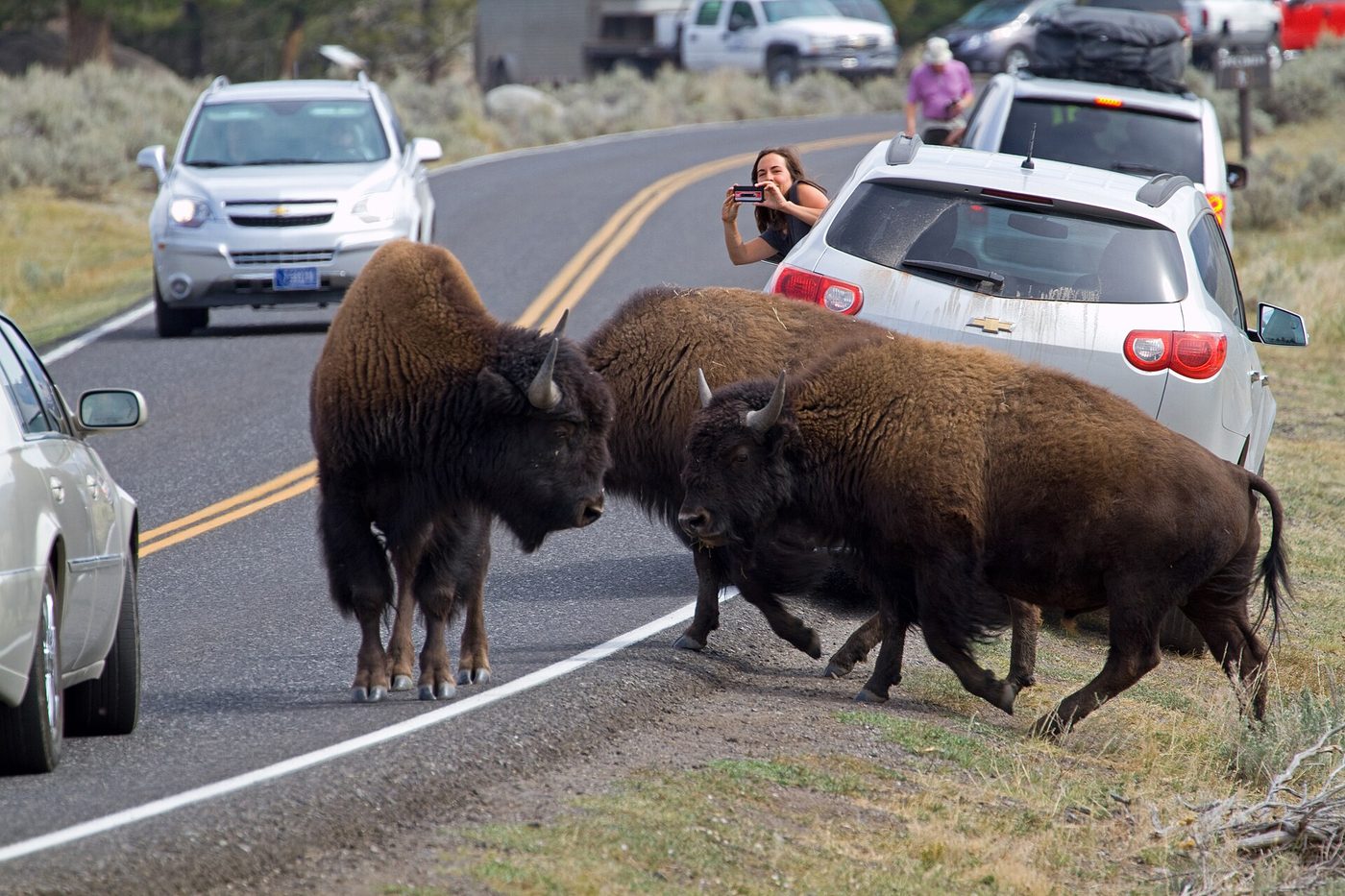
Wildlife on the road is part of the Yellowstone experience, and so are the traffic jams it causes. When bison walk down the road, stay in your car and let them pass; they have right of way and are far faster and more unpredictable than they look. When people stop for a bear or a wolf, pull fully into a pullout rather than stopping in the lane, and never leave your car in the road. Avoid driving after dark where you can: elk and bison on an unlit road are hard to see, and collisions are common.
Gas, food and supplies
There are gas stations at Canyon Village, Fishing Bridge, Grant Village, Mammoth Hot Springs, Old Faithful and Tower Junction, and all of them offer 24-hour pay-at-the-pump fueling by card, year-round. Fill up whenever you drop below half a tank rather than aiming for a particular station. Our gas stations in Yellowstone page lists them with seasons.
Food inside the park ranges from dining rooms (the Old Faithful Inn and Lake Yellowstone Hotel are the grandest) to cafeterias, grab-and-go counters and general stores. It’s convenient and rarely cheap, and the queues at noon in summer can be long. The smartest move is a cooler in the car and a picnic at one of the park’s many picnic areas, which frees your lunch hour for a quiet viewpoint instead of a crowded counter.
Phone signal, maps and apps
Mobile signal in Yellowstone is patchy: usable around the main developed areas such as Mammoth, Old Faithful, Grant Village, Lake and Canyon, and absent across long stretches in between. There is no free public Wi-Fi. Before you arrive, download the official NPS app’s offline content, save the park as an offline area in your maps app, and pick up the paper map you’re handed at the entrance. It is still the best overview of the park. Our guides to Yellowstone cell service, the best Yellowstone app and Yellowstone maps go further. A GPS-triggered Yellowstone audio tour is a cheap way to get the stories behind what you’re seeing without a guide.
Visitor centers, rangers and medical care
The Albright Visitor Center at Mammoth is open all year, and the big visitor education centers at Old Faithful and Canyon are well worth an hour. Rangers run talks and walks through the summer, and children can earn a Junior Ranger badge. Our Yellowstone visitor centers guide compares them all. For health care, the Mammoth clinic operates year-round and clinics at Lake and Old Faithful open in summer. For emergencies, call 911.
The first-timer mistakes worth avoiding
After all of the above, the mistakes that cost visitors the most time and money come down to a short list:
- Trying to drive the whole Grand Loop in a day. You can, technically. You’ll see very little of it.
- Booking one base in a gateway town for a long trip. Three-hour round trips to the far side of the park, every day, add up.
- Starting at 10 a.m. You’ll meet everyone else, at every parking lot, all day.
- Getting too close to animals. Most injuries in the park come from bison, not bears, and they happen when people walk up for a photo.
- Leaving the boardwalk. The ground in thermal areas can be a thin crust over scalding water.
- Underpacking for the weather. Frost on a July morning at Old Faithful is not unusual.
Our Yellowstone mistakes to avoid expands that list to 15, things to know before visiting Yellowstone covers the practical surprises, and 50 Yellowstone tips from locals and rangers is the page to skim the night before you go. If this is your first time, first time visiting Yellowstone brings it all together as one narrative plan.
How do you stay safe in Yellowstone?
Keep at least 100 yards from bears and wolves and 25 yards from every other animal, bison and elk included. Stay on boardwalks and marked trails in thermal areas. Carry bear spray on any hike and know how to use it. Drive slowly, especially at dawn and dusk. Most injuries come from ignoring one of those four.
Some detail on each, from the National Park Service’s safety guidance:
- Wildlife distances. The 100-yard and 25-yard rules are regulations, not suggestions. Bison look placid and slow; they can run at around 35 mph and have injured more people in Yellowstone than any other animal. Use binoculars or a zoom lens rather than your feet. If an animal moves toward you, you’re too close.
- Thermal areas. Always walk on boardwalks and designated trails. The water in hot springs and geysers can be near or above boiling, the crust around them can be thin, and even runoff can burn. Swimming or bathing in water that is entirely of thermal origin is illegal.
- Bear spray. Carry it on every hike, keep it on your hip rather than in your pack, and use it when a charging bear is 30 to 60 feet away. The NPS reports that 91% of the people injured by bears in Yellowstone were hiking alone or with just one partner, so hike in groups of three or more where you can. You can’t fly with bear spray, so buy it or rent it when you arrive; rentals in and around the park start at about $16 for one to two days (checked September 2026). Don’t leave the can in a hot car: it can explode above 120°F.
- Altitude. Most of the park lies more than a mile above sea level, and some visitors feel it as headaches, breathlessness or poor sleep. Drink more water than usual and take the first day easy.
- Weather. Afternoon thunderstorms are common in summer. Get off exposed ridges and away from open water by early afternoon, and carry a warm layer on every walk.
- Drones. Launching a drone is prohibited in Yellowstone, as it is across national parks.
The complete guide, including rules for pets, driving and backcountry travel, is Yellowstone safety. For the specific risks, see bison attacks and how to avoid them, bear spray in Yellowstone, thermal safety, Yellowstone’s elevation and flying a drone in Yellowstone. And if the supervolcano is on your mind: the US Geological Survey keeps a close watch on it, and it is not a realistic factor in planning a holiday. Our Yellowstone supervolcano guide explains why.
Planning for your group
The steps above work for everyone. These are the extra considerations for particular kinds of traveler.
Families with children
Yellowstone is one of the best family trips in the US, provided you plan around short attention spans and long drives. Geysers are a lot of waiting punctuated by a lot of excitement, so bring snacks and pick eruptions with good predictions. Keep small children’s hands held on every boardwalk: the drop-offs are short, but what’s at the bottom is boiling. Many of the main boardwalks work with a sturdy stroller, but not all, and a child carrier is more flexible. Kids can pick up a Junior Ranger booklet at any visitor center and earn a badge. Our Yellowstone with kids guide is the family planner, with separate pages for Yellowstone with toddlers and the Junior Ranger program.
Seniors and travelers with limited mobility
A great deal of Yellowstone can be enjoyed from the car, from roadside pullouts and from short, level walks. The main Old Faithful viewing area is flat and paved, the one-way Upper Terrace Drive at Mammoth shows off the terraces from the car, and some Canyon viewpoints are a short paved walk from the parking lot. Other boardwalks involve stairs or steep grades, so check each one before you set off. US citizens and permanent residents aged 62 and over can buy the $20 annual or $80 lifetime senior pass, and those with a permanent disability can get the free Access Pass. Our guides to Yellowstone for seniors and accessible Yellowstone list the easiest sights, the accessible lodging and the best tours.
Traveling with a dog
Yellowstone is a hard park for dogs. Pets are allowed only in developed areas and within 100 feet of roads, parking areas and campgrounds, and never on boardwalks, trails, in the backcountry or in thermal areas. They must be on a leash no longer than six feet and can’t be left unattended. There are no kennels in the park, though gateway towns have boarding. A limited number of in-park cabins accept pets for $40 a night (from April 24, 2026). If your dog is coming, read are dogs allowed in Yellowstone? before you book anything.
International visitors
Visitors from abroad have three extra things to plan. First, entry to the US itself: most UK, Australian and many European travelers use an ESTA under the Visa Waiver Program, which you should apply for well before you fly. Second, the $100 nonresident fee at Yellowstone and at Grand Teton, which makes the $250 America the Beautiful pass the better deal for almost any two-park trip. Third, the distances: the nearest big international gateways are Salt Lake City and Denver, five and eight or more hours away by car, so most visitors connect to Bozeman or Jackson instead. Our Yellowstone for international visitors guide covers money, driving and seasons, and visiting Yellowstone from the UK covers flights, car hire and the things that surprise British visitors. Everything here is in US units: miles, °F and gallons.
Adding Grand Teton
Grand Teton National Park begins just south of Yellowstone’s South Entrance, and for many people the pairing is the ideal trip: Yellowstone’s geysers and wildlife, then Grand Teton’s jagged skyline, lakes and hiking. The parks charge separate entrance fees (and the $100 nonresident fee applies at each), so an annual pass often pays for itself. Add at least two days for Grand Teton. Our Yellowstone and Grand Teton planner has itineraries of three to eight days, and the distance between the two parks, Yellowstone vs Grand Teton and where to stay for both cover the details.
What to pack for Yellowstone
Packing for Yellowstone is really packing for three seasons in one day. A July morning at Old Faithful can start near freezing and reach the 70s by afternoon, with a thunderstorm in between. These are the things that earn their place in the car:
- Layers. A base layer, a fleece or light insulated jacket and a waterproof shell, in every season. A warm hat and gloves outside July and August.
- Proper footwear. Comfortable walking shoes for boardwalks, and hiking shoes or boots if you plan to hike.
- Binoculars. The single most useful item for wildlife. A spotting scope is even better for wolf-watching in the Lamar Valley.
- Sun protection. At 7,000 to 8,000 feet the sun is strong even when the air is cool: a hat, sunglasses and sunscreen.
- Water and food. Refillable bottles and a cooler with lunch and snacks, because food stops are far apart and queues are long.
- Bear spray. Bought or rented on arrival, as above.
- Navigation. The paper park map, offline maps and the NPS app, downloaded before you lose signal.
- Power. A car charger and a power bank, since you’ll be using your phone as a camera and a map.
- Small comforts. A headlamp for early starts, insect repellent for June, and a light blanket or camp chair for waiting out geyser eruptions.
The printable, season-by-season version is our Yellowstone packing list, and what to wear in Yellowstone explains how to layer for 40-degree swings in a day.
Is Yellowstone worth it, and how does it compare?
Yes, if you accept what it is: a huge, busy, driving-heavy park where the payoff is geothermal scenery and roadside wildlife you can’t see anywhere else on Earth. If you’d rather hike quiet mountain trails from a single base, Grand Teton or Glacier may suit you better, and many people pair Yellowstone with one of them.
The honest downsides are real. Summer crowds at the headline sights are heavy, much of your time is spent in the car, the in-park lodging is expensive for what you get, and the weather can turn on you in any month. People who come expecting a quiet wilderness from their first hour are often disappointed; people who plan around the crowds almost never are. Go early, stay late, walk a mile past the end of the busy boardwalk, and the park still feels as strange and wild as it must have to the surveyors who argued for protecting it in 1872.
How it compares:
- Yellowstone vs Yosemite. Yosemite is granite cliffs and waterfalls concentrated in one spectacular valley; Yellowstone is thermal features and wildlife spread across a plateau. Yosemite is easier to base yourself for; Yellowstone has far more to see from the road. See Yellowstone vs Yosemite.
- Yellowstone vs Glacier. Glacier is alpine scenery and hiking along the Going-to-the-Sun Road; Yellowstone is geysers and big-animal wildlife. Both charge the nonresident fee. See Yellowstone vs Glacier.
- Yellowstone vs Grand Teton. Next door, smaller, with mountains instead of geysers. Most people should do both. See Yellowstone vs Grand Teton.
The full pros-and-cons verdict, and who shouldn’t go, is in is Yellowstone worth visiting?
Frequently asked questions
Do you need a reservation to enter Yellowstone?
No. Yellowstone has no timed-entry or vehicle reservation system in 2026. You pay the entrance fee at the gate (or buy a pass online beforehand) and drive in. You do need reservations for in-park lodging and campsites, which sell out months ahead in summer, and it’s wise to book rental cars and popular guided tours early.
How far in advance should you plan a trip to Yellowstone?
For a summer trip with in-park lodging, start 12 to 13 months out, because Xanterra releases each month’s rooms 13 months ahead on the 5th. Campsites on Recreation.gov open about six months ahead. For a shoulder-season trip staying in gateway towns, three to six months is usually enough.
What is the best month to visit Yellowstone?
September, especially the second half, for the best balance of open roads, mild weather, wildlife and thinner crowds. June is the best summer month for families. May is excellent for bears and bison calves but has unreliable weather. July and August are the most crowded.
Can you see Yellowstone in one day?
You can see one region well in a day, such as Old Faithful, Grand Prismatic Spring and the Firehole River from the West Entrance, but not the whole park. The Grand Loop alone is about 140 miles of 45 mph road before traffic and stops. Allow at least three days to see the main highlights.
Is it better to stay inside Yellowstone or in a gateway town?
Staying inside puts you at the sights at dawn and dusk and saves hours of driving, but rooms are pricier, simpler and book out early. Gateway towns offer more choice and modern comforts. For trips of four days or more, the best plan is a mix: two nights inside the park and the rest in the town nearest your other focus.
What is the closest airport to Yellowstone?
Yellowstone Airport in West Yellowstone is right by the West Entrance but operates only seasonally, with limited flights and few rental cars. The most practical airports are Bozeman, about 1.5 hours from the North Entrance and 2 hours from the West Entrance, and Jackson Hole, about 1.5 hours from the South Entrance through Grand Teton.
How much does it cost to enter Yellowstone in 2026?
It costs $35 per private vehicle for seven days, $30 per motorcycle and $20 per person on foot or bicycle. Since January 1, 2026, non-US residents aged 16 and over also pay a $100 nonresident fee unless admitted with an annual or America the Beautiful pass, which costs $250 for nonresidents and $80 for US residents.
Is Yellowstone open in winter?
Yes, but in a very different form. Only the road from the North Entrance through Mammoth and the Lamar Valley to Cooke City is open to cars. From December 15, 2026 to mid-March 2027 the rest of the interior is reachable by guided snowcoach or snowmobile, and only two lodges, at Mammoth and Old Faithful, operate.
Do you need a car to visit Yellowstone?
Practically, yes, for an independent trip. There’s no public transport or shuttle system inside the park, and the sights are spread across roughly 140 miles of road. The alternative is a guided tour from a gateway town such as West Yellowstone, Gardiner, Bozeman or Jackson, which works well if you don’t want to drive.
Is there cell service in Yellowstone?
Only in patches, mainly around developed areas such as Mammoth, Old Faithful, Grant Village, Lake and Canyon, with long gaps in between. There’s no free public Wi-Fi. Download offline maps and the NPS app before you arrive, and keep the paper map from the entrance station.
Accommodation is the decision that constrains everything else in a Yellowstone itinerary, and it needs making first. Our full comparison of the best hotels near Yellowstone National Park covers West Yellowstone, Gardiner, Cooke City, Cody and Jackson, including what each base costs, how far ahead to book, and which one suits the trip you are actually planning.
Sources
Prices, dates and closures were checked against these primary sources on September 10, 2026. We re-verify every March and September, and sooner when the park announces a change.
- National Park Service, Yellowstone fees and passes
- National Park Service, Park roads: seasonal dates and construction
- National Park Service, Current conditions and closures
- National Park Service, Safety in Yellowstone
- National Park Service, Directions and transportation
- National Park Service, Operating hours and seasons
- National Park Service, Weather and climate
- National Park Service, Goods and services: gas, stores and medical care
- National Park Service, Pets in Yellowstone
- National Park Service, 2025 visitation release
- National Park Service, America the Beautiful passes and the nonresident fee
- US Department of the Interior, Announcement of the 2026 fee changes
- Xanterra Travel Collection, Yellowstone lodging reservations and policies
- Recreation.gov, Campground reservations
- US Department of State, Visa Waiver Program
Image credits
| Photo | Credit |
|---|---|
| Grand Prismatic Spring from the air (top of page) | Jim Peaco, National Park Service, public domain, via Wikimedia Commons |
| Lower Falls from Artist Point | The Dye Clan, CC BY-SA 3.0, via Wikimedia Commons |
| Yellowstone Lake in May | Jay Elhard, National Park Service, public domain, via Wikimedia Commons |
| Old Faithful from the Inn’s balcony | Yellowstone National Park, public domain, via Wikimedia Commons |
| Snowcoach on Swan Lake Flat | Neal Herbert, National Park Service, public domain, via Wikimedia Commons |
| Roosevelt Arch | Acroterion, CC BY-SA 4.0, via Wikimedia Commons |
| Old Faithful Inn | gillfoto, CC BY-SA 4.0, via Wikimedia Commons |
| Madison Campground | Yellowstone National Park, public domain, via Wikimedia Commons |
| Old Faithful eruption prediction sign | Lucas·G, CC BY-SA 4.0, via Wikimedia Commons |
| Bison crossing the road | Tony Hisgett, CC BY 2.0, via Wikimedia Commons |