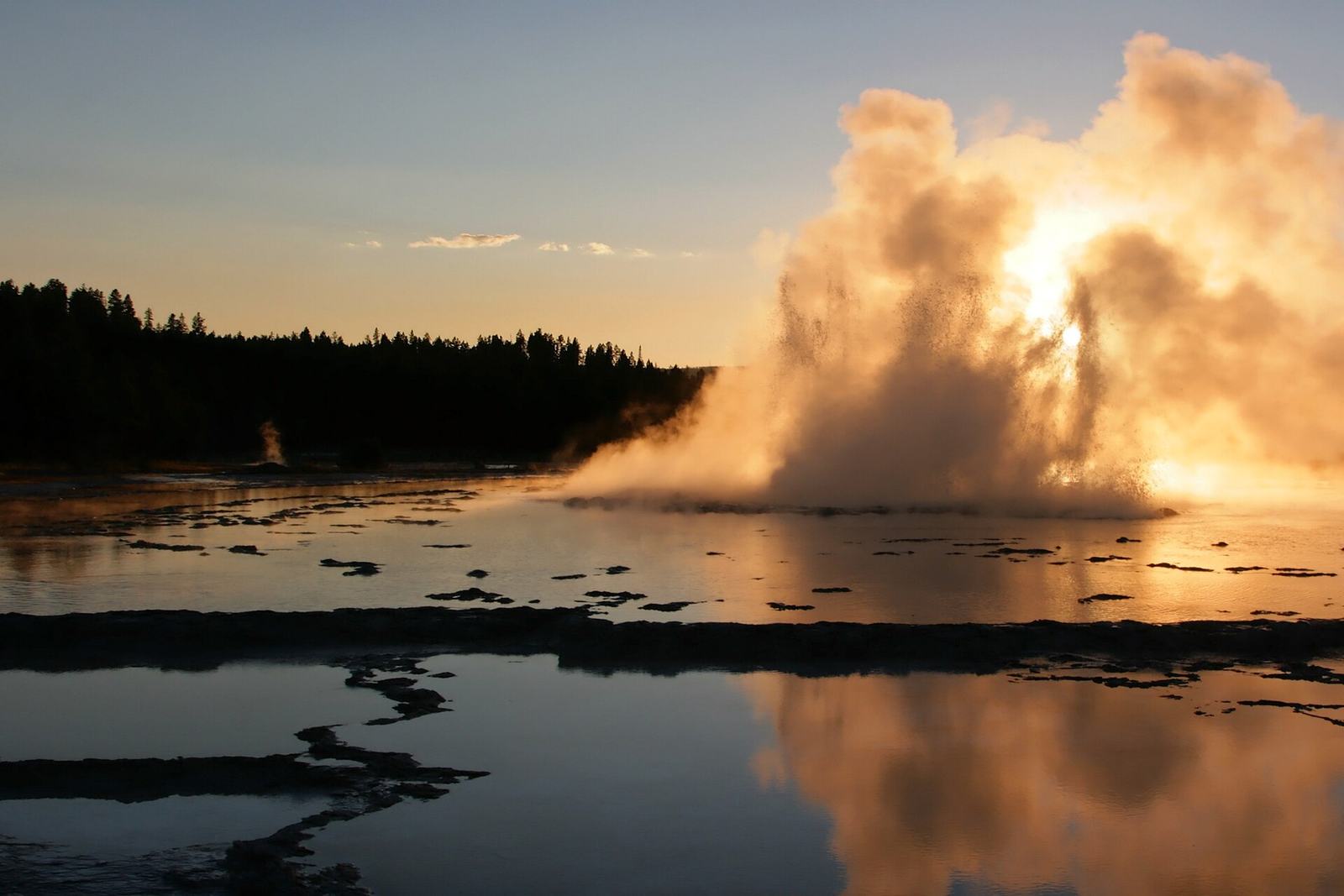
Yellowstone geysers make up the largest concentration of active geysers on Earth: more than 500 of them among more than 10,000 hydrothermal features, according to NPS. Most sit in a string of basins along the Firehole River between Madison Junction and Old Faithful, with Norris and West Thumb nearby (checked September 2026).
You can see the headline features in a day. Understanding what you’re looking at, and catching the big geysers when they actually erupt, takes a little more planning. Old Faithful is on a schedule you can look up. Grand Geyser, the tallest regularly predicted geyser in the world, is too, though with a wider window. Steamboat, the world’s tallest active geyser, has gone from dozens of major eruptions a year to almost none. And Biscuit Basin, a favorite stop for decades, has been closed since a hydrothermal explosion in 2024.
This hub covers every geyser basin you can visit, what each one is best for, which geysers are predicted and how to use the predictions, when to go, the science visitors ask about, what’s closed, and sample routes for one to three days. The two most famous features have their own guides: Old Faithful and Grand Prismatic Spring.
How many geysers are in Yellowstone?
More than 500. NPS says Yellowstone has more than 10,000 hydrothermal features, including more than 500 geysers, which is more geysers than anywhere else on Earth. Only a small fraction erupt regularly and predictably enough for visitors to plan around, and most are small.
The exact number changes all the time. Features go dormant, new ones break out, and hot springs occasionally turn into geysers or the other way around. A count also depends on how you define a geyser: many small features erupt only a few inches high, or only once in years. What matters for a visit is that the Upper Geyser Basin alone packs at least 150 hydrothermal features into about one square mile around Old Faithful, the densest concentration in the world (checked September 2026).
The reason all this exists is heat. Yellowstone sits over a large volcanic system, and the magma beneath it keeps the ground above unusually hot. Rain and snowmelt seep deep into the rock, heat up and rise back through cracks, emerging as hot springs, geysers, steam vents and mudpots. For the geology behind it, see our guide to the Yellowstone supervolcano.
The four types of thermal features (plus one)
Yellowstone’s hydrothermal features come in four main types, and knowing which you’re looking at makes the boardwalks far more interesting. Our geyser vs hot spring guide explains them in more depth.
| Feature | What it is | Why it looks that way | Best places to see one |
|---|---|---|---|
| Hot spring | A pool of hot water that circulates freely | Water can escape heat by convection, so pressure never builds | Grand Prismatic Spring, Morning Glory Pool, Abyss Pool |
| Geyser | A hot spring with a constriction in its plumbing that traps water and steam | Pressure builds until the water flashes to steam and erupts | Old Faithful, Grand, Castle, Steamboat, Great Fountain |
| Fumarole (steam vent) | A vent with so little water that it all boils away as steam | Hottest features in the park, often hissing or roaring | Norris (Roaring Mountain nearby), Mud Volcano area |
| Mudpot | A hot spring with little water, where acid breaks rock down into clay | Gases bubble up through thick mud | Fountain Paint Pot, Artists Paintpots, Mud Volcano |
| Travertine terrace | Hot water dissolves limestone and deposits it as it cools | Builds stepped white and orange terraces | Mammoth Hot Springs |
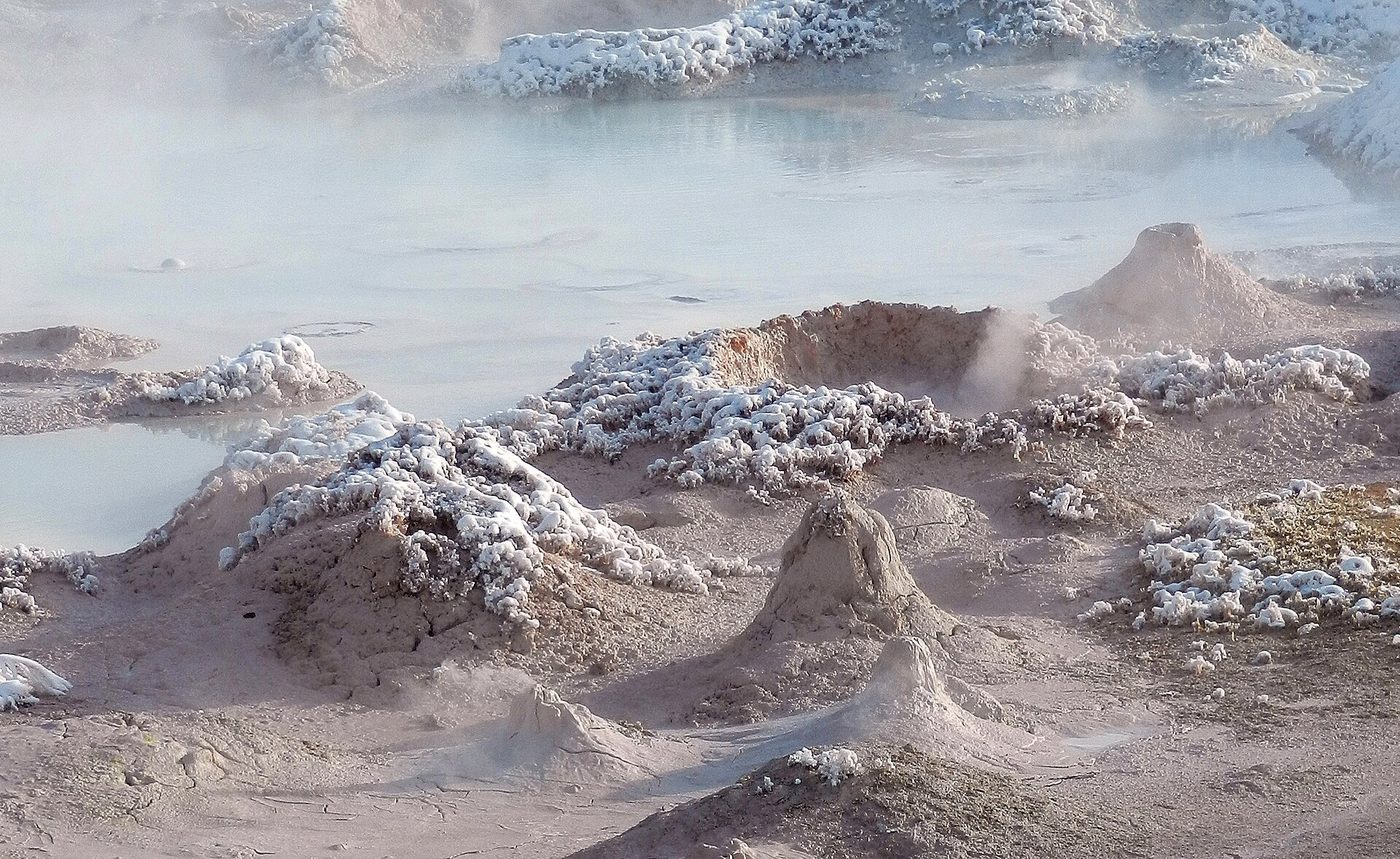
Want to see all four in one short walk? Fountain Paint Pot in the Lower Geyser Basin has hot springs, geysers, fumaroles and mudpots on a single boardwalk loop of about half a mile. It’s the best 30 to 45 minutes of thermal education in the park.
For the physics of an eruption, see how do geysers work.
Yellowstone’s geyser basins at a glance
These are the thermal areas you can reach on a road trip, from south to north along the main route. Distances are road miles; times are for a good visit without rushing (checked September 2026).
| Basin | Location | Best for | Time to allow | Honest verdict |
|---|---|---|---|---|
| Upper Geyser Basin | Old Faithful | Old Faithful, Grand, Castle, Riverside, Daisy, Morning Glory Pool | Half a day to a full day | The one unmissable basin |
| Black Sand Basin | 1 mile northwest of Old Faithful | Emerald Pool, Cliff Geyser | 30 min | Worth a quick stop |
| Biscuit Basin | 2 miles north of Old Faithful | — | — | Closed since July 2024 |
| Midway Geyser Basin | 6 miles north of Old Faithful | Grand Prismatic Spring, Excelsior Geyser crater | 1 hour (plus overlook trail) | Unmissable |
| Lower Geyser Basin | 8-10 miles north of Old Faithful | Fountain Paint Pot, Great Fountain Geyser, Firehole Lake Drive | 1.5-2 hours | Excellent, and underrated |
| Norris Geyser Basin | 30 miles north of Old Faithful | Steamboat, Porcelain Basin, acid features | 1.5-2 hours | Very different and well worth it |
| Artists Paintpots | 3.7 miles south of Norris | Mudpots, colorful springs | 45 min-1 hour | Good short walk; skip if short of time |
| West Thumb Geyser Basin | On Yellowstone Lake, 17 miles east of Old Faithful | Lakeshore hot springs, Abyss Pool, Fishing Cone | 45 min | Beautiful setting; small |
| Mud Volcano | 9.7 miles south of Canyon | Dragon’s Mouth, mudpots, sulfur smell | 45 min | Fun, quick, smelly |
| Mammoth Hot Springs | Near the North Entrance | Travertine terraces | 1.5-2 hours | A different kind of thermal area; unmissable |
For a visual overview, see our Yellowstone geyser basins map. For an opinionated shortlist, see best geysers in Yellowstone.
Upper Geyser Basin
The Upper Geyser Basin is the heart of Yellowstone’s geyser country. Boardwalks and paved paths loop from the Old Faithful area north along the Firehole River for roughly a mile and a half to Morning Glory Pool, passing the largest collection of big geysers in the world. Our Upper Geyser Basin guide walks every loop.
Old Faithful erupts at a median interval of about 102 minutes, give or take 10 minutes, based on NPS figures from January 2025, with intervals ranging from 54 to 118 minutes. Eruptions reach 106 to more than 180 feet, average about 130 feet, and last 1.5 to 5 minutes (checked September 2026). It’s the most reliable big geyser in the park, and the one every visitor sees. Check Old Faithful eruption times before you go.
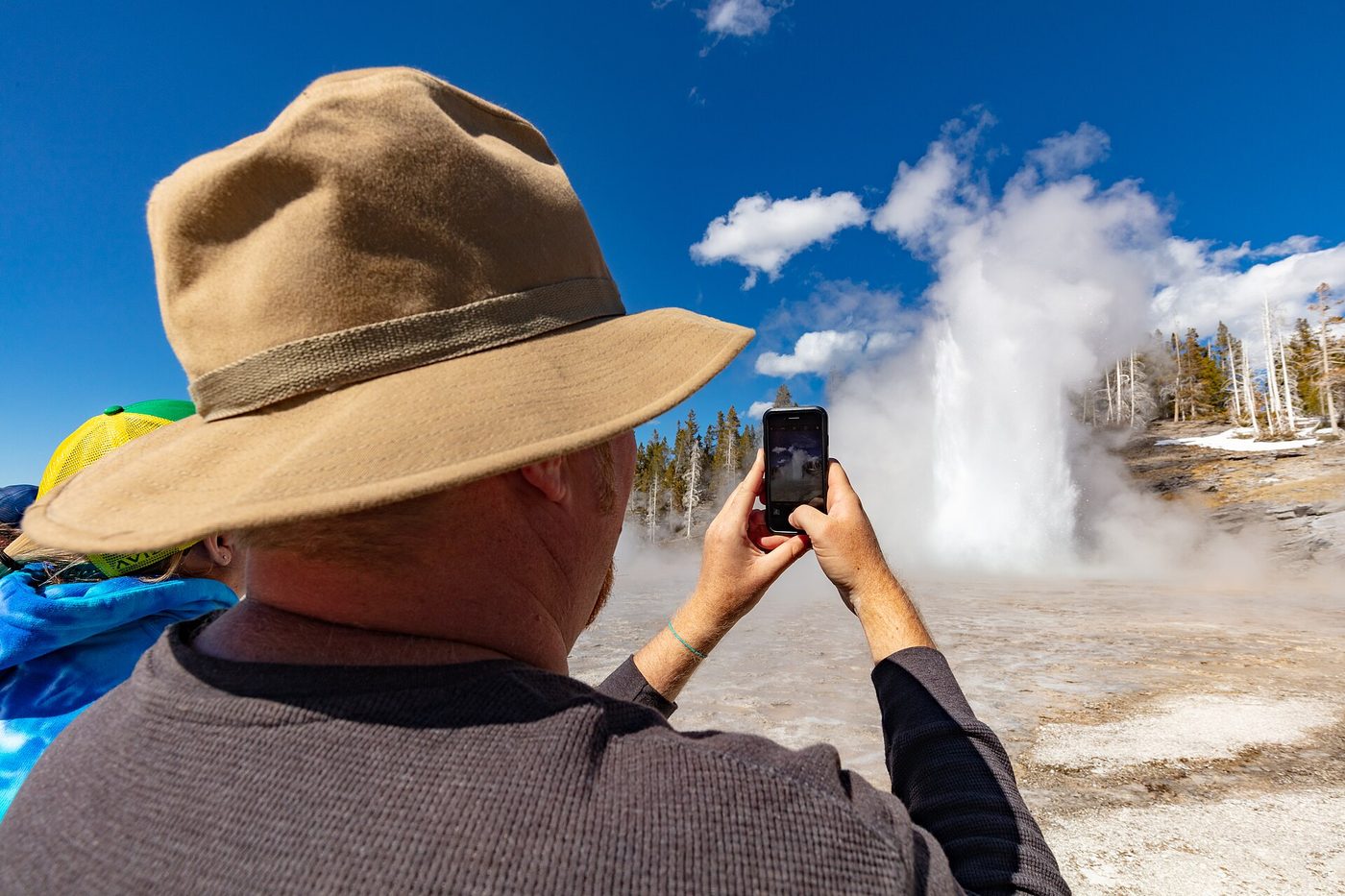
Grand Geyser is the tallest predictable geyser in the world, reaching up to 200 feet in a series of bursts over about 9 to 12 minutes. Its recent intervals have been roughly 6 to 7 hours, and it’s predicted with a window of a couple of hours either side. Watching Grand means committing an afternoon, but many geyser gazers rate it above Old Faithful. See Grand Geyser.
Castle Geyser has the largest sinter cone in the basin and erupts up to about 90 feet, with around 20 minutes of water followed by a long, roaring steam phase. Its cycle is roughly 16 to 17 hours, so catching one is a matter of luck unless you check the prediction.
Riverside Geyser arches about 75 feet out over the Firehole River for around 20 minutes, roughly every 5.5 to 7 hours. Its vent starts overflowing an hour or two before an eruption, which gives you a cue.
Daisy Geyser shoots at an angle up to about 75 feet for 3 to 4 minutes, roughly every 2 to 4 hours.
Beehive Geyser on Geyser Hill is not officially predicted, but its small “indicator” vent usually starts erupting 15 to 20 minutes before Beehive’s powerful 150-foot-plus column. If you see a crowd gathering on Geyser Hill, find out why.
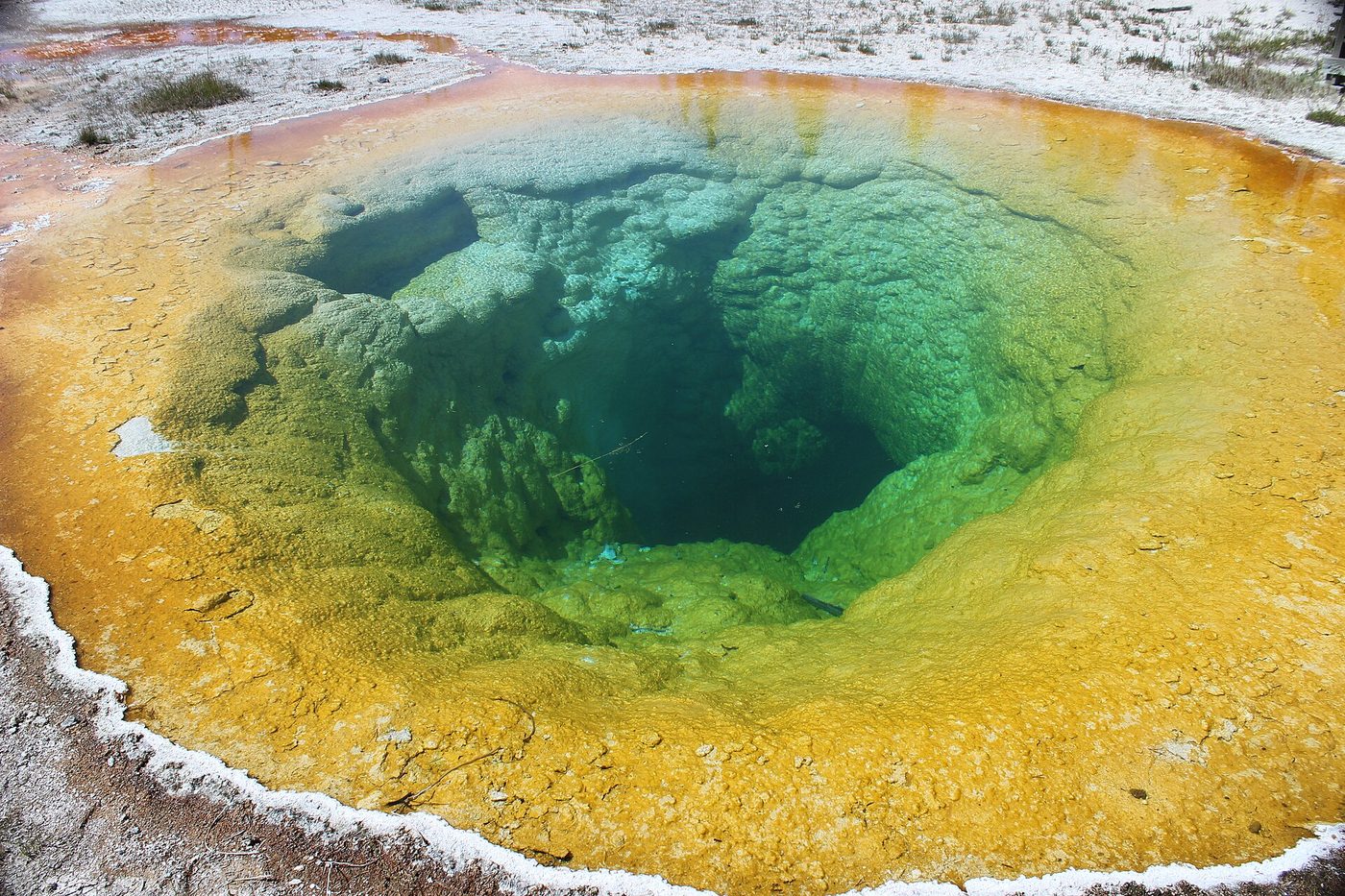
Morning Glory Pool, at the far end of the basin, is one of the park’s most famous hot springs. Its colors have changed over the decades partly because visitors threw coins, rocks and trash into it, clogging the vent and lowering its temperature, which let orange and yellow microbial mats spread inward. It’s a strong reminder of why you should never throw anything into a thermal feature. See Morning Glory Pool.
Black Sand Basin, a short drive or bike ride northwest of Old Faithful, has the deep green Emerald Pool and the frequent small eruptions of Cliff Geyser beside Iron Spring Creek. It’s a quick, worthwhile stop. See Black Sand Basin.
Walking the Upper Geyser Basin
The basin is flat, and most of the main loop is boardwalk or paved path, but the distances add up. From the Old Faithful Visitor Education Center, the loop around Geyser Hill is a little over a mile. Continuing north past Castle, Grand, Giant and Grotto geysers to Riverside Geyser and Morning Glory Pool is roughly 1.5 miles one way, so a full out-and-back with Geyser Hill runs about 3 to 3.5 miles. Allow at least two to three hours, and more if you’re waiting for a predicted eruption.
A good route: watch Old Faithful from the main viewing area, walk the Geyser Hill loop (watching for Beehive’s indicator), follow the path north past Castle and Grand, continue to Morning Glory Pool, and return on the other side of the river past Riverside. Check the predictions before you set off so you can be in the right spot at the right time. Restrooms and water are at the visitor center and lodges only, so carry water, and bring a hat: there’s almost no shade.
Parts of the paved path are shared with bikes, and the main routes are generally accessible for wheelchairs and strollers, although some boardwalk sections include steps or grades. Ask at the visitor center for the current accessible route.
Biscuit Basin, just north of Black Sand Basin, is closed. More on that below.
Midway and Lower Geyser Basins
Midway Geyser Basin
Midway is small but home to two giants. Grand Prismatic Spring, which USGS calls the largest hot spring in the United States, spreads out in rings of blue, green, yellow and orange, with steam often hiding the colors on cool mornings. Beside it sits the enormous crater of Excelsior Geyser, which now pours an estimated 4,000 to 4,500 gallons of near-boiling water a minute into the Firehole River. Excelsior erupted to around 100 feet and more in the 1880s and had a brief revival in 1985, but it is essentially a vast hot spring today.
The boardwalk gives you a close-up; for the famous aerial view, walk the overlook trail from the Fairy Falls trailhead, which climbs about 105 feet over 0.6 miles (checked September 2026). See our guides to Midway Geyser Basin, Excelsior Geyser and the Grand Prismatic overlook trail.
Lower Geyser Basin
The largest basin by area, and the most underrated. Three stops make it:
- Fountain Paint Pot: a boardwalk loop of about half a mile, 30 to 45 minutes, with all four feature types, including Clepsydra Geyser, which erupts almost continuously, and the pink and gray bubbling mudpots.
- Firehole Lake Drive: a one-way side road of about 3 miles past White Dome Geyser, Great Fountain Geyser, Pink Cone and Firehole Lake.
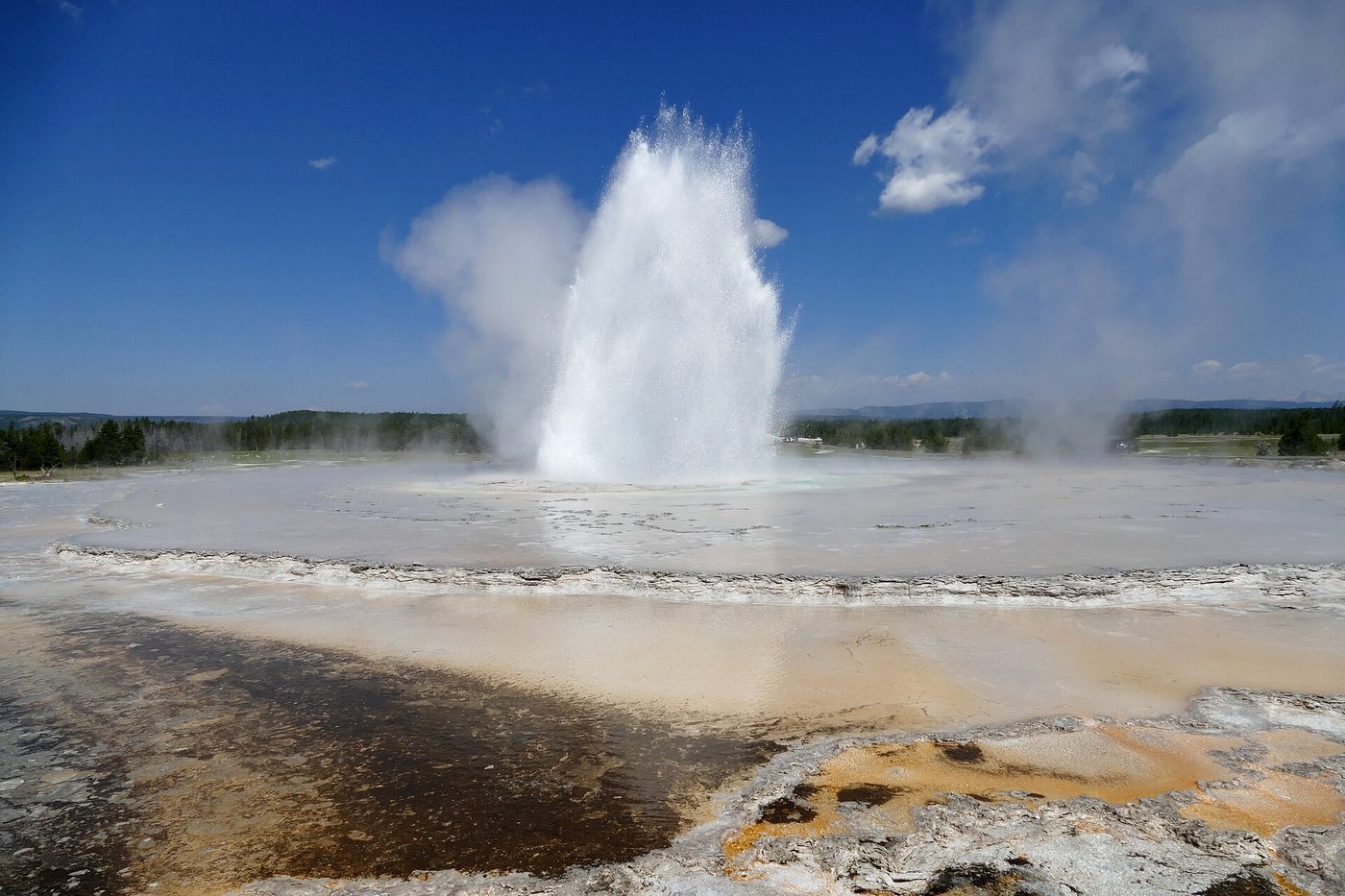
- Great Fountain Geyser: the only predicted geyser outside the Upper Geyser Basin. It erupts every 9 to 15 hours or so, from about 75 to over 220 feet, in a series of bursts that can last an hour, and it’s predicted with a window of about 2 hours either side. At sunset, with the eruption reflected in its terraces, it’s one of the best sights in the park.
See our Lower Geyser Basin and Firehole Lake Drive guides.
Norris Geyser Basin and Steamboat Geyser
Norris, about 30 miles north of Old Faithful, feels like another planet. NPS describes it as one of the hottest and most acidic areas in the park, with many features above boiling. Instead of the blue pools of the Firehole basins, you’ll find milky blue, white, rust-red and bright green features, and a landscape that changes from year to year.
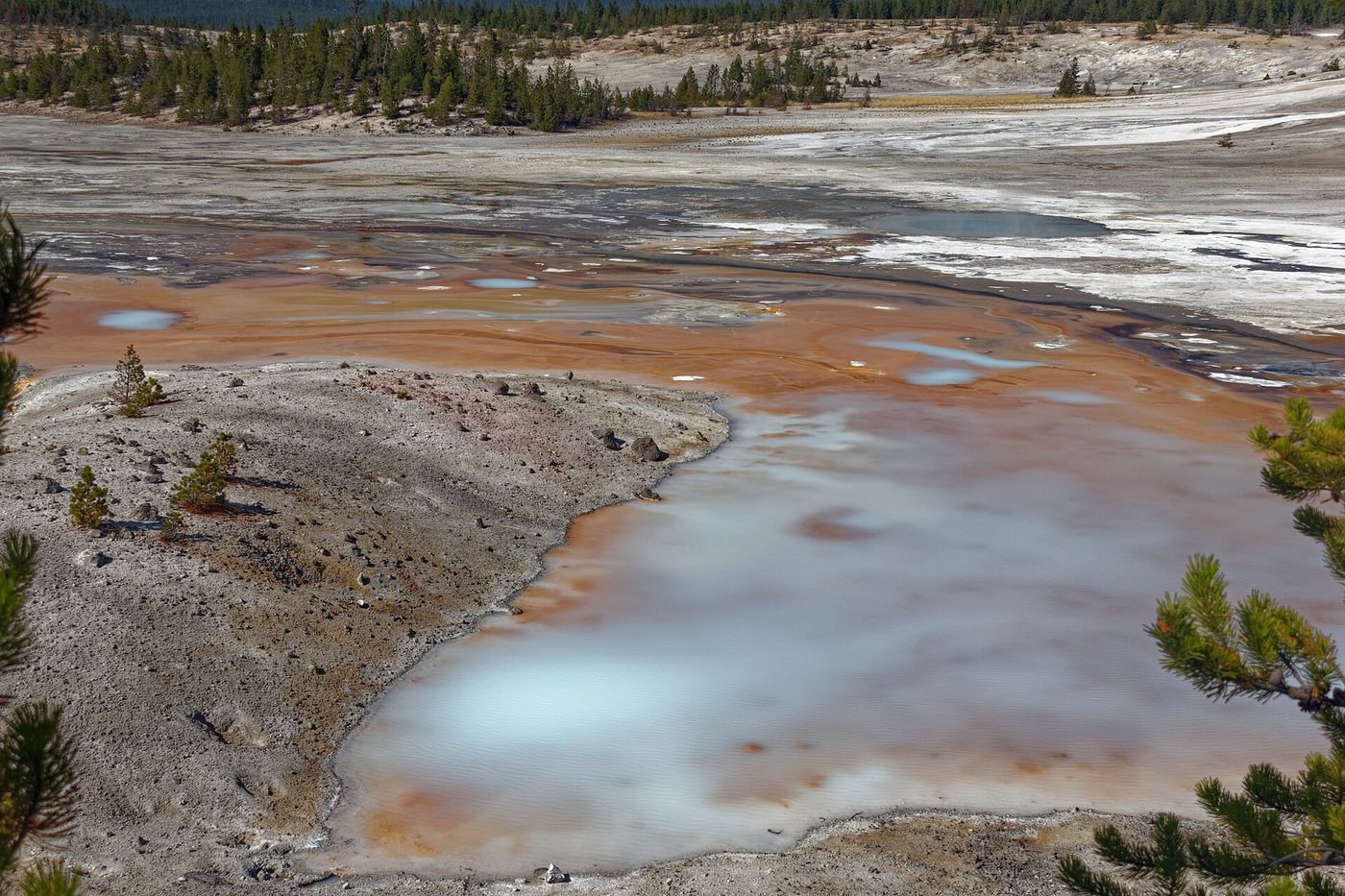
Norris has two sections. Porcelain Basin is a bare, steaming white valley that you view from a boardwalk loop of roughly half a mile, or a little over a mile with the extra loop. Back Basin is a forested loop of about 1.75 miles past Steamboat Geyser, Cistern Spring and Echinus Geyser, one of the largest acidic geysers known, with a pH of about 3.5. Allow 1.5 to 2 hours for both. See our full Norris Geyser Basin guide.
Steamboat Geyser: the world’s tallest active geyser
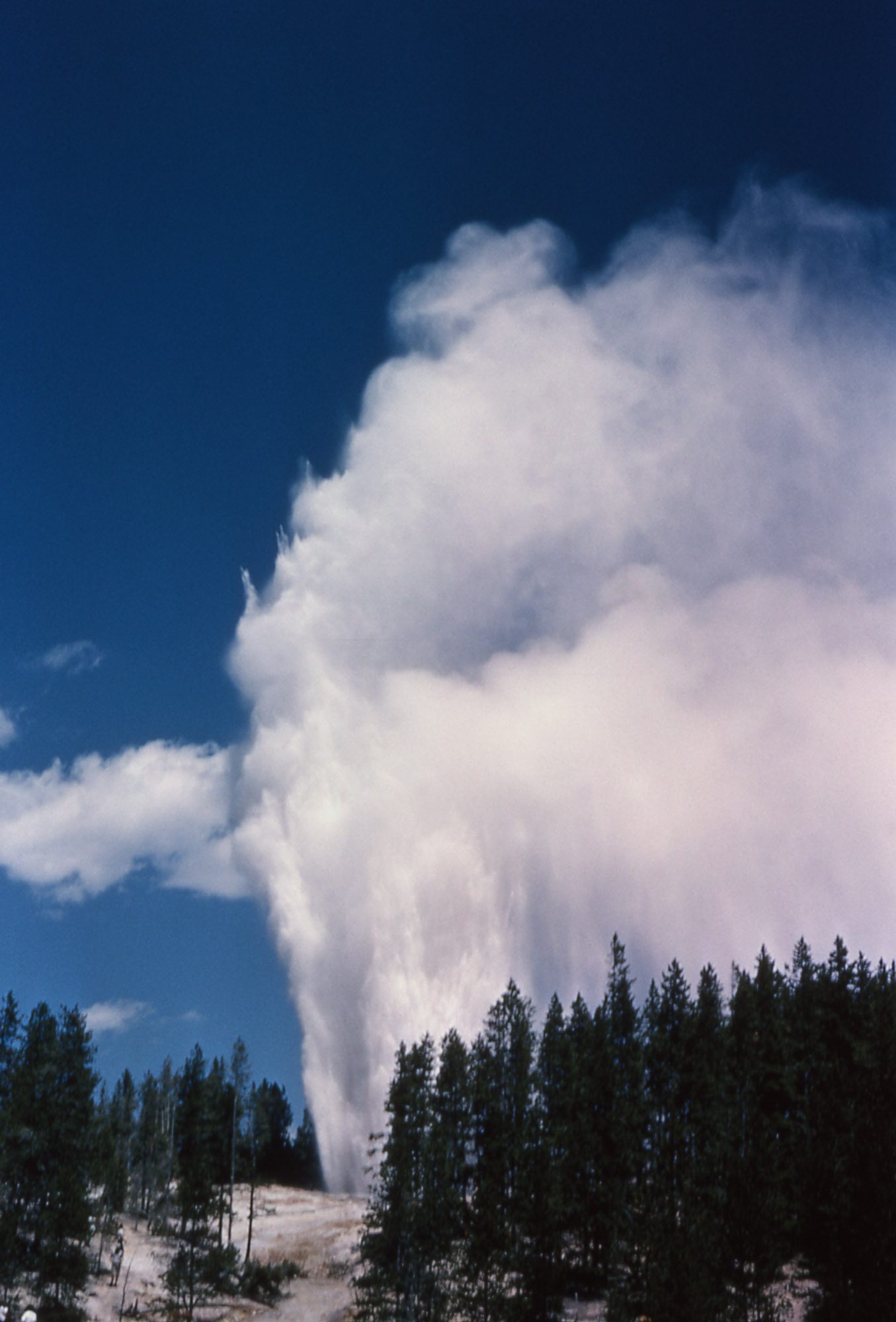
Steamboat’s major eruptions reach more than 300 feet, making it the tallest active geyser in the world. They are also unpredictable, sometimes years apart. Steamboat went through a remarkable active phase after 2018, then slowed sharply. NPS’s count of major eruptions tells the story (checked September 2026):
| Year | Major eruptions |
|---|---|
| 2018 | 32 |
| 2019 | 48 |
| 2020 | 48 |
| 2021 | 20 |
| 2022 | 11 |
| 2023 | 9 |
| 2024 | 6 |
| 2025 | 3 |
| 2026 (as of NPS update) | 1, on February 27 |
Your chances of seeing a major eruption on a given visit are tiny. What you’ll likely see instead are minor eruptions of about 6 to 40 feet, which can last 1 to 4 minutes and happen every few minutes. They’re still worth a look. One practical note: NPS warns that spray from a major eruption can damage the glass and paint of vehicles in the parking lot. See our Steamboat Geyser guide, which tracks its eruptions.
Artists Paintpots
About 3.7 miles south of Norris, a lollipop trail of about 1.1 miles climbs gently through the Gibbon Geyser Basin to colorful hot springs and a hillside of bubbling mudpots. It’s a pleasant 45-minute walk and a good family stop, but skip it if you’ve already seen Fountain Paint Pot and you’re short of time. See Artists Paintpots.
Roadside extras between Madison and Norris
Several small thermal features sit right beside the Grand Loop Road and make easy five-minute stops on the drive between the Firehole basins and Norris:
- Beryl Spring, a vivid blue-green hot spring beside the Gibbon River, with a short boardwalk from a roadside pullout between Madison Junction and Norris.
- Gibbon Falls, not a thermal feature but a pretty 84-foot waterfall a few miles away on the same stretch of road, often combined with Beryl Spring.
- Roaring Mountain, north of Norris on the road to Mammoth, a bare hillside dotted with steaming fumaroles. It was much louder in the early 1900s, but on a cool, still morning you can still hear it hiss.
None of these is worth a special trip, but all three are worth a stop if you’re driving past anyway.
West Thumb Geyser Basin
West Thumb is the only major geyser basin on the shore of Yellowstone Lake, and its setting is unforgettable: steaming, colorful pools right beside the cold blue lake, with mountains beyond. Short boardwalk loops take you past the main features in about 45 minutes.
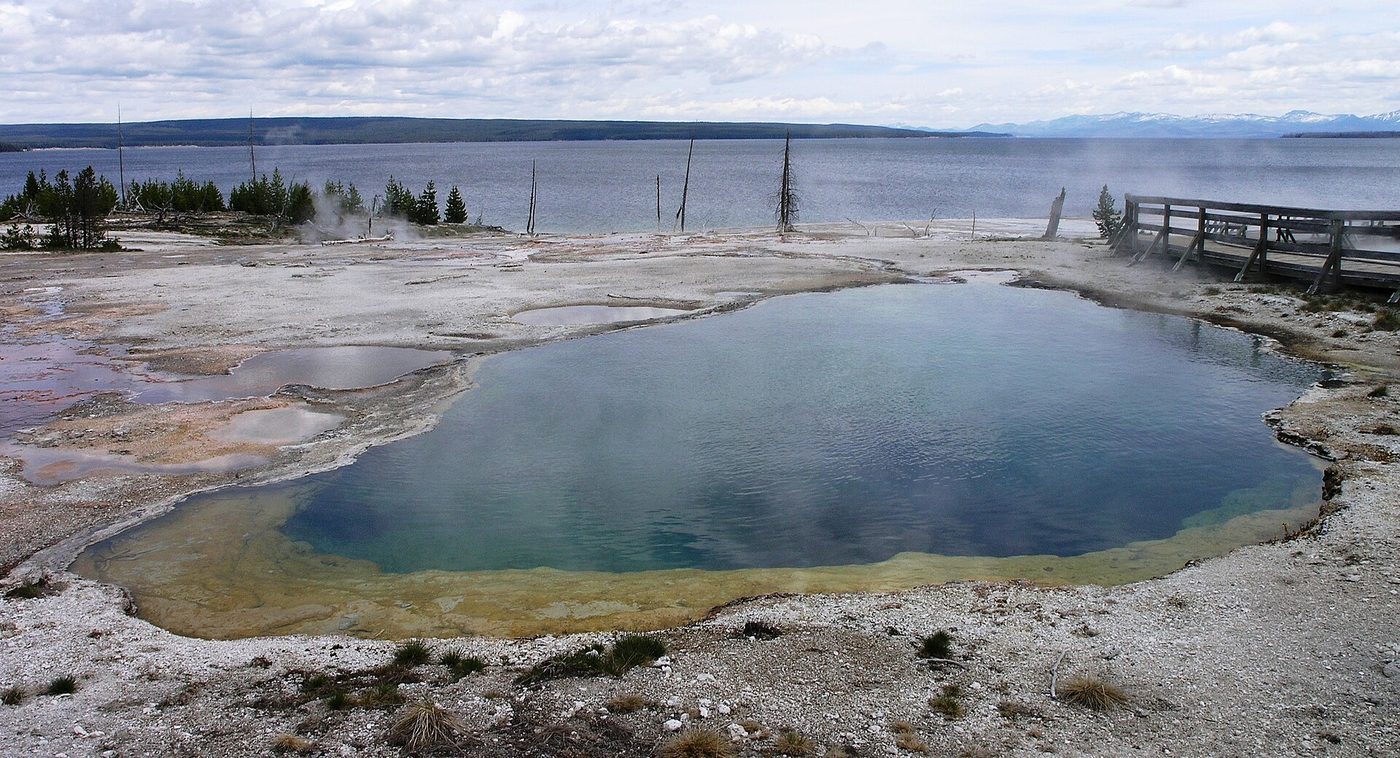
- Abyss Pool is one of the deepest hot springs in the park, about 53 feet, with a deep blue-green color. It erupted between 1987 and 1992 and has been quiet since.
- Fishing Cone stands in the lake itself. Early visitors famously caught trout and cooked them in the cone, a practice long since banned.
- Black Pool and Bluebell Pool show the color changes that happen as springs heat up and cool down.
West Thumb is the first thermal area you reach from Grand Teton and the South Entrance, and it’s about 30 minutes from Old Faithful. See our West Thumb Geyser Basin guide.
Mud Volcano and the mudpot areas
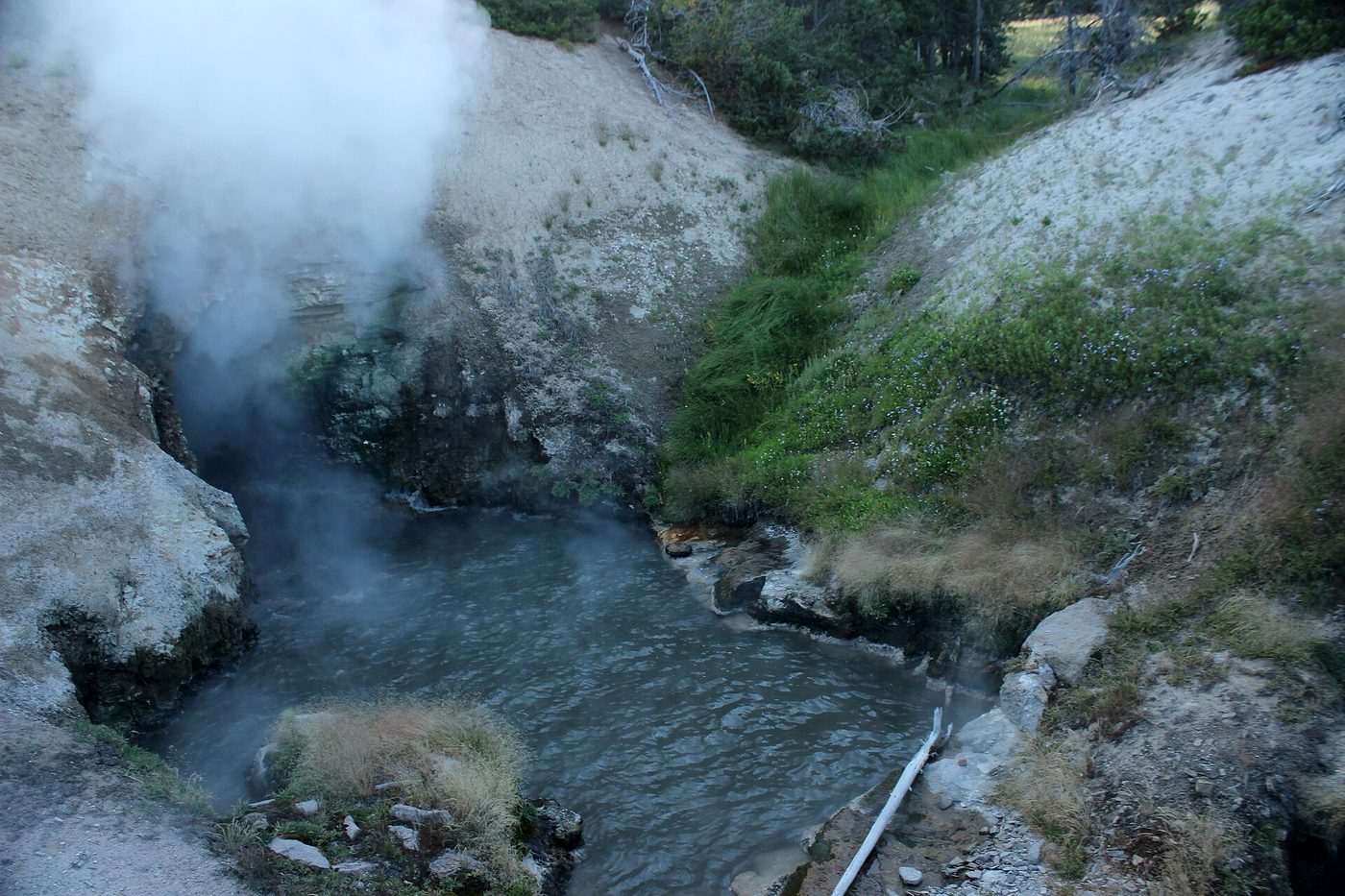
About 9.7 miles south of Canyon Village, on the edge of Hayden Valley, Mud Volcano is the loudest and smelliest thermal area in the park. A short, steep boardwalk loop passes Dragon’s Mouth Spring, where waves of hot water slosh out of a cave with a thumping roar and clouds of steam, and Mud Volcano itself, a bubbling mud crater. Black Dragon’s Caldron and Sour Lake are further along.
Honest verdict: a fun, quick stop that pairs naturally with Hayden Valley wildlife. It won’t compete with the geyser basins for scenery. See Mud Volcano.
Where does the rotten-egg smell come from? Hydrogen sulfide gas, rising from deep underground, is what gives Mud Volcano, Norris and other areas their smell. In most places it’s merely unpleasant, but NPS advises leaving an area if you feel sick. See why does Yellowstone smell like rotten eggs.
Mammoth Hot Springs: terraces instead of geysers
Mammoth, near the North Entrance, is a completely different kind of thermal area. There are no geysers. Instead, hot water rising through limestone deposits travertine, building white, cream and orange terraces that grow, shift and dry up over the years. Boardwalks climb through the Lower Terraces, and a one-way drive loops the Upper Terraces. Mammoth has its own hub: see Mammoth Hot Springs.
Backcountry geyser basins: Lone Star, Shoshone and Heart Lake
Some of Yellowstone’s best geysers are away from the roads.
Lone Star Geyser is the easiest backcountry geyser to visit. A flat, mostly paved trail of about 4.8 miles round trip from near Kepler Cascades, south of Old Faithful, leads to its tall sinter cone. It erupts about every 3 hours, to 30 to 45 feet, and there’s a logbook at the site where visitors record eruption times. Bikes are allowed on the old road to the geyser. See our Lone Star Geyser trail guide.
Shoshone Geyser Basin, at the west end of Shoshone Lake, is the largest backcountry geyser basin in the park, reached by a long hike past Lone Star or by paddling across Shoshone Lake. It’s a serious overnight trip that needs a backcountry permit, and there are no boardwalks, so thermal ground rules are critical. See Shoshone Geyser Basin.
Heart Lake Geyser Basin, in the south of the park, is another backcountry area for experienced hikers.
What’s closed: Biscuit Basin and swimming
Biscuit Basin
On July 23, 2024, a hydrothermal explosion at Biscuit Basin sent visitors running as rock, mud and water blasted into the air and damaged the boardwalk. Nobody was seriously hurt, but the basin’s parking lot and boardwalks have been closed since, including the usual access to the Mystic Falls trail. A second explosion in June 2026 sent a milky plume several miles down the Firehole River. NPS says the area is closed until further notice (checked September 2026). See Biscuit Basin for status updates.
Hydrothermal explosions like these, caused by water flashing to steam just below the surface, are a far more realistic hazard in Yellowstone than a volcanic eruption.
Swimming in thermal water
Swimming or soaking in hot springs is illegal and dangerous. People have died after falling or walking into Yellowstone’s thermal features. The places where visitors once could swim in thermally heated river water, the Firehole River swim area and the Boiling River near Mammoth, were closed in 2026 (checked September 2026). All swimming questions are covered in our fishing in Yellowstone hub, including the Firehole River swimming page.
Which Yellowstone geysers are predicted?
NPS predicts six geysers: Old Faithful, Castle, Grand, Daisy and Riverside in the Upper Geyser Basin, and Great Fountain in the Lower Geyser Basin. Predictions are posted at the Old Faithful Visitor Education Center, in the lodges and on the NPS App, and aren’t usually available from early November to mid-December or mid-March to mid-April.
Predictions are based on the timing and length of each geyser’s previous eruption, so each one comes with a window. Here’s roughly what to expect (checked September 2026; intervals drift, so treat these as typical, not fixed):
| Geyser | Basin | Typical height | Typical interval | Prediction window |
|---|---|---|---|---|
| Old Faithful | Upper | 106-180+ ft | About 102 min (54-118) | About ±10 min |
| Grand | Upper | Up to 200 ft | About 6-7 hours recently | About ±1.5-2 hours |
| Castle | Upper | About 90 ft | About 16-17 hours | About ±1-2 hours |
| Riverside | Upper | About 75 ft (arching) | About 5.5-7 hours | About ±1-2 hours |
| Daisy | Upper | About 75 ft (angled) | About 110-240 min | About ±30 min |
| Great Fountain | Lower | 75-220+ ft | About 9-15 hours | About ±2 hours |
How to use them:
- Check the predictions first thing at the visitor education center, in a lodge lobby or on the NPS App.
- Plan your walk around the geyser with the widest window. Old Faithful is easy to fit around the others.
- Arrive early in the window and settle in. Geysers erupt when they’re ready, not when the prediction says.
- Talk to the geyser gazers. Volunteer and enthusiast geyser watchers often know the latest cues, such as Riverside’s overflow or Beehive’s indicator.
The NPS doesn’t predict Steamboat, Beehive or the smaller geysers. Our Yellowstone geyser predictions guide explains the windows in more detail.
When is the best time to see Yellowstone’s geysers?
Early morning and evening from late May to mid-October give the best combination of access, light and smaller crowds. Cool mornings produce huge steam clouds, which look dramatic at geysers but can hide the colors of hot springs such as Grand Prismatic. For the colors, visit on a warm, sunny late morning or afternoon.
A few specifics:
- Time of day. Geysers erupt at all hours, but crowds peak from late morning to mid-afternoon in summer. An evening Old Faithful eruption after the day visitors leave is magical.
- Colors vs steam. Hot spring colors show best in warm, dry, sunny air, and the classic Grand Prismatic photos are taken from the overlook on a sunny summer afternoon. Steam plumes look best on cold, still mornings, especially in fall and winter.
- Season. Summer has all the roads and services open. September and early October have cooler air, bigger steam and fewer people. Late October to mid-December and mid-March to mid-April are quiet, but predictions often stop.
- Winter. The geyser basins in winter are extraordinary, with steam, frost-covered trees and bison warming themselves near the thermal ground. You reach them by snowcoach or snowmobile from mid-December to mid-March. See Old Faithful in winter and Yellowstone snowcoach tours.
Our best time to see geysers in Yellowstone guide goes into more depth, including photography.
The science: colors, temperatures and smells
Why are Yellowstone’s hot springs so colorful?
The colors come from two sources. The deep blue of the hottest pools is pure water absorbing red light and scattering blue, like a deep lake. The yellows, oranges, reds and browns around the edges are microbial mats, communities of heat-loving microorganisms called thermophiles. Each kind thrives at a different temperature range, so the colors form rings as the water cools outward from the center. See why are Yellowstone hot springs colorful.
How hot are Yellowstone’s hot springs?
At the elevations of the geyser basins, water boils at roughly 199°F instead of 212°F. Many hot springs are close to that temperature, and features at Norris can be superheated above boiling. NPS measured water near Old Faithful’s vent at 203°F (checked September 2026). Even the “cooler” orange edges of a pool can cause severe burns. See how hot are Yellowstone hot springs.
Is Yellowstone about to erupt?
No sign of it. The volcano is monitored constantly by the Yellowstone Volcano Observatory. Earthquakes, ground uplift and changes in thermal features are normal and don’t indicate an imminent eruption. See our Yellowstone supervolcano hub.
Why do geysers change?
Nothing in a geyser basin is permanent. Earthquakes can reroute underground plumbing overnight: the 1959 Hebgen Lake earthquake, centered just west of the park, triggered eruptions in hundreds of features and changed the behavior of many more. Mineral deposits slowly seal vents and open new ones. Norris is known for occasional basin-wide “disturbances,” when many features there change their behavior at once for days or weeks. And people have caused change too, as the debris thrown into Morning Glory Pool shows.
That constant change is why predictions have windows, why guidebook intervals drift and why the hydrothermal explosions at Biscuit Basin, though startling, weren’t a sign of anything larger. It’s also why a return visit is never quite the same.
Planning a geyser day: 1-, 2- and 3-day routes
One day
Start at Midway Geyser Basin by 8 a.m. for Grand Prismatic before the parking lot fills, then Fountain Paint Pot. Reach Old Faithful by late morning, check predictions, watch an eruption and walk the Upper Geyser Basin loop to Morning Glory Pool, timing your route around Grand, Castle or Riverside if one is due. Finish at Black Sand Basin, and come back to Old Faithful for an evening eruption if you’re staying nearby.
Two days
Day 1: the Upper Geyser Basin at a slow pace, with at least one predicted geyser beyond Old Faithful and an evening eruption. Day 2: Grand Prismatic from the overlook trail in the late morning, Fountain Paint Pot, Firehole Lake Drive and Great Fountain Geyser (if predicted), then Norris in the afternoon.
Three days
Add West Thumb and Mud Volcano on day 3, as part of a route around Yellowstone Lake and Hayden Valley, or hike to Lone Star Geyser.
Our Yellowstone geyser basin itinerary has timed routes, and the park-wide Yellowstone itinerary fits geyser days into a full trip.
Where to stay for geysers: the Old Faithful area lodges put you in the Upper Geyser Basin at dawn and dusk; West Yellowstone is the nearest gateway town, about 30 miles away; Madison Campground is the closest campground.
Geyser-gazing tips
- Bring a folding seat or pad. Waiting for Grand or Great Fountain can mean an hour or two on a bench or the ground.
- Watch the wind. Steam and spray blow downwind. Choose the upwind side of a geyser for a clear view and a dry camera.
- Keep your camera rolling. Big eruptions often start with a few false starts, and the best moment comes in the first minute.
- Don’t leave at the first pause. Grand Geyser often pauses between bursts, and Great Fountain erupts in a long series.
- Use the NPS App and the lodge boards. Predictions are updated throughout the day as eruptions are recorded.
- Stay for dusk. A geyser erupting in the last light, with the crowds gone, is one of the best experiences in the park.
- Protect your gear. Geyser spray contains dissolved silica that can spot lenses and car windows. Wipe it off gently and promptly.
Staying safe on the boardwalks
The rules are simple and non-negotiable:
- Stay on the boardwalks and marked trails. The ground around thermal features is often a thin crust over boiling water.
- Never touch the water or throw anything into a feature.
- Keep children close and hold hands.
- Leave pets in the car or at your campsite; they’re not allowed on boardwalks.
- No drones anywhere in the park.
- Watch for bison and elk near the boardwalks, especially in winter.
For the full detail, see our Yellowstone thermal safety guide and the wider Yellowstone safety hub.
Frequently asked questions
What is the most famous geyser in Yellowstone?
Old Faithful, which erupts about every 102 minutes, give or take 10, to heights of 106 to more than 180 feet. Grand Geyser is taller, and Steamboat Geyser is the tallest active geyser in the world, but neither is as regular or as easy to see.
How many geyser basins are in Yellowstone?
NPS and most guides count about nine to eleven named geyser basins and thermal areas, depending on how they’re grouped. The main ones visitors can reach by road are the Upper, Midway, Lower, Norris and West Thumb geyser basins, plus Mud Volcano and Mammoth Hot Springs.
Which Yellowstone geyser basin is best?
The Upper Geyser Basin, home to Old Faithful and the largest concentration of big geysers in the world. If you only visit one other, make it Midway Geyser Basin for Grand Prismatic Spring. Norris is the best choice for something completely different.
When did Steamboat Geyser last erupt?
According to NPS, Steamboat’s most recent major eruption as of its 2026 update was on February 27, 2026. It had three major eruptions in 2025, down from 48 in both 2019 and 2020. Minor eruptions of 6 to 40 feet happen often.
Can you swim in Yellowstone hot springs?
No. Entering thermal features is illegal and can be fatal. The Firehole River swim area and the Boiling River near Mammoth, which once allowed swimming in thermally warmed river water, were both closed in 2026. Legal hot springs soaking is available outside the park.
Is Biscuit Basin open?
No. Biscuit Basin has been closed since a hydrothermal explosion on July 23, 2024, including its boardwalk, parking lot and the usual access to Mystic Falls. Another explosion occurred in June 2026. NPS says it remains closed until further notice.
Can you see Yellowstone’s geysers in winter?
Yes. From mid-December to mid-March, you can reach the Upper Geyser Basin and Old Faithful by guided snowcoach or snowmobile. The steam, frost and wildlife make winter one of the most beautiful times to visit, though predictions and some services are limited.
Sources
- National Park Service, Yellowstone: hydrothermal features, checked September 2026
- National Park Service, Yellowstone: exploring the Old Faithful area, checked September 2026
- National Park Service, Yellowstone: Steamboat Geyser, checked September 2026
- U.S. Geological Survey: Yellowstone Volcano Observatory
- U.S. Geological Survey: Grand Prismatic Spring
Image credits
| Photo | Credit |
|---|---|
| Great Fountain is the only predicted geyser outside the Upper Geyser Basin (top of page) | user:Flicka, CC BY-SA 3.0, via Wikimedia Commons |
| Photographing Grand Geyser, the tallest predicted geyser in the world | Yellowstone National Park, public domain, via Wikimedia Commons |
| Objects thrown into Morning Glory Pool helped change its colors | Miguel Hermoso Cuesta, CC BY-SA 4.0, via Wikimedia Commons |
| Fountain Paint Pot shows all four types of thermal feature on one short loop | Yellowstone National Park from Yellowstone NP, USA, public domain, via Wikimedia Commons |
| Porcelain Basin at Norris, one of the hottest and most acidic areas in the park | Dirtsc, CC BY-SA 3.0, via Wikimedia Commons |
| A major Steamboat eruption can exceed 300 feet, but they have become rare | EE Mackin, public domain, via Wikimedia Commons |
| Abyss Pool at West Thumb is about 53 feet deep | No machine-readable author provided. Mav assumed (based on copyright claims)., CC BY-SA 3.0, via Wikimedia Commons |
| Dragon’s Mouth Spring thumps and roars at the Mud Volcano area | Miguel Hermoso Cuesta, CC BY-SA 4.0, via Wikimedia Commons |
| Great Fountain erupts in bursts that can continue for about an hour | Yellowstone National Park from Yellowstone NP, USA, public domain, via Wikimedia Commons |