Most Yellowstone National Park facts you will find online are recycled from lists written years ago, and a fair number of them are wrong — the geyser interval has changed, the visitor figures have moved, and at least one popular “fact” about the supervolcano is something the United States Geological Survey has explicitly denied. Everything below is dated and attributed, checked in September 2026 against the National Park Service and the USGS.
Use it as a reference rather than a read-through. If you are actually planning a visit, the sequence starts at our hub on planning a trip to Yellowstone.
The essential numbers
| Fact | Figure | Source and date |
|---|---|---|
| Established | 1 March 1872 | The world’s first national park |
| Size | 2,219,791 acres, about 3,470 sq mi | Larger than Rhode Island and Delaware combined |
| States | ~96% Wyoming, ~3% Montana, ~1% Idaho | |
| Recreation visits, 2025 | 4,762,988 | NPS, second-highest on record |
| Visitor hours, 2025 | 86,891,452 | NPS |
| Overnight stays, 2025 | 1,238,983 | NPS |
| Hydrothermal features | more than 10,000 | |
| Geysers that have erupted | 1,283 recorded in a 2011 study | |
| Share of the world’s geysers | roughly half to two-thirds | |
| Mammal species | 67 | NPS, checked Sept 2026 |
| Caldera | 30 by 45 miles | NPS |
| Earthquakes per year | 700 to 3,000 | NPS |
| Entrances | 5 | |
| Grand Loop Road | about 142 miles | |
| Speed limit | 45 mph unless posted | NPS |
When was Yellowstone established, and why?
On 1 March 1872, when President Ulysses S. Grant signed the act setting the land aside “for the benefit and enjoyment of the people” — the phrase carved into the Roosevelt Arch at the North Entrance, whose cornerstone Theodore Roosevelt laid in 1903.
It was the first national park anywhere in the world, and the idea was genuinely novel: not a royal hunting reserve, not a private estate, but land held in public trust. Every national park system on earth descends from that act.
Some context that the tidy version usually omits. The park was created before Wyoming, Montana and Idaho were states, which is part of why it straddles three of them. There was no agency to run it for its first 44 years — the National Park Service was not founded until 1916 — so from 1886 the US Army administered Yellowstone from Fort Yellowstone at Mammoth, which is why the Albright Visitor Center is an old officers’ quarters and why Mammoth looks like a military post. The fort operated from 1891 to 1913.
And the land was not empty. Indigenous peoples had used and travelled through this landscape for more than 10,000 years, and the creation of the park involved their exclusion from it. That is part of the history too. Twenty-seven tribes have documented connections to this land, and archaeological evidence of human presence here goes back to the end of the last ice age.
A few other dates worth having:
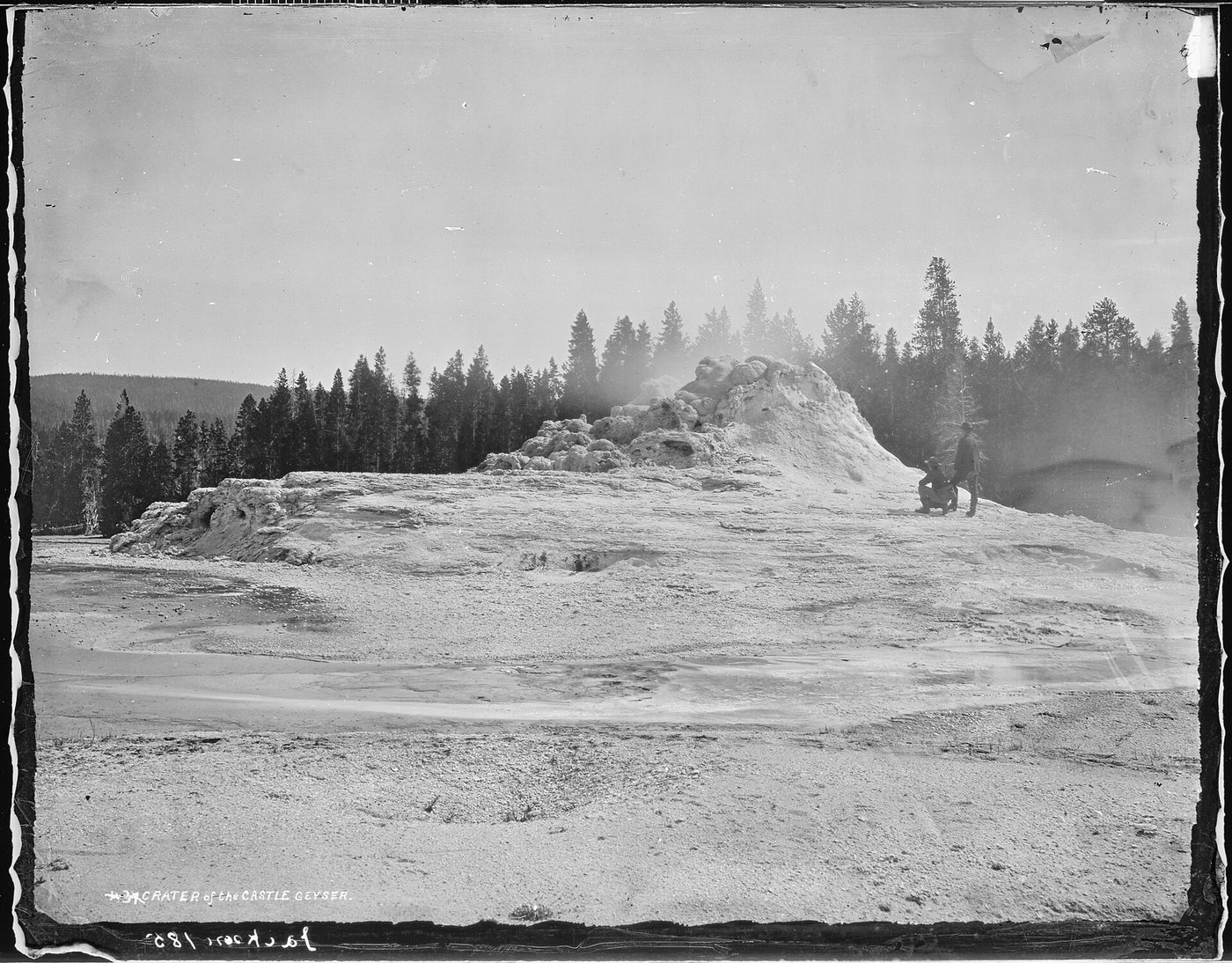
- 1871: the Hayden Geological Survey, with photographer William Henry Jackson and painter Thomas Moran, produces the images that persuade Congress the place is real.
- 1886–1918: the US Army runs the park, building Fort Yellowstone and establishing the patrol system that became the ranger service.
- 1903: the Roosevelt Arch cornerstone is laid at the North Entrance.
- 1904: the Old Faithful Inn opens, the largest log structure in the world.
- 1916: the National Park Service is created.
- 1988: fires burn roughly 36 per cent of the park in a single summer, reshaping forest ecology and public understanding of fire.
- 1995–96: wolves are reintroduced after some seventy years of absence.
- 2022: catastrophic June floods destroy sections of the North Entrance road and close Pebble Creek campground, which remains shut.
- 2024 and 2026: hydrothermal explosions at Biscuit Basin close the basin and its boardwalk indefinitely.
Size and geography
- 2,219,791 acres, roughly 3,470 square miles.
- About 63 miles north to south and 54 miles east to west.
- Larger than Rhode Island and Delaware combined, and larger than Puerto Rico.
- Roughly 2.5 times the area of neighbouring Grand Teton National Park.
- Most of the park sits between about 7,000 and 8,500 feet, on a volcanic plateau in the Rocky Mountains.
- Five entrances, of which only the North Entrance at Gardiner, Montana is open to cars year-round.
- The Grand Loop Road is about 142 miles, a figure of eight connecting nearly every major sight.
- There is no rail service to the park and no public transport within it.
The park is the core of the Greater Yellowstone Ecosystem, one of the largest nearly intact temperate ecosystems remaining on earth, extending across roughly 22 million acres of park, national forest and wilderness. That surrounding land is why the wildlife populations here behave as they do. The fuller geographical picture is on where is Yellowstone National Park.
How many geysers does Yellowstone have?
This is what the park is famous for, and the numbers are genuinely remarkable.
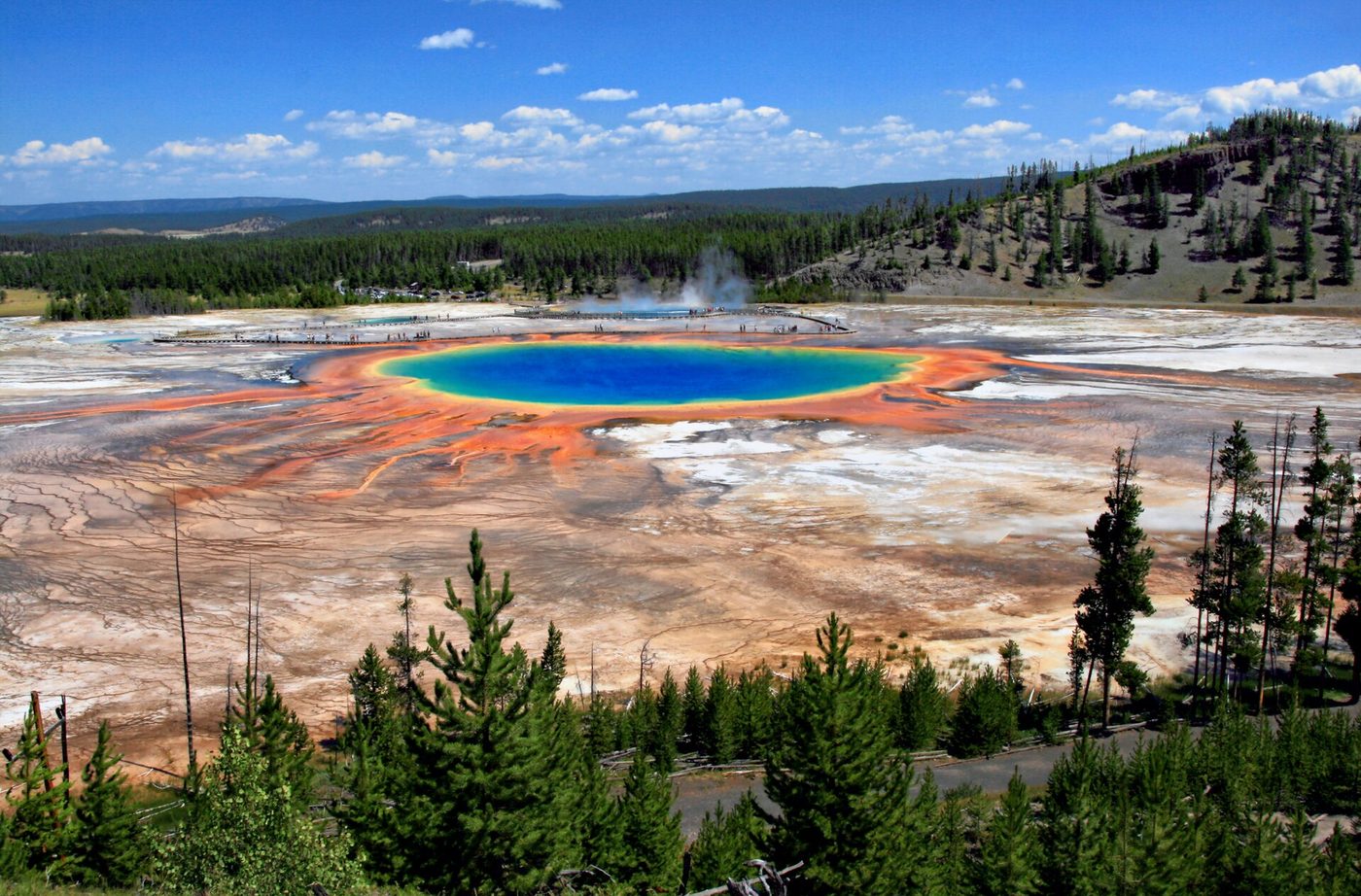
- More than 10,000 hydrothermal features: geysers, hot springs, mud pots and fumaroles.
- 1,283 geysers had erupted in the park according to a 2011 study — more than half of all the geysers on earth, and by some counts closer to two-thirds.
- The heat source is a volcanic hotspot that the North American plate has been sliding across for about 16.5 million years, leaving a chain of old calderas across the Snake River Plain.
- Three giant eruptions: about 2.1 million, 1.3 million and 631,000 years ago. The 2.1-million-year event was roughly 6,000 times the size of the 1980 Mount St Helens eruption, spreading ash over more than 5,790 square miles.
- The most recent left the caldera 30 by 45 miles across that much of the park sits inside.
- Magma sits 3 to 8 miles beneath Sour Creek Dome and 8 to 12 miles beneath Mallard Lake Dome.
- The youngest lava flow in the park is the Pitchstone Plateau rhyolite, around 70,000 years old.
- 700 to 3,000 earthquakes are recorded here in a typical year; almost none are felt.
Steamboat Geyser in Norris Geyser Basin is the tallest active geyser in the world, throwing water more than 300 feet in a major eruption. Its behaviour is wildly variable: 32 major eruptions in 2018, 48 in each of 2019 and 2020, then 20, 11, 9, 6, 3 — and just one in 2026, on 27 February. Nobody can predict it.
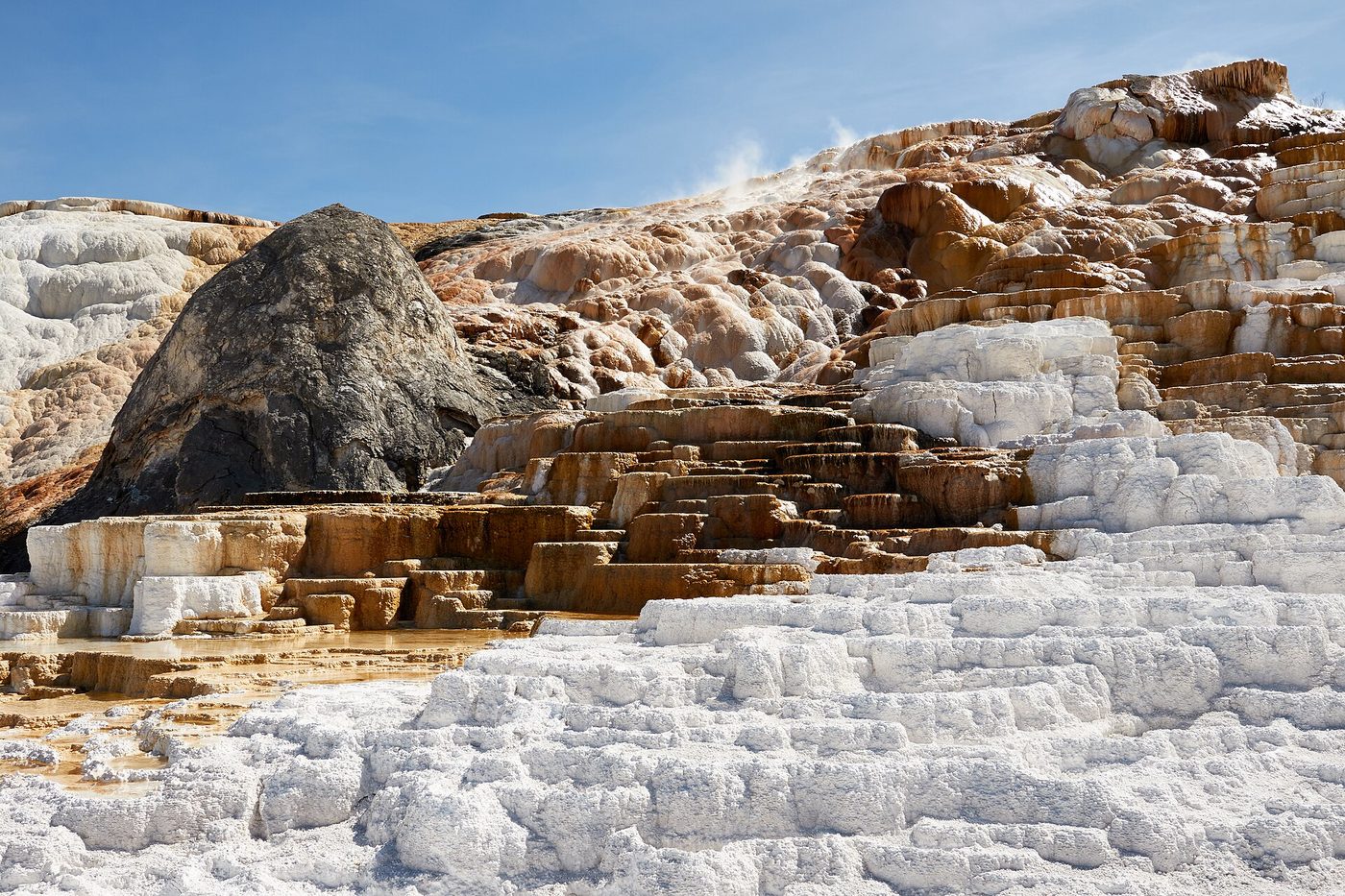
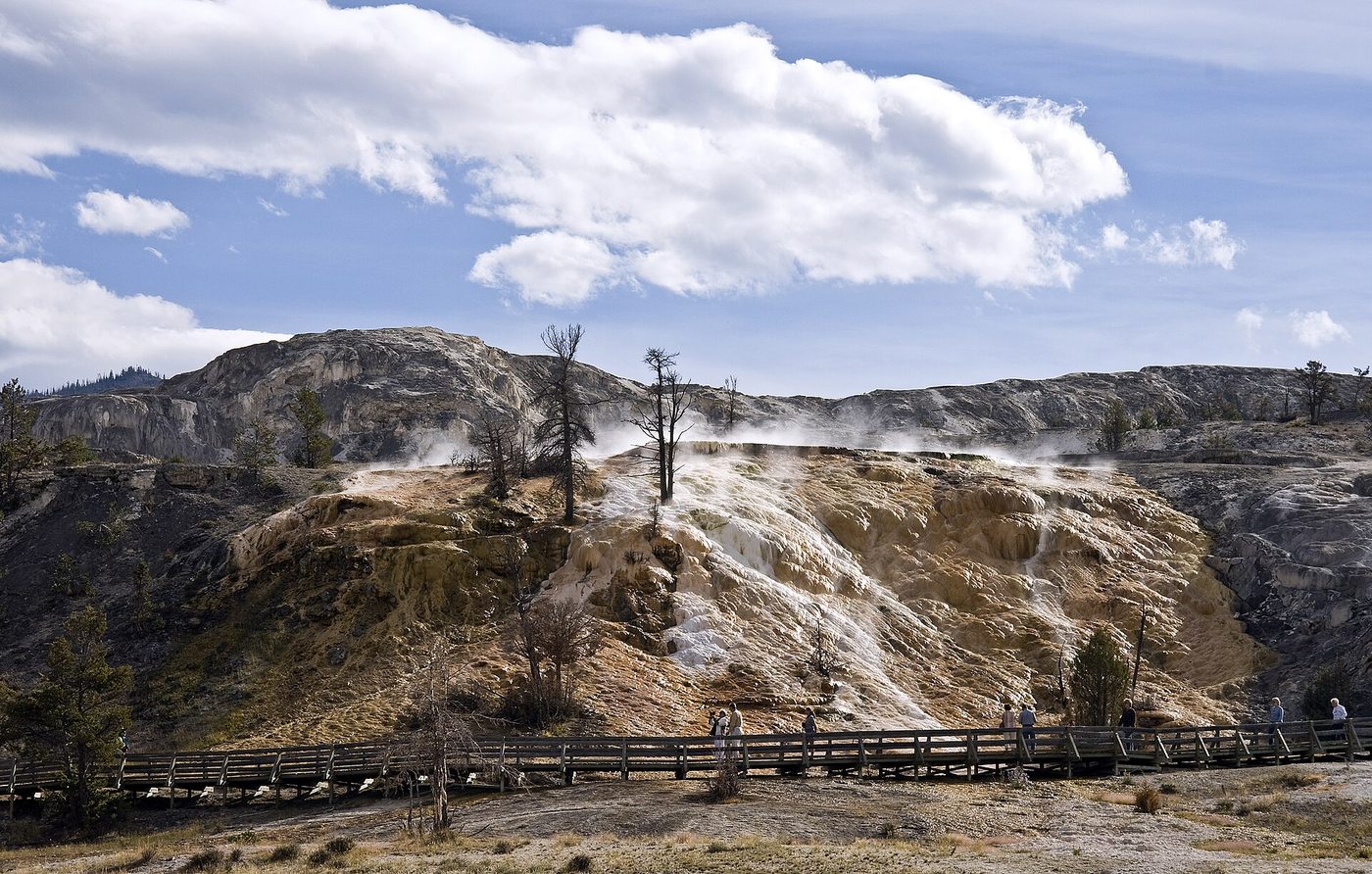
Mammoth Hot Springs deposits more than two tons of travertine a day, which is why its terraces visibly change from year to year. It is also the odd one out among the park’s thermal areas: it sits outside the caldera, its water arrives along a fault from the Norris area, and it builds terraces of travertine rather than the silica sinter found in the geyser basins.
Some of the smaller numbers are the ones that stay with people. Echinus Geyser at Norris runs at a pH of about 3.5, roughly as acidic as vinegar. Excelsior Geyser discharges 4,000 to 4,500 gallons a minute of water at about 199°F, straight into the Firehole River. Abyss Pool at West Thumb is about 53 feet deep and, having been dormant for decades, erupted between 1987 and 1992. Vents on the floor of Yellowstone Lake at Mary Bay have been measured at 252°F.
The features also change constantly. Biscuit Basin, one of the most-visited small basins in the park, has been closed since a hydrothermal explosion on 23 July 2024, with a second explosion in June 2026 sending a milky plume some 3.7 miles down the Firehole. Nothing here is permanent on a human timescale.
Old Faithful, by the numbers
The single most misquoted set of facts in the park, because the geyser has changed and the internet has not.
As of January 2025, the National Park Service gives the median interval as 102 minutes, plus or minus 10, with individual intervals ranging from 54 to 118 minutes. The “every 91 minutes” and “every hour” figures that circulate widely are out of date; the interval has lengthened over the decades, largely because of earthquakes altering the plumbing.
The rest:
- Height: 106 feet to more than 180 feet, averaging about 130 feet.
- Duration: 1.5 to 5 minutes.
- Volume: 3,700 to 8,400 gallons per eruption.
- Water temperature at the vent: 203°F.
Old Faithful is neither the tallest geyser in the park nor the largest. It is famous because it is the most predictable, which in the nineteenth century made it the one you could build a hotel next to.
Five other geysers are predicted by rangers at the Old Faithful Visitor Education Center, and several of them are more impressive: Grand, which reaches up to 200 feet in bursts; Castle, with a cycle of roughly 16 to 17 hours; Riverside, which arches about 75 feet over the Firehole River; Daisy, which erupts at an angle; and Great Fountain, in the Lower Geyser Basin, which rises from 75 to 220 feet on a window of roughly nine to fifteen hours. The full picture is on Yellowstone geysers.
What animals live in Yellowstone?
The National Park Service lists 67 different mammal species in Yellowstone, the largest concentration of mammals in the lower 48 states.
Current population figures, with their dates, because these move:
| Species | Figure | As of |
|---|---|---|
| Bison | about 5,400 | August 2024 |
| Grizzly bears | about 1,030 in the Greater Yellowstone Ecosystem | 2024 |
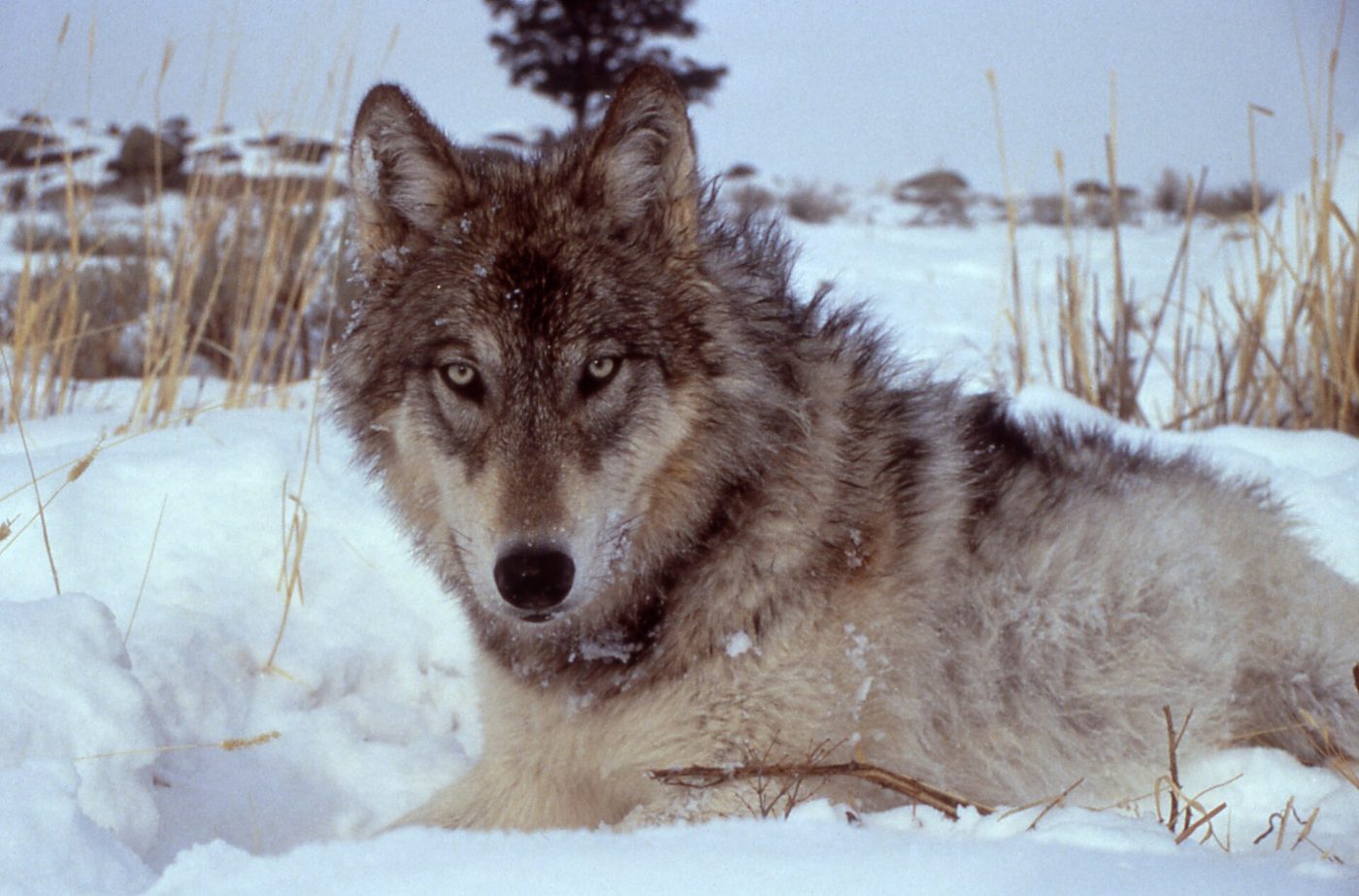
| Wolves | at least 108 living primarily in the park | January 2025 |
Other wildlife facts worth having:
- Ungulates in the park include bison, elk, moose, mule deer, white-tailed deer, pronghorn, bighorn sheep and mountain goats.
- Large predators include grizzly and black bears, wolves, mountain lions, coyotes, Canada lynx and wolverines.
- Yellowstone’s bison are the only herd in the United States to have lived continuously on the same land since prehistoric times.
- The minimum legal distances are 100 yards from bears, wolves and cougars and 25 yards from everything else, including bison and elk.
- Bison can run three times faster than a human, per the National Park Service. They injure more visitors than bears do.
The safety rules that follow from all of this are not optional and are covered in full on Yellowstone safety.
A note on how these population figures behave. Bison numbers swing by a thousand or more between a summer count and the following spring, because winter kills animals and because management removals happen at the park boundary. Wolf numbers move with pack dynamics, disease and hunting outside the park. Grizzly figures are estimates for the whole Greater Yellowstone Ecosystem rather than a head count inside the boundary. Any single number you read is a snapshot with a date on it, and a source quoting a figure without a date is not worth much.
Beyond the mammals, the park supports hundreds of bird species and a short list of native fish, amphibians and reptiles. Native fish, including Yellowstone cutthroat trout, Arctic grayling and mountain whitefish, must be released; every lake trout caught in Yellowstone Lake must by law be killed, because they are an introduced predator that has badly damaged the cutthroat population.
The wolf reintroduction
The best-documented ecological experiment in any national park, and the fact most visitors want.
Wolves were eradicated from Yellowstone by the 1920s under federal predator control. They were reintroduced from Canada in 1995 and 1996 — the number of animals released is given variously as 31 or 41 depending on how the two years and the associated releases in central Idaho are counted, so treat any single figure with caution.
What followed is genuinely disputed in its details and genuinely remarkable in outline. Elk numbers fell and elk behaviour changed; willow and aspen recovered in places; beaver and songbird populations shifted; coyote numbers dropped. The popular version of this story — that wolves “changed the rivers” — is a simplification that ecologists have argued about for twenty years, and the honest position is that the effects are real, complex and still being measured.
As of January 2025 there were at least 108 wolves living primarily inside the park. A more recent secondary report of 84 wolves in eight packs at the end of 2025 has not been confirmed against the Wolf Project’s own figures, so we are not stating it as fact. Lamar Valley remains the best place on earth to see a wild wolf — the detail is on Lamar Valley.
Water, canyon and falls
- Yellowstone Lake covers about 132 square miles with 141 miles of shoreline at an elevation of 7,733 feet, making it the largest high-elevation lake in North America. It is about 20 miles long and 14 wide, averages about 41°F, and freezes over from late December or early January until late May or early June.
- Survival time in that water is roughly 20 to 30 minutes. It is not a swimming lake.
- The Grand Canyon of the Yellowstone is about 20 miles long, more than 1,000 feet deep and 1,500 to 4,000 feet wide.
- The Lower Falls drops 308 feet, roughly twice the height of Niagara and the highest-volume waterfall in the Rocky Mountains. The Upper Falls drops 109 feet.
- Silver Cord Cascade, at around 1,200 feet, is taller than the Lower Falls by total drop, but it is a thin horsetail cascade rather than a plunge.
- At least 45 named waterfalls exist in the park, and the USGS puts the number of drops over 15 feet at approximately 350. The full list is on Yellowstone waterfalls.
- The Continental Divide runs through the park, so water leaving Yellowstone reaches both the Atlantic and the Pacific.
- The Yellowstone River drains the lake and cuts the Grand Canyon of the Yellowstone, and runs undammed from its headwaters through the park.
- Fishing Bridge carried anglers over the Yellowstone River from 1902; the current bridge dates from 1937, and fishing from it stopped in 1973 to protect spawning cutthroat.
Weather and extremes
Monthly averages from the National Park Service weather page, in °F, high and low:
| Month | High | Low | Month | High | Low | |
|---|---|---|---|---|---|---|
| January | 28.6 | 9.6 | July | 79.6 | 46.7 | |
| February | 34.0 | 13.0 | August | 78.3 | 45.3 | |
| March | 39.6 | 17.2 | September | 67.8 | 37.0 | |
| April | 49.4 | 26.0 | October | 55.7 | 29.4 | |
| May | 60.4 | 34.3 | November | 38.7 | 19.2 | |
| June | 70.0 | 41.2 | December | 30.5 | 11.8 |
- Winter days typically run 0 to 20°F, and the record low is −66°F.
- Average annual snowfall is about 150 inches, roughly double that at higher elevations.
- The National Park Service’s own advice: “Expect big temperature swings, rain, or snow during every month of the year.” Snow in July is unusual but not rare.
The month-by-month picture for planning purposes lives on the best time to visit Yellowstone.
How many people visit Yellowstone?
In 2025 Yellowstone recorded 4,762,988 recreation visits, the second-highest total in its history, along with 86,891,452 visitor hours and 1,238,983 overnight stays. The park stayed open through the 43-day federal shutdown that year.
July is comfortably the busiest month, with 975,109 visits in July 2025 alone. Put differently: roughly a fifth of the year’s visitors arrive in one month, on a road network with a 45 mph limit and no public transport.
That concentration, rather than the total, is what shapes a visit. The same park in late September is a genuinely different and much quieter place.
Two further numbers put that in perspective. Around 1.24 million of the year’s visits involve an overnight stay, which means the great majority of visitors are day users driving in and out. And the West Entrance handles roughly half of all entries, which is why the queue on Yellowstone Avenue at nine in the morning in July looks the way it does while the Northeast Entrance sees a fraction of the traffic.
Visitation also collapses seasonally. July alone accounts for around a fifth of the year; the four months from November to February combined account for a small fraction of it, because most of the park is closed to cars.
Facts that are usually wrong
“Yellowstone is overdue for an eruption.” No. The USGS states plainly that “Yellowstone is not overdue for an eruption,” notes that the magma beneath the caldera is only 5 to 15 per cent molten, and says that scientists are not convinced a large eruption will ever occur here again. The average-interval arithmetic that produces frightening numbers is, in the USGS’s own description, meaningless.
“Old Faithful erupts every hour.” Not since long before you read it. The current median interval is about 102 minutes, with a range of 54 to 118.
“The animals are leaving because the volcano is about to blow.” A recurring viral claim, usually built on video of bison running down a road. Bison run down roads because roads are easier than snow. There is no evidence of animals fleeing the caldera and the seismic and deformation networks would show a problem long before the bison did.
“Yellowstone is in Wyoming.” Mostly, at about 96 per cent, but 3 per cent is in Montana and 1 per cent in Idaho — and two of the main gateway towns are in Montana.
“You can swim in the hot springs.” You cannot, and people have died trying. More than 20 people have been killed by hot-spring burns in the park’s history. Swimming in thermal features is prohibited, and where swimming is legal at all is covered on fishing and water in Yellowstone.
“Bears are the main danger.” Traffic accidents are the leading cause of injury and death in the park, and bison injure more people than bears. Of bear-injury victims since 1970, 91 per cent were alone or with one other person, which is why the advice is to hike in groups.
Facts worth repeating
- Yellowstone is home to roughly half the world’s geysers and more hydrothermal features than any other place on earth.
- The bison herd is the only one in the country to have lived continuously on the same ground since prehistoric times.
- Yellowstone Lake has underwater hot springs, with vent temperatures at Mary Bay recorded at 252°F, and cone-shaped “spires” up to 20 feet tall near Bridge Bay.
- The resurgent domes inside the caldera rise and fall by inches over years as magma and fluids shift.
- Echinus Geyser at Norris is roughly as acidic as vinegar, at a pH around 3.5.
- The park has no traffic lights, and one of the most photographed animals on earth regularly stops all the traffic anyway.
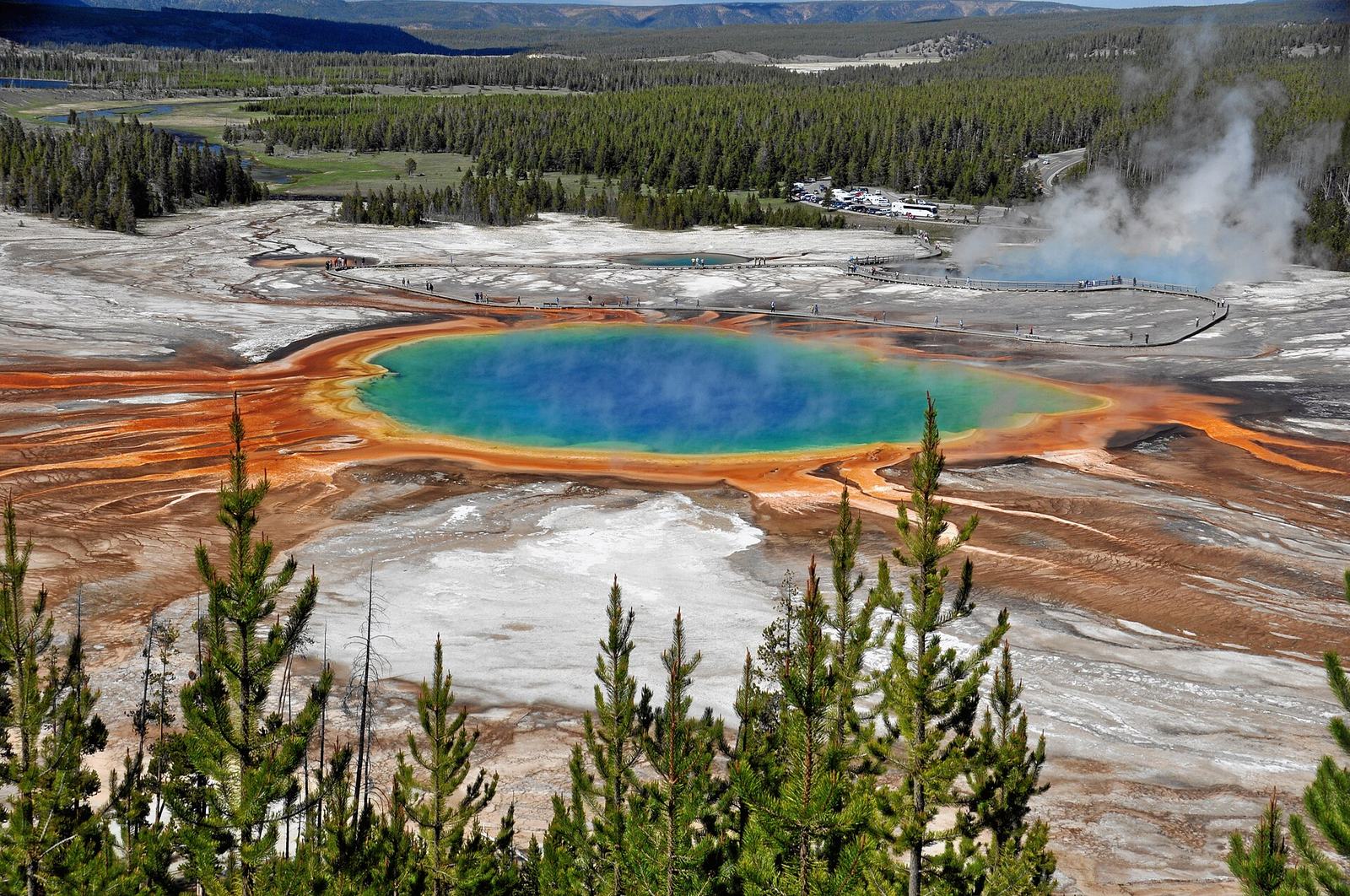
- Grand Prismatic Spring’s colours come from heat-loving microbes, arranged in bands by temperature, which is why the ring pattern is so regular.
- The Northeast Entrance Ranger Station, built in 1934–35, is a National Historic Landmark in its own right.
Facts are the easy part of a Yellowstone trip. The hard parts are timing, distance and booking, which is where most visits go wrong — our practical advice is on Yellowstone National Park tips and first time visiting Yellowstone, and the full planning sequence is on planning a trip to Yellowstone.
Frequently asked questions
When was Yellowstone National Park established?
On 1 March 1872, when President Ulysses S. Grant signed it into existence as the world’s first national park. It predates the states of Wyoming, Montana and Idaho, and it predates the National Park Service itself, which was not created until 1916.
How big is Yellowstone National Park?
2,219,791 acres, or about 3,470 square miles — larger than Rhode Island and Delaware combined. It spans roughly 63 miles north to south and 54 miles east to west, with about 96 per cent in Wyoming, 3 per cent in Montana and 1 per cent in Idaho.
How many geysers are in Yellowstone?
A 2011 study recorded 1,283 geysers that have erupted in the park, which is roughly half of all the geysers on earth and by some counts closer to two-thirds. The park has more than 10,000 hydrothermal features in total, including hot springs, mud pots and fumaroles.
How often does Old Faithful erupt?
The National Park Service gives the median interval as 102 minutes, plus or minus 10, as of January 2025, with individual intervals between 54 and 118 minutes. Older sources saying 91 minutes or “every hour” are out of date; the interval has lengthened over time.
Is the Yellowstone supervolcano going to erupt?
The USGS states that Yellowstone is not overdue for an eruption, that the magma beneath the caldera is only 5 to 15 per cent molten, and that scientists are not convinced a large eruption will ever happen again here. The last eruption was a lava flow about 70,000 years ago.
How many animals live in Yellowstone?
The National Park Service lists 67 mammal species. Recent counts give about 5,400 bison (August 2024), about 1,030 grizzly bears across the Greater Yellowstone Ecosystem (2024) and at least 108 wolves living primarily in the park (January 2025).
How many people visit Yellowstone each year?
4,762,988 recreation visits in 2025, the second-highest total on record, with 975,109 of those in July alone. That works out at about 86.9 million visitor hours and nearly 1.24 million overnight stays.
What is the deepest or largest lake in Yellowstone?
Yellowstone Lake, at about 132 square miles with 141 miles of shoreline, sitting at 7,733 feet — the largest high-elevation lake in North America. Its deepest point is around 390 feet, in a canyon near Stevenson Island.
Sources
- National Park Service: Yellowstone mammals
- National Park Service: the Yellowstone volcano
- National Park Service: exploring Old Faithful
- National Park Service: Yellowstone safety
- USGS: is Yellowstone overdue for an eruption?
Image credits
| Photo | Credit |
|---|---|
| The colours come from heat-loving microbes, arranged in bands by water temperature (top of page) | James St. John from Newark, Ohio, CC BY 2.0, via Wikimedia Commons |
| Yellowstone holds more than 10,000 hydrothermal features, more than anywhere else on earth | Brocken Inaglory, CC BY-SA 3.0, via Wikimedia Commons |
| Mammoth deposits more than two tons of travertine a day, so the terraces change year to ye | Frank Schulenburg, CC BY-SA 4.0, via Wikimedia Commons |
| On a cold morning the steam hides the spring entirely, which is why midday is better here | Dirtsc, CC BY-SA 3.0, via Wikimedia Commons |
| At least 108 wolves lived primarily inside the park as of January 2025 | Doug Smith, public domain, via Wikimedia Commons |
| Boardwalks are relaid regularly here, because the ground itself keeps moving | Acroterion, CC BY-SA 4.0, via Wikimedia Commons |
| Early survey photographs like this one helped persuade Congress to create the park in 1872 | William Henry Jackson, public domain, via Wikimedia Commons |