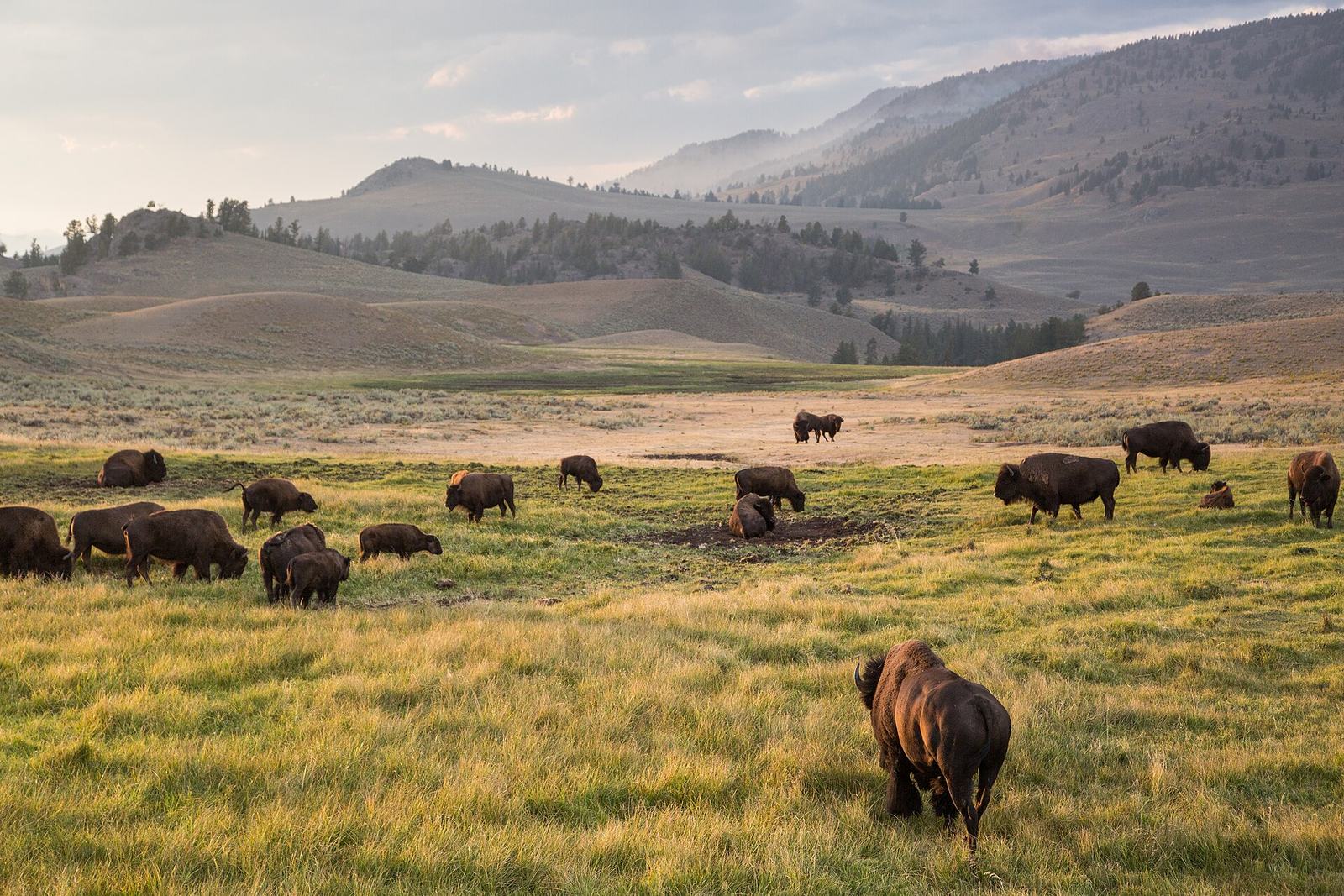
Lamar Valley is a broad, treeless river valley in Yellowstone’s northeast corner, in Wyoming, and it’s the best place in the park to see wolves, along with big herds of bison, elk, pronghorn and bears. It lies along the Northeast Entrance Road between Tower-Roosevelt and Cooke City, Montana. That road is open to cars all year.
People call it the Serengeti of North America, and for once the travel-brochure nickname isn’t much of a stretch. On a good morning in late May you can stand at a pullout at first light and watch hundreds of bison and their orange calves spread across the valley floor, a grizzly digging on a hillside, pronghorn on the flats, and, if you’re lucky and patient, a wolf pack trotting along the Lamar River a mile away.
It’s also a place where expectations need managing. Lamar isn’t a zoo, and the wildlife moves. At noon in July, you may drive the entire valley and see bison and nothing else. The visitors who see wolves are almost always the ones who arrive before sunrise with good optics and stay put. This hub explains how to do that: where to stop, when to come, how the wolf watchers work, and what to expect in each season.
We also cover the rest of Yellowstone’s great wildlife country: Hayden Valley in the center of the park, the Tower-Roosevelt area with Tower Fall and the Petrified Tree, the Lamar Buffalo Ranch, the Blacktail Deer Plateau and the drive to the Northeast Entrance. For the park’s animals species by species, see our Yellowstone wildlife guide.
Is Lamar Valley in Wyoming or Montana?
Lamar Valley is in Wyoming. It’s in the northeast corner of Yellowstone National Park, which lies mostly in Wyoming. The confusion comes from the gateway towns: the nearest ones, Cooke City and Silver Gate at the Northeast Entrance and Gardiner at the North Entrance, are all in Montana.
So if you drive in from Gardiner or Cooke City, you’ll cross the state line inside the park without much fanfare. Several popular websites describe Lamar as “Lamar Valley, Montana,” and it shows up that way in some map apps. The valley itself, the Lamar Buffalo Ranch and Slough Creek are all on the Wyoming side.
The Northeast Entrance Road that runs through it connects Tower-Roosevelt Junction with the Northeast Entrance, a distance of 29 miles. The valley floor proper, the wide open section most people mean, is only about 8 miles long and 3 to 4 miles wide, between Lamar Canyon in the west and the Soda Butte Creek confluence in the east. Both figures show up online, which is why you’ll read that Lamar is anything from 8 to 30 miles long. They’re both right; they’re measuring different things.
Lamar Valley at a glance
The practical facts for planning (NPS unless noted, checked September 2026).
| Location | Northeast Yellowstone, Wyoming, on the Northeast Entrance Road |
| Road | Tower-Roosevelt Junction to Northeast Entrance, 29 miles |
| Valley floor | About 8 miles long, 3 to 4 miles wide |
| Road access | Gardiner to Cooke City is open to cars year-round |
| Nearest services | Tower-Roosevelt (seasonal lodge, store, 24-hour card fuel); Cooke City and Silver Gate; Gardiner |
| Best for | Wolves, bison, elk, pronghorn, grizzly and black bears, bighorn sheep, coyotes, bald eagles |
| Best time of day | Sunrise to about 9 a.m., and the last 2 hours before dark |
| Best seasons | Late April to June, and September to March for wolves |
| Campgrounds | Slough Creek (June 15 to October 12, 2026); Tower Fall (May 22 to September 27, 2026); Pebble Creek closed in 2026 |
| Lodging | Roosevelt Lodge cabins (June 5 to September 6, 2026); Cooke City, Silver Gate, Gardiner |
| Cell service | Little to none in the valley |
| Fees | No separate fee; park entrance fee applies |
Why they call it the Serengeti of North America
Lamar is a wide, glacier-carved valley of grassland and sagebrush, cut by the Lamar River and its tributaries, Slough Creek and Soda Butte Creek. There are few trees on the valley floor, so animals are visible from a long way off, and the grass supports large herds of grazers through summer. Where the grazers are, the predators follow.
That openness is what makes Lamar different from most of Yellowstone. The park’s central plateau is covered in lodgepole pine forest, where a wolf could be 50 yards off the road and you’d never know. In Lamar, you can watch an elk herd, a bison bull and a pair of coyotes in one sweep of the binoculars, all against a backdrop of mountains that are snow-capped into June.
The northern range as a whole, which runs from Gardiner and Mammoth east through Blacktail, Tower and Lamar, is lower and drier than the rest of the park. Snow is thinner here in winter, so elk, bison, pronghorn and bighorn sheep move down to it from higher country when the weather turns. That’s why the wildlife viewing here is good in every season, and why wolves concentrate here in winter.
What wildlife can you see in Lamar Valley?
Bison are almost guaranteed from spring to fall, often in herds of hundreds. You also have good chances of elk, pronghorn, coyotes, grizzly and black bears, bald eagles and ospreys, plus bighorn sheep on the cliffs toward the east end. Wolves are the headline species, but seeing one usually takes an early start and patience.
Here’s what to expect, species by species, and where to look.
| Species | How likely | Where and when to look |
|---|---|---|
| Bison | Very likely, April to November | Across the valley floor; the road often goes right through the herds |
| Pronghorn | Likely, spring to fall | Flats in the western valley and around the Buffalo Ranch |
| Elk | Likely year-round | Hillsides and edges of timber, especially early and late in the day |
| Coyotes | Likely | Hunting voles in open meadows, any time of day |
| Wolves | Possible, best at dawn and dusk | Far across the valley, usually seen through a spotting scope |
| Grizzly bears | Possible, April to October | Hillsides and on carcasses, especially in spring |
| Black bears | Possible, spring and early summer | Forest edges around Tower and the east end |
| Bighorn sheep | Possible | Cliffs near Lamar Canyon and the eastern end toward Soda Butte |
| Mountain goats | Occasional | High on Barronette Peak’s cliffs near the Northeast Entrance |
| Moose | Occasional | Willows along Soda Butte Creek toward Cooke City |
| River otters | Occasional | Trout Lake, Slough Creek, Lamar River |
| Bald eagles, ospreys, sandhill cranes | Likely in season | Along the rivers and in wet meadows |
Wolves
Wolves are why many visitors come to Lamar, and they’re why the valley is famous. The park had at least 108 wolves living primarily inside its boundaries in January 2025, and the northern range is where they’re most visible. Pack names, sizes and territories shift every year as packs form, split and die out. Junction Butte, the pack most associated with the Slough Creek and Lamar area in recent years, is a good example of how quickly things change, so ask the wolf watchers what’s been active this week.
Honest expectations: most wolf sightings in Lamar are distant. You’ll often see a wolf as a dark or gray dot a mile away, and with naked eyes you’d miss it entirely. A good spotting scope turns that dot into an animal. Close sightings from the road do happen, especially when a pack is on a kill near the road, but they’re a bonus, not the norm. Our wildlife hub covers wolves in more depth.
Bison
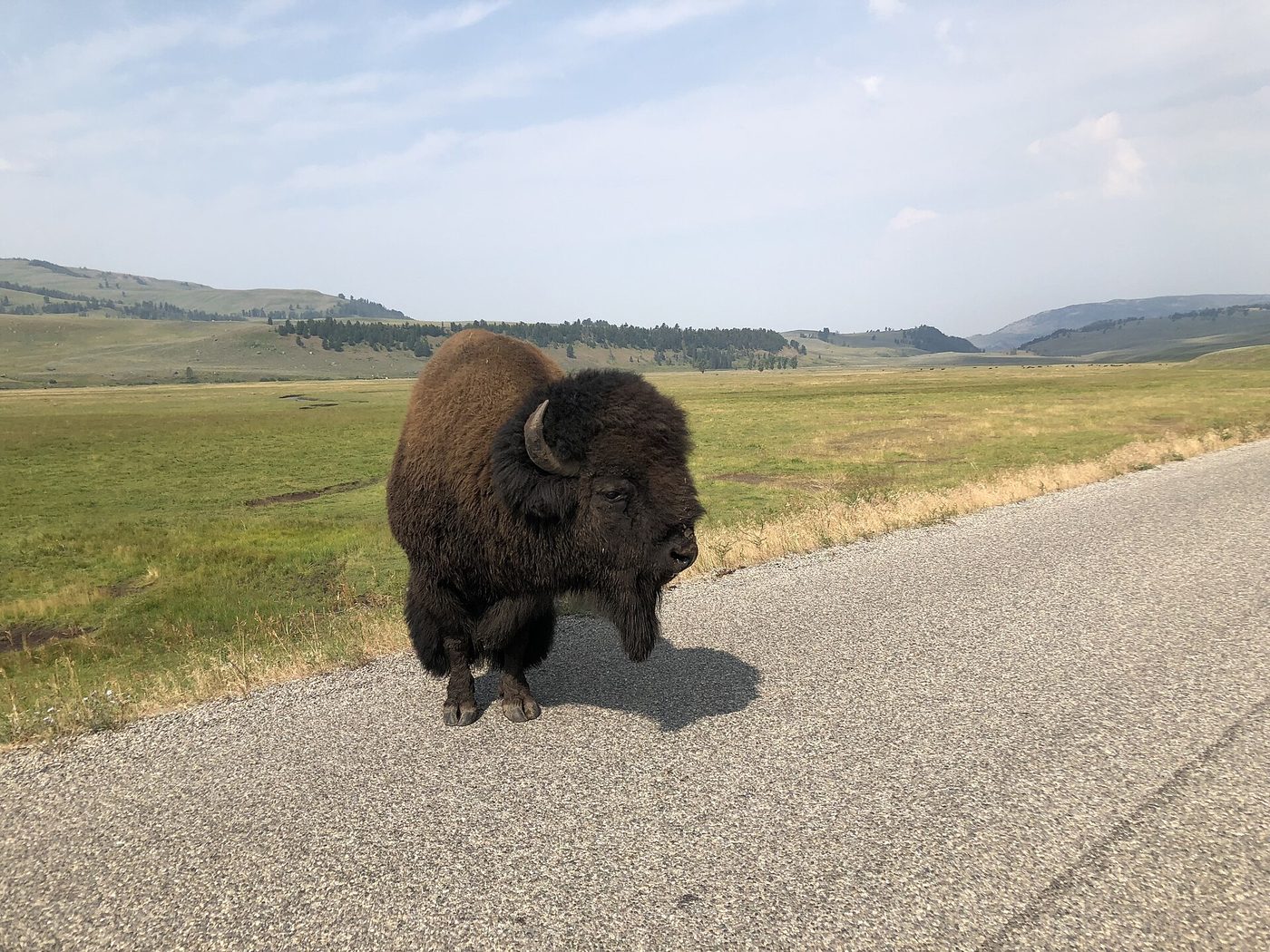
Lamar is one of the park’s two great bison valleys, along with Hayden. From late April, you’ll see calves, which are reddish-orange for their first couple of months. From late July through August, the bison rut fills the valley with bellowing bulls and dust wallows. Bison walk on the road regularly, and a bison jam can hold you up for 20 minutes. Stay in your car and let them pass.
Bears
Grizzlies come out of their dens from about March, and spring is prime time to see them in Lamar, often feeding on winter-killed carcasses or digging for roots on the slopes. Black bears are more common around the forested edges near Tower-Roosevelt. Bear sightings drop in midsummer, when many bears move to higher elevations.
The Lamar Valley drive, west to east
The Northeast Entrance Road runs 29 miles from Tower-Roosevelt Junction to the Northeast Entrance, climbing gradually from the Yellowstone River through Lamar and up Soda Butte Creek to the mountains around Cooke City. Without stops, it takes about 45 minutes to an hour. With wildlife stops, it’s easily a morning.
Wolf watchers and guides use informal names for many pullouts, some after landmarks and some after people or events. They aren’t on official park signs, but you’ll hear them at the pullouts, so it helps to know them. Here’s the drive from west to east, with the stops that matter. Our detailed Lamar Valley map marks each one, and our Lamar Valley drive guide has timings for doing it as a half-day trip.
Tower-Roosevelt Junction to Lamar Canyon
- Tower-Roosevelt Junction. Start with a full tank; there’s 24-hour card fuel here. Roosevelt Lodge sits just off the junction.
- Yellowstone River bridge. Just east of the junction, the road crosses the Yellowstone River. Look for bighorn sheep on the cliffs to the east and ospreys along the river.
- Junction Butte and the Little America flats. The road climbs onto an open plateau of ponds and sagebrush, with Specimen Ridge to the south. It’s a good area for pronghorn, bison, sandhill cranes and wolves crossing between the Slough Creek and Lamar areas.
- Slough Creek road. A gravel road runs north a couple of miles to Slough Creek Campground and trailhead. The pullouts at the junction and along the road overlook the Slough Creek flats, one of the most reliable places for wolves, particularly in spring when a pack dens in the area.
- Lamar Canyon. The road narrows through a short rocky canyon beside the Lamar River. There are few safe places to stop, but watch for bighorn sheep and otters in the river.
The main valley floor
- Western end of the valley. The valley opens up dramatically as you leave Lamar Canyon. The pullouts here are some of the busiest wolf-watching spots, with long views across the river to the slopes of Specimen Ridge and up the Lamar River.
- The Hitching Post and the middle of the valley. A cluster of pullouts where many watchers set up scopes to scan both sides of the valley. Bison herds are often everywhere here.
- Lamar Buffalo Ranch. The historic ranch buildings on the north side of the road, now used by Yellowstone Forever for field courses. The pullouts nearby look over the flats where bison, pronghorn and coyotes are regular.
- Confluence of the Lamar River and Soda Butte Creek. The east end of the main valley. The road turns northeast to follow Soda Butte Creek.
Soda Butte Creek to the Northeast Entrance
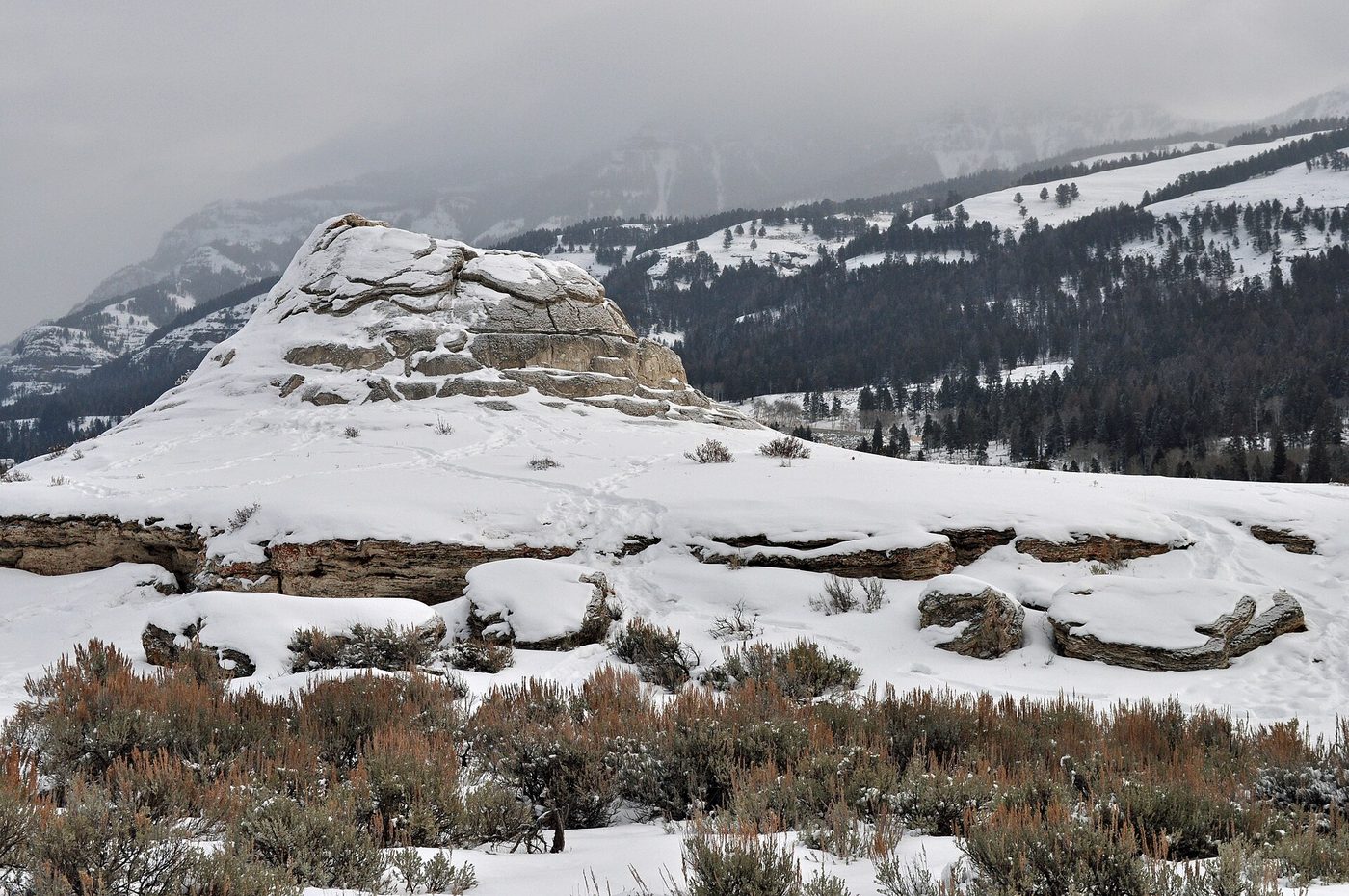
- Soda Butte. An extinct hot spring cone of travertine right beside the road, the only significant thermal feature in this part of the park. Grizzlies and wolves are seen on the slopes above Soda Butte Creek in spring.
- Trout Lake trailhead. A small parking area for the short, steep walk up to Trout Lake, popular for river otters and, in early summer, spawning cutthroat trout.
- Round Prairie and the Pebble Creek area. A wide meadow backed by cliffs, good for moose, bison and bears. Pebble Creek Campground was closed in 2026 after flood damage.
- Barronette Peak and Icebox Canyon. The valley narrows under the towering cliffs of Barronette Peak, where mountain goats sometimes appear as white dots high on the rock. Icebox Canyon holds ice into early summer.
- Northeast Entrance. The log ranger station, built in 1934-35, is a National Historic Landmark. Silver Gate is just beyond, and Cooke City a few miles farther.
Driving tips for Lamar:
- Pull completely off the road, all four wheels, before you stop. Stopping in the lane is one of the most common causes of accidents in wildlife jams.
- Don’t park on the grass or sagebrush. Use pullouts, even if it means walking back.
- Watch for people crossing the road at busy pullouts, especially at dawn when light is low.
- Expect bison on the pavement. Give them room and don’t honk.
- Budget extra time in summer 2026 for the Gardner River High Bridge between Mammoth and Tower, which was one lane with delays of up to 15 minutes and no vehicles 8’6″ or wider through late October (checked September 2026).
How to actually see wolves in Lamar Valley
Seeing wolves in Yellowstone is less about luck than about routine. The people who see wolves day after day follow a few simple habits. You can copy them.
Get there before sunrise
Wolves are most active at dawn and dusk. In June, sunrise in Lamar is before 5:30 a.m., which means leaving Gardiner around 4 a.m. or Cooke City around 4:45 a.m. to be in position at first light. It’s brutal on a vacation, but the first two hours of daylight are when most wolf sightings happen. By 9 or 10 a.m., wolves are usually bedded down out of sight.
Look for the scopes
Early in the morning, you’ll see clusters of cars at pullouts and people with tripods and big spotting scopes pointed at a distant hillside. These are the wolf watchers: some are longtime regulars who come for weeks or months every year, some are researchers, and some are guides with clients. If a group is set up and looking intently at one spot, there’s a good chance they’re watching something.
Park properly, walk over quietly, and ask what they’re seeing. Many regulars are generous and will let you look through their scope. Keep your voice down, don’t slam car doors, and don’t crowd them.
Bring optics
This is the single biggest factor after timing. Binoculars (8×42 or 10×42 is a good all-round choice) are essential. A spotting scope on a tripod makes a huge difference for wolves, which are often a mile or more away. If you don’t own one and wolves are the goal, a guided tour with scopes is worth the money.
Scan, don’t drive
The worst way to see wolves is to drive up and down the valley. Pick a pullout with a wide view, stop, and scan slowly with binoculars: ridgelines, the edges of timber, the river, and anywhere ravens or magpies are gathering, which can mean a carcass.
Follow the rules
- Stay at least 100 yards from wolves and bears, and at least 25 yards from everything else.
- Never use calls, howling or playback to attract wolves. It disturbs them and it’s harassment of wildlife.
- Don’t follow wolves on foot or pursue them to get closer.
- Never feed any wildlife, and don’t leave food out at pullouts.
- Drones are prohibited everywhere in the park.
Our Yellowstone safety guide has the full set of rules for watching wildlife.
A sample dawn morning, hour by hour
Here’s what a well-run June morning in Lamar looks like if you’re staying in Gardiner. Shift everything 45 minutes later if you’re in Cooke City or Silver Gate and working the eastern end.
- 3:45 a.m. Alarm. Coffee in the thermos, breakfast packed the night before, layers on. It’s often in the 30s°F at this hour even in June.
- 4:00 a.m. Leave Gardiner. Drive slowly through Mammoth and across Blacktail; this is prime time for elk and deer on the road, and it’s dark.
- 5:00 a.m. Reach Tower-Roosevelt Junction as the sky starts to lighten. Scan the Little America flats on the way past.
- 5:15 a.m. Pull into a pullout overlooking Slough Creek or the western valley. Set up binoculars or the scope, and start scanning slowly: ridgelines first, then timber edges, then the valley floor.
- 5:30 to 7:30 a.m. The main window. If a group of watchers is focused on one slope, join them quietly. If nothing is happening after 30 or 40 minutes, move east one area.
- 7:30 to 9:00 a.m. Work your way east past the Buffalo Ranch toward Soda Butte, stopping wherever bison, pronghorn or a gathering of scopes catches your eye. Eat breakfast at a pullout.
- 9:00 to 10:00 a.m. Wildlife activity drops off. Walk up to Trout Lake, or turn around and head back west for Tower Fall and the Petrified Tree.
- Midday. Nap. Seriously. If you’re planning to come back for the evening, an afternoon rest at your lodging makes the second session far more enjoyable.
- 6:30 p.m. to dark. Return to the valley for the evening session, and leave enough daylight margin to drive back safely.
Two mornings on this routine will teach you more about Lamar than a week of midday drives.
What if you don’t see wolves?
Plenty of people spend a morning in Lamar and don’t see a wolf, and it’s worth saying plainly: that’s normal. Wolves cover huge territories, and a pack that was on a kill beside the road yesterday may be 15 miles away today. Don’t treat a wolf-less morning as a failure. A few things improve your odds on the next attempt.
- Come back at dusk the same day. Evening sightings are less common than dawn ones, but the pullouts are quieter and your chances aren’t zero.
- Try a different end of the valley. If the western pullouts and Slough Creek were empty, try the Soda Butte and Round Prairie area the next morning, or the reverse.
- Ask where things were seen. Wolf watchers, guides and rangers often know which slope a pack used yesterday.
- Give it more than one morning. Your odds go up sharply over two or three dawns compared with one.
- Enjoy what’s there. A morning in Lamar almost always delivers bison, pronghorn, coyotes and eagles, and often bears. Coyotes hunting voles in the grass are one of the most entertaining things to watch in the park, and they’re far easier to see than wolves.
Photographing wildlife in Lamar
Lamar is a photographer’s valley, but it’s a long-lens valley. The legal distances, 100 yards from wolves and bears and 25 yards from bison and elk, plus the fact that most predators are far away, mean a phone camera will rarely give you a satisfying wildlife shot. A lens in the 400 to 600 mm range is what most wildlife photographers use here, and even that often won’t bring a distant wolf into frame.
The best light is the same as the best wildlife time: the first hour after sunrise, when low sun lights the valley from the east and backlights bison breath on cold mornings, and the golden hour before sunset. Midday light in summer is flat and hazy.
Some practical tips:
- Shoot from the pullout, not the road. Setting up a tripod on the pavement is dangerous and blocks traffic.
- Use your car as a blind when animals are close to the road. Animals are often less disturbed by a vehicle than by a person on foot.
- Landscapes are easy wins. On days when animals are distant, the valley itself, the river, and the peaks at the east end make great images, especially with storm clouds in summer or snow in winter.
- Never bait, call or approach for a better picture. It’s illegal, and it’s the fastest way to get a citation and a very public reprimand from the other watchers.
When is the best time to visit Lamar Valley?
For most visitors, late May to mid-June is the best time: bison calves, bears out of hibernation, wolves near their dens and every road open. For serious wolf watching, winter from December to March is best. In any season, be there at sunrise or in the last two hours before dark.
Time of day
The daily rhythm matters more than the month. Wildlife is most active from first light to about 9 a.m., and again from about two hours before sunset until dark. The middle of the day is when many visitors arrive, and it’s when the valley is quietest for wildlife. If you can only visit once, make it at dawn.
Evening has one advantage over morning: you don’t need a 4 a.m. alarm. But you’ll be driving back to your lodging in the dark with bison on the road, which is its own hazard. Plan accordingly.
Month by month
| Month | What’s happening | Our take |
|---|---|---|
| January | Wolves easiest to see against snow; bison, elk and bighorn sheep on lower slopes | Excellent for wolves; very cold; only the Gardiner-Cooke City road is open |
| February | Wolf breeding season, packs very active | Excellent for wolves |
| March | Bears start emerging late in the month; snow still deep | Good; quiet |
| April | Grizzlies on winter-killed carcasses; first bison calves late in the month | Very good; roads elsewhere begin reopening |
| May | Bison calves everywhere; bears active; wolves near dens; Dunraven Pass opened May 22 in 2026 | Best all-round month |
| June | Elk and pronghorn young; wildflowers; wolf pups may appear; crowds build | Very good, but busier |
| July | Midday heat, animals less active; bison rut starts late in the month | Go early; worst month for crowds |
| August | Bison rut in full swing, dust and bellowing bulls | Good for bison, weaker for predators |
| September | Elk rut begins; aspens turn late in the month; crowds thin | Very good |
| October | Elk rut, first snow; Dunraven Pass closed October 12, 2026 | Very good; check road dates |
| November | Quiet, cold; most other park roads closed to cars | Good for solitude and wolves |
| December | Winter season begins; wolves and bison on snow | Excellent for wolves |
For every month in detail, including temperatures and what to pack, see our guide to the best time to visit Lamar Valley. Opening and closing dates for the park’s other roads belong to our Yellowstone road closures page, so check there before you plan a route.
Lamar Valley in winter
Winter is Lamar’s secret season. The road from Gardiner through Mammoth, Tower and Lamar to Cooke City is the only road in Yellowstone that normally stays open to regular cars all year, so you can drive into the best wolf-watching country in the park on a January morning.
Why winter is so good:
- Wolves stand out against snow, even at a distance.
- Prey animals concentrate on the lower, windblown slopes of the northern range, and wolves follow them.
- Crowds disappear. You may share a pullout with only a handful of dedicated watchers.
What you need to know:
- The road can be icy and snowpacked, and it can close temporarily during storms. Snow tires or at least good all-season tires are strongly recommended, and carry a winter emergency kit.
- Services are minimal. Roosevelt Lodge and the Tower Fall store are closed. Gardiner and Cooke City have limited winter services, and the 24-hour card fuel at Tower-Roosevelt is useful to know about.
- Past Cooke City, the road is closed in winter, so you can’t continue east to Cody or the Beartooth Highway. Cooke City is a dead end for cars in winter.
- Dawn temperatures are often below 0°F. Dress in layers, with insulated boots, and bring a thermos.
Guided winter wildlife tours run out of Gardiner and Mammoth, and they’re a good idea if you aren’t used to winter driving. Our Yellowstone in winter guide covers winter trips across the whole park.
Tower-Roosevelt, the Buffalo Ranch and the valley’s history
Tower-Roosevelt Junction marks the western gateway to Lamar, where the road from Mammoth meets the Northeast Entrance Road and the road south over Dunraven Pass to Canyon. It’s historically called Roosevelt Country, and it’s more than a place to fill the tank.
Roosevelt Lodge
Roosevelt Lodge, a rustic log lodge with simple cabins, is near the junction. It’s the base for the Old West Cookout, horseback rides and stagecoach rides. The lodge operates only in summer (June 5 to September 6 in 2026, checked September 2026). Lodge seasons and booking rules are covered in our Yellowstone lodging guide, and our full Tower-Roosevelt guide covers the area’s activities and services.
Tower Fall
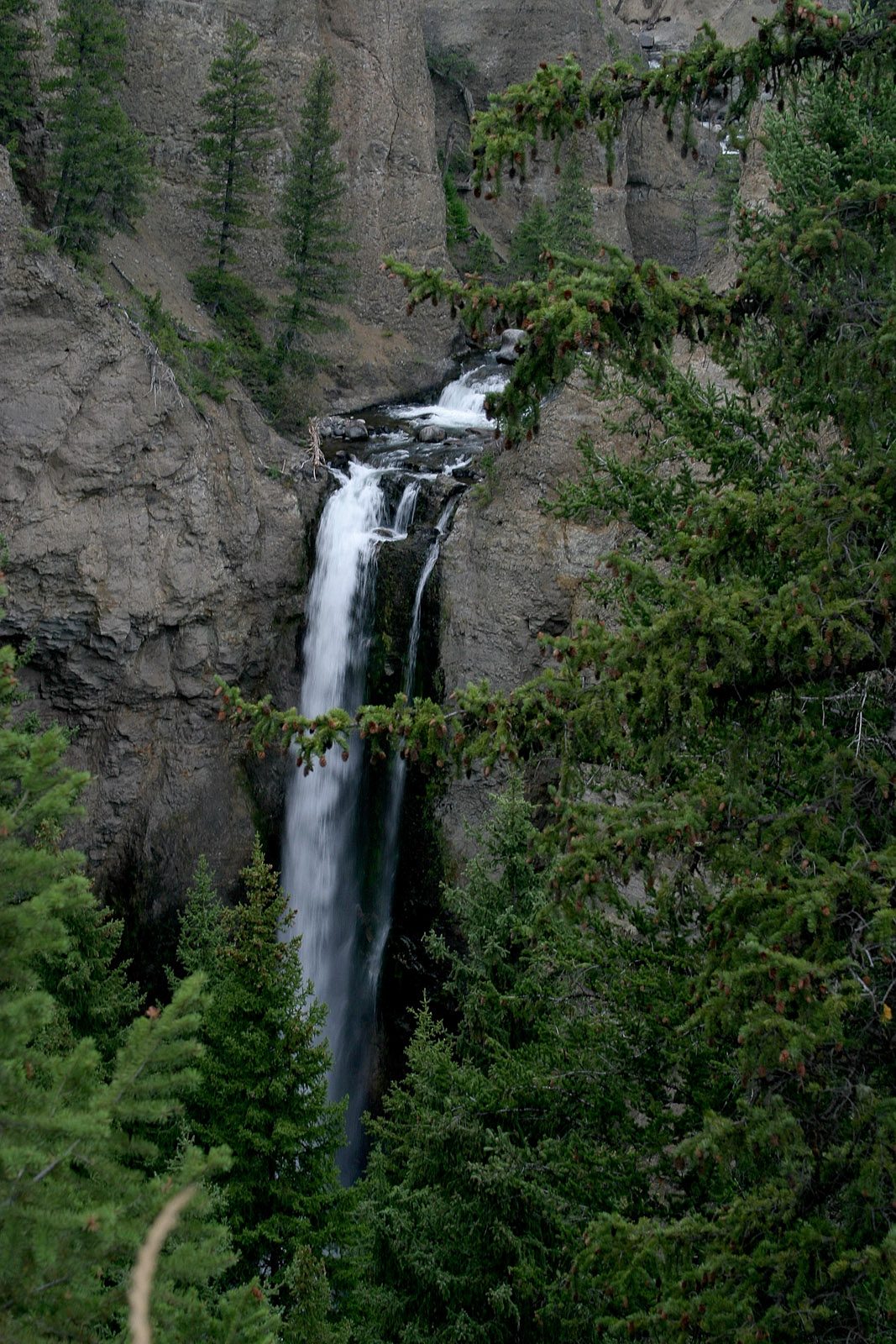
Tower Fall drops 132 feet over a cliff framed by volcanic pinnacles, 2 miles south of the junction on the road toward Dunraven Pass. The overlook is a short walk from the parking area beside the general store. The trail that used to continue down to the base of the falls is closed because of severe erosion, so the overlook is as close as you can get.
Is it worth it? Yes, as a 15- to 20-minute stop if you’re driving between Canyon and Tower. It’s not worth a special detour on its own. Just north, the Calcite Springs Overlook looks down into the narrow downstream end of the Grand Canyon of the Yellowstone, with columns of basalt on the canyon walls and thermal steam near the river. It’s one of the park’s most underrated viewpoints. See our guide to Tower Fall.
Remember that the road south of Tower Fall over Dunraven Pass is seasonal: in 2026 it was open from May 22 to October 12. Outside that window, Tower Fall and Calcite Springs can’t be reached by car.
The Petrified Tree
About a mile west of the junction, a short spur road leads to a fossilized redwood tree standing upright on a hillside, protected by an iron fence. It was buried by volcanic debris roughly 45 to 50 million years ago and turned to stone. The fence is there because early visitors chipped away the other trees that once stood nearby.
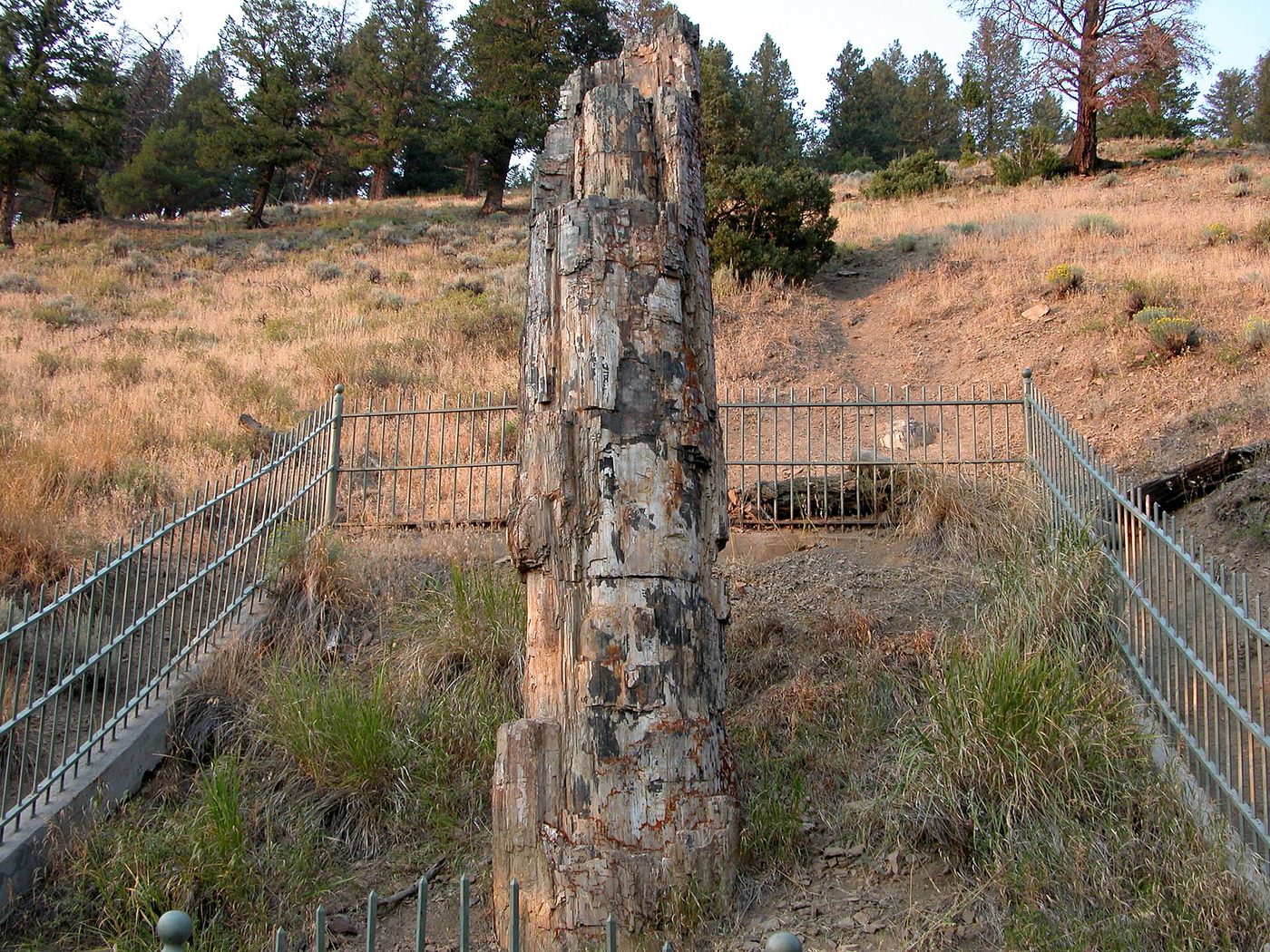
It’s a quick stop, 10 minutes at most, and the spur road is narrow, so it isn’t suited to large RVs or trailers. Our verdict: worth the stop if you’re passing and curious about the fossil forests, but it’s not a highlight. The bigger story is on Specimen Ridge, south of Lamar, which the NPS calls home to the largest concentration of petrified trees in the world. Reaching those takes a steep, unmarked backcountry hike. See our Petrified Tree guide for both.
Lamar Buffalo Ranch and the return of bison and wolves
The Lamar Buffalo Ranch is a small group of historic buildings in the middle of the valley, and it’s where Yellowstone’s bison were brought back from the brink.
By the early 1900s, market hunting and poaching had left only a couple of dozen wild bison in Yellowstone. The park responded by starting a bison ranch in Lamar Valley, around 1907, raising bison from a small herd, including animals brought in from private herds, and eventually releasing them. Ranching ended decades later, and today’s Yellowstone bison, several thousand of them, descend in part from that effort. Four buildings remain from the ranch and are listed on the National Register of Historic Places.
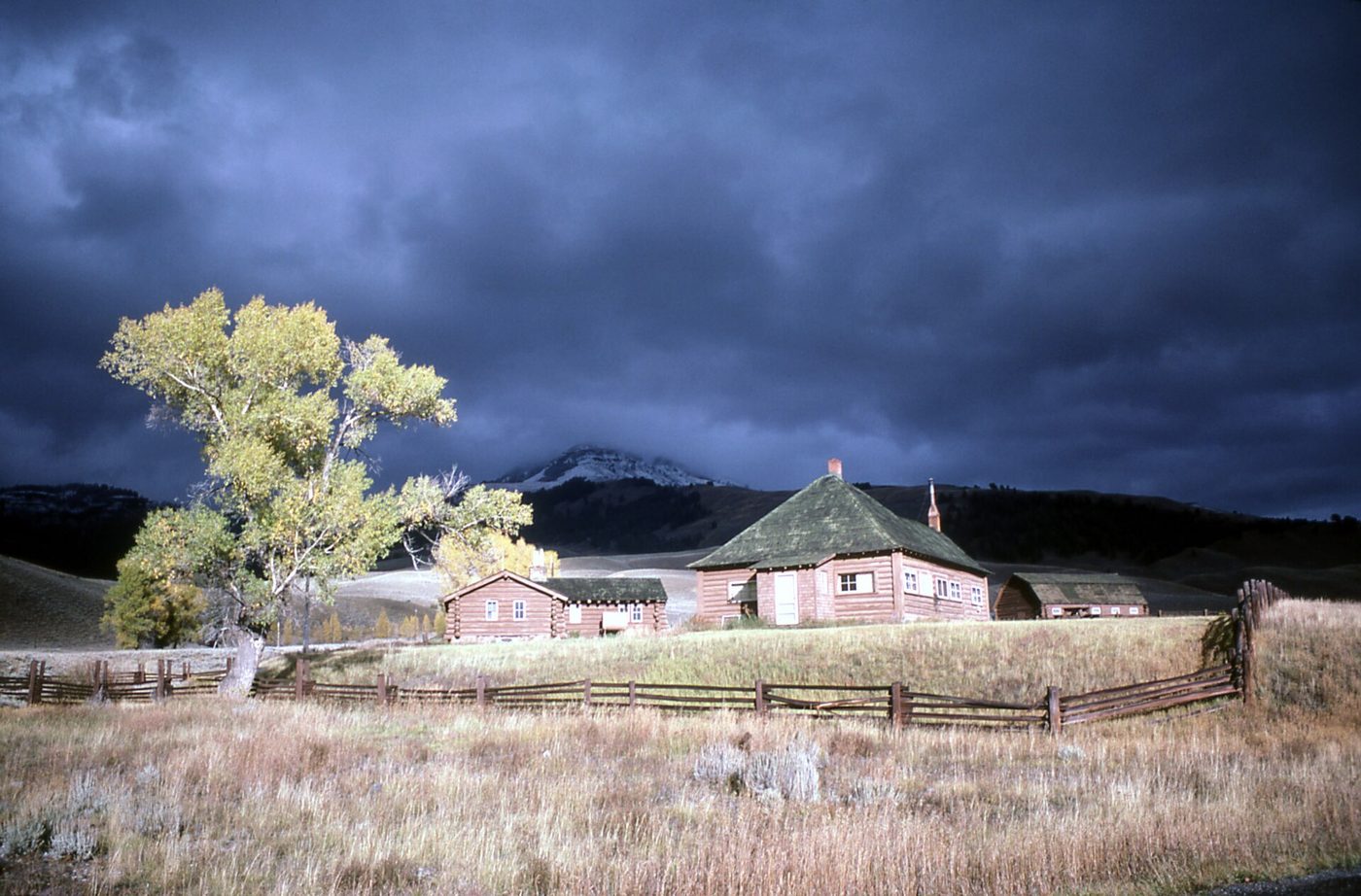
Today, the ranch is a field campus of Yellowstone Forever, the park’s nonprofit partner, which runs multi-day courses on wildlife, wolves and ecology there. The buildings aren’t open to casual visitors, but the pullouts nearby are some of the best wildlife viewing spots in the valley. Read more in our Lamar Buffalo Ranch guide.
The wolves come back
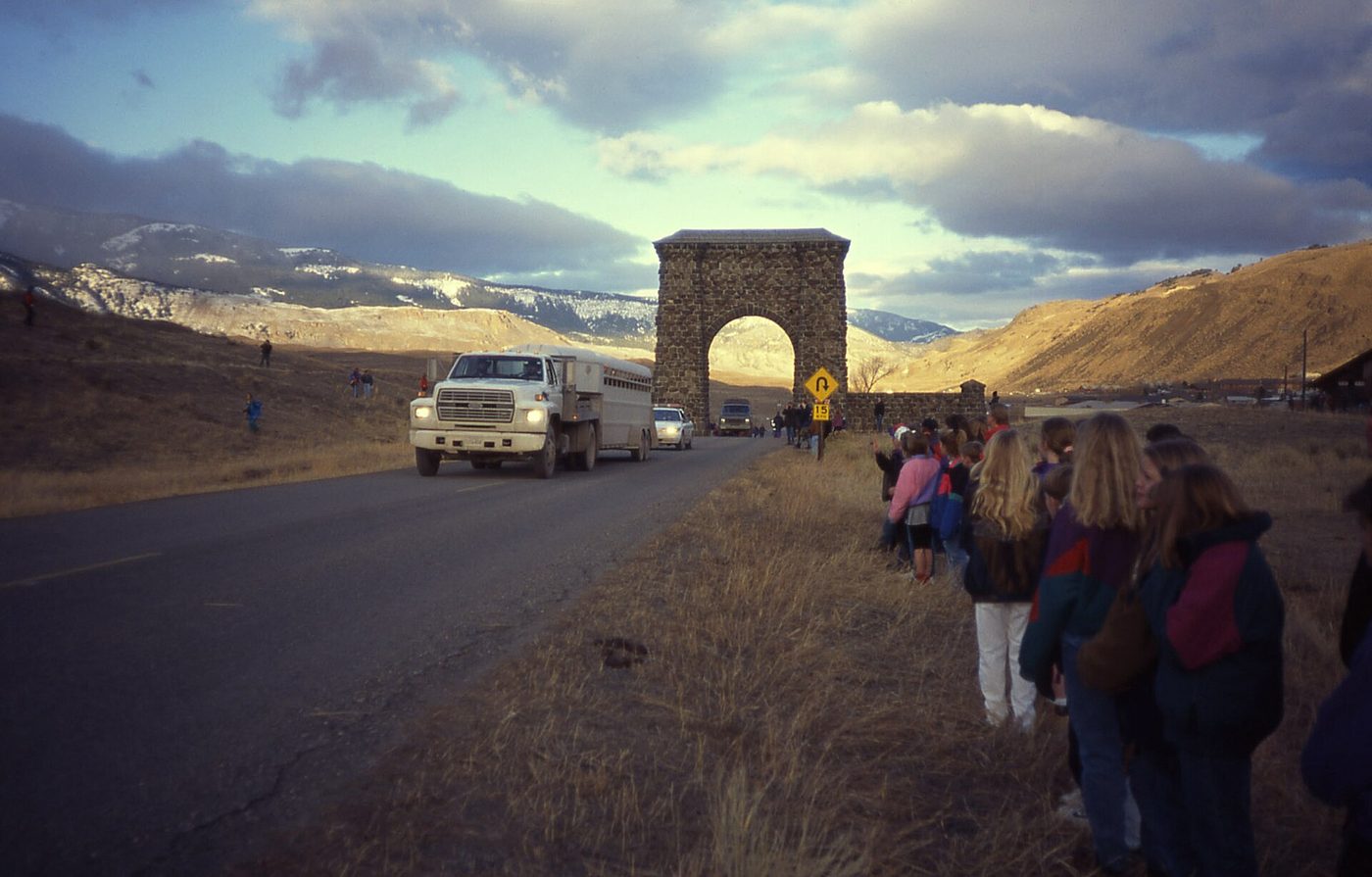
Lamar also played a central role in the return of wolves. The last wolves native to Yellowstone were killed in the 1920s, reportedly including two pups near Soda Butte Creek in 1926. For nearly 70 years, the park had no wolf packs. In 1995 and 1996, wolves captured in Canada were brought to Yellowstone and held in acclimation pens, including pens in the Lamar area, before being released. More wolves from northwest Montana followed in 1997.
The reintroduction is one of the most studied wildlife recoveries in the world, and it’s the reason Lamar is now famous for wolves. Scientists still debate how much the wolves changed the rest of the ecosystem, but there’s no debate that they made the northern range one of the best places on earth to watch wild wolves.
Hayden Valley: the other great wildlife valley
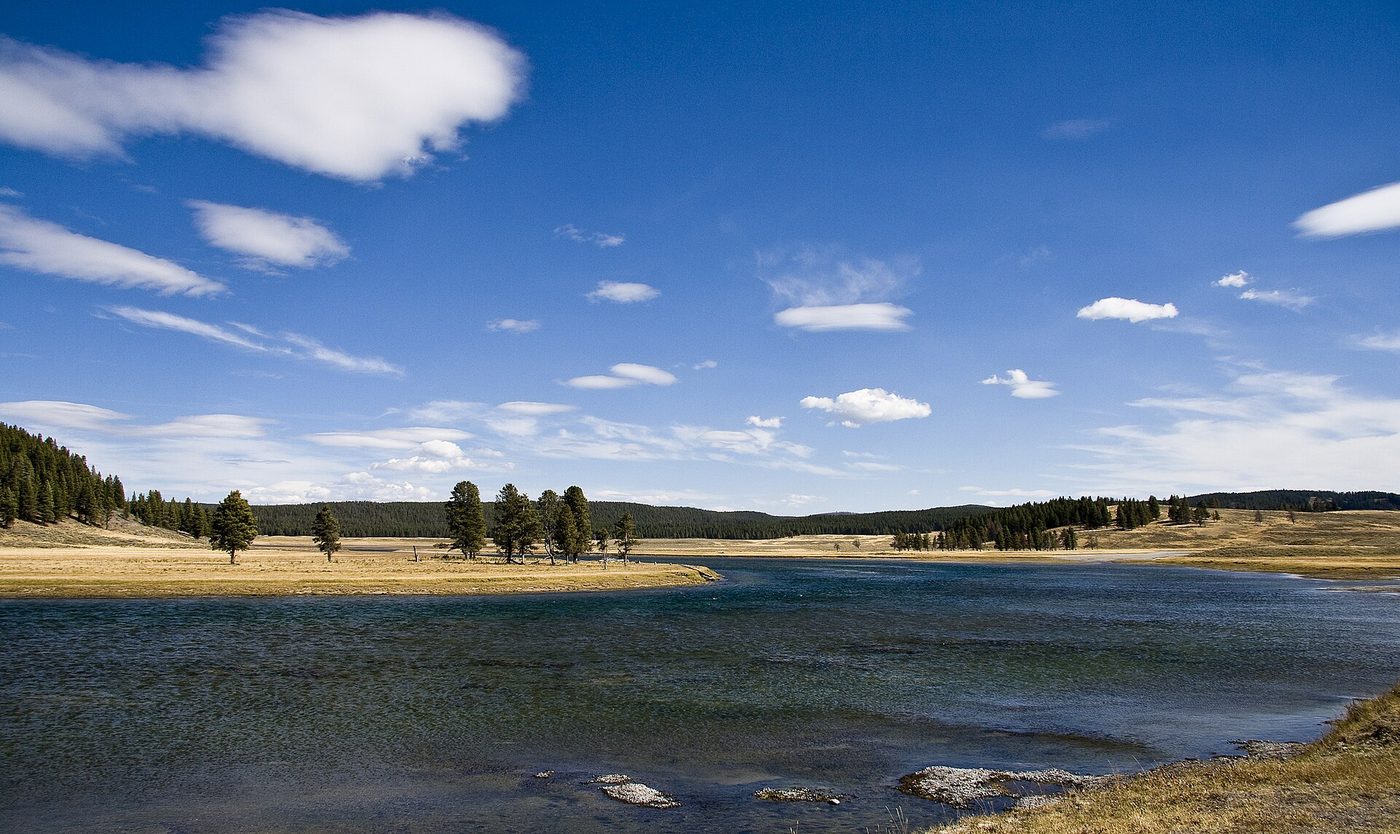
Hayden Valley is Yellowstone’s second great wildlife valley, and for many visitors it’s the more convenient one. It lies in the center of the park, along the Grand Loop Road between Canyon Village and Fishing Bridge, with the Yellowstone River meandering slowly through it.
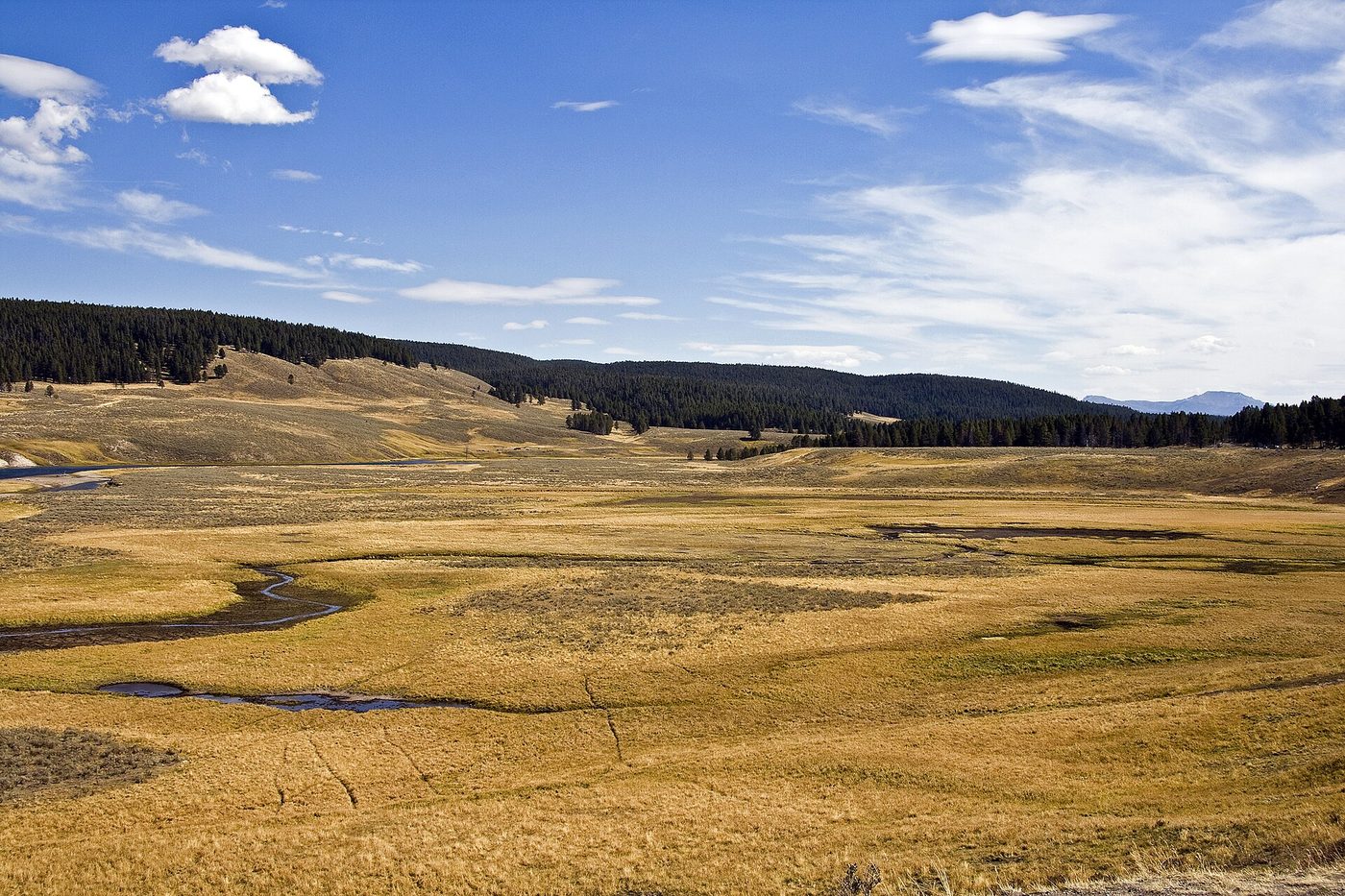
The valley covers roughly 50 square miles of grassland and sagebrush. It’s the bed of an ancient lake, from a time when Yellowstone Lake was much larger, and its fine-grained lake sediments support grass rather than forest. That’s why it’s so open, and why bison favor it.
What to see in Hayden:
- Bison. Hayden’s big draw. During the rut, from late July through August, the valley can hold huge herds, and the road through it is often at a standstill.
- Grizzly bears. Hayden is one of the more reliable places in the park to see grizzlies at a distance, especially in spring and early summer.
- Wolves. Seen less often than in Lamar, but packs use the area, and the same dawn-and-scope approach applies.
- Waterbirds. Trumpeter swans, American white pelicans, Canada geese, ducks and sandhill cranes along the river.
- Elk and coyotes. Common along the forest edges.
The best-known viewpoint is Grizzly Overlook, a large pullout at the north end of the valley with a wide view across the river and meadows. It’s a popular spot for watchers, especially at dawn and dusk. Our guide to Grizzly Overlook covers parking and what’s been seen there.
Much of Hayden Valley has special protections for wildlife, including restrictions on fishing and off-trail travel, so check current regulations before you fish or walk away from the road. For fishing rules across the park, see our fishing in Yellowstone guide.
Near the south end of the valley are Mud Volcano and Sulphur Caldron, two of the park’s most interesting thermal areas, and LeHardy Rapids on the Yellowstone River is just beyond. North of the valley, the Grand Canyon of the Yellowstone is about 10 minutes away. Our complete Hayden Valley guide has a pullout-by-pullout map.
Lamar Valley vs Hayden Valley: which is better?
If wolves are your top priority, or you’re visiting in winter, choose Lamar. If you want bison and a good chance of grizzlies without a long detour from the Grand Loop, choose Hayden. Hayden is far easier to fit into a typical itinerary; Lamar rewards the extra drive with more consistent predator sightings.
| Lamar Valley | Hayden Valley | |
|---|---|---|
| Location | Northeast corner, off the Grand Loop | Center of the park, on the Grand Loop |
| Best for | Wolves, bison, pronghorn, bighorn sheep | Bison, grizzlies, waterbirds |
| Wolf odds | Best in the park | Lower |
| Winter access by car | Yes | No (oversnow only) |
| Distance from Old Faithful | About 2.5 to 3 hours each way | About 1.5 hours each way |
| Crowds | Busy at dawn pullouts; quieter midday | Busy all day in summer, frequent bison jams |
| Services nearby | Tower-Roosevelt (seasonal), Cooke City, Gardiner | Canyon Village, Lake, Fishing Bridge |
| Our verdict | Worth a dedicated early morning | Worth planning around as you drive the loop |
Many visitors do both: Hayden as part of a Canyon and Lake day, and Lamar from a base at Gardiner, Mammoth, Roosevelt or Cooke City. If you only have two days in Yellowstone and you’re staying in the south or west, Hayden is the realistic choice. Our full comparison, with a season-by-season breakdown, is in Lamar Valley vs Hayden Valley.
Blacktail, the northeast corner and hiking the northern range
Between Mammoth and Tower-Roosevelt, the Grand Loop Road crosses the Blacktail Deer Plateau, a rolling upland of sagebrush, aspen and small ponds that most visitors drive through without stopping. It’s worth slowing down.
Blacktail is good for elk, mule deer, bison and coyotes, and wolves pass through, especially in winter. The Blacktail Plateau Drive, an unpaved, one-way road of about 6 miles, loops off the main road through quieter country and rejoins it to the east. It’s open seasonally, it’s slow and bumpy, and it’s usually one of the quietest drives in the northern part of the park. Our guide to the Blacktail Deer Plateau covers the drive, the pullouts and the short hikes.
Wraith Falls, a 79-foot cascade at the end of an easy 1-mile round-trip walk, and Undine Falls, visible from a roadside pullout, are nearby. So is Mammoth Hot Springs, with its terraces and elk-filled village; see our Mammoth Hot Springs hub.
Northeast Yellowstone beyond Lamar
East of Lamar, the corner of the park between Soda Butte Creek and the Northeast Entrance is a world of its own: high peaks, dense forest, moose country and the gateway towns of Silver Gate and Cooke City. From late May to mid-October (May 22 to October 12 in 2026), the Beartooth Highway and the Chief Joseph Scenic Byway continue east from Cooke City to Red Lodge and Cody, two of the most spectacular drives in the region. Our guide to northeast Yellowstone covers the area, the entrance and the drives beyond.
Hiking in Lamar Valley and the northern range
You don’t have to hike to enjoy Lamar, but a short walk away from the road changes the experience. These are the most popular options (distances are round trip, from NPS, checked September 2026).
| Trail | Distance | What to expect |
|---|---|---|
| Trout Lake | 1.2 miles, about 150 feet of climb | Short, steep climb to a small lake; otters and spawning cutthroat trout in early summer |
| Slough Creek | 3.4 miles | Follows an old wagon road to wide meadows; good wildlife, but bear country |
| Lost Lake | 2.8 miles, 300 feet | Starts behind Roosevelt Lodge; forest, a lake and the Petrified Tree |
| Specimen Ridge | 3 miles to the ridge area | Steep, unmarked; fossil trees and big views over Lamar |
| Wraith Falls | 1 mile | Easy, flat walk to a 79-foot cascade |
Hiking here requires bear awareness. Hike in a group of three or more, carry bear spray, make noise, and check at a visitor center or backcountry office for closures, which are common in spring when bears are feeding on carcasses. In wet spring conditions, some trails are muddy, and stream crossings can be dangerous. Our best hikes in Yellowstone hub has full trail guides.
Planning your visit: getting there, drive times and what to bring
Drive times
Lamar is out of the way for most itineraries, and underestimating the drive is the most common planning mistake. These are approximate one-way times to the middle of the valley without wildlife stops. Add 30 to 60 minutes in summer for traffic and animal jams.
| From | Approximate drive to central Lamar Valley |
|---|---|
| Cooke City or Silver Gate | 30 to 40 minutes |
| Tower-Roosevelt | 20 to 30 minutes |
| Gardiner | About 1 hour 15 minutes |
| Mammoth Hot Springs | About 1 hour |
| Canyon Village (via Dunraven Pass, summer) | About 1 hour 15 minutes |
| Old Faithful | About 2.5 to 3 hours |
| West Yellowstone | About 2.5 to 3 hours |
The takeaway: if wolves at dawn matter to you, stay in Cooke City, Silver Gate, at Roosevelt or at Slough Creek, or at least in Gardiner. Trying to reach Lamar for sunrise from Old Faithful or West Yellowstone means a 2 or 3 a.m. start.
Services and practicalities
- Gas: Tower-Roosevelt has 24-hour card fuel year-round. Gardiner and Cooke City have gas stations. There’s nothing in the valley.
- Food: There’s nowhere to buy food in the valley. Pack breakfast, lunch, snacks and a thermos. The Tower Fall store and Roosevelt Lodge operate in summer only.
- Restrooms: Vault toilets at a few pullouts and picnic areas. Plan ahead.
- Cell service: Little to none. Download offline maps before you go.
- Road conditions: Check before you leave, particularly in spring, fall and winter.
What to pack for a day in Lamar
- Binoculars for everyone, and a spotting scope if you have one
- Warm layers, a hat and gloves, even in July; dawn is cold at this elevation
- Rain shell
- Thermos of coffee, breakfast and lunch
- Bear spray if you’ll walk anywhere
- Camp chairs for long sessions at a pullout
- A paper map and offline map app
- A full tank of gas
- A field guide or wildlife app for identifying birds and tracks
Lamar Valley with kids
Lamar can be a wonderful family day, with some adjustments. The pre-dawn start is the hard part with young children, so consider going in the late afternoon and early evening instead, bringing pajamas and snacks, and letting kids sleep on the drive back. Bison and pronghorn are visible at any hour, and the Junior Ranger booklet has wildlife activities that keep kids busy between sightings.
Give each child their own pair of inexpensive binoculars, which makes a real difference to how engaged they are. Keep short walks to easy options like Wraith Falls, and keep children close at pullouts where people and cars mix. Pullouts with room to stretch out on a blanket, like those in the middle of the valley, work better than cramped roadside stops.
Accessibility
Lamar is one of the more accessible wildlife areas in the park, because nearly all the viewing is from roadside pullouts. Many pullouts are paved or hard-packed gravel and level, and you can watch wildlife from your car. Some pullouts have steep or uneven edges, and vault toilets at picnic areas vary in accessibility. The trails in the area, including Trout Lake, aren’t accessible. Guided tours with vehicles designed for wildlife viewing are a good option for visitors with limited mobility.
Where to stay near Lamar Valley
Where you sleep decides whether dawn in Lamar is easy or exhausting. Here are the options, closest first.
- Slough Creek Campground. The closest campsites to the heart of the wolf country, with 16 sites open June 15 to October 12 in 2026, at $20 a night, reservable six months ahead (checked September 2026). It’s small and very popular. Compare it with other park campgrounds in our camping in Yellowstone guide.
- Tower Fall Campground. 31 sites, open May 22 to September 27 in 2026, $20 a night. A short drive from Lamar.
- Roosevelt Lodge cabins. Rustic cabins at Tower-Roosevelt, summer only. The closest lodging to the valley inside the park.
- Silver Gate and Cooke City, Montana. Small towns just outside the Northeast Entrance with motels, cabins and a few restaurants. The best base for dawn wolf-watching in the eastern valley, and open in winter.
- Gardiner, Montana. The largest gateway town on this side of the park, with the most lodging and restaurant choice. It’s about 1 hour 15 minutes from the valley, which is doable for dawn visits.
- Mammoth Hot Springs Hotel. Inside the park, open in summer and winter, about an hour from Lamar.
Our detailed guide to where to stay near Lamar Valley compares each option by season, price and driving time, and our Yellowstone gateway towns hub covers Gardiner, Cooke City and Silver Gate in full.
Should you take a guided wildlife tour?
For many visitors, especially first-timers, a guided Lamar wildlife tour is worth it. Guides start early, carry quality spotting scopes, know where animals have been seen over the previous days, and share information with other guides and watchers. They also handle the pre-dawn driving, which is the part many people struggle with.
A tour is less useful if you already own a good scope, are staying close to the valley and are happy to spend several mornings learning the pullouts on your own. Watching wolves isn’t complicated once you’ve spent a morning with the regulars.
Options include private and small-group tours from Gardiner, Mammoth and Cooke City, and multi-day field courses from Yellowstone Forever based at the Lamar Buffalo Ranch. In winter, guided tours from Gardiner and Mammoth are especially valuable, since they handle the winter driving. See our Yellowstone tours hub for options and prices.
Is Lamar Valley worth it?
Yes, if you’re serious about wildlife and willing to get up early. It’s the best place in Yellowstone to see wolves, one of the best for bison and bears, and its open scenery is beautiful in every season. It’s less worth it on a short trip based in the park’s south or west, or for a midday drive-through in July.
Here’s how we’d use it, depending on your trip.
If you have one day in the valley
Start at a pullout in the western valley or at Slough Creek at sunrise. Watch until about 9 a.m., then drive slowly east to the Buffalo Ranch, Soda Butte and Round Prairie. Walk up to Trout Lake mid-morning. Have a packed lunch, then either continue to Cooke City or return west to Tower Fall and the Petrified Tree. Spend the evening back in the western valley or at Slough Creek, watching until dusk.
If you have a half day
Choose dawn over evening. Arrive at first light, stay until 9 or 10 a.m., and then head to Tower-Roosevelt and Mammoth.
If you’re on a 2- or 3-day Yellowstone trip
Skip Lamar unless you’re staying on the north side of the park, and use Hayden Valley instead. If you’re entering or leaving through the North or Northeast Entrance, though, include Lamar at dawn on that day.
If you’re coming in winter
Base yourself in Gardiner and drive in for sunrise. Go with a guide at least once, and plan to spend several mornings in the valley, since winter weather can wipe out a day.
The honest verdict: Lamar is where Yellowstone feels most like wild country, and it’s the part of the park that many repeat visitors love most. It asks more of you than the boardwalks do: early alarms, long drives, patience, and a willingness to spend three hours staring at an empty hillside. When the hillside isn’t empty, it’s worth every minute. For more on the animals you’re hoping to see, return to our Yellowstone wildlife hub.
Frequently asked questions
Where is Lamar Valley located?
Lamar Valley is in the northeast corner of Yellowstone National Park, in Wyoming, along the Northeast Entrance Road between Tower-Roosevelt Junction and the Northeast Entrance near Silver Gate and Cooke City, Montana.
Why is Lamar Valley called the Serengeti of North America?
Its wide, open grasslands support big herds of bison, elk and pronghorn, and the predators that follow them: wolves, grizzly bears, coyotes and occasionally cougars. Because there are so few trees, animals are visible from long distances, much like on the African savanna.
How long does it take to drive through Lamar Valley?
The 29-mile Northeast Entrance Road from Tower-Roosevelt to the Northeast Entrance takes about 45 minutes to an hour without stops. With wildlife watching, plan at least half a day.
What is the best time of day to see wolves in Lamar Valley?
Sunrise to about 9 a.m. is best, followed by the last two hours before dark. Wolves are usually bedded down and out of sight through the middle of the day.
Is Lamar Valley open in winter?
Yes. The road from Gardiner through Mammoth, Tower-Roosevelt and Lamar Valley to Cooke City is normally the only park road open to cars all year. It can be icy and may close briefly during storms, and the road east of Cooke City is closed in winter.
Can you see wolves in Lamar Valley without a spotting scope?
Sometimes, but most sightings are at long distances, often a mile or more. Binoculars help, but a spotting scope makes a big difference. Wolf watchers and guides at pullouts often let visitors look through their scopes.
Is Hayden Valley or Lamar Valley better?
Lamar is better for wolves and winter visits; Hayden is more convenient on the Grand Loop and very good for bison and grizzlies. Many visitors on longer trips see both.
Are there services in Lamar Valley?
No. The nearest gas, food and lodging are at Tower-Roosevelt (seasonal, with 24-hour card fuel), Cooke City and Silver Gate, and Gardiner. Bring food, water and warm clothing for the day.
Sources
- National Park Service: Tower-Roosevelt and the Northeast, checked September 2026
- National Park Service: Yellowstone park roads, checked September 2026
- National Park Service: Yellowstone campgrounds, checked September 2026
- National Park Service: Yellowstone mammals, checked September 2026
- National Park Service: Yellowstone safety, checked September 2026
- Yellowstone Forever: field seminars at the Lamar Buffalo Ranch, checked September 2026
- Yellowstone National Park Lodges: Roosevelt Lodge and summer seasons, checked September 2026
Image credits
| Photo | Credit |
|---|---|
| Bison herds are almost guaranteed in the valley from spring to fall (top of page) | Neal Herbert, public domain, via Wikimedia Commons |
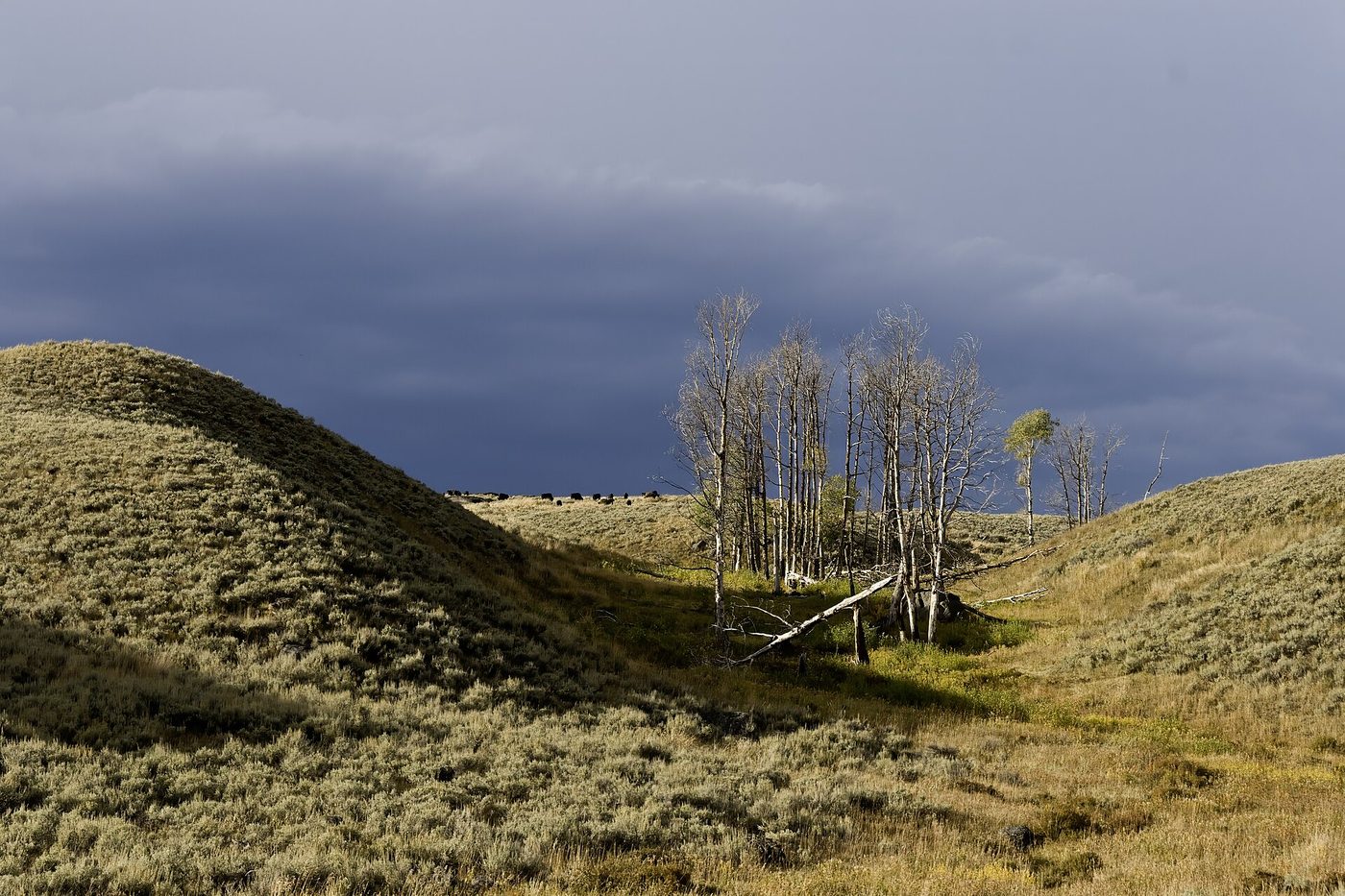
| Summer storms roll across the open hills of the northern range | Acroterion, CC BY-SA 4.0, via Wikimedia Commons |
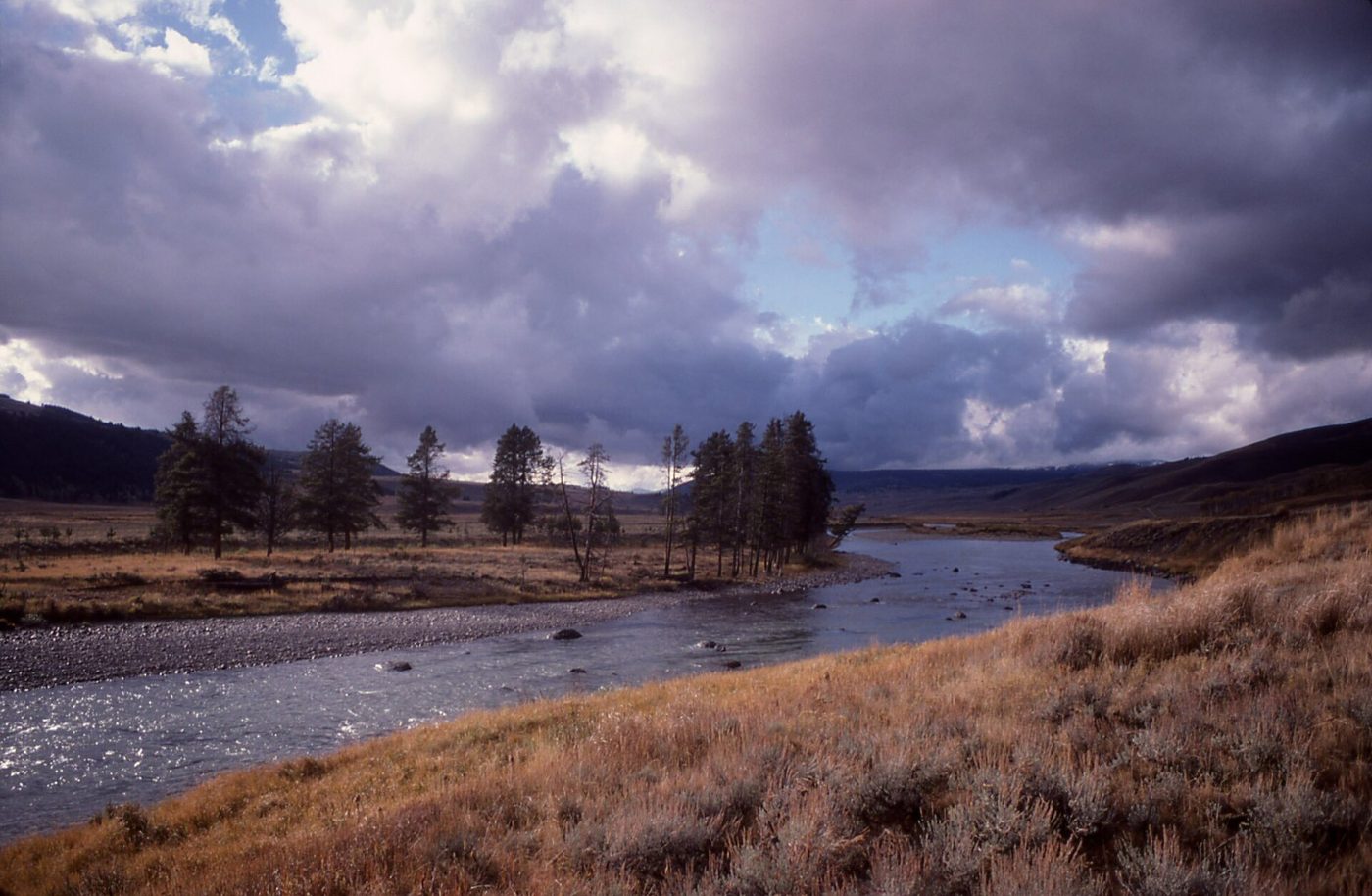
| The Lamar River winds through the valley floor | J. Schmidt, public domain, via Wikimedia Commons |
| Bison use the road as much as the grass | Proudpakistani11, CC BY-SA 4.0, via Wikimedia Commons |
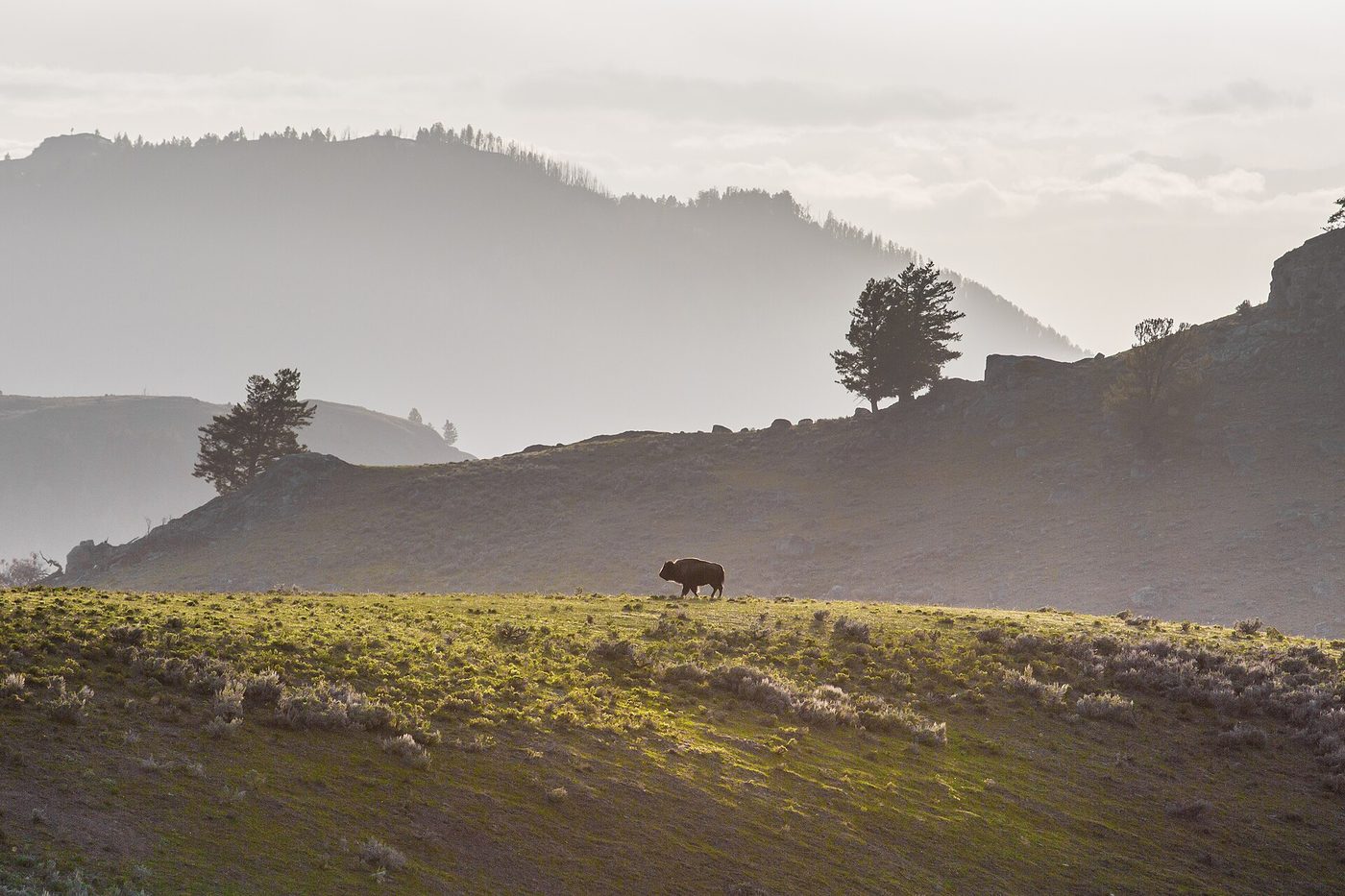
| Early mornings, when the valley is quiet and misty, are the best time for wildlife | Yellowstone National Park from Yellowstone NP, USA, public domain, via Wikimedia Commons |
| Reintroduced wolves arrive through the Roosevelt Arch at the North Entrance in the mid-199 | Yellowstone National Park from Yellowstone NP, USA, public domain, via Wikimedia Commons |
| Soda Butte, beside the road near the east end of the valley | Mike Cline, public domain, via Wikimedia Commons |
| Tower Fall from the overlook; the trail to the base is closed | Greg Willis from Denver, CO, usa, CC BY-SA 2.0, via Wikimedia Commons |
| The fence went up after souvenir hunters destroyed the trees that once stood nearby | Ildar Sagdejev (Specious), CC BY-SA 4.0, via Wikimedia Commons |
| The Lamar Buffalo Ranch, now a Yellowstone Forever field campus | J. Schmidt, public domain, via Wikimedia Commons |
| Hayden Valley’s open grasslands sit on an ancient lakebed | Acroterion, CC BY-SA 4.0, via Wikimedia Commons |
| The Yellowstone River draws swans, pelicans and geese through Hayden Valley | Acroterion, CC BY-SA 4.0, via Wikimedia Commons |