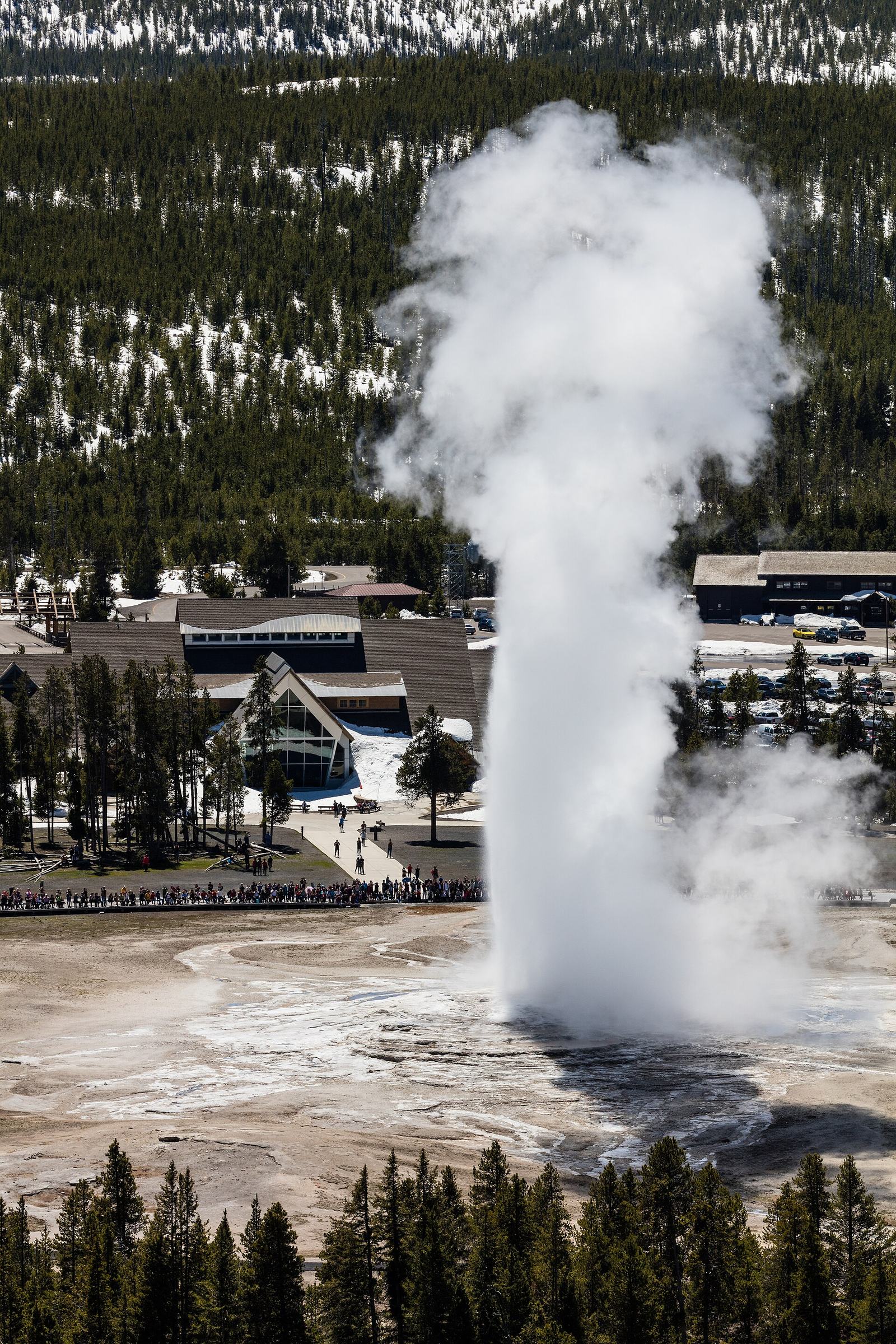
Old Faithful erupts roughly every 102 minutes, sending 3,700 to 8,400 gallons of boiling water 106 to more than 180 feet into the air for one and a half to five minutes. Rangers predict each eruption to within about 10 minutes, so you can plan your day around it, and the mile and a half of boardwalk behind it holds more geysers than anywhere else on Earth.
It’s the most famous sight in the first national park, and probably the most photographed geyser in the world. It isn’t the tallest geyser in Yellowstone, or the most beautiful, and on a July afternoon you’ll share it with a few thousand people. But there’s a reason it has held its place since the Washburn expedition named it in September 1870. It goes off on something close to a schedule, it’s a short walk from the car, and when it erupts on a cold, still morning, with the steam catching the low sun and a few dozen people standing quietly on the benches, it’s still one of the great sights in America.
This guide is the site’s hub for Old Faithful and the geyser basin around it. It covers exactly how often the geyser erupts now (and why so many websites still get it wrong), how predictions work and where to find them, the best places to watch from, how long to spend, a timed plan for the boardwalks, the other predicted geysers worth waiting for, parking and facilities, the best time of day and year, and the status of Biscuit Basin, which has been closed since a hydrothermal explosion in 2024. Lodging at Old Faithful is covered in our lodging in Yellowstone National Park guide, and restaurants in where to eat in Yellowstone.
When does Old Faithful erupt?
Old Faithful erupts roughly every 102 minutes, the NPS’s median interval as of January 2025, with gaps ranging from 54 to 118 minutes. Rangers predict each eruption from the length of the last one, usually to within about 10 minutes, and post it at the visitor center, the lodges and in the NPS App.
Here are the numbers that matter, from the NPS (checked September 2026):
| Fact | Figure |
|---|---|
| Median interval between eruptions | 102 minutes, plus or minus 10 (as of January 2025) |
| Range of intervals | 54 to 118 minutes |
| Eruptions per day | About 14 at the current median (our calculation) |
| Height | 106 to more than 180 feet, averaging 130 feet |
| Duration | 1.5 to 5 minutes |
| Water per eruption | 3,700 to 8,400 gallons |
| Water temperature at the vent | 203°F |
| Prediction accuracy | Usually within about 10 minutes of the posted time |
The practical upshot: if you arrive at a random moment, you’ll wait anywhere from a few minutes to more than an hour and a half. So don’t arrive at a random moment. Check the prediction first, and plan your walk around it. Our guide to Old Faithful eruption times explains how to check today’s predictions from anywhere, and how often Old Faithful erupts goes deeper into the interval and how it has changed.
How Old Faithful eruption predictions work
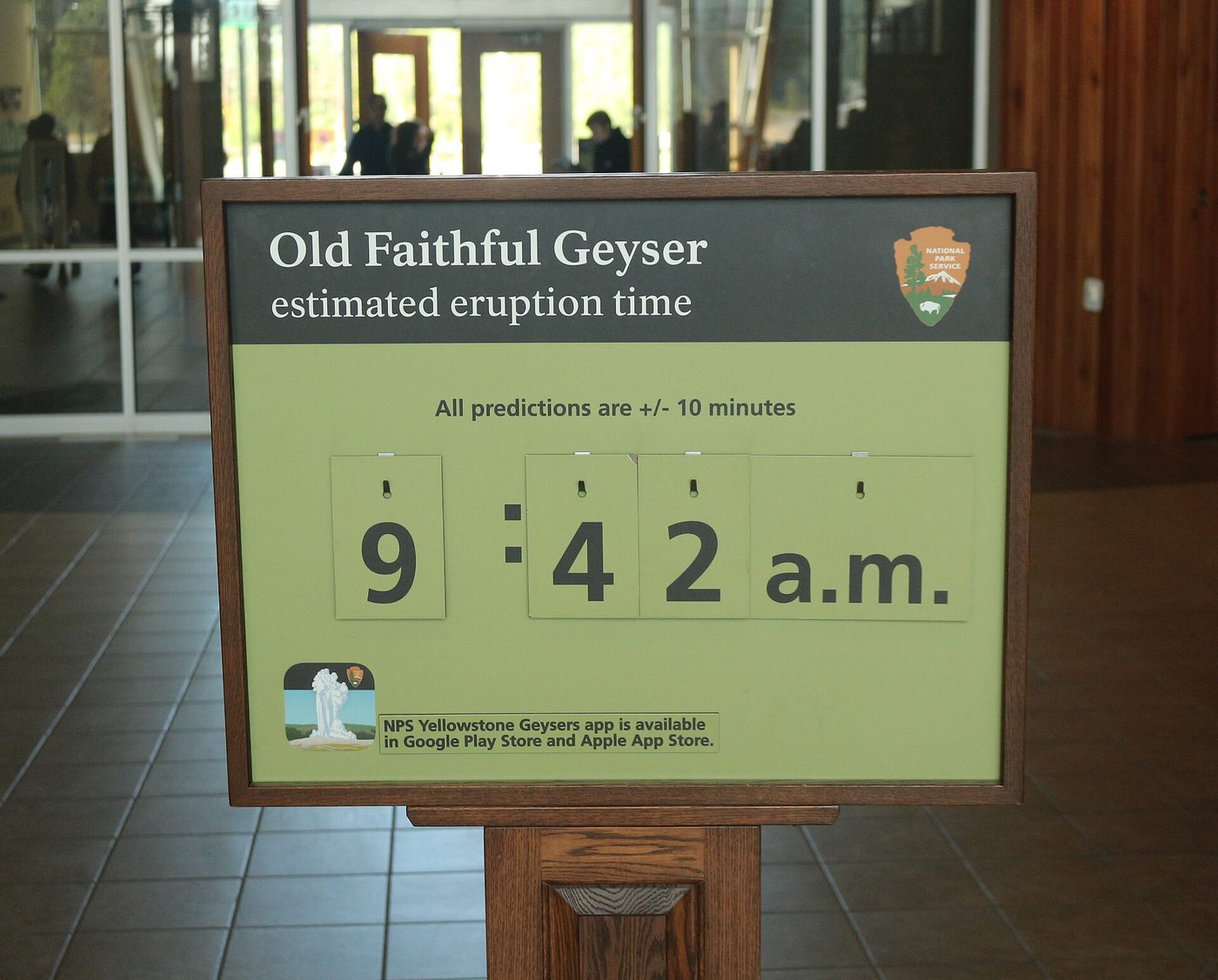
Old Faithful is predictable because of a simple relationship the park has tracked for decades: the length of each eruption tells you how long the geyser will take to recharge before the next one. A long eruption empties more of the underground plumbing, so the next interval is longer; a short eruption leaves more water behind, so the next one comes sooner. Rangers time each eruption, apply the relationship, and post a predicted time for the next.
Where to find the prediction:
- The Old Faithful Visitor Education Center, on a board inside the entrance and on signs around the viewing area.
- The lodges, at the front desks of the Old Faithful Inn, Old Faithful Lodge and Old Faithful Snow Lodge.
- The NPS App, which shows the current predictions for Old Faithful and the other predicted geysers. Download it before you arrive, since cell signal is patchy.
How accurate is it? Usually within about 10 minutes either side of the posted time. That’s why the advice is to be on the benches 10 to 20 minutes early in summer, both to be sure of seeing it and to get a seat.
When predictions aren’t available. Predictions are typically not posted from early November to mid-December and from mid-March to mid-April, when the visitor center is closed between seasons. The geyser keeps erupting, of course; you just have to wait for it the old-fashioned way.
Watching from home. The NPS webcams page carries a livestream of Old Faithful and the Upper Geyser Basin, operated with help from volunteers and partners. It’s a good way to check the weather, or to watch an eruption from wherever you are. See our Old Faithful webcam guide.
Why the numbers you’ve read don’t match
Search for Old Faithful’s interval and you’ll find at least four different answers: 74 minutes, 90 minutes, 92 minutes and 102 minutes. They’re not all wrong; they’re from different years.
- 74 minutes was a widely quoted average decades ago, and some popular sites still repeat it.
- About 90 minutes, “varying from 50 to 127 minutes,” is the figure on an older NPS article, last updated in 2019.
- About 92 minutes is the average given in several reference sources.
- 102 minutes, plus or minus 10, with a range of 54 to 118, is the current NPS median as of January 2025.
The interval changes over time because the geyser’s underground plumbing changes. Earthquakes are a big factor: the 1983 Borah Peak earthquake in Idaho noticeably lengthened Old Faithful’s intervals, and other quakes have nudged them since. Mineral deposits slowly alter the geyser’s internal channels too. The headline hasn’t changed much, since Old Faithful is still reliable enough to predict, but the numbers have. When you see a figure, check the date.
Where is the best place to watch Old Faithful?
The main benches in front of the visitor center give the classic head-on view. For fewer people, try the Old Faithful Inn’s upper deck, the Old Faithful Lodge windows or the boardwalk on Geyser Hill. For the best view of all, walk up to Observation Point, about 1.6 miles round trip.
Here are the viewpoints, ranked by what they offer:
| Viewpoint | What it’s like | Crowds | Best for |
|---|---|---|---|
| Observation Point | A viewpoint on the hill across the Firehole River, looking down on the geyser, the Inn and the basin | Light | The best overall view and photos |
| Old Faithful Inn upper deck | An outdoor deck on the Inn’s upper floor, reached from the lobby mezzanine | Moderate | A drink in hand, a view over the crowd |
| Geyser Hill boardwalk | The boardwalk across the river, looking back at the geyser | Light to moderate | A side-on view with the basin around you |
| Main benches | The semicircle of benches in front of the visitor center | Heavy at midday | The classic view and the best sound |
| Old Faithful Lodge windows | Big windows in the lodge’s main hall | Light | Bad weather, small children, a coffee |
| Snow Lodge area | Views from around the Snow Lodge | Light | Winter |
Our pick: watch one eruption from the benches for the full experience, with the crowd counting down and the roar of the water. Then catch the next from Observation Point, where you’ll see the whole column against the forest and the basin steaming around it. The trail climbs steadily from the Geyser Hill boardwalk, about 1.6 miles round trip from the visitor center, and it’s worth every step. On the way down, the short spur to Solitary Geyser adds a small, frequently erupting geyser most visitors never see.
Our best place to watch Old Faithful guide compares the viewpoints in detail, and the Observation Point trail guide covers the hike.
How long should you spend at Old Faithful?
Plan at least two hours: enough for one eruption plus a walk on Geyser Hill. Half a day adds the walk to Morning Glory Pool and a predicted geyser such as Castle or Grand. A full day, or an overnight stay, is best, because the basin is quietest at dawn and dusk.
Here’s a timed plan for a half day, built around the posted prediction. Call the predicted time “T”:
| Time | What to do |
|---|---|
| T minus 20 minutes | Arrive at the benches in front of the visitor center, or at the Inn deck |
| T | Watch Old Faithful erupt |
| T plus 10 minutes | Cross the Firehole River to the Geyser Hill loop, past Beehive, Anemone and Heart Spring |
| T plus 60 minutes | Walk north along the Firehole to Castle Geyser and the Grand Geyser group |
| T plus 90 minutes | Continue to the Grotto group, Riverside Geyser and Morning Glory Pool, about 1.5 miles from Old Faithful |
| T plus 150 minutes | Walk back along the paved path, via the Daisy Geyser group if it’s due |
| T plus 200 minutes | The next Old Faithful eruption, this time from Observation Point or the Inn’s upper deck |
If you only have two hours: watch the eruption, then walk the Geyser Hill loop and back, and look into the Old Faithful Inn’s lobby.
If you have a full day: add the predicted geysers (see below), lunch at the Inn or a picnic, Black Sand Basin, and an evening eruption at sunset. And if you can, stay the night: see our where to stay at Old Faithful guide.
A full day in the geyser basin
With a whole day, you can build the plan around the big predicted geysers rather than the famous one. A good sequence:
- Early morning: the first eruption from the benches, when there’s frost on the boardwalks and a fraction of the midday crowd, then Geyser Hill while the steam is thick.
- Mid-morning: check the prediction board. If Grand is due in the late morning, head there early, since its window is wide, and bring water and a snack.
- Midday: lunch, then Black Sand Basin, about a mile north, while the main lots are at their busiest.
- Afternoon: Riverside Geyser if it’s due, and Morning Glory Pool, then back along the paved path past the Daisy group.
- Late afternoon: Observation Point for an eruption from above.
- Evening: a last eruption at sunset, and if you’re staying the night, a walk on the boardwalks under the stars.
Most visitors see one eruption. With this plan you’ll likely see four or five, plus two or three other geysers, and you’ll understand why this basin is the heart of the park.
The Upper Geyser Basin walk: Geyser Hill to Morning Glory Pool
Old Faithful sits at the southern end of the Upper Geyser Basin, which holds at least 150 hydrothermal features within one square mile, including the largest concentration of active geysers in the world. A network of boardwalks and paved paths runs north from Old Faithful along the Firehole River to Morning Glory Pool, about 1.5 miles away, with loops and side trails on both banks. Everything is flat, and much of it is paved, so it works with strollers and many wheelchairs. Our Upper Geyser Basin guide has the full map.
Geyser Hill
Right across the river from Old Faithful, a loop of boardwalk climbs a low hill of steaming vents and pools. Highlights include Beehive Geyser, which can erupt more than 100 feet from a small cone and often gives a warning when a small vent beside it, the Beehive Indicator, starts spouting 15 to 20 minutes before; Anemone Geyser, which erupts every few minutes; Plume Geyser; Giantess Geyser, which erupts rarely but violently; and the deep blue Heart Spring. See Beehive Geyser.
Castle and Grand
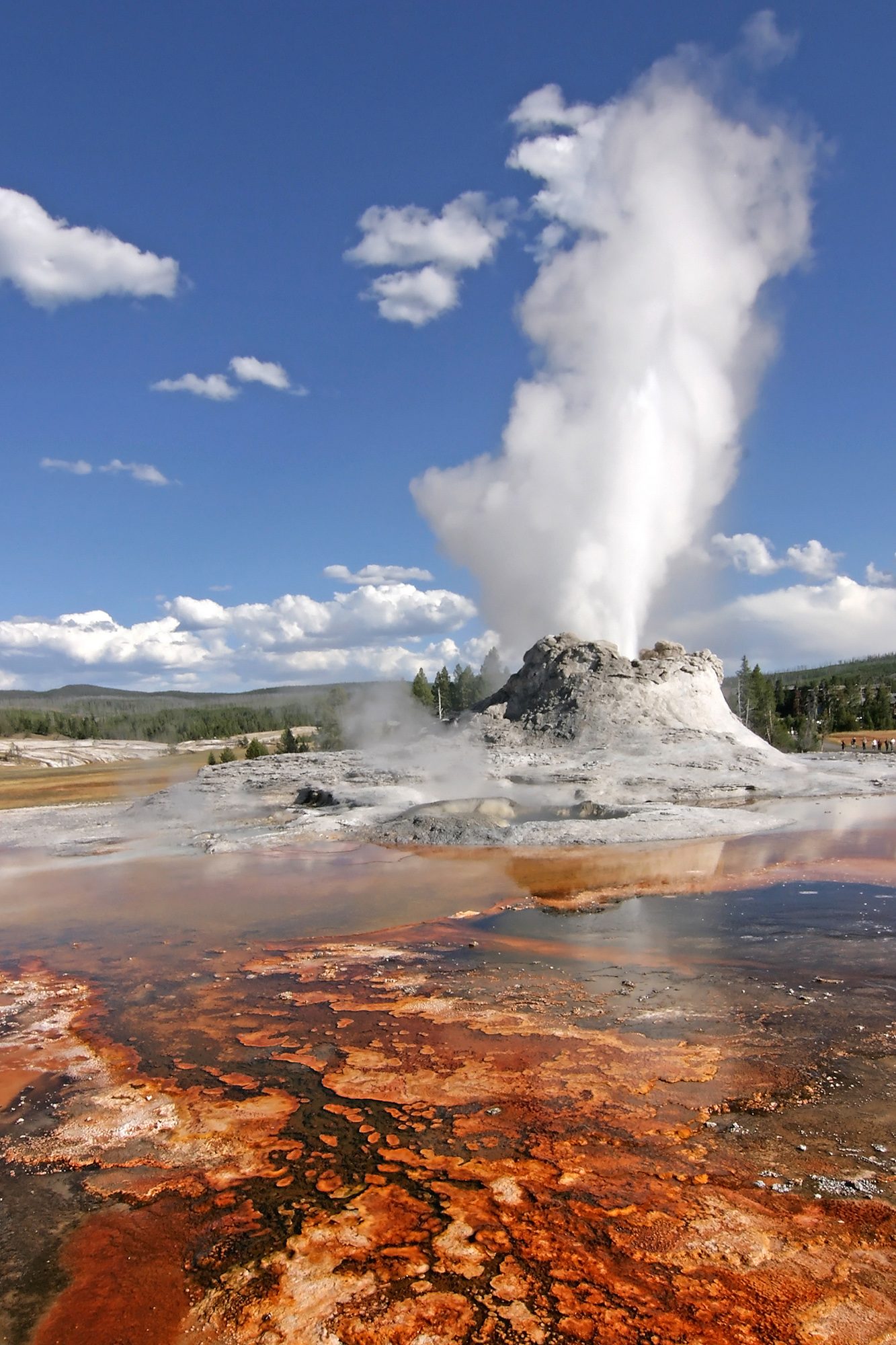
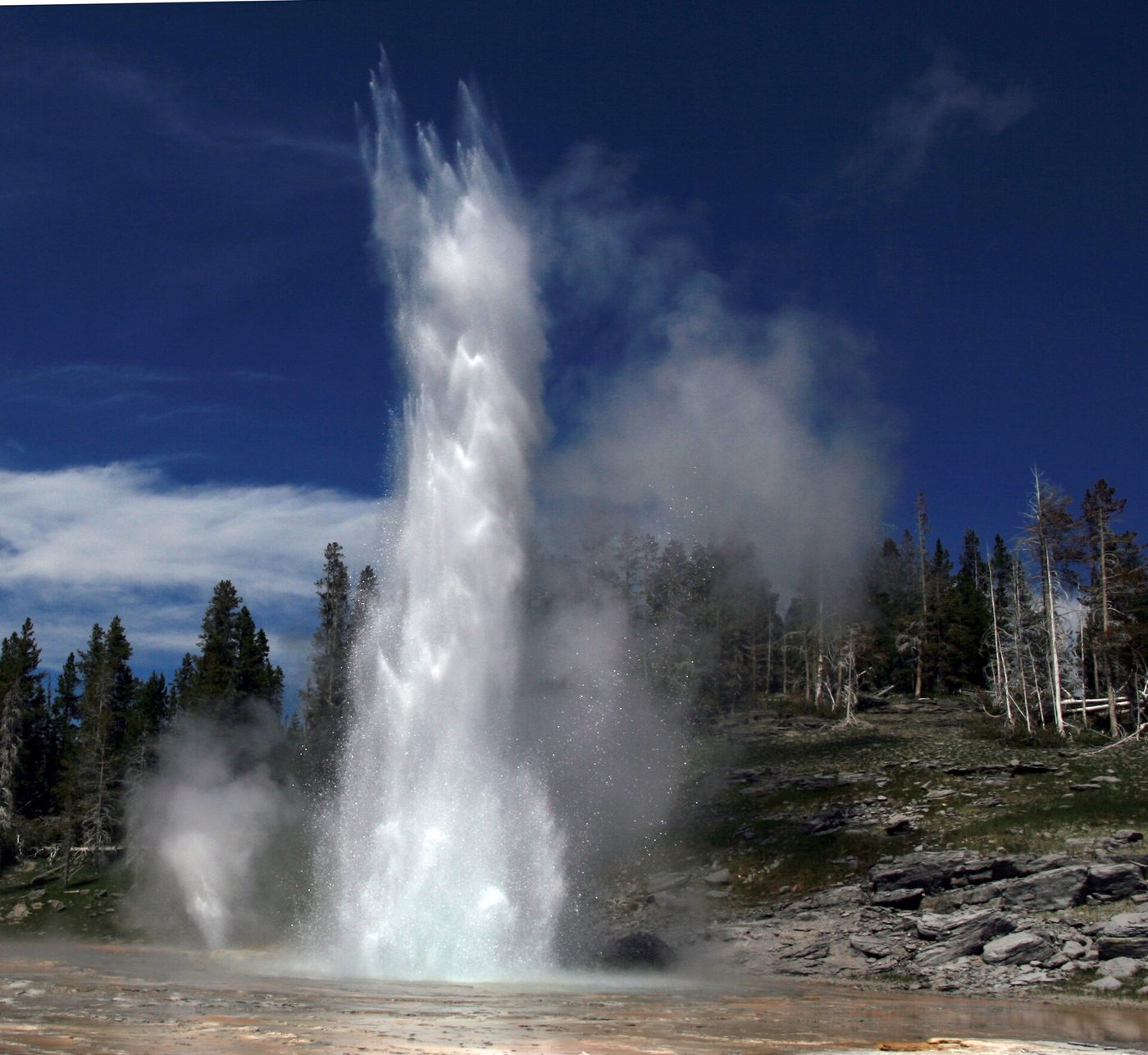
A half mile or so north, Castle Geyser sits on one of the largest and oldest sinter cones in the park. It erupts to about 90 feet in a water phase lasting around 20 minutes, followed by a long, roaring steam phase, and recent records put its cycle at roughly 16 to 17 hours. Just beyond, Grand Geyser is the tallest predictable geyser in the world, bursting up to 200 feet in a series of one to four surges over 9 to 12 minutes, roughly every 6 to 7 hours in recent years. Its prediction window is wide, often a couple of hours, but the wait is part of the fun: when neighboring Turban Geyser, which erupts every 17 to 22 minutes, starts to act up, the crowd leans forward. If Grand is predicted during your visit, it’s worth planning your day around. See Grand Geyser.
Grotto, Giant and Daisy
Further north, Grotto Geyser has one of the strangest cones in the park, formed around tree trunks that were long ago encased in sinter. Nearby, Giant Geyser is one of the largest geysers in the world when it erupts, but it has long, irregular gaps between eruptions, sometimes months or years. See Giant Geyser. On a side loop, Daisy Geyser erupts at an angle to about 75 feet for three or four minutes, typically every two to four hours, and is predicted by rangers.
Riverside Geyser and Morning Glory Pool
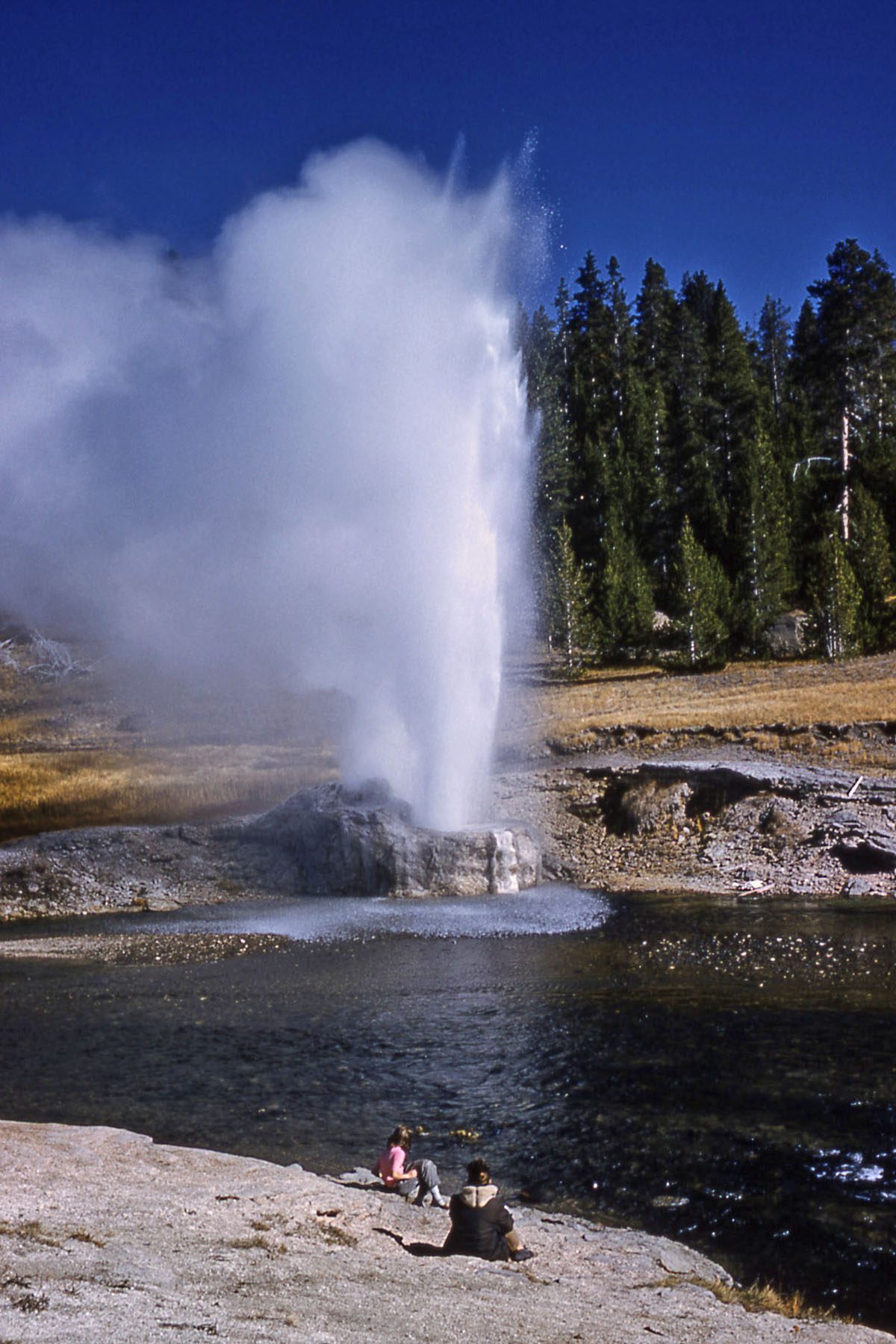
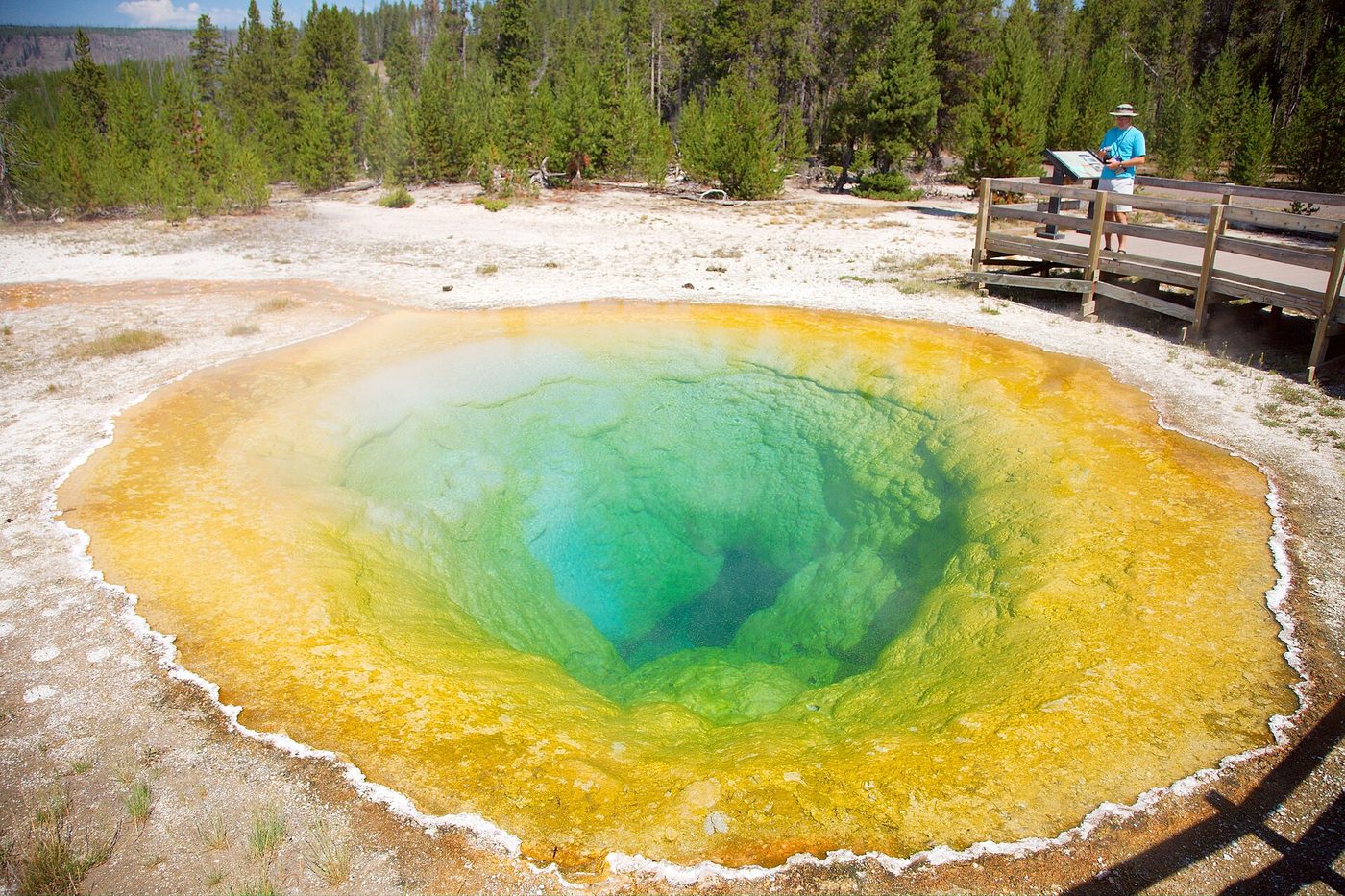
At the northern end, Riverside Geyser arches about 75 feet out over the Firehole River for around 20 minutes, roughly every 5.5 to 7 hours. It’s one of the prettiest eruptions in the park, and its predictions are fairly accurate; watch for water overflowing from its vent an hour or two before. Just beyond is Morning Glory Pool, once the most famous hot spring in the park. Decades of coins, trash and rocks thrown in by visitors have partly blocked its vent, lowering the temperature and letting orange and yellow bacteria creep in toward the center. It’s still beautiful, but not what it was. See Morning Glory Pool.
The other predicted geysers
Old Faithful is one of six geysers the NPS regularly predicts. The others are all worth planning around if their windows fall during your visit. Check the board at the visitor center, the lodges or the NPS App.
| Geyser | Location | Height | Duration | Typical interval |
|---|---|---|---|---|
| Old Faithful | Upper Geyser Basin | 106 to 180+ ft | 1.5-5 min | About 102 minutes (54-118) |
| Grand | Upper Geyser Basin | Up to 200 ft | 9-12 min | About 6-7 hours in recent years |
| Castle | Upper Geyser Basin | About 90 ft | About 20 min water, then steam | About 16-17 hours |
| Riverside | Upper Geyser Basin | About 75 ft, arching | About 20 min | About 5.5-7 hours |
| Daisy | Upper Geyser Basin | About 75 ft, angled | 3-4 min | About 2-4 hours |
| Great Fountain | Lower Geyser Basin | 75 to 200+ ft | Up to an hour or more | Roughly once or twice a day |
The Old Faithful figures are from the NPS (checked September 2026); the others are recent typical values from published geyser records and can change, so always check the current prediction. For the full geyser picture across the park, see our Yellowstone geysers guide.
Black Sand Basin and Biscuit Basin
Just north of the Upper Geyser Basin along the Grand Loop Road are two smaller basins with their own parking lots.
Black Sand Basin is open, a short loop past Emerald Pool, Sunset Lake and Cliff Geyser, which erupts from the bank of Iron Spring Creek. It takes 20 to 30 minutes and is a good stop on the way in or out. See Black Sand Basin.
Biscuit Basin has been closed since a hydrothermal explosion on July 23, 2024, which blasted rock and debris across the boardwalk and parking area. Another hydrothermal explosion hit the area in June 2026, and the basin, its boardwalk and parking lot remain closed until further notice (checked September 2026). The closure also cuts off the usual trailhead for Mystic Falls. Hydrothermal explosions like these happen when water trapped underground flashes to steam, and they’re a reminder that the ground in Yellowstone’s basins is alive. See our Biscuit Basin guide for the latest status.
How hot is Old Faithful? And other facts
The water at Old Faithful’s vent is 203°F, according to the NPS, close to boiling at this altitude. Deeper in the plumbing, it’s hotter still: measurements quoted in reference sources put it at about 244°F at a depth of 72 feet, kept from boiling by the pressure of the water above. Once it’s out in the air, the water cools quickly; monitoring of the water pooled after eruptions has given average temperatures around 170°F. Any of those will scald you instantly, which is why the boardwalks exist.
A few more facts:
- Named in 1870. Members of the Washburn expedition named Old Faithful in September 1870, and it was the first geyser in the park to be named, for its regularity.
- Height. Eruptions range from 106 to more than 180 feet, with an average around 130 feet, according to the NPS.
- Water. Each eruption expels 3,700 to 8,400 gallons.
- Not the tallest. That’s Steamboat Geyser at Norris, the world’s tallest active geyser, which is far less predictable. See Steamboat Geyser.
- Not the only one. A geyser in Calistoga, California, is also called Old Faithful; it’s a different, much smaller geyser.
For more, see our guide to how hot Old Faithful is.
How a geyser works
A geyser needs three things: heat, water and a plumbing system with a constriction in it. Yellowstone has all three in abundance. The heat comes from the magma a few miles beneath the surface, part of the volcanic system that has shaped the region for millions of years. The water comes from rain and snowmelt, which seeps down through cracks in the rock and is heated as it goes. And the plumbing, a network of fissures and chambers lined with a hard mineral called siliceous sinter, or geyserite, holds that water under pressure.
Because of the weight of the water above it, water deep in the system can be heated well past its normal boiling point without turning to steam. Eventually, bubbles of steam form and rise, pushing a little water out of the vent. That small overflow lowers the pressure on the superheated water below, which then flashes violently into steam, expanding more than a thousand times in volume and blasting the water above it into the air. That’s an eruption. When the system has emptied, it slowly refills and reheats, and the cycle starts again.
The shape of the plumbing decides the kind of geyser. Cone geysers, like the one at the center of this guide, erupt in a narrow jet from a mound of sinter. Fountain geysers, like Grand, erupt from pools in a series of bursts. The plumbing also explains why some geysers are regular and others erratic: small changes from earthquakes or mineral deposits can shift the timing of a whole system.
Yellowstone holds about half of the world’s active geysers, more than anywhere else on Earth, because it combines a huge heat source, plenty of water and the right kind of rock. The USGS Yellowstone Volcano Observatory monitors the system continuously, and its website is the best place to learn about the volcano beneath the park. Our Yellowstone geysers guide covers the park’s other geyser basins.
Parking, facilities and getting there
Getting there. The geyser is on the Grand Loop Road, 16 miles south of Madison Junction and 17 miles west of West Thumb. From the West Entrance, it’s about 30 miles, roughly 50 minutes to an hour. From the South Entrance, it’s 39 miles via West Thumb. The area is reached by a large interchange off the main road. Grand Prismatic Spring is about 6 miles north, on the way to Madison; see our Grand Prismatic Spring guide.
Parking. The village has several large parking lots around the visitor center, the Inn, the lodge and the Snow Lodge. They get busy at midday in summer but rarely fill entirely, so this is one of the few big stops where you can arrive at noon and still park. Large RVs have designated spaces.
Facilities. The area around the geyser is a small village, with:
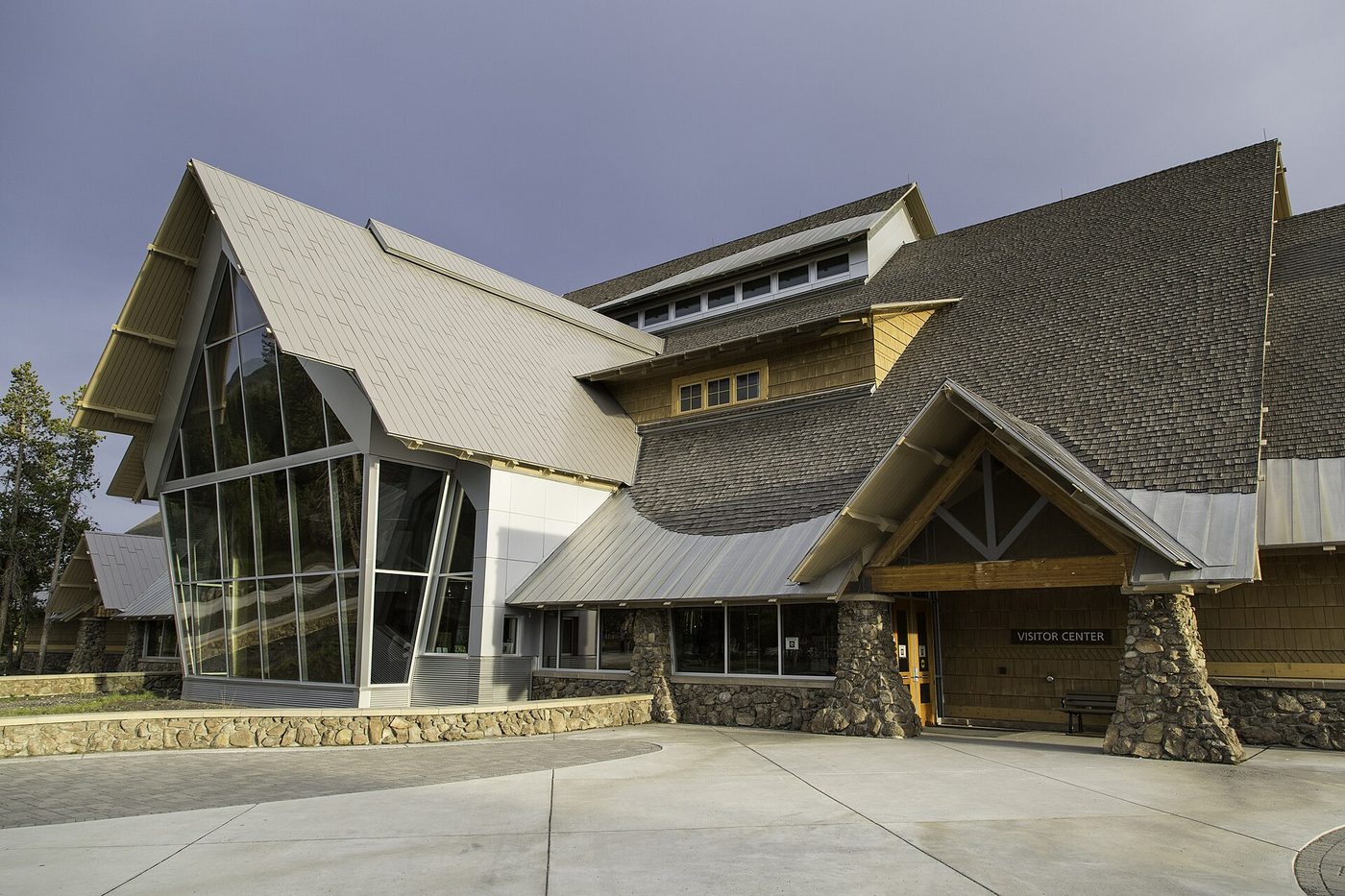
- The Old Faithful Visitor Education Center, open year-round, with exhibits on how geysers work, a film, a bookstore, Junior Ranger programs and the prediction board.
- Three lodges: the historic Inn, the Lodge Cabins and the Snow Lodge. Day visitors are welcome in the Inn’s lobby; see our Old Faithful Inn tour guide.
- Places to eat, from the Inn’s dining room to cafeterias, delis and a bake shop. See where to eat in Yellowstone.
- General stores with groceries, snacks and souvenirs.
- Gas stations, with 24-hour card fueling.
- A medical clinic in summer.
- Restrooms at the visitor center and around the village.
Accessibility. The main viewing area and much of the Upper Geyser Basin are on flat, paved paths and boardwalks, making this one of the most accessible big sights in the park. Observation Point is a steep, unpaved trail.
Best time to visit Old Faithful
Time of day. Early morning and evening are best. Before about 9 a.m. and after 6 p.m. in summer, the benches are far emptier, the light is softer and, on cool mornings, the steam is spectacular. Midday is the worst time for crowds, though the parking is manageable.
Time of year. Summer brings everything open and the biggest crowds. September and early October are our favorite: fewer people, cold mornings with big steam plumes and elk wandering through the basin. Spring can be cold and snowy but quiet. In winter, you can only reach Old Faithful by snowcoach or snowmobile, and the experience is extraordinary.
At night. The geyser erupts through the night, and on a moonlit night, or under the stars, it’s something few visitors see. Predictions usually aren’t posted overnight, so you may have to wait. Bring a headlamp, stay on the boardwalk and watch for bison. See our things to do in Yellowstone at night guide.
Cold, calm mornings give the tallest, clearest steam columns. Warm, windy afternoons give the clearest view of the water column itself. Photographers should try both.
Photography tips for the geyser basin
- Shoot with the light behind or beside the column. Backlit steam glows; front-lit steam can look flat and gray. Early morning from the benches puts the sun to one side, and late afternoon from Observation Point sets the column against the darker forest.
- Use a fast shutter for the water and a slower one for the steam. Around 1/1000 of a second freezes the water column; a longer exposure on a tripod at dusk smooths the steam into a soft plume.
- Frame with people for scale. A line of silhouettes on the boardwalk shows how big an eruption really is.
- Watch the wind. Steam blows downwind, so stand upwind to keep the column clear.
- Protect your gear. Geyser spray carries dissolved minerals that leave spots on lenses and filters. Wipe them promptly.
- Try the other geysers. Castle’s great cone, Riverside’s arch over the river and Grand’s surging bursts make more varied pictures than the main event.
Our Yellowstone photography guide covers light and locations across the park.
Is Old Faithful worth it?
Yes, but not for the reason most people think. The eruption itself is shorter and smaller than Grand Geyser’s, and you’ll share it with a crowd at midday. What makes it worth the trip is everything around it: the densest cluster of geysers on Earth, walkable on flat boardwalks in an afternoon.
Here’s the honest version. If you arrive at 1 p.m. in July, watch one eruption over the heads of a large crowd and drive on, you’ll probably wonder what the fuss is about. That’s how a lot of people see it, and why “overrated” comes up in reviews.
But if you come early or late, watch from Observation Point or the Inn’s deck, walk the Upper Geyser Basin to Morning Glory Pool and catch one of the big predicted geysers like Grand or Riverside, you’ll understand why this is the heart of the world’s first national park. For most visitors, Old Faithful is the anchor of the geyser-basin day in a longer trip; our Yellowstone itinerary shows how to fit it in, and the things to do in Yellowstone guide puts it in context with the park’s other highlights.
Old Faithful in winter
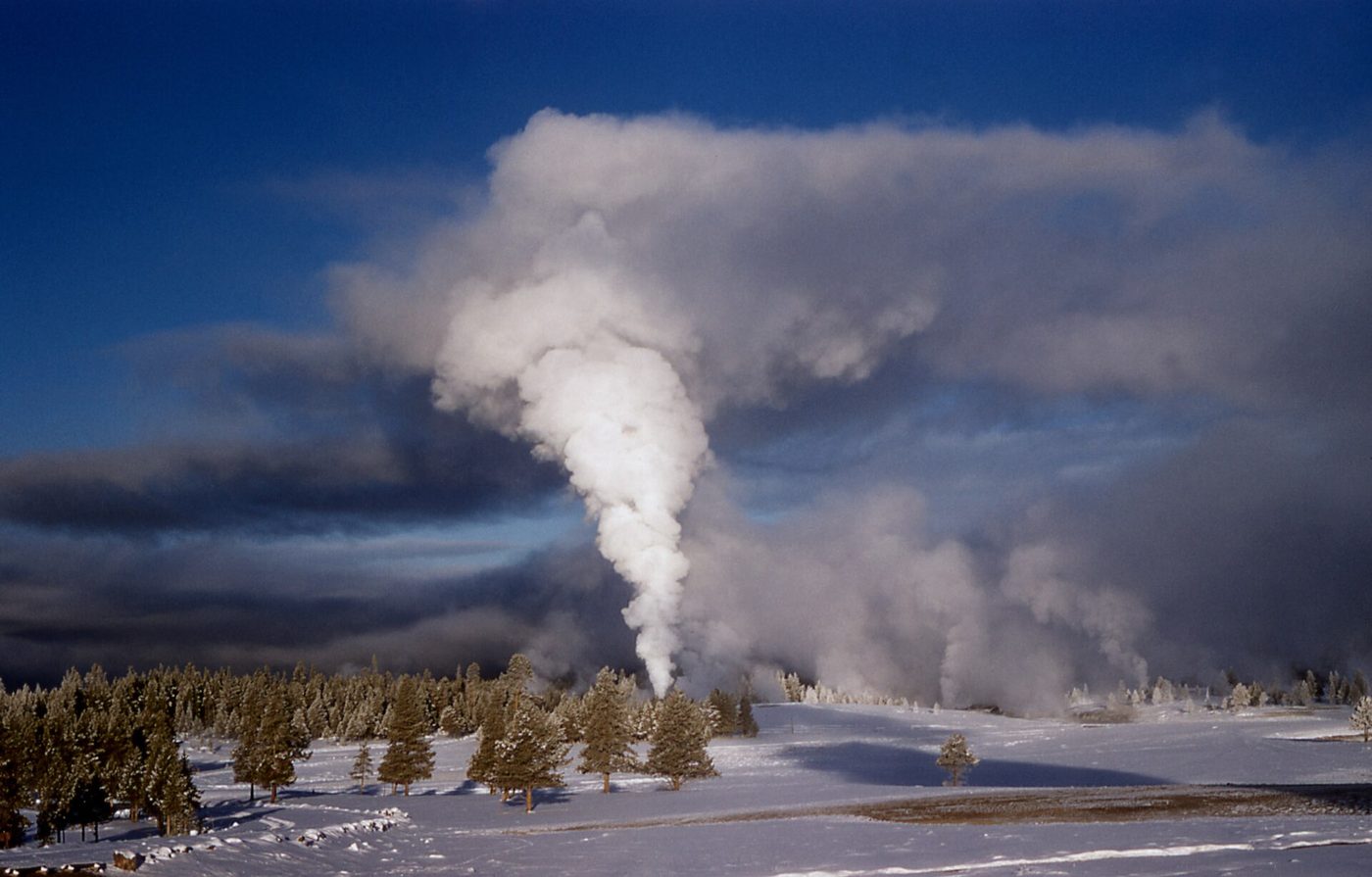
In winter, from mid-December to mid-March, the geyser is reachable only by guided snowcoach or snowmobile, or on skis. The rewards are huge: eruptions into subzero air produce towering steam clouds, frost coats the trees around the basin, bison graze on the warm ground, and you might share an eruption with a dozen people. The Snow Lodge is the only place to stay in the park’s interior in winter, and the visitor education center is usually open. See our Old Faithful in winter and Yellowstone in winter guides.
Staying and eating at Old Faithful
The best way to experience the geyser is to stay overnight, so you can watch eruptions at dawn and dusk when the crowds are gone. The Inn, the Lodge Cabins and the Snow Lodge are all a short walk away, and they book up months ahead in summer. See our lodging in Yellowstone National Park and where to stay at Old Faithful guides. For restaurants, from the Inn’s dining room to a quick sandwich, see where to eat in Yellowstone.
Safety in the geyser basin
The Upper Geyser Basin is beautiful and dangerous. The ground around the hot springs is often a thin crust over boiling water, and people have been badly burned and killed after leaving the boardwalk. A few rules:
- Stay on the boardwalks and marked paths, always, and hold small children’s hands.
- Never touch the water or throw anything into a hot spring or geyser.
- Give bison and elk room. They often walk through the basin and across the boardwalks. Stay at least 25 yards from them, and 100 yards from bears and wolves.
- No pets on the boardwalks.
- Watch for slippery boardwalks in rain, frost and snow.
The full rules, and what to do in an emergency, are on our Yellowstone safety page.
Visiting with kids
The geyser basin is one of the best places in Yellowstone for children, as long as you set the rules before anyone gets out of the car. Pick up a Junior Ranger booklet at the visitor education center, whose exhibits on how geysers work are built for curious hands. Watch an eruption from the benches, where kids can follow the countdown on the prediction board, then walk a short section of Geyser Hill, where Anemone Geyser erupts every few minutes and keeps impatient children happy. Hold small hands on every boardwalk, since most have no railings, and keep strollers well back from the edges. The paved path toward Castle Geyser is easy going for little legs, and there are restrooms at the visitor center and the lodges. For more ideas, see Yellowstone with kids.
Frequently asked questions
How often does Old Faithful erupt?
About every 102 minutes, the NPS median as of January 2025, with intervals from 54 to 118 minutes. That’s about 14 eruptions a day.
How long does an Old Faithful eruption last?
Between one and a half and five minutes, according to the NPS.
How tall is Old Faithful?
Eruptions range from 106 to more than 180 feet, averaging about 130 feet.
Where can I find Old Faithful eruption times?
At the Old Faithful Visitor Education Center, at the front desks of the Old Faithful lodges, and in the NPS App. Predictions are usually accurate to within about 10 minutes. They’re typically not posted from early November to mid-December and mid-March to mid-April.
Can you see Old Faithful at night?
Yes. It erupts around the clock, though predictions usually aren’t posted overnight. Bring a headlamp and stay on the boardwalk.
Is Old Faithful free to see?
Yes, once you’ve paid the park entrance fee. There’s no extra charge to watch the geyser or walk the boardwalks. See our Yellowstone entrance fee guide.
How far is Old Faithful from Grand Prismatic Spring?
About 6 miles, a 10- to 15-minute drive north on the Grand Loop Road, though parking at Grand Prismatic can add much more in summer.
Is Biscuit Basin open?
No. Biscuit Basin has been closed since a hydrothermal explosion in July 2024, and another explosion hit the area in June 2026. It remained closed as of September 2026.
Can you drive to Old Faithful in winter?
No. From mid-December to mid-March, you can reach Old Faithful only by guided snowcoach or snowmobile, or on skis.
What is the Upper Geyser Basin?
It’s the area around the famous geyser, stretching about 1.5 miles north along the Firehole River to Morning Glory Pool. It holds at least 150 hydrothermal features in about a square mile, including the largest concentration of active geysers in the world.
Why is Morning Glory Pool changing color?
Coins, trash and rocks thrown in by visitors have partly clogged its vent, lowering the water temperature. Cooler water lets orange and yellow heat-loving bacteria spread toward the center, dulling the famous blue.
Sources
- National Park Service, Yellowstone: explore Old Faithful, webcams and livestream, visitor centers, current conditions
- USGS Yellowstone Volcano Observatory: Yellowstone hydrothermal activity
Image credits
| Photo | Credit |
|---|---|
| An eruption seen from Observation Point, with the Old Faithful village and the crowd on th (top of page) | Yellowstone National Park, public domain, via Wikimedia Commons |
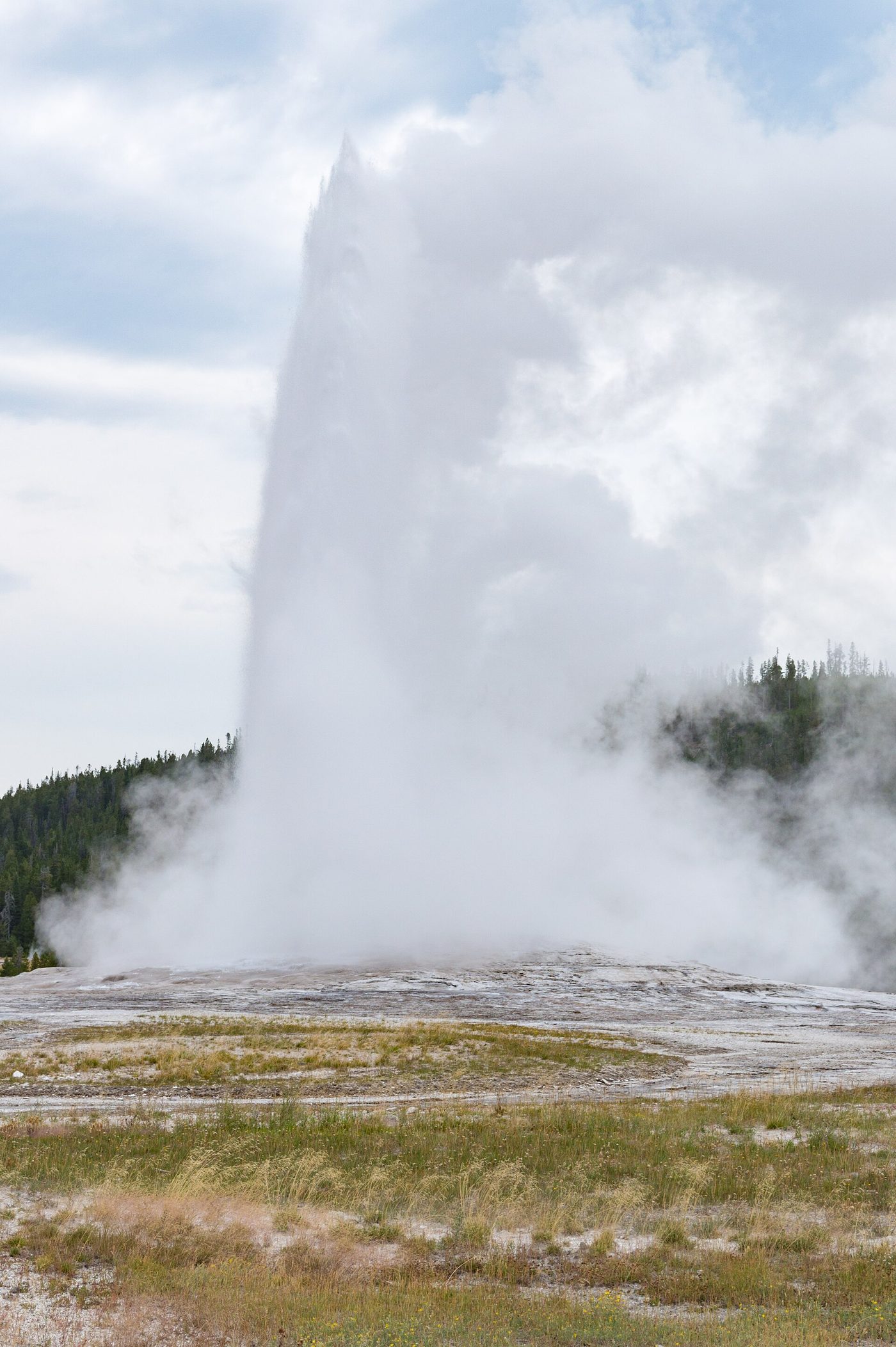
| Eruptions last one and a half to five minutes and average about 130 feet | Supercarwaar, CC BY-SA 4.0, via Wikimedia Commons |
| Castle Geyser, on one of the oldest cones in the basin, a short walk north of Old Faithful | user: Flicka, Edited (Sharpening – Downsampled) by Arad Mojtahedi., CC BY-SA 3.0, via Wikimedia Commons |
| Grand Geyser, the tallest predictable geyser in the world, with Vent Geyser erupting along | Brocken Inaglory, CC BY-SA 3.0, via Wikimedia Commons |
| Riverside Geyser in 1959, arching over the Firehole just as it still does today | NPS/Haselton, public domain, via Wikimedia Commons |
| Morning Glory Pool, 1.5 miles from Old Faithful; debris thrown in by visitors has cooled i | User:MatthiasKabel, CC BY-SA 3.0, via Wikimedia Commons |
| The Old Faithful Visitor Education Center, where each eruption prediction is posted | Yellowstone National Park from Yellowstone NP, USA, public domain, via Wikimedia Commons |
| Castle Geyser’s steam phase on a winter day, when every plume doubles in size | McClelland, public domain, via Wikimedia Commons |