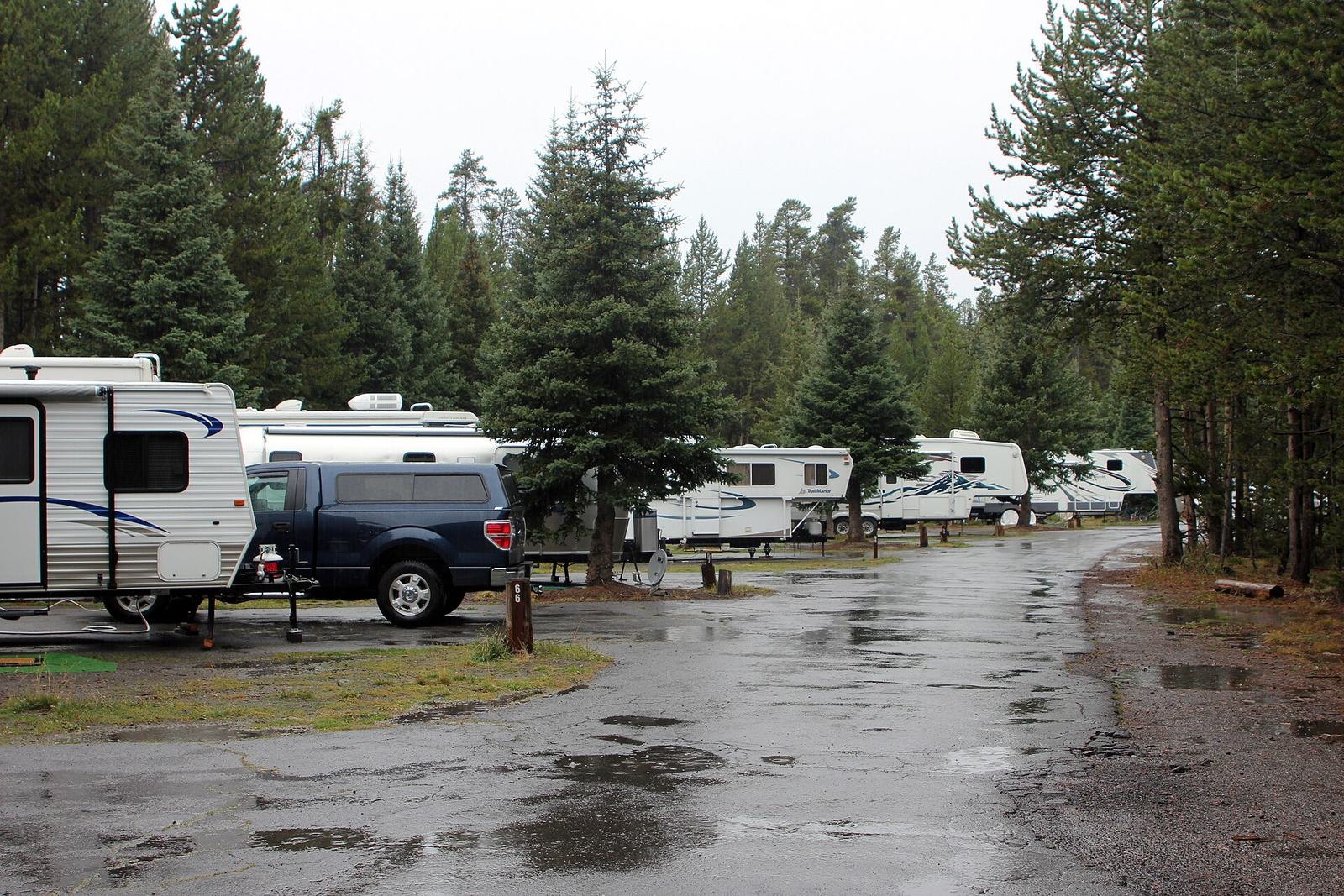
Yellowstone RV camping comes down to a short list. One park inside Yellowstone has full hookups — Fishing Bridge RV Park, hard-sided rigs only, up to 95 feet. Four more campgrounds take rigs of 40 to 60 feet with no hookups at all. Everything else inside the boundary tops out between 25 and 45 feet, and several of those sites are a tight squeeze for anything longer than a van.
That is the whole in-park picture, and it is the part most guides skate over. The rest of this page covers what the length limits really mean on the ground, how booking changes for the 2027 season, where the dump stations are, which gateway RV parks work for each entrance, and whether bringing a motorhome is the right call for your trip at all. Prices and dates below were checked in September 2026 against the National Park Service and the park concessioner.
Three ways to do it
Every RV trip to Yellowstone is one of three setups, and choosing between them early saves a lot of rebooking later.
Stay in the park with hookups. That means Fishing Bridge RV Park on the north shore of Yellowstone Lake, and only Fishing Bridge. It is $94 plus tax a night for 2026, hard-sided vehicles only, and it books out almost as fast as the lodges.
Stay in the park without hookups. Bridge Bay, Canyon, Grant Village and Madison all take large rigs and all run on your own batteries, generator and water tank. Madison is the best base for the geyser basins; Bridge Bay is the biggest; Canyon puts you closest to the Grand Canyon of the Yellowstone and Hayden Valley.
Stay outside and drive in. West Yellowstone, Gardiner, Cody and Jackson all have commercial RV parks with full hookups, laundry, showers and reliable cell service. You pay for that in windshield time — 30 minutes to Madison Junction from West Yellowstone, and well over an hour from most gateway towns to the middle of the park.
Most people who bring a big rig end up doing a mix: a few nights in the park to get early-morning access to the wildlife valleys, a few nights outside to dump, fill, do laundry and reconnect. That is a perfectly sensible plan and it is the one we would recommend to a first-timer.
For the full campground picture, including tent sites and the small northern campgrounds, see camping in Yellowstone. This page stays on the RV side of it.
Where can you camp with an RV inside Yellowstone?
Ten of the park’s campgrounds accept RVs, but only five accept large ones. Fishing Bridge RV Park (95 feet, full hookups), Bridge Bay and Madison (60 feet), Grant Village (50 feet) and Canyon (40 feet) are the realistic options for anything over about 35 feet. The remaining campgrounds cap out at 25 to 45 feet with narrow, wooded, often sloping sites.
The split matters for more than length. The five larger campgrounds are run by the park concessioner and reserved through their system for 2026; the smaller ones are run by the National Park Service and reserved through Recreation.gov. The larger ones have dump stations, allow generators and sit near services. The smaller ones have neither dump stations nor generator privileges, and several have vault toilets rather than flush.
Pebble Creek has been closed since the 2022 floods and the National Park Service says it will remain closed until further notice. Norris was not offered for the 2026 summer season. If you are working from an older guide or a blog post that still lists those two, the guide is stale — which, as of our September 2026 check, described a fair number of the pages ranking for this topic.
Yellowstone RV campgrounds at a glance
Everything below was checked against the National Park Service campgrounds page in September 2026. Fees exclude Wyoming lodging tax. Dates are 2026 dates and shift a little year to year, so confirm before you book.
| Campground | Sites | 2026 season | Nightly fee | Max RV | Hookups | Dump station | Generators |
|---|---|---|---|---|---|---|---|
| Fishing Bridge RV Park | 310 | May 8 – Oct 17 | $94 + tax | 95 ft | Full (water, sewer, 50 amp) | Yes | Yes |
| Bridge Bay | 431 | May 15 – Sep 13 | $38 + tax | 60 ft | None | Yes | Yes |
| Madison | 276 | May 1 – Oct 17 | $38 + tax | 60 ft | None | Yes | Yes |
| Grant Village | 429 | Jun 26 – Sep 26 | $45 + tax | 50 ft | None | Yes | Yes |
| Canyon | 272 | May 29 – Sep 19 | $45 + tax | 40 ft | None | Yes | Yes |
| Mammoth | 82 | Year-round | $25 | 45 ft summer / 30 ft Oct–Apr | None | No | No |
| Indian Creek | 70 | Jun 12 – Sep 14 | $20 | 35 ft | None | No | No |
| Slough Creek | 16 | Jun 15 – Oct 12 | $20 | 30 ft | None | No | No |
| Tower Fall | 31 | May 22 – Sep 27 | $20 | 30 ft | None | No | No |
| Lewis Lake | 84 | Jun 15 – Oct 11 | $20 | 25 ft | None | No | No |
| Pebble Creek | 27 | Closed | — | — | — | — | — |
A few things worth pulling out of that table. Madison opens on May 1 and closes on October 17, which makes it the longest in-park season outside Mammoth and Fishing Bridge — useful if you are travelling in the shoulder months. Grant Village does not open until late June, so it is no help on an early-summer trip. And Mammoth is the only campground open all year, at a 30-foot limit through the winter, which is the entire answer to “can I take an RV to Yellowstone in January.”
Fishing Bridge RV Park: the only full hookups in the park
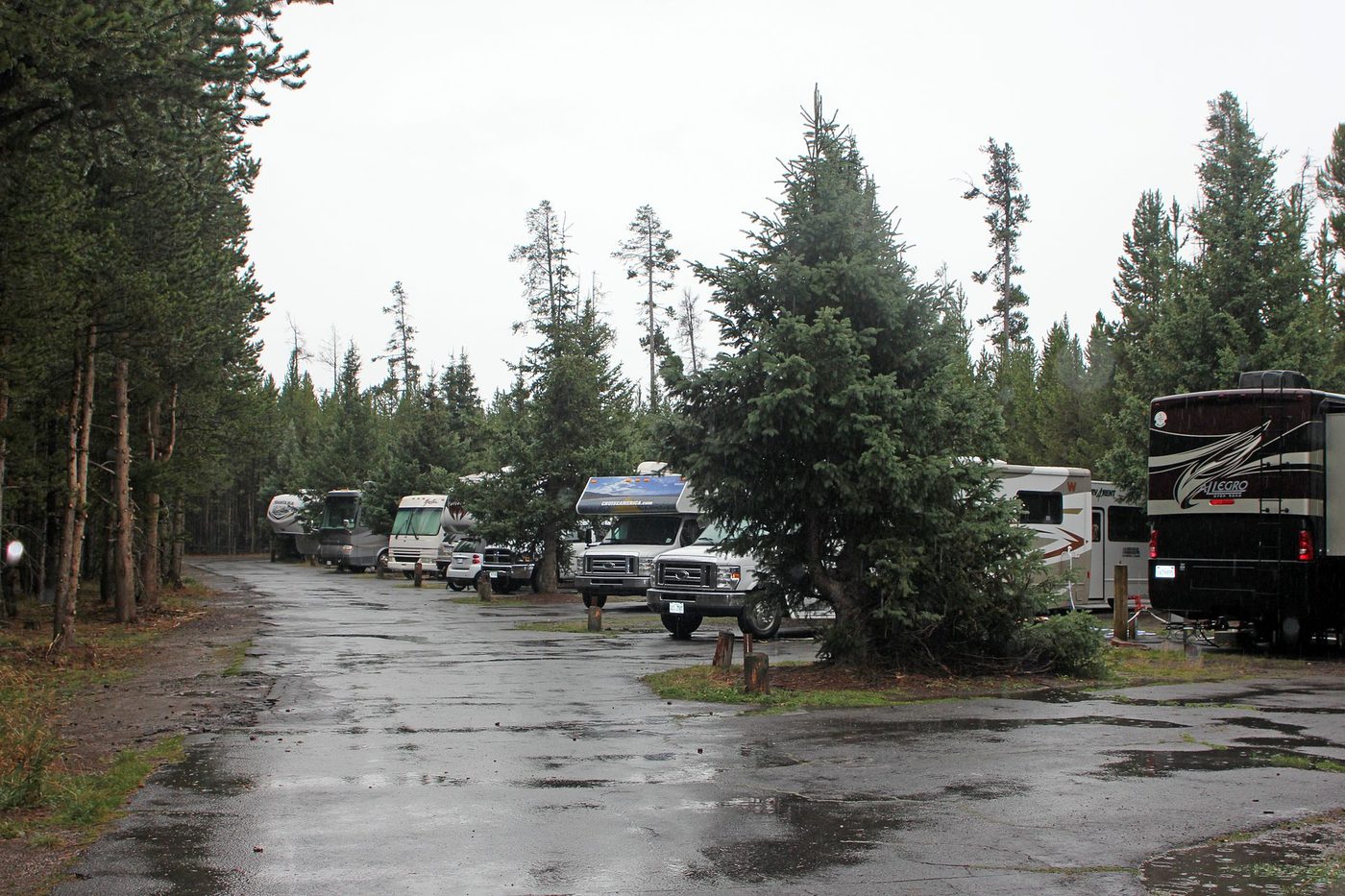
Fishing Bridge is a genuine RV park rather than a campground with RVs squeezed into it. Sites are back-in and pull-through, paved, with water, sewer and 50-amp electric at each one. The facility came out of a multi-year rebuild with larger sites, a new dump station and recycling area, more showers and laundry in an expanded registration building.
The hard-sided rule is not a suggestion. Tents, tent-trailers and pop-ups with canvas sides are not permitted here, because this is grizzly country on the shore of Yellowstone Lake and the rule exists for a reason. If your camper has soft walls that fold out, you need a different campground.
At $94 plus tax for 2026 it is the most expensive campsite in the park by a wide margin — nearly four times a Madison site and roughly what you would pay at a good commercial park in West Yellowstone. What you get for the difference is sewer at the site, a location in the middle of the loop that puts Hayden Valley, the lake and the canyon all within half an hour, and no generator noise because nobody needs a generator.
The catch is availability. Three hundred and ten sites sounds like a lot until you understand that in-park lodging and camping release on a 13-month rolling window and the popular July and August dates disappear on the morning they open. There is more detail, including a site-by-site read on which loops are worth asking for, on our Fishing Bridge RV Park page.
Does Yellowstone have RV hookups anywhere else?
No. Fishing Bridge RV Park is the only place inside Yellowstone with water, sewer or electric at the site. Every other campground in the park is dry camping — you arrive with a full fresh tank and empty grey and black tanks, and you leave when one of the three runs out. Plan on three to five days for most rigs with careful use.
That surprises people who have camped in state parks or at commercial resorts, where a 30-amp pedestal is standard. It also drives the single most common planning mistake we see: booking five nights at Madison in a 34-foot Class A with two teenagers and no idea how much water a daily shower actually consumes.
Dry camping in Yellowstone is entirely manageable if you go in expecting it:
- Water. Fill before you enter. Potable water is available at the developed campgrounds and service areas, but filling a 60-gallon tank from a campground spigot is slow and not always permitted at the site.
- Power. Generators are allowed at the five large campgrounds during posted daytime hours only, and prohibited outright at Mammoth, Indian Creek, Lewis Lake, Slough Creek and Tower Fall. A decent solar setup or a big lithium bank changes the trip more than any other upgrade.
- Waste. Dump stations sit at Bridge Bay, Canyon, Fishing Bridge, Grant Village and Madison. They close when temperatures drop below freezing, which in Yellowstone can mean any month of the year.
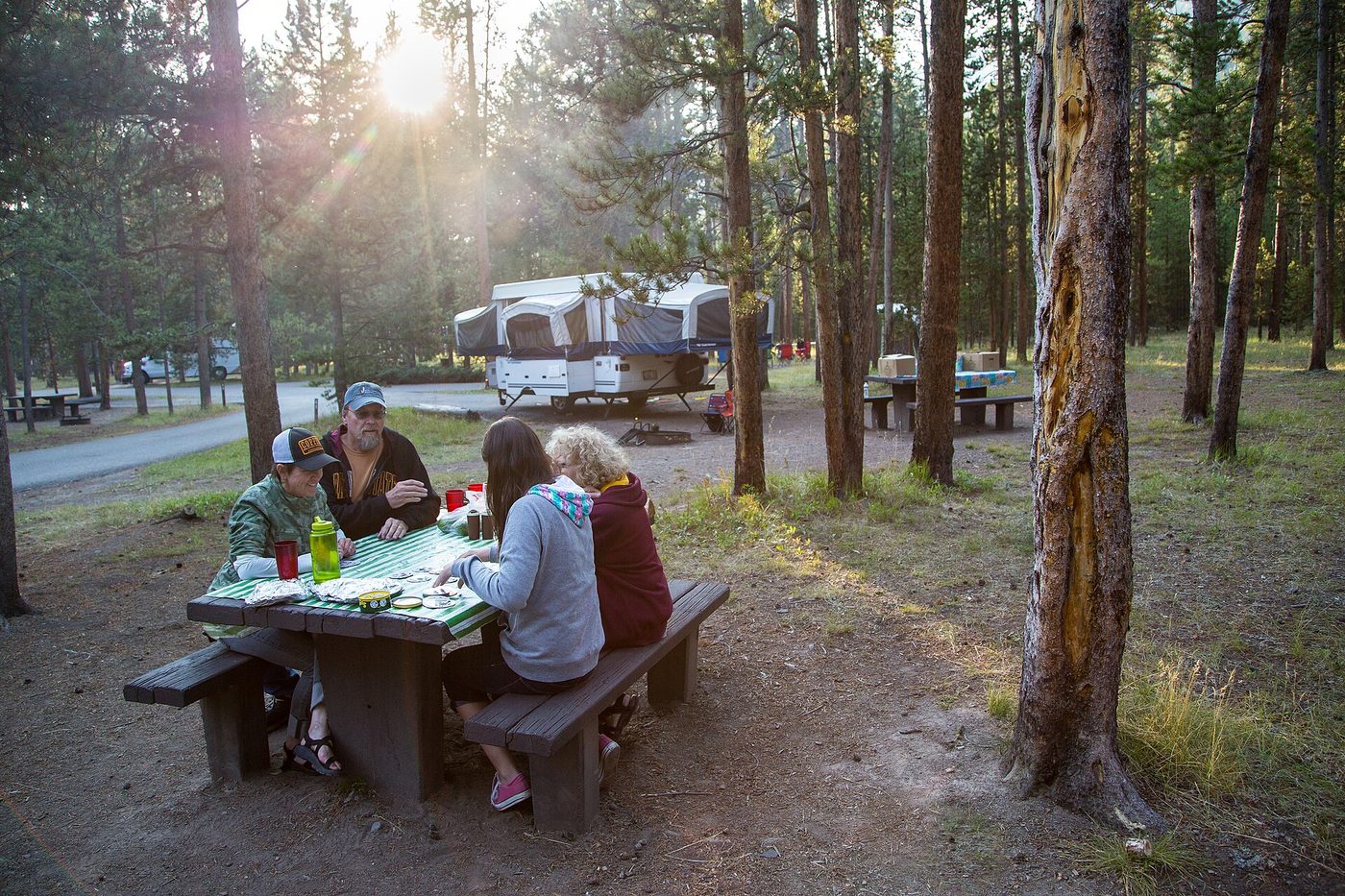
- Cold. Overnight lows in the campgrounds run into the 30s °F in June and September, and the 20s at the shoulders. Propane consumption goes up accordingly.
Length limits, and why the posted number is not the number that matters
The maximum length in the table is the length of the longest site in that campground, not a promise that the site will be available or that you will enjoy getting into it. Two numbers matter more.
The first is your combined length. A 32-foot travel trailer behind a long-bed crew cab is a 55-foot combination, and that is what has to fit. Many campgrounds will ask you to unhitch, which is fine, but the approach road and the turn into the loop still have to accommodate the whole thing on the way in.
The second is the turn, not the site. Tower Fall is the classic example: a 30-foot limit that exists because the approach includes a hairpin on the Tower–Canyon road that has embarrassed a lot of drivers. Lewis Lake’s 25 feet reflects tight, wooded sites rather than the road. Slough Creek’s 30 feet comes with two miles of washboard gravel that will rattle the cupboards out of a lightly built rig.
Our honest rule of thumb, by combined length:
| Combined length | What works | What to avoid |
|---|---|---|
| Under 25 ft (van, small Class C) | Anything in the park, including Slough Creek and Lewis Lake | Nothing, really — this is the sweet spot |
| 25–35 ft | All five large campgrounds, Mammoth in summer, Indian Creek | Lewis Lake, Slough Creek’s gravel |
| 35–45 ft | Fishing Bridge, Bridge Bay, Madison, Grant, Canyon at the top end | Every NPS-run campground; Tower Fall’s hairpin |
| 45–60 ft | Fishing Bridge, Bridge Bay, Madison | Canyon, Grant, all small campgrounds, the North Entrance road in 2026 |
| Over 60 ft | Fishing Bridge only, or a gateway park | Everything else |
We go deeper into the site-by-site measurements, including which loops at Bridge Bay and Madison actually hold a long rig, on Yellowstone RV length limits.
How do you book an RV site in Yellowstone?
For the 2026 season, Bridge Bay, Canyon, Grant, Madison and Fishing Bridge RV Park are reserved through the park concessioner on a 13-month rolling window: on the 5th of each month, the same month of the following year opens, online at midnight Mountain Time and by phone from 7:00 a.m. The five National Park Service campgrounds open on Recreation.gov exactly six months before the date of your stay.
That is about to change, and the change is the single most useful thing on this page if you are planning a 2027 trip.
From the 2027 summer season, Bridge Bay, Canyon, Grant, Madison and Fishing Bridge RV Park move to Recreation.gov, with reservations opening approximately six months ahead rather than thirteen. Fishing Bridge will also allow reserving individual sites rather than a site type. Practically, that means the 13-month scramble goes away and is replaced by a six-month one, and that a July 2027 stay will open in roughly January 2027 rather than June 2026.
Three consequences worth planning around:
- Do not sit on a 2026 booking habit. If you have booked Yellowstone before, the date you have in your head is wrong for 2027.
- Set an alarm for the release, not the day after. Six-month windows on Recreation.gov for popular national park campgrounds clear in minutes, not hours.
- Use a cancellation alert service. Sites open up constantly as plans change, and a watch tool will find them faster than you will refreshing by hand.
All campsites must be reserved in advance during the summer. The one exception is Mammoth, which runs first-come, first-served from October 15 to April 1. Booking rules for the lodges themselves are a separate matter and live on our Yellowstone lodging page.
Driving an RV on Yellowstone’s roads
Yellowstone’s Grand Loop is 142 miles of two-lane road with no shoulder in long stretches, blind curves above rivers, and traffic that stops dead without warning because somebody spotted a bison. Add a 35-foot box with a 30-mph crosswind and it becomes real work. None of this is a reason not to bring an RV. It is a reason to plan shorter driving days than you would in a car.
Assume 30 to 35 mph average across the park, not the 45-mph speed limit. Madison to Old Faithful is 16 miles and will take 40 minutes on a July afternoon. Canyon to Lamar Valley looks like an easy hop on the map and is an hour and a half with Dunraven Pass in the middle — a steep, exposed climb with switchbacks where a heavy rig will be in low gear both directions.
Specific hazards for a large vehicle:
- Dunraven Pass (Tower–Canyon): 8,859 feet, tight curves, long descents. Use engine braking; do not ride the service brakes down.
- Sylvan Pass (East Entrance road): steep and exposed, with avalanche closures at the shoulders of the season.
- The Gardner River High Bridge on the North Entrance road: single lane with delays up to 15 minutes around the clock from April 13 to late October 2026, and — critically — closed to vehicles 8 feet 6 inches or wider, or 75 feet or longer. If you are running a wide-body coach or a long combination, the North Entrance is not your entrance in 2026.
- Chip sealing and bridge work elsewhere on the loop, with delays up to 30 minutes.
Road construction and seasonal openings change every year, sometimes mid-season. Check Yellowstone road closures before you finalise a route, and again the week you travel. Our full treatment of the driving side, including parking strategy at Old Faithful and Midway Geyser Basin, is on driving an RV in Yellowstone.
One more thing about parking. The big pullouts at the popular thermal areas fill by 9:00 a.m. in July and a 35-foot rig cannot use an ordinary car space. The practical answer is either to arrive before 8:00, to tow a car and leave the rig at the campground, or to accept that you will see the famous stops in the late afternoon. Visitors who bring a toad or a motorcycle almost universally say it was the right decision.
Dump stations, water, propane and power
Dump stations inside the park are at Bridge Bay, Canyon, Fishing Bridge, Grant Village and Madison. They close when temperatures fall below freezing, which is worth knowing in May and late September. There is no dump station at Mammoth or at any of the small northern campgrounds, so if you are camped at Slough Creek or Tower Fall your nearest option is Canyon, about an hour away, or Gardiner outside the North Entrance.
Gateway towns all have commercial dump stations, and several accept non-guests for a fee — Yellowstone Grizzly RV Park in West Yellowstone, for instance, charges $30 for a dump and $10 for a water fill if you are not staying there (checked September 2026). That is a reasonable emergency option and a poor daily plan.
Propane is available in the gateway towns rather than reliably inside the park. Gas stations inside the park operate at Canyon, Fishing Bridge, Grant, Mammoth, Old Faithful and Tower Junction, with 24-hour card fuelling available year-round, but fuel prices in the park run well above what you will pay in Bozeman or Cody. Fill outside if you can — on a 60-gallon tank that gap is real money.
Full details, including hours and the outside-the-park alternatives by entrance, are on Yellowstone RV dump stations.
Generators, quiet hours and living without hookups
Generators are permitted at Bridge Bay, Canyon, Fishing Bridge, Grant Village and Madison during posted daytime hours, and are not permitted at all at Mammoth, Indian Creek, Lewis Lake, Slough Creek and Tower Fall. Quiet hours run overnight at every campground and they are enforced, both by camp hosts and by your neighbours, who came to a national park partly for the quiet.
If you are dry camping for more than two nights, the equation is simple:
- A 200-watt solar panel and a 100 Ah lithium battery will run lights, water pump, fans and phone charging indefinitely in a Yellowstone summer.
- Air conditioning needs shore power or a generator, full stop. In practice you rarely want it. Campground elevations run from 6,200 feet at Mammoth to 7,800 at Grant, and nights are cold.
- Furnace draw is the sleeper problem. A propane furnace blower on a 35 °F night will flatten a small battery bank by morning. Down bedding is lighter than a second battery.
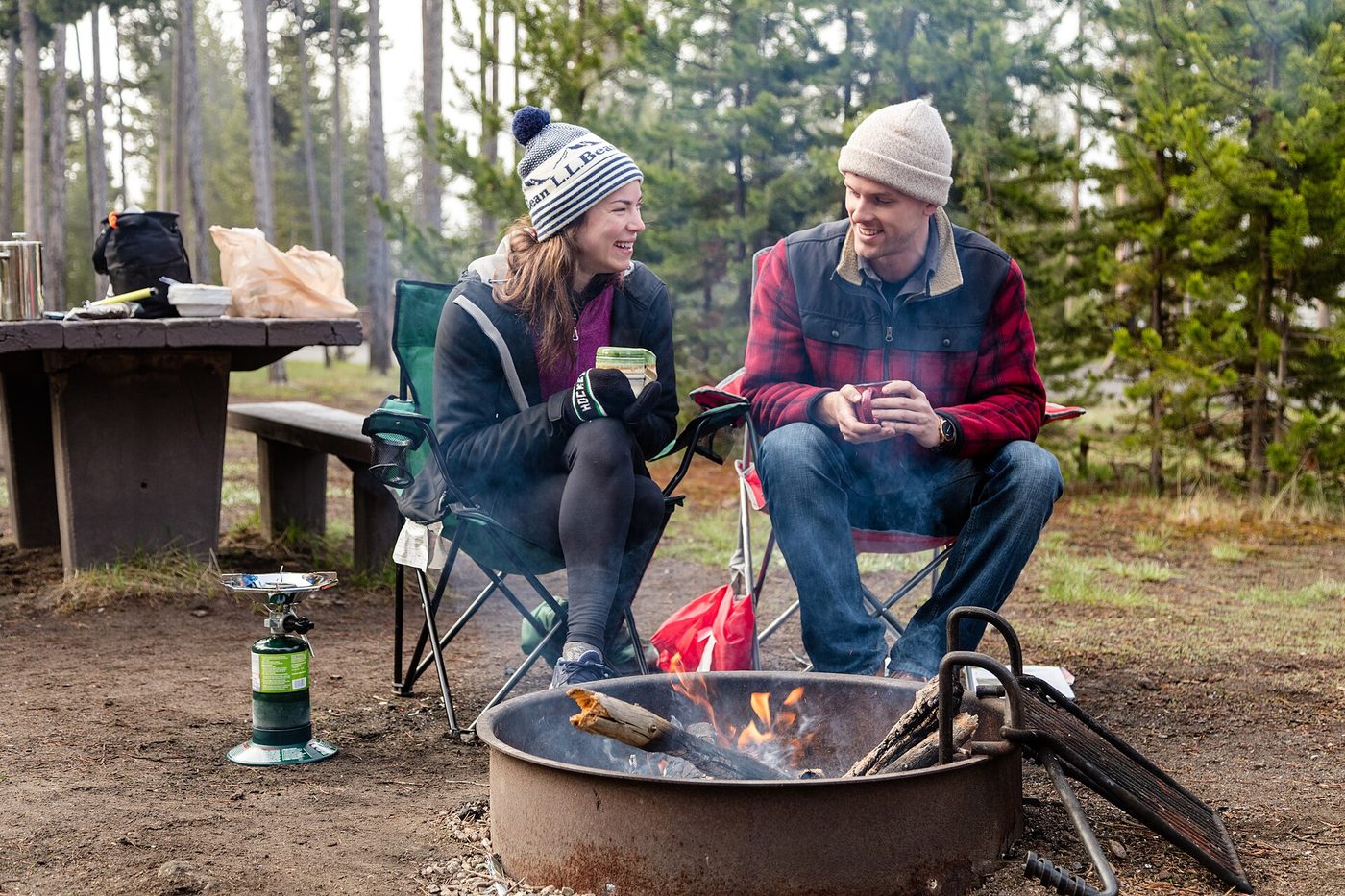
Gateway RV parks by entrance
Outside the boundary, you get full hookups, laundry, better cell coverage and often a decent shower block, at prices that in high season are not far off Fishing Bridge. Here is the honest read on each gateway.
West Entrance — West Yellowstone, Montana. The busiest and the best-served. Yellowstone Grizzly RV Park sits three blocks from the entrance with full hookups including 50 amp, pull-through sites, laundry, bathhouses, a playground and a store. Yellowstone Holiday is out on Hebgen Lake for people who want water instead of town. This is the strongest gateway for an RV trip: you are 30 minutes from Madison Junction and inside a town with groceries, restaurants and a hardware store. See West Yellowstone RV parks for the full comparison.
North Entrance — Gardiner, Montana. Open year-round, close to Mammoth and the best base for Lamar Valley wildlife. Yellowstone RV Park has 46 sites a mile from the entrance, all with full 30-amp service and limited 50 amp, pull-throughs 36 to 40 feet and back-ins to 65 feet deep, two bathhouses, laundry and free wifi (checked September 2026). Note the 2026 Gardner River High Bridge restriction above before committing a wide or very long rig to this entrance. More on Gardiner RV parks.
East Entrance — Cody, Wyoming. Fifty miles from the entrance along the Buffalo Bill Scenic Byway, which is a genuinely good drive rather than a chore. Cody has the widest choice of full-service parks of any gateway outside West Yellowstone, plus a real town with a rodeo, a serious museum complex and hospital services. The downside is distance: it is a long way to the middle of the park and back.
South Entrance — Jackson, Wyoming, via Grand Teton. Expensive and busy, but you pass through Grand Teton to get there, which nobody has ever complained about. If your trip includes both parks this is the obvious approach. Sites near Jackson book early and cost more than anywhere else on this list.
Northeast Entrance — Cooke City and Silver Gate, Montana. Tiny, remote, seasonal, and reached over the Beartooth Highway or the Chief Joseph Scenic Byway — both spectacular and both hard work in a big rig. Limited RV facilities. Wonderful if wolves are the point of your trip and you are in something small.
For a broader comparison of the towns themselves — groceries, restaurants, medical, what each is actually like to spend an evening in — see Yellowstone gateway towns, and for the parks specifically, RV parks near Yellowstone.
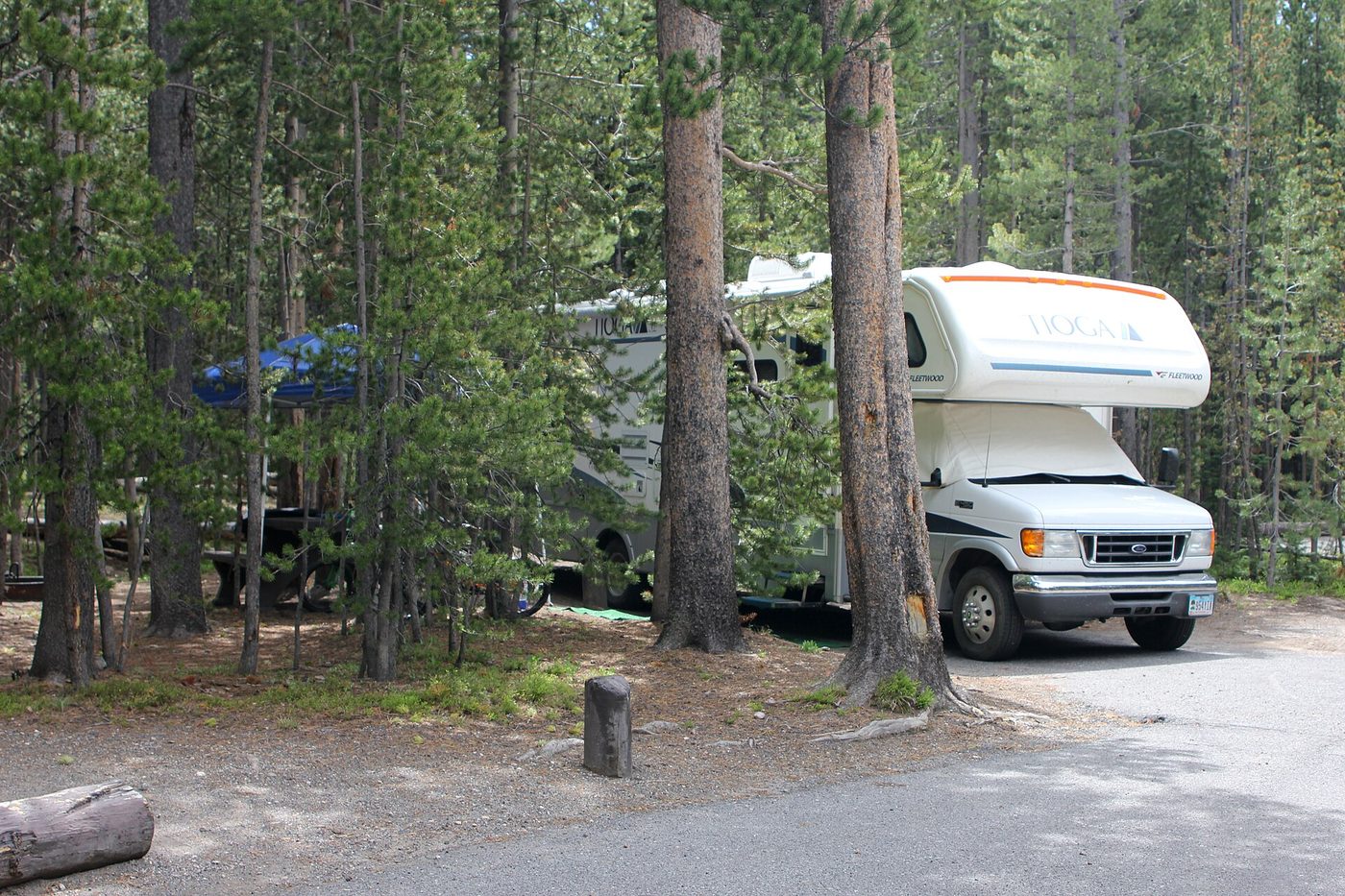
Renting an RV for a Yellowstone trip
Plenty of people do their first Yellowstone trip in a rental, particularly visitors flying in from the UK, Germany and Australia who are used to campervan holidays. It works well, with two caveats specific to this park.
First, rental delivery inside the park is prohibited. The National Park Service states plainly that “the delivery or pick-up of out-of-park RVs or other camper unit rentals is prohibited.” You collect and return in a gateway city — Bozeman, Salt Lake City, Denver and Jackson are the usual pickup points.
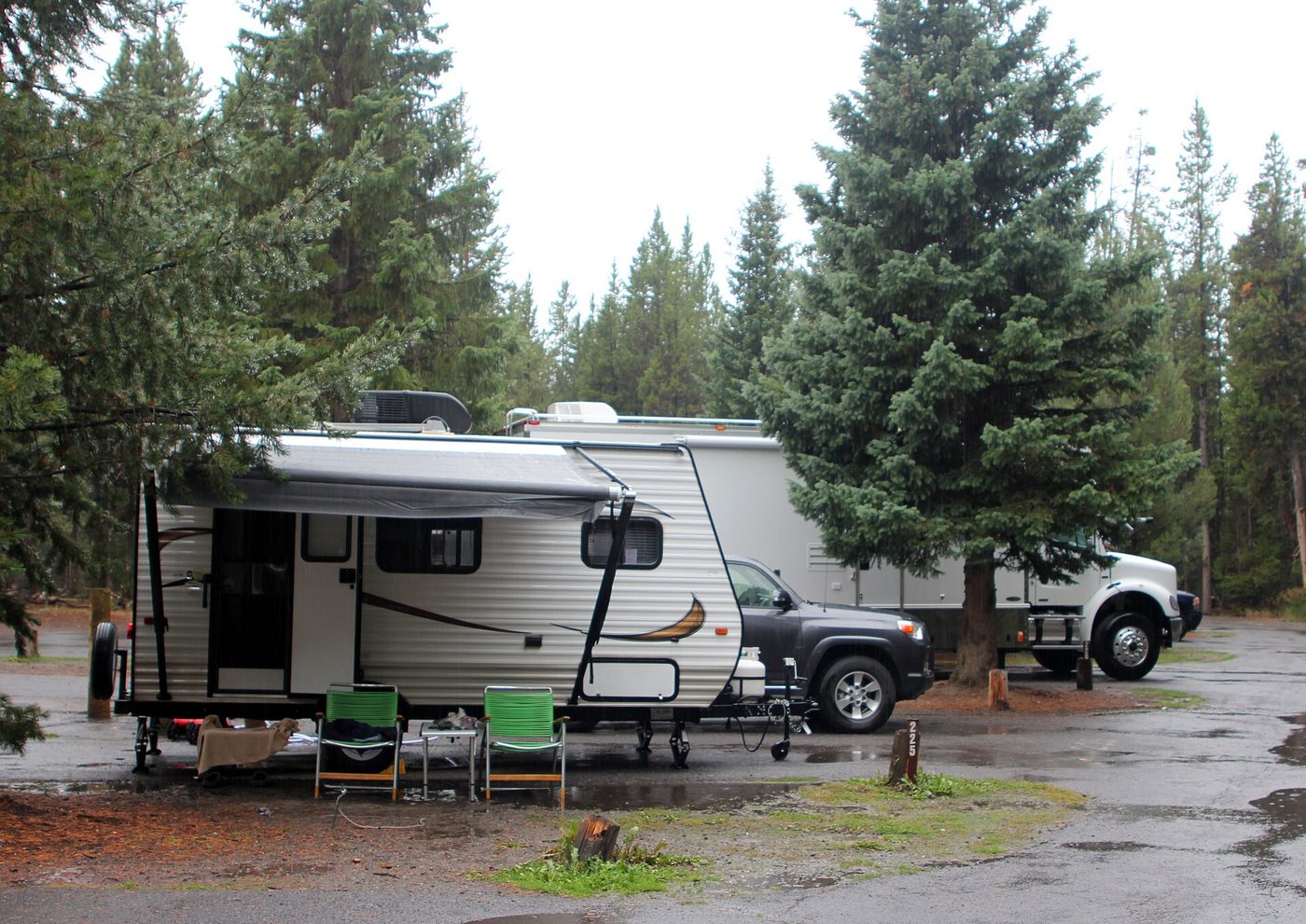
Second, size sells and size hurts. Rental fleets push 30- to 32-foot Class C units because they sleep six. In Yellowstone, that length locks you out of half the campgrounds and makes every pullout a decision. If your group can live in a 24-foot unit, take the 24-foot unit; you will spend the difference on better parking and less stress.
Budget honestly. A peak-summer Class C rental, plus insurance, plus mileage, plus generator hours, plus fuel at 8 to 10 mpg, frequently lands above the cost of a mid-range hotel plus a rental car for the same trip. The reason to do it anyway is that you wake up inside the park, which is a genuinely different holiday. The reason not to is if you were expecting it to be the cheap option. It usually is not. We break down the operators, insurance traps and one-way fees on RV rental for Yellowstone.
What does RV camping in Yellowstone cost?
Per night, for 2026, excluding tax:
| Line item | In-park dry | In-park hookups | Gateway park |
|---|---|---|---|
| Site | $38–$45 | $94 | $60–$110 peak |
| Hookups | none | included | included |
| Showers | pay, at select sites | included | usually included |
| Typical drive to sights | 0–40 min | 0–35 min | 30–90 min |
Add the park entrance fee on top — $35 for a private vehicle for seven days, and note that since January 1, 2026 each non-US resident aged 16 and over pays a $100 nonresident fee in addition, unless admitted on an annual or America the Beautiful pass. That changes the maths substantially for an international family and is worth reading in full on our Yellowstone entrance fee page before you book anything.
Fuel is the line most people underestimate. A week-long loop with day trips runs 600 to 900 miles. At 9 mpg and in-park pump prices, that is a meaningful number, and it is the single best argument for picking one or two bases rather than moving the rig every night.
A five-night RV route that actually works
Moving a large vehicle every day in Yellowstone is miserable. Two bases is the sweet spot. Here is a route we would genuinely use, assuming a mid-size rig and a summer trip.
Nights 1–3: Madison. Set up once. Old Faithful and the Upper Geyser Basin are 16 miles south; Midway and Lower geyser basins are closer still; Norris is 14 miles north. Go out early, come back for lunch and a nap when the crowds peak, go out again at 6:00 p.m. when the light turns and the parking lots empty. Madison’s season runs May 1 to October 17, the longest of the big campgrounds.
Night 4: Canyon or Bridge Bay. Move east across the middle of the park. Canyon puts you at the Grand Canyon of the Yellowstone with Hayden Valley on your doorstep for a dawn wildlife drive; Bridge Bay puts you on the lake with an easier approach for a longer rig. Canyon’s 40-foot limit is the deciding factor for many.
Night 5: Gardiner or Mammoth. Head north for the terraces and a run out to Lamar Valley at first light. If your rig is under 45 feet in summer, Mammoth Campground is right there and open year-round. If you want a dump, a laundry and a real shower before the drive home, take Gardiner — remembering the 2026 bridge restrictions on the North Entrance road.
That itinerary, expanded into a day-by-day version with drive times, alternates for shoulder season and a wet-weather plan, is on Yellowstone RV itinerary.
When should you come in an RV?
Mid-June through mid-September is the reliable window: every campground open, every road open, and warm enough that dry camping is pleasant. Late May and early October are the value picks — Madison and Fishing Bridge are still open, prices soften, crowds thin and the wildlife is more active. They are also the months when a hard freeze can close the dump stations and dust an unheated rig overnight.
Winter RV camping is essentially not a thing here. Mammoth is the only campground open, at a 30-foot limit, with no hookups and no dump station, and the interior park roads are closed to wheeled vehicles from early November to mid-April. If Yellowstone in winter is the goal, take a snowcoach and a room. The month-by-month picture, including what is open and what the weather actually does, lives on the best time to visit Yellowstone.
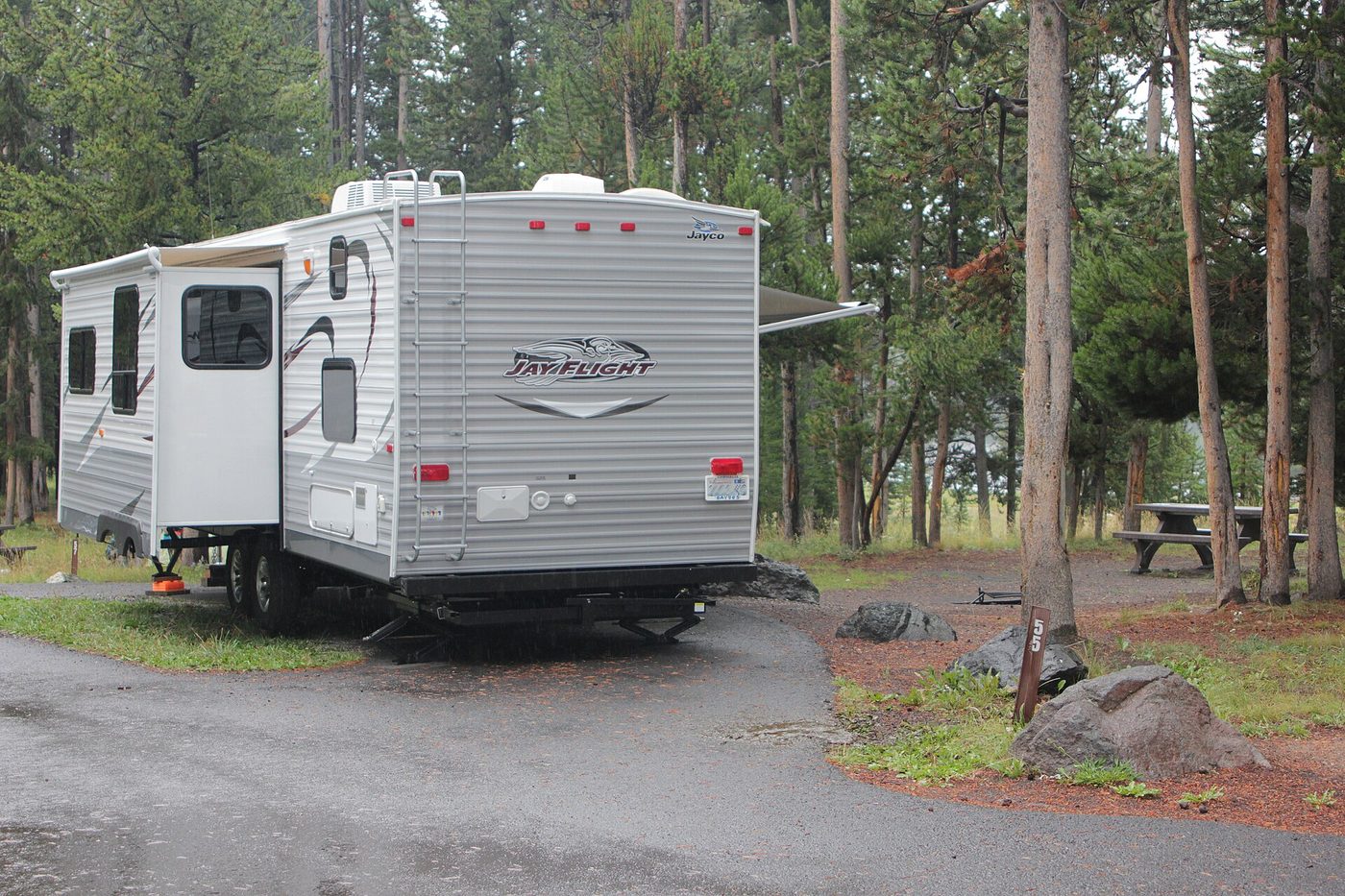
Bears, food storage and the rules that get people cited
Every campground in Yellowstone is in bear country, and the rules are not decorative. Food, coolers, cooking gear, dishes, rubbish and anything scented go inside the hard-sided vehicle or in a bear box when you are not actively using them. That includes the grill grate with last night’s dinner baked onto it.
An RV makes this easy, which is one of the quiet advantages of travelling in one — your kitchen is already a hard-sided container. The mistakes we see are external: a cooler left under the awning, a dog bowl by the step, a rubbish bag hung on the ladder overnight. Rangers do walk the loops, and the fines are real.
Wildlife distance rules apply in campgrounds exactly as they do at a roadside pullout: 25 yards from bison and elk, 100 yards from bears and wolves. Bison walk through Madison and Bridge Bay regularly. The correct response is to go inside and watch through the window, not to step closer for a photo. Full detail, including what to do if a bear comes into camp, is on Yellowstone safety.
Is an RV the right way to see Yellowstone? The honest verdict
For a family of four or more travelling from within driving distance, with a rig under about 35 feet: yes, unreservedly. You get in-park nights at a fraction of lodge prices, your own kitchen in a park with limited and expensive dining, and the freedom to be at Lamar Valley at 5:45 a.m. without a two-hour drive first.
For a couple flying in for six nights, renting a 32-foot Class C: probably not. You will spend a big chunk of the budget on the rental and the fuel, you will find parking stressful at exactly the places you came to see, and a hotel in West Yellowstone with a compact rental car will cost less and hurt less. Rent the van version if you want the freedom; rent a car and book a room if you want the sights.
For anyone over 45 feet combined: bring it, but plan around it. Fishing Bridge or a gateway park, a towed car for daily driving, and a route that avoids Dunraven Pass, Tower Fall and the North Entrance bridge in 2026. That is a good trip. Trying to treat a 50-foot combination like a car is not.
And if you already own the rig and you are asking whether Yellowstone is worth the hassle of driving it here — it is. This is one of the few parks where the campgrounds are genuinely inside the scenery rather than parked at the edge of it, and where being on-site at dawn changes what you see rather than just saving you a drive.
Frequently asked questions
Can you camp overnight in an RV in a Yellowstone parking lot?
No. Overnight camping and sleeping in vehicles is only permitted in designated campsites within the park’s campgrounds. Parking lots, pullouts and picnic areas are all off limits overnight, and this is actively enforced. There is no dispersed or boondocking option inside the park boundary.
What is the maximum RV length allowed in Yellowstone?
Ninety-five feet, at Fishing Bridge RV Park, which is the only site in the park that will take a combination that long. Elsewhere the ceiling is 60 feet at Bridge Bay and Madison, 50 at Grant Village, 40 at Canyon and 25 to 45 feet at the smaller National Park Service campgrounds.
Do Yellowstone campgrounds have electric hookups?
Only Fishing Bridge RV Park, which has water, sewer and 50-amp electric at every site and takes hard-sided vehicles only. Every other campground in Yellowstone is dry camping with no hookups of any kind, though five of them have dump stations and permit generators during posted daytime hours.
Can you take an RV through the North Entrance in 2026?
Only if it is under 8 feet 6 inches wide and under 75 feet long. The Gardner River High Bridge is single-lane with delays up to 15 minutes, 24 hours a day, from April 13 to late October 2026, and vehicles over those dimensions are prohibited. Use the West or North-East approach instead.
How far ahead do you need to book an RV site in Yellowstone?
For 2026, the five concessioner campgrounds open 13 months ahead on the 5th of each month, and the popular summer dates go within the day. From the 2027 season those five move to Recreation.gov on a roughly six-month window. The National Park Service campgrounds already open exactly six months ahead.
Is there cell service or wifi at Yellowstone campgrounds?
Patchy at best. There is usable signal around Old Faithful, Canyon, Grant, Mammoth and Fishing Bridge, and effectively nothing at Madison, Bridge Bay after dark, or anywhere in the northern campgrounds. Download maps before you arrive and tell people at home you will be out of contact.
Can you have a campfire at an RV site?
Yes, in the fire ring provided, unless a fire ban is in effect — which is common in late summer. Firewood must be bought locally or gathered dead-and-down only where permitted; do not bring firewood from home, because of the risk of moving insect pests into the park.
Are generators allowed all night?
No. Generators are permitted only during posted daytime hours at Bridge Bay, Canyon, Fishing Bridge, Grant Village and Madison, and are banned entirely at Mammoth, Indian Creek, Lewis Lake, Slough Creek and Tower Fall. If you need power overnight, you need batteries.
Sources
- National Park Service: Yellowstone campgrounds
- National Park Service: Yellowstone operating dates and hours
- National Park Service: Yellowstone park roads and construction
- National Park Service: Yellowstone entrance fees
- Yellowstone National Park Lodges: camping and RV reservations
- Recreation.gov: Yellowstone National Park
Image credits
| Photo | Credit |
|---|---|
| Fishing Bridge RV Park is the only place inside the park with water, sewer and 50-amp elec (top of page) | Yellowstone National Park from Yellowstone NP, USA, public domain, via Wikimedia Commons |
| Paved loops and back-in sites at Fishing Bridge, on the north shore of Yellowstone Lake | Yellowstone National Park from Yellowstone NP, USA, public domain, via Wikimedia Commons |
| Hard-sided vehicles only at Fishing Bridge: no tents, tent-trailers or canvas pop-ups | Yellowstone National Park from Yellowstone NP, USA, public domain, via Wikimedia Commons |
| Madison Campground opens May 1 and closes in mid-October, the longest season of the big ca | Neal Herbert, public domain, via Wikimedia Commons |
| Overnight lows drop into the 30s even in midsummer, which is the real reason dry camping d | Yellowstone National Park, public domain, via Wikimedia Commons |
| A 24-foot Class C fits nearly every campground in the park | Yellowstone National Park from Yellowstone NP, USA, public domain, via Wikimedia Commons |
| Bridge Bay takes rigs to 60 feet and is the largest campground in Yellowstone at 431 sites | Yellowstone National Park from Yellowstone NP, USA, public domain, via Wikimedia Commons |