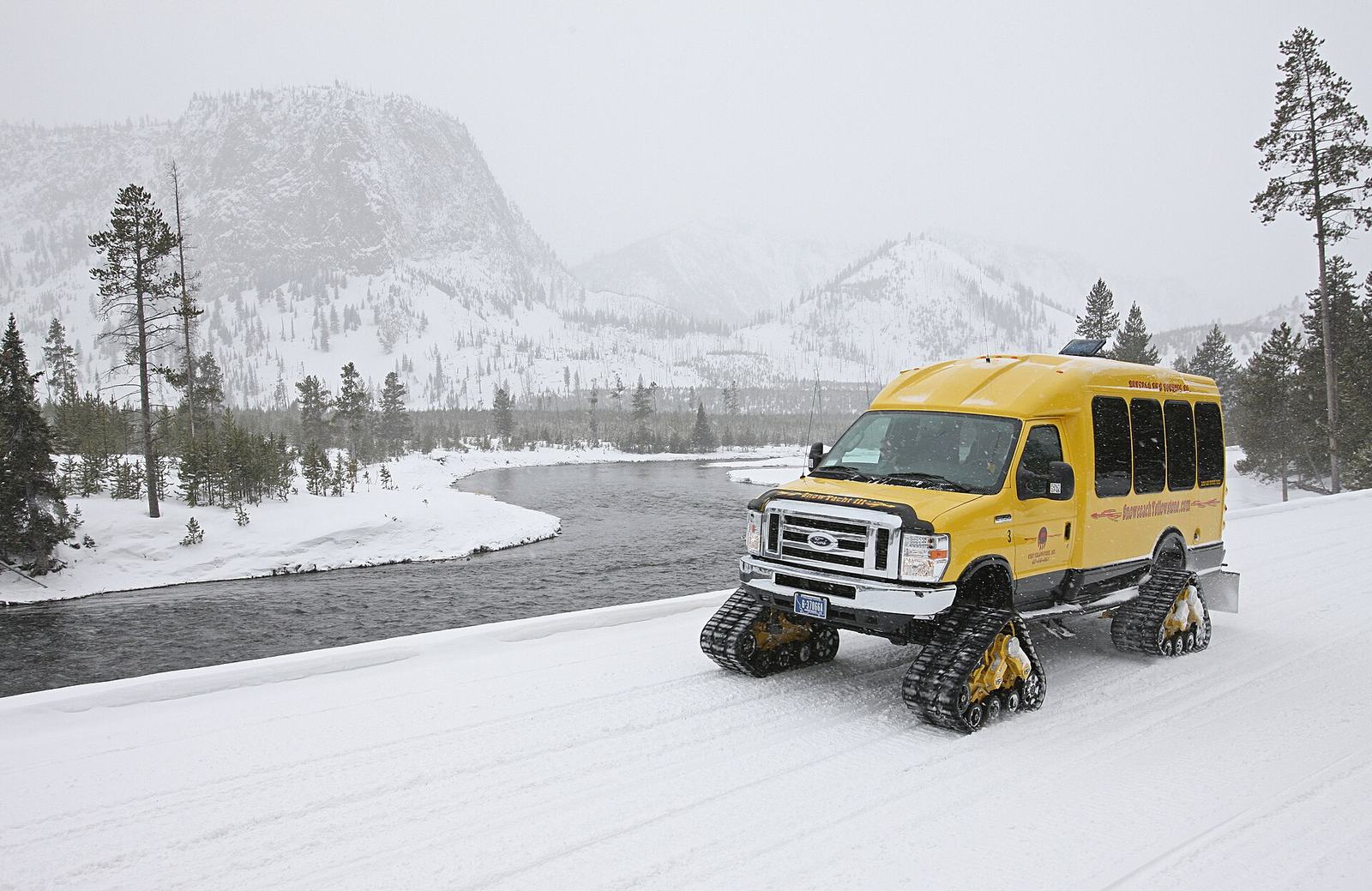
Yellowstone in winter means snowcoaches and snowmobiles instead of cars, two lodges instead of nine, and some of the best wildlife watching of the year. The 2026-27 oversnow season runs from December 15, 2026 to mid-March 2027, and the only road open to your own car runs from Gardiner through Lamar Valley to Cooke City.
If you’ve only seen the park in summer, winter is a different place. Old Faithful erupts into air cold enough to freeze the spray on the trees around it. Bison walk through the geyser basins with frost on their beards, plowing snow aside with their heads to reach the grass beneath. Wolves stand out against the white of Lamar Valley in a way they never do in July. And the crowds that pack the boardwalks in summer are gone. The whole park sees a small fraction of its summer visitors in the depths of winter.
The catch is access. You can’t drive yourself to Old Faithful, Grand Prismatic or the Grand Canyon of the Yellowstone in winter. You go by guided snowcoach or snowmobile, on skis or snowshoes, or not at all. Lodging inside the park shrinks to two hotels. Prices for tours are high, and the weather is serious: nights well below zero are normal, and the park’s record low is -66°F.
This guide covers the whole winter season in one place: the 2026-27 dates by road segment, what’s open, how to get in, the pros and cons of snowcoaches and snowmobiles, where to stay, what to do, what to pack and whether it’s worth it. If you’re still choosing a season, our best time to visit Yellowstone guide compares winter with the rest of the year, and the planning a trip to Yellowstone guide covers the basics.
Is Yellowstone open in winter?
Yes. Yellowstone never closes, but from early November most roads are closed to cars. The oversnow season runs December 15, 2026 to mid-March 2027, when guided snowcoaches and snowmobiles reach Old Faithful and Canyon. The northern road from Gardiner through Lamar Valley to Cooke City stays open to cars all winter.
That makes Yellowstone’s winter really three periods, not one:
- The early-winter gap (early November to December 14). Most park roads close to cars at the end of October, and the oversnow season hasn’t started. Only the northern road is open. The interior is closed to everyone while snow builds and crews prepare the roads for oversnow travel.
- The oversnow season (December 15 to mid-March). Guided snowcoaches and snowmobiles run on groomed roads through the interior, the two winter lodges are open, and this is what most people mean by “Yellowstone in winter.”
- The spring gap (mid-March to mid-April). Oversnow travel ends in stages, and the interior closes again while plows clear the roads for spring. Only the northern road stays open.
If you’re coming for the full winter experience, aim for January or February. If you’re coming for wolves and the northern range, any time from November to April works, because that road never closes.
Yellowstone winter season 2026-27: key dates
These are the 2026-27 dates the NPS has published for oversnow travel by road segment (checked September 2026). Oversnow travel ends in stages in March because crews start plowing some roads before others.
| Road segment | 2026-27 winter status |
|---|---|
| North Entrance (Gardiner) to Mammoth to Tower-Roosevelt to Northeast Entrance (Cooke City) | Open to cars all year |
| Mammoth to Norris | Oversnow December 15, 2026 to March 7, 2027 |
| Norris to Madison, Norris to Canyon, Canyon to Washburn | Oversnow December 15, 2026 to March 9, 2027 |
| Canyon to Fishing Bridge | Oversnow December 15, 2026 to March 14, 2027 |
| West, South and East entrances and the remaining oversnow roads (including Madison to Old Faithful) | Oversnow December 15, 2026 to March 15, 2027 |
| Dunraven Pass, Beartooth Highway, Chief Joseph Scenic Byway | Closed from October 12, 2026 until spring |
And these are the key lodging and facility dates published so far:
| Facility | 2026-27 winter dates (checked September 2026) |
|---|---|
| Mammoth Hot Springs Hotel and Cabins | Open through March 7, 2027; dining room through March 8, 2027 |
| Old Faithful Snow Lodge | Winter season typically mid-December to early March; NPS lists 2026-27 dates as TBD |
| Concessioner snowcoach, Mammoth to Old Faithful | December 16, 2026 to March 7, 2027 |
| Mammoth Campground | Open year-round |
| Albright Visitor Center, Mammoth store, clinic and post office | Open year-round |
| Old Faithful Visitor Education Center, warming huts, ski shops | Winter dates TBD |
Dates in Yellowstone “are subject to change without advance notice,” as the NPS puts it, and heavy snow or thin snow can shift the season. Check our Yellowstone road closures page before you go, and the lodging in Yellowstone National Park guide for lodge seasons and booking rules.
The winter season month by month
Each part of the winter feels different, and the right month depends on what you’re after.
- Early November to mid-December. Most park roads close to cars at the end of October, and there’s no oversnow travel yet, so the interior is off limits. The northern road is open, Lamar Valley is quiet, bighorn sheep are in their rut near Gardiner and many gateway businesses close for their own off season. Come for wolves and solitude, not geysers. See Yellowstone in November.
- Mid-December to early January. The oversnow season opens on December 15, the lodges fill for Christmas and New Year’s, and days are at their shortest, with less than nine hours of daylight around the solstice. This is the busiest stretch of the winter, which still means quiet by summer standards. See Yellowstone in December.
- January. The coldest month and the steamiest. Cold snaps can hold temperatures below zero for days, which makes the geyser basins look otherworldly and the frost on the trees thickest. See Yellowstone in January.
- February. Our pick for a winter trip. The snowpack is deep, days are noticeably longer, and wolves are in their mating season and easier to find. Presidents’ Day weekend is busy. See Yellowstone in February.
- March. Oversnow travel ends in stages between March 7 and March 15, 2027. Early March still feels like deep winter, with a big snowpack and fewer visitors; after the last roads close, the interior shuts until the spring opening, and the first grizzlies leave their dens. See Yellowstone in March.
What’s open in Yellowstone in winter
Here’s a quick map of what’s running from mid-December to early March:
- Lodging: Mammoth Hot Springs Hotel and Old Faithful Snow Lodge. That’s it inside the park. Everything else is closed.
- Camping: Mammoth Campground only, open year-round on a first-come, first-served basis.
- Food: dining rooms and casual options at Mammoth and at the Snow Lodge; the Mammoth General Store stays open all year.
- Visitor centers: Albright Visitor Center in Mammoth year-round; the Old Faithful Visitor Education Center in winter (2026-27 dates still TBD). The Canyon Visitor Education Center’s lobby and restrooms work as a warming hut.
- Warming huts: heated shelters with restrooms and sometimes snacks at Canyon, Fishing Bridge, Madison, West Thumb, Indian Creek and Mammoth. They’re where snowcoach and snowmobile groups stop to thaw.
- Fuel: 24-hour card fueling at Canyon, Fishing Bridge, Grant Village, Old Faithful and Tower-Roosevelt, plus Mammoth.
- Medical: the Mammoth clinic is open year-round.
- Recreation: ski and snowshoe rentals, ski shuttles and outdoor ice skating at the two lodges, run by the concessioner.
The honest summary: in winter, Yellowstone is two small outposts, Mammoth and Old Faithful, connected by oversnow roads, with one open road across the north. Plan everything around those. Our Yellowstone winter lodging guide goes into detail on the two hotels and the gateway towns.
Can you drive through Yellowstone in winter?
Only on one road. The roughly 52-mile route from the North Entrance at Gardiner through Mammoth, Tower-Roosevelt and Lamar Valley to the Northeast Entrance is plowed and open to cars all year, continuing to Cooke City. Every other park road is closed to private vehicles from early November until spring.
That one road is the best winter drive in the lower 48 states for wildlife. It runs from the sagebrush and hot springs of Mammoth, past Blacktail Plateau and Tower Junction, through the broad white bowl of Lamar Valley and up Soda Butte Creek to the tiny town of Cooke City, where it dead-ends in winter because the Beartooth Highway beyond is closed. You drive out and back the same way.
A few things to know before you drive it:
- Conditions change quickly. The road is plowed, but it can be icy, snow-packed or closed for a few hours during storms. Snow tires or all-season tires with good tread and four-wheel drive or all-wheel drive are strongly recommended. Carry chains if you have them.
- Wildlife uses the road. Bison walk down the plowed lanes because it’s easier than wading through snow. Slow down, never honk, and wait for them to move.
- Services are few. Gardiner, Mammoth and Cooke City have fuel, food and lodging. Between them there’s very little. Fill up before you go.
- Cell coverage is patchy. Tell someone your plans, and carry a warm layer, water and snacks in case you’re held up.
For more detail on the drive and the rules, see our guide to whether you can drive through Yellowstone in winter, and for the valley itself, the Lamar Valley guide.
How to get into the interior: snowcoach, snowmobile, skis or snowshoes
To reach Old Faithful, the Grand Canyon of the Yellowstone or anywhere else in the interior in winter, you have four choices. All motorized oversnow travel in Yellowstone must be with a commercial guide, with one narrow exception covered below.
Snowcoach
A snowcoach is a van or small bus fitted with tracks or huge low-pressure tires. It’s heated, has big windows and carries anywhere from about eight to more than a dozen passengers, with a guide who drives and narrates. Snowcoach tours run from West Yellowstone (the most options), Mammoth, Gardiner and the South Entrance area, going to Old Faithful, the Grand Canyon of the Yellowstone or both. Most day trips from West Yellowstone to Old Faithful take about eight to ten hours.
The concessioner also runs a snowcoach transfer between Mammoth and Old Faithful for guests of the Snow Lodge, from December 16, 2026 to March 7, 2027, listed at $179.45 per adult for the 2026-27 season (checked September 2026; confirm when booking). Other operators set their own prices, which vary by route and length. Our Yellowstone snowcoach tours guide compares them.
Snowmobile
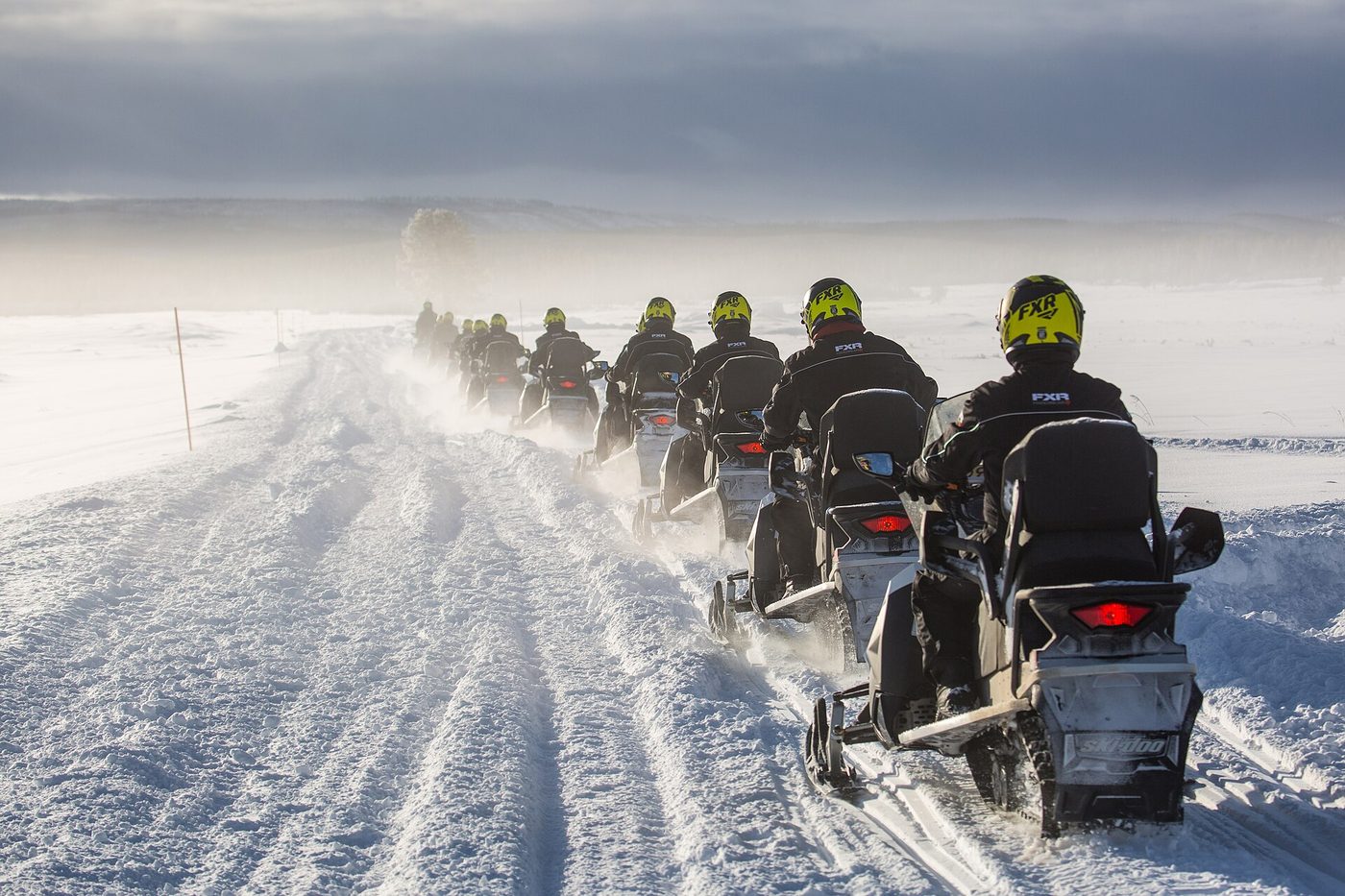
Guided snowmobile tours leave mostly from West Yellowstone, and also from the South and East entrances, and head for Old Faithful and sometimes the canyon. You drive your own machine in a guided group, usually of up to ten, on groomed roads at controlled speeds. Snowmobiles in the park must meet strict noise and emissions standards, so operators supply the machines, along with helmets, suits and boots.
A full-day guided snowmobile trip to Old Faithful typically covers 60 to 100 miles or more depending on the route. Prices vary by operator, by the number of riders per sled and by the route, and a single rider pays more than two sharing. Our Yellowstone snowmobile tours guide compares operators and routes.
Non-commercial snowmobile permits
The one exception to the guide rule is the Non-Commercial Snowmobile Access Program, which lets a small number of groups enter each day without a commercial guide. Permits are allocated by lottery, with the application window in August for the following winter, and each permit costs $40 per day under the program rules (checked September 2026). Every group leader has to complete an online education program, and all snowmobiles must still meet the park’s technology standards. The August 2026 window for the 2026-27 season has already passed. Our Yellowstone non-commercial snowmobile permit guide explains how the lottery works for next time.
Skis and snowshoes
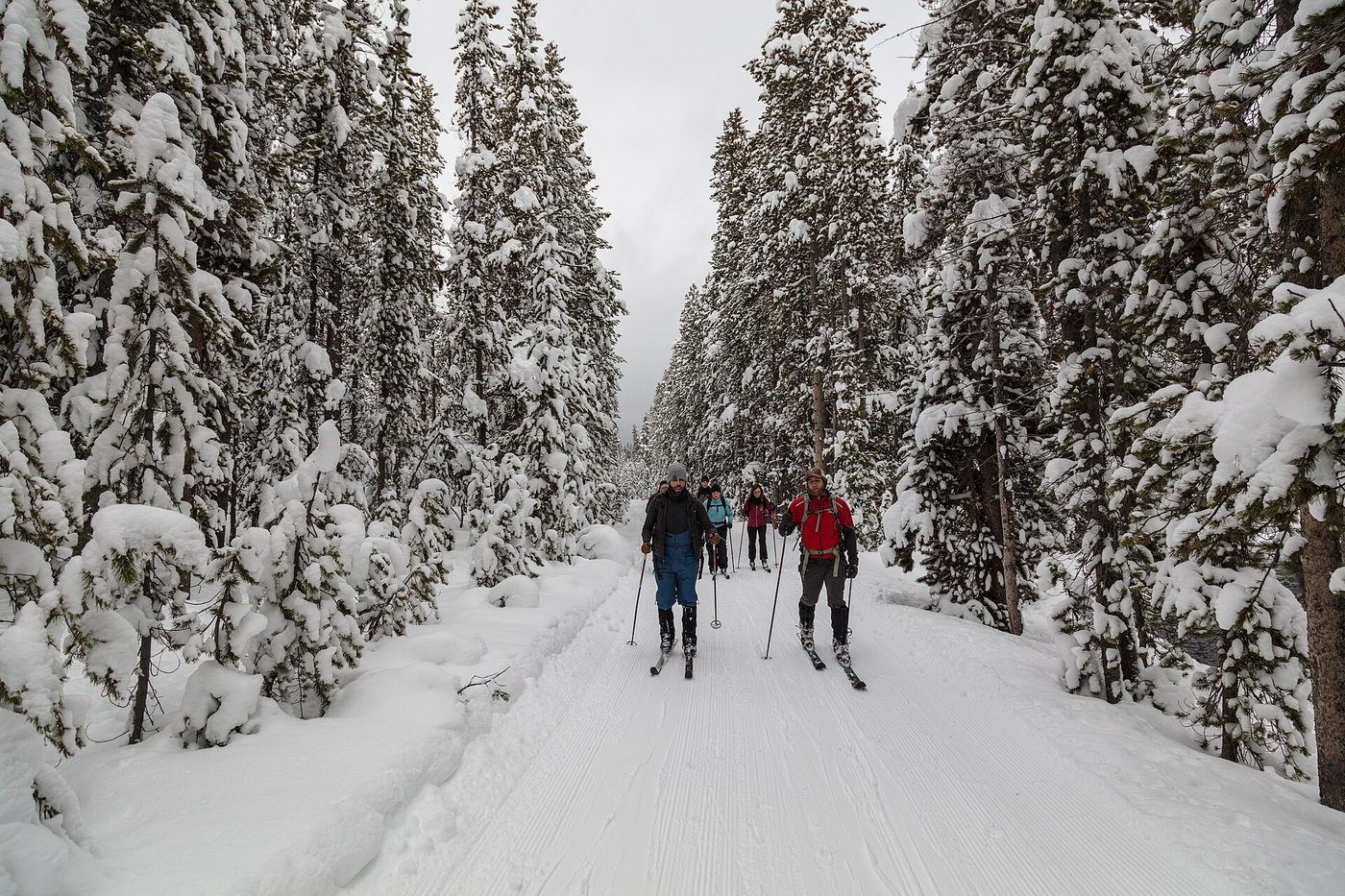
You can also get around on your own power. Groomed and marked ski and snowshoe trails run around Mammoth and Old Faithful, and the concessioner runs ski shuttles from both lodges to trailheads in the interior. Skiing out to Lone Star Geyser, around the Upper Geyser Basin or along the canyon rim is one of the most memorable things you can do in the park. See cross-country skiing in Yellowstone and snowshoeing in Yellowstone.
Snowcoach vs snowmobile: which is better?
A snowcoach is better for families, photographers and anyone who hates the cold: it’s heated, you can ask the guide questions and stop often. A snowmobile is better if you want the thrill of driving yourself and don’t mind wind, noise and a long, cold day. Both reach Old Faithful.
Here’s how they compare on the things that matter:
| Snowcoach | Snowmobile | |
|---|---|---|
| Warmth | Heated cabin | Open to the weather; heated grips and seats help |
| Views | Big windows; photos through glass, or step out at stops | Unobstructed, but you’re concentrating on driving |
| Interpretation | Guide narrates the whole way | Guide talks at stops only |
| Wildlife stops | Easy; everyone gets out | Frequent, but brief |
| Ages | Good for young children and older visitors | Minimum ages for drivers and passengers vary by operator |
| Experience | Relaxed, social | Physical, exhilarating |
| Cost per person | Usually lower for couples and families | Higher, especially for single riders |
| Best for | Families, photographers, anyone who feels the cold | Couples and adventurous adults |
Our verdict: if you’re going once, choose a snowcoach to Old Faithful and spend the time looking rather than driving. If you love it and come back, try a snowmobile. For a full comparison, see snowcoach vs snowmobile, and for everything on offer, including ski and wildlife trips, Yellowstone winter tours.
Getting to Yellowstone in winter
Getting to the park in winter takes more planning than in summer, because some airports and roads that serve Yellowstone in July are closed.
Airports. Bozeman is the main winter gateway and the best choice for both the North and West entrances. Jackson serves the South Entrance area, and Billings, Cody and Idaho Falls also have year-round commercial service. The small airport at West Yellowstone is seasonal, operating from early May to mid-October, so it’s no help in winter. There’s no passenger train to the park. Our guide to the best airport for Yellowstone and Grand Teton compares them.
Driving routes. From Bozeman, the drive to Gardiner runs east on I-90 to Livingston and then south on US-89 through the Paradise Valley, about 80 miles in all. It’s a straightforward highway drive in most conditions and takes you straight to the one park road open to cars. The drive to West Yellowstone, about 90 miles on US-191, follows the Gallatin River through a narrow, winding canyon that can be slick and busy with truck traffic; allow extra time, and see our Gallatin Canyon guide. From Jackson, tours head north to the South Entrance area. The East Entrance from Cody is little used in winter, because oversnow travel over Sylvan Pass is limited by avalanche danger.
Road conditions. Check the state 511 services for Montana and Wyoming before you set off, and again before you drive home. Winter storms can close highways for hours.
Rental cars. Ask for four-wheel or all-wheel drive, and ask specifically about tires, because rental fleets don’t always fit winter tires. If you’re only visiting the interior on tours, many operators in West Yellowstone and Gardiner can arrange pickup from your hotel, and some from the airport.
Where to stay in Yellowstone in winter
Inside the park, you have two choices.
- Mammoth Hot Springs Hotel and Cabins is on the one road open to cars, so you can drive right up. It’s the natural base for Lamar Valley wolf watching and the Mammoth terraces, and the concessioner’s snowcoaches to Old Faithful leave from here. Our Mammoth Hot Springs Hotel guide covers rooms and dining, and Mammoth Hot Springs in winter covers what to do there.
- Old Faithful Snow Lodge is the only lodging in the park’s interior in winter, and you can only reach it by snowcoach or snowmobile. Staying here means you can watch Old Faithful at dawn and dusk with almost nobody around, ski straight out the door and walk the Upper Geyser Basin on a moonlit night. It books up early. See our guide to Old Faithful in winter.
Both lodges book through the concessioner, which opens reservations 13 months ahead. Winter rooms at the Snow Lodge, especially over the holidays, go fast.
Outside the park, your base depends on how you plan to enter:
- Gardiner, Montana: the best base for Lamar Valley and Mammoth, with year-round road access. Quiet, small, with a handful of restaurants open in winter. See things to do in Gardiner.
- West Yellowstone, Montana: the hub for snowcoach and snowmobile tours to Old Faithful, with the most choice of lodging and operators. See West Yellowstone and West Yellowstone in winter.
- Cooke City, Montana: a tiny town at the end of the northern road, popular with backcountry snowmobilers and wolf watchers.
- Jackson, Wyoming: the base for South Entrance tours, and a winter destination in its own right.
Camping: Mammoth Campground stays open all winter. It’s cold, basic and first-come, first-served, but it’s there. See winter camping in Yellowstone.
Things to do in Yellowstone in winter
The winter list is shorter than the summer one, but most of it is better than its summer equivalent. The highlights:
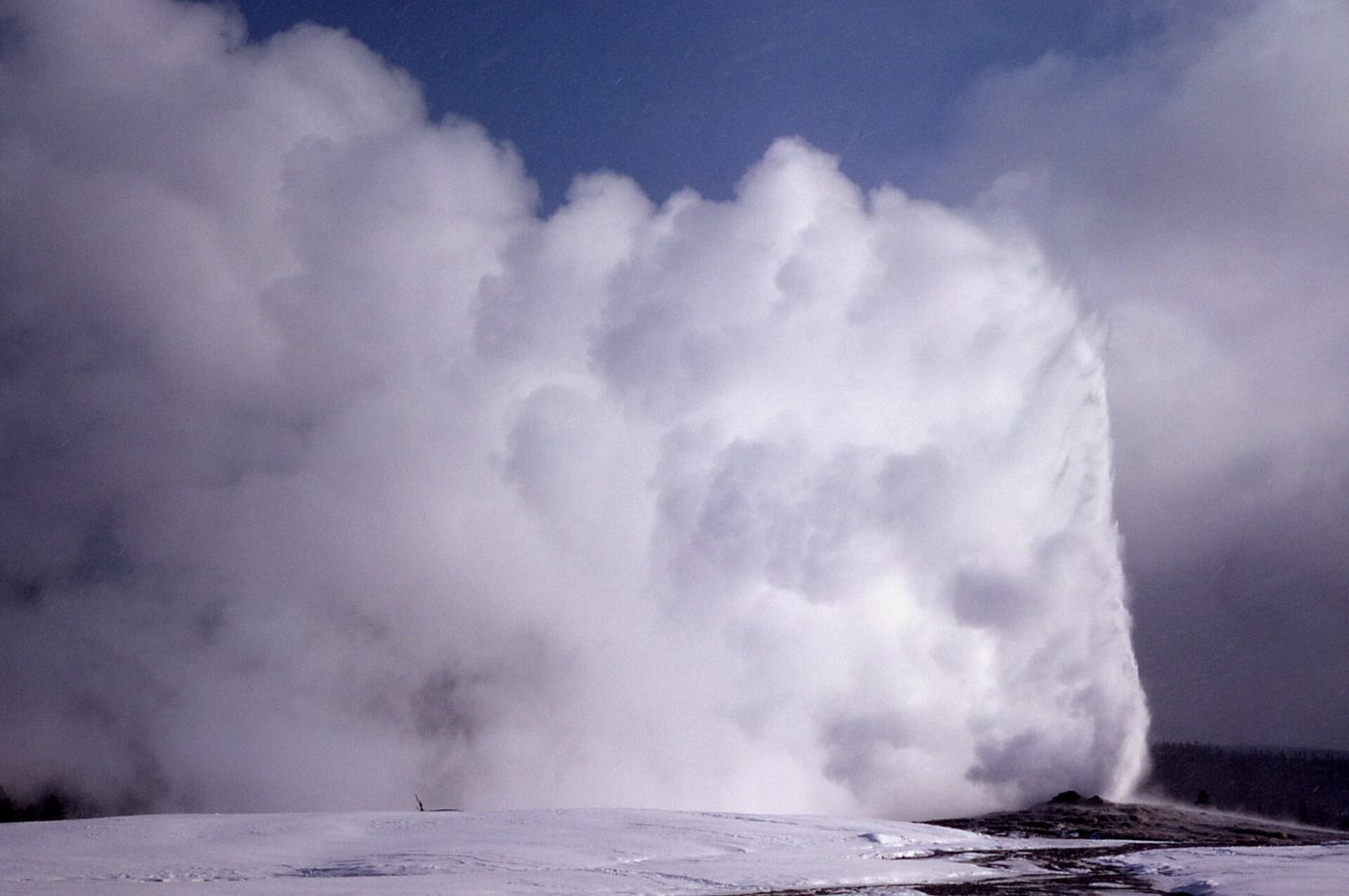
- See Old Faithful erupt in the snow. Winter eruptions produce massive steam clouds, and you’ll share the benches with a few dozen people at most.
- Watch wolves in Lamar Valley. Winter is the best season to see them, and the road is open.
- Take a snowcoach or snowmobile to the geyser basins. The trip itself is half the experience.
- Ski or snowshoe to Lone Star Geyser or along the canyon rim. Groomed trails and shuttles make it accessible.
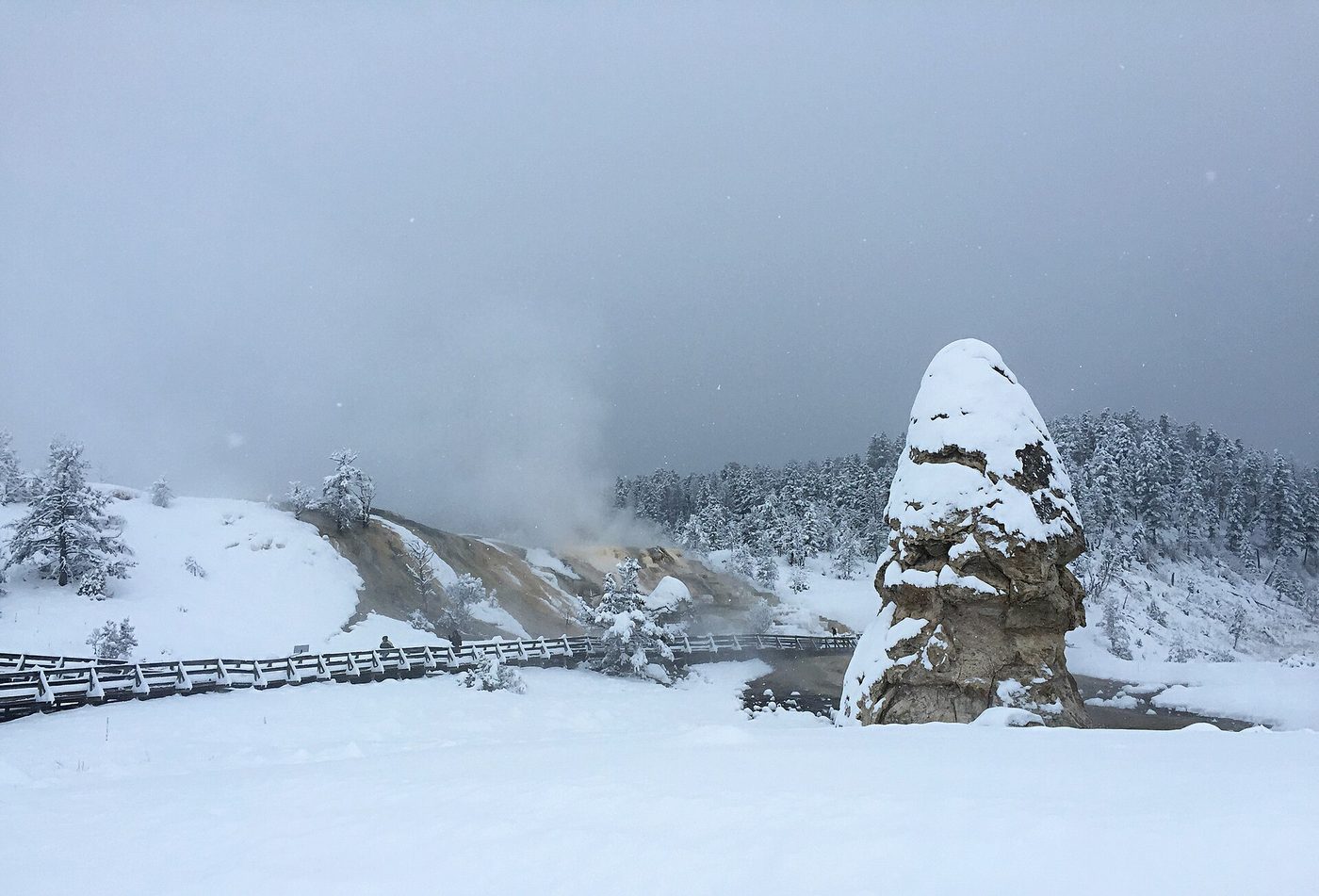
- Walk the Mammoth terraces. The lower boardwalks stay open, and the steaming white travertine looks even stranger in snow.
- Photograph frost-covered bison and “ghost trees” coated in rime near the geyser basins.
- See the Grand Canyon of the Yellowstone frozen. The Lower Falls builds an ice cone at its base that can be hundreds of feet tall.
- Join a ranger program or a guided wildlife tour out of Mammoth or Gardiner.
- Ice skate at the lodges, and warm up by the fire afterward.
- Soak in hot springs outside the park near Gardiner, since soaking inside the park is not allowed.
For the full list with details, see our guide to things to do in Yellowstone in winter. Families should read Yellowstone with kids in winter, which covers age limits for tours and how to keep children warm. And for everything the park offers year-round, the things to do in Yellowstone guide is the hub.
Winter wildlife: wolves, bison and more
Winter is the best time of year for some of Yellowstone’s most famous animals, and the northern range is where it happens. Snow pushes elk and bison down to lower valleys, and the predators follow.
- Wolves: the dark shapes of wolves against the snow are easier to spot than in any other season. Lamar Valley and the road east of Tower are the classic places, especially at dawn. February brings the mating season, when packs are active and vocal.
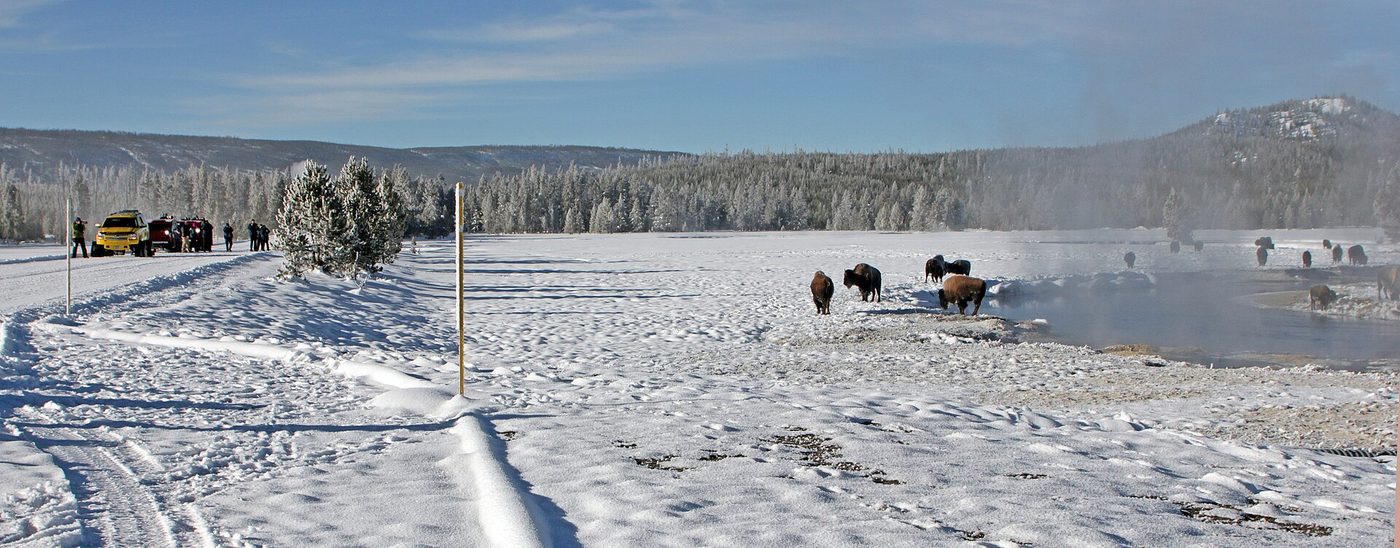
- Bison: herds winter in Lamar and Hayden valleys and in the geyser basins, where the warm ground keeps grass accessible. You’ll often see them on the roads.
- Elk: big herds gather on the northern range and around Mammoth and Gardiner.
- Bighorn sheep: their rut runs through late fall and early winter on the cliffs near Gardiner and in the Lamar area.
- Others: coyotes, red foxes, river otters, bald eagles, moose, and even the odd mountain lion track.
Grizzlies and black bears are denning through most of the winter and start emerging in March. Our Yellowstone wildlife in winter guide goes into detail, and for a guided day with scopes and an expert who knows the packs, see Yellowstone winter wolf tours. For all the park’s animals, the Yellowstone wildlife guide is the hub, and wolf watching in Yellowstone covers the etiquette.
The same distance rules apply in winter: at least 100 yards from wolves and bears, and 25 yards from bison, elk and everything else. Animals are stressed in winter, and every calorie they spend fleeing from people is one they can’t spare. Our Yellowstone safety guide covers the rules.
Old Faithful and the geyser basins in winter
The geyser basins are the heart of a winter visit to the interior. Cold air makes steam plumes huge and dramatic, and the warm ground around the hot springs creates small green oases in the snow where bison graze. Frost coats the trees near the geysers, turning them into white sculptures.
Old Faithful erupts as reliably in winter as in summer, and the Old Faithful Visitor Education Center posts predictions. If you’re staying at the Snow Lodge, you can watch eruptions from its windows and walk the boardwalks at any time, carrying traction devices for icy sections. If you’re on a day tour, you’ll usually have time for one or two eruptions and a walk through part of the Upper Geyser Basin. Our Old Faithful guide has more, and the Upper Geyser Basin guide covers the boardwalks.
Other thermal areas you can reach in winter: the Midway and Lower geyser basins on the way from West Yellowstone, Norris on some tours, and West Thumb on routes from the South Entrance. Grand Prismatic Spring is usually hidden under steam in winter, so don’t expect the summer colors. Mammoth Hot Springs, on the open road, is reachable by car.
And the Grand Canyon of the Yellowstone, reached on some snowcoach tours, is spectacular in winter, with the Lower Falls framed in ice and snow. See our Grand Canyon of the Yellowstone guide.
Winter photography tips
Winter is the season photographers wait for, and a few habits make a big difference:
- Watch the weather for steam. Calm, clear, very cold mornings make the tallest, cleanest steam plumes. Wind flattens them and overcast skies can wash out detail.
- Expose for the snow. Cameras tend to make snow look grey. Dial in one to two stops of positive exposure compensation and check your histogram.
- Protect your gear. Keep spare batteries in an inside pocket. When you go indoors, leave your camera in a sealed bag until it warms up, so condensation doesn’t form inside the lens.
- Bring reach. A long lens of 400mm or more lets you photograph wolves and bison at a legal and respectful distance. Many wolf watchers also use phone adapters on spotting scopes.
- Get out of the coach. Snowcoach windows reflect and fog. Use every stop to step outside, and tell your guide if you’re there to photograph.
- Look for frost. The rime-coated “ghost trees” near the geyser basins are among the most distinctive subjects in the park.
Our Yellowstone photography and Yellowstone wildlife photography guides go further.
Winter weather and what to pack
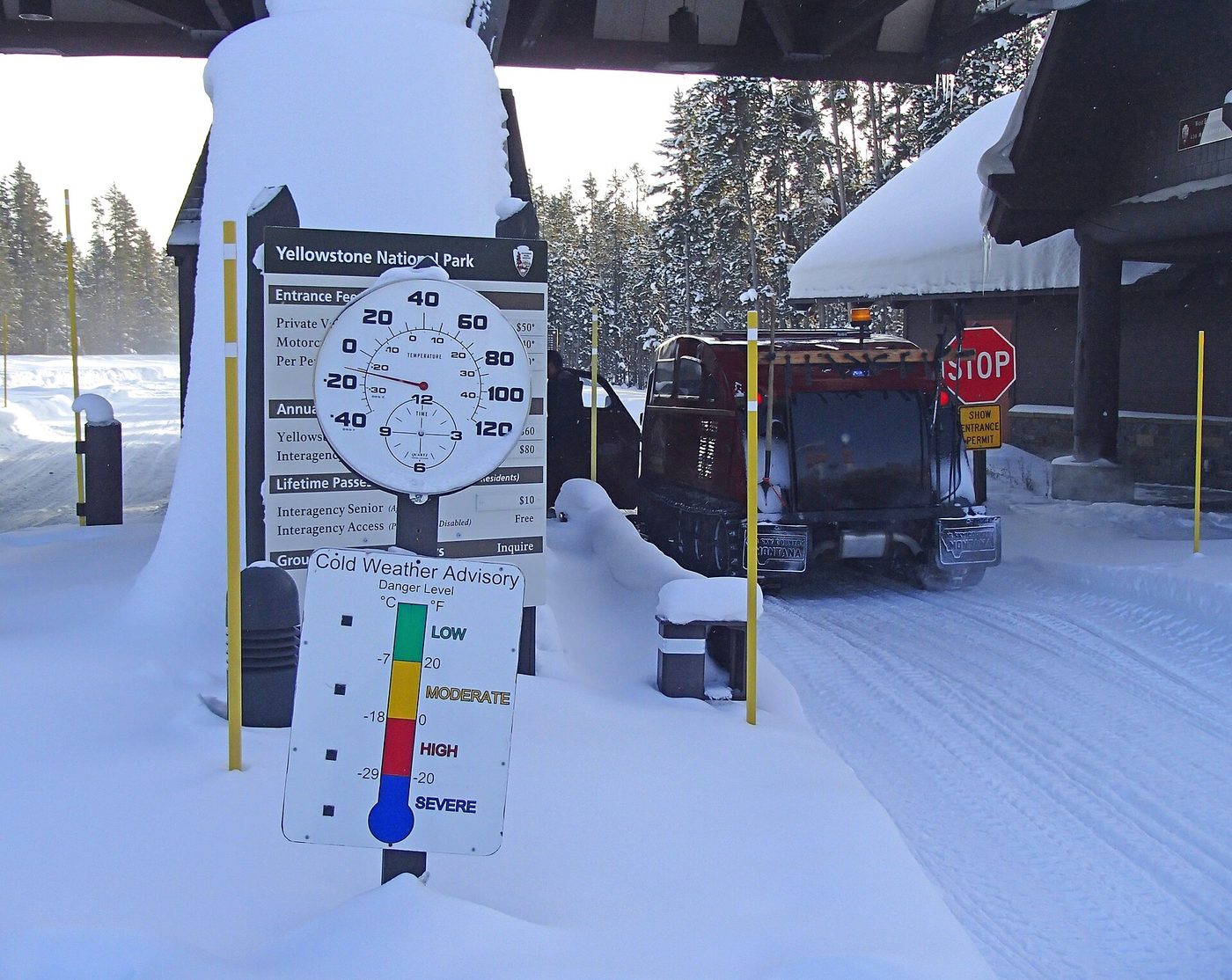
The NPS describes winter daytime temperatures as ranging from zero to 20°F, with sub-zero temperatures common, especially at night and at higher elevations. The park receives an average of 150 inches of snow a year, with higher elevations getting twice that. The record low is -66°F. Our best time to visit Yellowstone guide has the monthly averages; January is usually the coldest month.
Pack as if you’re going on an expedition, because in a way you are:
- Base layers: synthetic or wool long underwear, top and bottom. No cotton.
- Insulation: a fleece or down mid-layer, and a warm insulated jacket.
- Shell: a windproof and waterproof jacket and pants, especially for snowmobiling.
- Extremities: insulated waterproof boots, wool socks, a warm hat, a balaclava or neck gaiter, and mittens with liner gloves.
- Extras: goggles or sunglasses (snow glare is intense), hand and foot warmers, sunscreen, lip balm and traction devices for your boots.
- Camera gear: spare batteries kept warm in an inside pocket, because the cold drains them fast.
Snowmobile tours usually supply suits, boots, gloves and helmets, but check with your operator. For a full checklist, see the Yellowstone winter packing list.
Safety notes: frostbite and hypothermia are real risks. Stay on marked trails and boardwalks, since snow can hide thermal features and thin crust over boiling water. Bison are dangerous in winter too, and they often use the same trails and roads you do. Our Yellowstone safety guide covers thermal and wildlife safety in full.
Winter mistakes to avoid
Most winter trips that go wrong go wrong in the same few ways:
- Arriving before December 15 expecting to see Old Faithful. In the early-winter gap there’s no way into the interior. Check the dates before you book flights.
- Booking late. The Old Faithful Snow Lodge and the holiday-week snowcoach tours fill early. Book as soon as reservations open, especially for Christmas, New Year’s and Presidents’ Day.
- Expecting Grand Prismatic’s colors. In winter the spring is almost always buried in its own steam. Go for the atmosphere, not the rainbow.
- Underdressing for a snowmobile. Even with a suit, wind at speed in subzero air is brutal. Wear proper base layers, a neck gaiter and good gloves, and use the heated grips.
- Assuming the gateway towns are fully open. West Yellowstone is busy in winter, but Gardiner and Cooke City run on reduced hours, and many businesses close in November and April. Check before you count on a restaurant.
- Relying on your phone. Coverage in the park is limited and cold kills batteries. Download maps, carry a paper map and let someone know your plans.
- Driving the northern road after dark. In December and January it’s dark by around 5 p.m. Bison on a dark, icy road are hard to see. Plan to be back by dusk.
- Leaving the boardwalk or trail. Snow can hide thin crust over boiling water, and bison use the same packed paths you do. Stay on marked routes and give animals room.
Is Yellowstone worth visiting in winter?
Yes, if wildlife, steaming geysers and solitude matter more to you than convenience. Winter is the best season for wolves, and watching Old Faithful erupt into subzero air with a handful of people around is unforgettable. It isn’t worth it if you want to drive yourself around the park or keep costs low.
Here’s the honest breakdown:
Winter is worth it if you:
- want to see wolves, and are willing to get up early for them;
- love photography, especially steam, frost and animals in snow;
- dislike crowds;
- are happy to be guided, and to pay for it;
- enjoy skiing, snowshoeing or snowmobiling.
Winter is not for you if you:
- want to see all the park’s highlights in a few days of driving;
- are on a tight budget, since tours and the Snow Lodge are expensive;
- hate the cold;
- want to hike, or see bears.
For a first-time visitor who wants to see everything, summer or September is better. For a second visit, or for anyone drawn to wildlife and solitude, winter might be the best trip you ever take to Yellowstone.
Sample winter trips
Here are three ways to build a winter trip, depending on where you enter.
Three days from Gardiner and Mammoth
- Day 1: arrive via Bozeman, about 80 miles from Gardiner. Walk the Mammoth terraces and the Fort Yellowstone historic district, and look for elk around the village.
- Day 2: leave before dawn for Lamar Valley and spend the morning looking for wolves. Drive to Cooke City for lunch and back.
- Day 3: take a snowcoach day tour from Mammoth to the Grand Canyon of the Yellowstone or Old Faithful, or ski the Upper Terrace Loop.
Three days from West Yellowstone
- Day 1: arrive and explore town, including the Grizzly and Wolf Discovery Center.
- Day 2: take a guided snowmobile or snowcoach tour to Old Faithful, stopping in the geyser basins along the Firehole and Madison rivers.
- Day 3: take a snowcoach tour to the Grand Canyon of the Yellowstone, or ski the trails around town.
Five days: the full winter crossing
- Days 1-2: base in Gardiner or at the Mammoth Hotel, with a dawn in Lamar Valley and a day at Mammoth.
- Days 3-4: snowcoach from Mammoth to the Old Faithful Snow Lodge. Spend two nights watching eruptions, skiing and exploring the geyser basins.
- Day 5: snowcoach out to West Yellowstone or back to Mammoth.
The five-day version is the one to aim for if you can. Two nights at Old Faithful in winter is one of the great experiences in the national park system.
Frequently asked questions
Is Yellowstone open in winter?
Yes. The park never closes, but most roads close to cars from early November. From December 15, 2026 to mid-March 2027, guided snowcoaches and snowmobiles run to the interior. The road from Gardiner to Cooke City is open to cars all year.
Can you drive to Old Faithful in winter?
No. The road to Old Faithful is closed to private cars from early November until spring. In winter, you can reach Old Faithful only by guided snowcoach or snowmobile, or on skis.
When does the Yellowstone oversnow season start?
December 15, 2026. It ends in stages between March 7 and March 15, 2027, depending on the road segment.
Which lodges are open in Yellowstone in winter?
Only two: the Mammoth Hot Springs Hotel, which you can drive to, and the Old Faithful Snow Lodge, which you reach by snowcoach or snowmobile.
Do you need a guide to snowmobile in Yellowstone?
Yes, almost always. All snowmobiles in the park must be with a commercial guide, except for a small number of non-commercial permits given out by lottery each August.
How cold is Yellowstone in winter?
Very. Daytime temperatures usually range from zero to 20°F, and sub-zero nights are common. The record low is -66°F.
What is the best month to visit Yellowstone in winter?
February, for most people: the snowpack is deep, the days are a little longer and warmer than January, and wolves are active in their mating season. January is colder and quieter.
Can you see wolves in Yellowstone in winter?
Yes, and winter is the best season for it. Lamar Valley, on the road open to cars, is the best place, especially at dawn. A guided wolf tour greatly improves your chances.
Sources
- National Park Service, Yellowstone: park roads, operating hours and seasons, weather, visitor centers
- Yellowstone National Park Lodges (Xanterra): winter FAQ
Image credits
| Photo | Credit |
|---|---|
| A snowcoach on the groomed road along the Madison River in February (top of page) | Yellowstone National Park from Yellowstone NP, USA, public domain, via Wikimedia Commons |
| A snowcoach entering at the West Entrance on December 30, beside the park’s cold weather a | Yellowstone National Park from Yellowstone NP, USA, public domain, via Wikimedia Commons |
| A snowcoach group stops to watch bison in Gibbon Meadows in January | Yellowstone National Park from Yellowstone NP, USA, public domain, via Wikimedia Commons |
| A guided snowmobile group on Swan Lake Flat, south of Mammoth, in December | Yellowstone National Park from Yellowstone NP, USA, public domain, via Wikimedia Commons |
| Skiing the old road to Lone Star Geyser, one of the classic Old Faithful-area ski trails | Yellowstone National Park, public domain, via Wikimedia Commons |
| Old Faithful in winter; cold air turns each eruption into a towering steam cloud | Bryan Harry, public domain, via Wikimedia Commons |
| Liberty Cap and Palette Spring after an early-November snowfall; Mammoth is on the road op | Yellowstone National Park from Yellowstone NP, USA, public domain, via Wikimedia Commons |