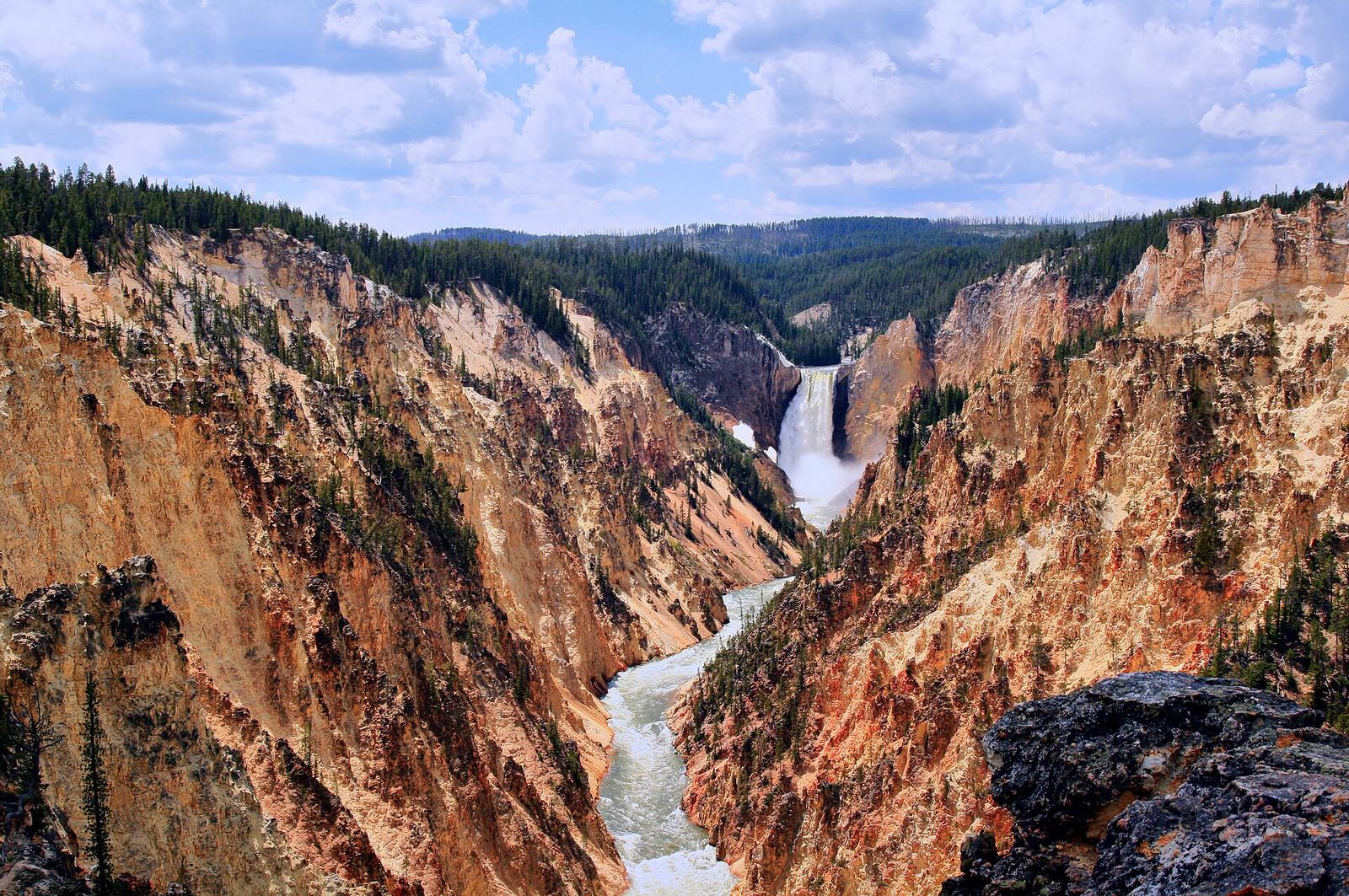
The best things to do in Yellowstone are watching Old Faithful erupt, walking the boardwalk past Grand Prismatic Spring, standing over the Lower Falls at Artist Point, scanning Lamar Valley for wolves at dawn and climbing through the travertine terraces at Mammoth Hot Springs. Below are 40 sights in all, grouped into the park’s five regions, each with the time it takes, how the parking really works and its status as of September 2026.
Most lists of Yellowstone attractions treat the park like a city: here are the top 20, go see them. That misses the thing that decides how your trip actually feels, which is the driving. Yellowstone covers about 2.2 million acres, more than Rhode Island and Delaware put together, and its main road, the Grand Loop, runs 142 miles in a figure eight. The speed limit tops out at 45 mph and drops lower around every developed area, and a single bison standing in the road can hold a mile of cars for twenty minutes. Two sights that look close on a map can be an hour apart in July.
So this guide is organized the way you’ll experience the park: region by region, with the drive between them. For every stop you get the time it realistically takes, what the parking lot is like at 11 a.m. in summer, and an honest verdict, including the handful of famous stops that aren’t worth a detour. Where something is closed or changed for 2026, it’s flagged right in the entry instead of being buried at the bottom.
If you’re still at the stage of deciding when to go and how long to stay, start with our complete Yellowstone trip planning guide and come back here. If you already know you want a day-by-day route, the Yellowstone itinerary turns these 40 sights into ready-made plans for two to seven days. And if you only want the absolute shortlist, our must-see sights in Yellowstone cuts it to the essentials.
A word on crowds before you start. Yellowstone logged 4,762,988 recreation visits in 2025, the second-highest year on record, and July alone brought in about 975,000 of them (NPS figures, checked September 2026). Almost all of those people visit the same dozen stops between 10 a.m. and 4 p.m. The single most useful thing you can do is flip that schedule: be at the famous places early or late, and spend the middle of the day driving, eating or walking somewhere quieter.
What is the number one thing to do in Yellowstone?
Watching Old Faithful erupt is the one thing nearly every visitor does, and it earns the spot: it goes off roughly every 60 to 110 minutes, predictions are posted, and you can walk there from the car. For raw spectacle, though, Grand Prismatic Spring and the Lower Falls hit harder.
If you forced us to rank the top ten, weighted by how much they deliver for the time they take, this is the list:
- Old Faithful and the Upper Geyser Basin. Not just the one geyser, but the mile and a half of boardwalk behind it, with more active geysers packed together than anywhere else on Earth.
- Grand Prismatic Spring from the Fairy Falls overlook. The boardwalk puts you beside it; the overlook shows you the colors. Do both if you can.
- Artist Point and the Lower Falls. A 308-foot waterfall at the head of a yellow-and-rust canyon, 200 yards from the parking lot.
- Lamar Valley at dawn. The best wildlife watching in the lower 48 states on a good morning, and the place to see wolves.
- Hayden Valley. Bison herds in the hundreds, right beside the road between Canyon and Lake.
- Mammoth Hot Springs. Terraces of white and orange travertine that look like nothing else in the park.
- Norris Geyser Basin. The hottest and most changeable thermal area in Yellowstone, home to Steamboat, the world’s tallest active geyser.
- West Thumb Geyser Basin. Hot springs on the shore of Yellowstone Lake, and the prettiest short boardwalk in the park.
- Yellowstone Lake. Best at sunset from Lake Butte Overlook, or from a chair in the Lake Yellowstone Hotel’s sunroom.
- Mud Volcano and Dragon’s Mouth Spring. Thirty minutes of sulfur, noise and boiling mud that kids talk about for years.
That list tilts toward the Lower Loop, and that’s accurate: the southern half of the park holds more of the headline sights. But the northern half has the wildlife, and many people’s favorite memory ends up being a wolf crossing the Lamar River rather than any geyser. Plan to see both halves.
A quick honest note about Old Faithful. It isn’t the tallest geyser in the park, and it isn’t the most beautiful. What it has is reliability, and a grandstand-style setting where a few thousand people cheer together at the same moment. That’s fun in its own way. If you find crowds wearing, watch one eruption from the benches, then catch the next one from Observation Point on the hill above, or from the upper deck of the Old Faithful Inn. It’s the same geyser with none of the elbows. Our full guide to Old Faithful covers prediction times, the best seats and what to pair it with.
How Yellowstone’s five regions fit together
The park splits naturally into five regions, and knowing them makes every other decision easier. Our guide to Yellowstone’s regions goes deeper on each, but here’s the working version:
- Geyser Country (southwest): Old Faithful, the Upper, Midway and Lower geyser basins along the Firehole River, Madison Junction and Norris. This is where most of the famous thermal features are.
- Mammoth Country (northwest): Mammoth Hot Springs, the historic Fort Yellowstone buildings, and Gardiner just outside the North Entrance.
- Roosevelt Country (northeast): Tower-Roosevelt, Tower Fall and Lamar Valley, the park’s wildlife heartland.
- Canyon Country (center): the Grand Canyon of the Yellowstone with its two big waterfalls, and Hayden Valley to the south.
- Lake Country (southeast): Yellowstone Lake, Fishing Bridge, Lake Village, West Thumb and Grant Village.
The Grand Loop links them in a figure eight. The Lower Loop (Madison, Old Faithful, West Thumb, Lake, Canyon, Norris) runs about 96 miles; the Upper Loop (Norris, Mammoth, Tower, Canyon) runs about 70. The Norris-Canyon road is the crossbar they share. Five entrances feed in from the outside: West (West Yellowstone), North (Gardiner), Northeast (Cooke City), East (from Cody) and South (from Grand Teton). Entrance details, fees and passes live on our Yellowstone entrance fee guide, and if you haven’t picked a gate yet, which entrance is best depends mostly on where you’re sleeping.
Here are the drive distances between the main junctions. The times are realistic summer times with a few stops, not what a navigation app promises at 6 a.m.
| From | To | Miles | Typical summer drive |
|---|---|---|---|
| West Entrance | Madison Junction | 14 | 30 min |
| Madison Junction | Old Faithful | 16 | 35-45 min |
| Old Faithful | West Thumb | 17 | 35-40 min |
| West Thumb | Lake Village / Fishing Bridge | 21 | 40 min |
| Fishing Bridge | Canyon Village (through Hayden Valley) | 16 | 35 min to over an hour |
| Canyon Village | Norris | 12 | 25 min |
| Norris | Madison Junction | 14 | 30 min |
| Norris | Mammoth Hot Springs | 21 | 45 min |
| North Entrance (Gardiner) | Mammoth Hot Springs | 5 | 15 min |
| Mammoth Hot Springs | Tower-Roosevelt | 18 | 40 min |
| Tower-Roosevelt | Canyon Village (over Dunraven Pass) | 19 | 45-50 min |
| Tower-Roosevelt | Northeast Entrance (through Lamar Valley) | 29 | 1 hr without stops |
| South Entrance | West Thumb | 22 | 40 min |
| East Entrance | Fishing Bridge | 27 | 45-50 min |
Mileage follows the NPS road chart. Drive the full 142-mile Grand Loop without stopping and you’re looking at five to six hours behind the wheel, which is why nobody sensible does it in a day.
Three practical things fall out of that table. First, an average of 25 to 30 mph is honest planning for summer. Second, the Hayden Valley stretch is the one most likely to blow up your schedule, because bison use the road as a footpath. Third, where you sleep matters more than any single sight: a night at Canyon or Lake puts you in the middle of everything, while West Yellowstone puts you 30 minutes from the first geyser and 90 minutes from the canyon. Our where to stay in Yellowstone guide works through that trade-off, and lodging in Yellowstone National Park covers the in-park lodges, their seasons and how booking works.
All 40 sights at a glance
| # | Sight | Region | Time needed | Parking reality (summer) | Status, September 2026 |
|---|---|---|---|---|---|
| 1 | Old Faithful | Geyser | 45-90 min | Huge lots, rarely full | Open |
| 2 | Upper Geyser Basin to Morning Glory | Geyser | 2-4 hr | Use Old Faithful lots | Open |
| 3 | Old Faithful Inn | Geyser | 30-45 min | Old Faithful lots | Summer season |
| 4 | Observation Point | Geyser | 45 min | Old Faithful lots | Open |
| 5 | Black Sand Basin | Geyser | 20-30 min | Small, fills midday | Open |
| 6 | Grand Prismatic Spring (Midway) | Geyser | 45-60 min | Full 10 a.m.-4 p.m. | Open |
| 7 | Fairy Falls overlook and falls | Geyser | 45 min / 3 hr | Fills by mid-morning | Open |
| 8 | Firehole Lake Drive, Great Fountain | Geyser | 30-90 min | Pullouts, easy | Open (summer road) |
| 9 | Fountain Paint Pot | Geyser | 30 min | Medium lot, turns over fast | Open |
| 10 | Lone Star Geyser and Kepler Cascades | Geyser | 2.5-4 hr | Small lot at Kepler | Open |
| 11 | Firehole Canyon Drive | Geyser | 20-30 min | Pullouts | Open; swim area closed |
| 12 | Norris Geyser Basin | Geyser | 1.5-3 hr | Fills late morning | Open |
| 13 | Artists Paintpots | Geyser | 45 min | Tiny, overflows to road | Open |
| 14 | Gibbon Falls | Geyser | 15 min | Roadside pullout | Open |
| 15 | Virginia Cascade Drive | Geyser | 20 min | Pullouts | Open (summer road) |
| 16 | Mammoth Lower Terraces | Mammoth | 1-2 hr | Several small lots | Open |
| 17 | Upper Terrace Drive | Mammoth | 30 min | Pullouts | Open (summer road) |
| 18 | Fort Yellowstone and Albright Visitor Center | Mammoth | 45-60 min | Easy | Open year-round |
| 19 | Roosevelt Arch | Mammoth | 15 min | Gardiner streets | Open year-round |
| 20 | Undine Falls and Wraith Falls | Mammoth | 15 / 45 min | Pullout / small lot | Open |
| 21 | Blacktail Plateau Drive | Mammoth | 45 min | None needed | Seasonal gravel road |
| 22 | Lamar Valley | Roosevelt | 2-4 hr | Pullouts, crowded at dawn | Open year-round |
| 23 | Slough Creek | Roosevelt | 1-2 hr | Gravel road, small lots | Open |
| 24 | Trout Lake | Roosevelt | 1 hr | Very small lot | Open |
| 25 | Tower Fall and Calcite Springs | Roosevelt | 30 min | Busy, turns over | Open until Oct 12 beyond Tower Fall |
| 26 | Petrified Tree | Roosevelt | 15 min | Tiny, no room for trailers | Open |
| 27 | Roosevelt Lodge, cookout and rides | Roosevelt | 1-3 hr | Easy | Summer season |
| 28 | Artist Point | Canyon | 30-45 min | Large but busy 10-3 | Open |
| 29 | North Rim viewpoints | Canyon | 1-2 hr | Several lots | Open |
| 30 | Brink of the Lower Falls | Canyon | 45 min | Medium lot | Open |
| 31 | Hayden Valley | Canyon | 1-2 hr | Pullouts | Open |
| 32 | Dunraven Pass and Mount Washburn | Canyon | 30 min / 4-5 hr | Trailhead fills early | Closes Oct 12, 2026 |
| 33 | Canyon Visitor Education Center | Canyon | 45-60 min | Large village lots | Open |
| 34 | Mud Volcano and Dragon’s Mouth | Lake | 30-45 min | Medium, turns over | Open |
| 35 | LeHardy Rapids | Lake | 20 min | Small pullout | Open |
| 36 | Fishing Bridge and visitor center | Lake | 30-45 min | Easy | Open |
| 37 | Lake Yellowstone Hotel | Lake | 45 min+ | Easy | Summer season |
| 38 | Storm Point and Lake Butte Overlook | Lake | 1.5 hr / 30 min | Small lots | Open; bear closures possible |
| 39 | Natural Bridge | Lake | 1.5 hr | Bridge Bay area | Seasonal bear closures |
| 40 | West Thumb Geyser Basin | Lake | 45 min | Medium, fills midday | Open |
Closures and changes to check before you go (September 2026)
Yellowstone is a moving target. Hydrothermal areas shift, floods take out roads, and trails close for years at a time. Several of the most-copied “top things to do” lists online still send people to places that are shut. This is where things stood when we checked the NPS conditions page in September 2026:
| What | What it means for you | Status (checked September 2026) |
|---|---|---|
| Biscuit Basin | Parking lot and boardwalk shut after a hydrothermal explosion on July 23, 2024 | Closed until further notice |
| Mystic Falls | The usual trailhead is at Biscuit Basin, so the standard route is cut | Effectively closed via Biscuit Basin |
| Firehole River Swim Area | The popular summer swimming hole in Firehole Canyon | Closed; NPS said no earlier than late summer or early fall |
| Boiling River (near Mammoth) | Soaking spot damaged in the June 2022 flood | No swimming |
| Uncle Tom’s Trail (Canyon) | The steel staircase down to the Lower Falls | Closed since 2019 |
| Dunraven Pass, Beartooth Highway, Chief Joseph Scenic Byway | High roads in the northeast | Close October 12, 2026 |
| Gardner River High Bridge (North Entrance road) | Single lane, delays up to 15 minutes, no vehicles 8’6″ or wider or 75′ or longer | Through late October 2026 |
| Pebble Creek and Norris campgrounds | Two campgrounds not operating this year | Closed / not listed for 2026 |
| Wildland fire danger | Campfire rules can tighten quickly | High (as of Aug 31, 2026) |
Road construction also adds its own delays: chip sealing can hold you up to 30 minutes, and bridge work near Bridge Bay, the Firehole River and the Yellowstone River up to 15 (checked September 2026). Opening and closing dates for every road segment, plus what stays open in winter, are on our Yellowstone road closures page. Campground status is in the Yellowstone camping guide.
One more thing that isn’t a closure but catches people out: in-park lodging and campgrounds sell out months ahead, and there’s no timed-entry system to the park itself. You can always drive in; you just can’t always sleep in. Plan the beds first, then the sights.
Geyser Country: Old Faithful, the Firehole basins and Norris
The Firehole River runs north from Old Faithful to Madison Junction, and along its banks sit three geyser basins that together hold most of the world’s active geysers. This is the most visited stretch of the park, and for good reason. It’s also where you most need a plan, because the parking lots here run from “huge and never full” at Old Faithful to “hopeless between 10 and 4” at Grand Prismatic. For the full treatment of the spring itself, see our Grand Prismatic Spring guide; for the basin behind Old Faithful, the Upper Geyser Basin guide has the trail map and the predicted-geyser schedule.
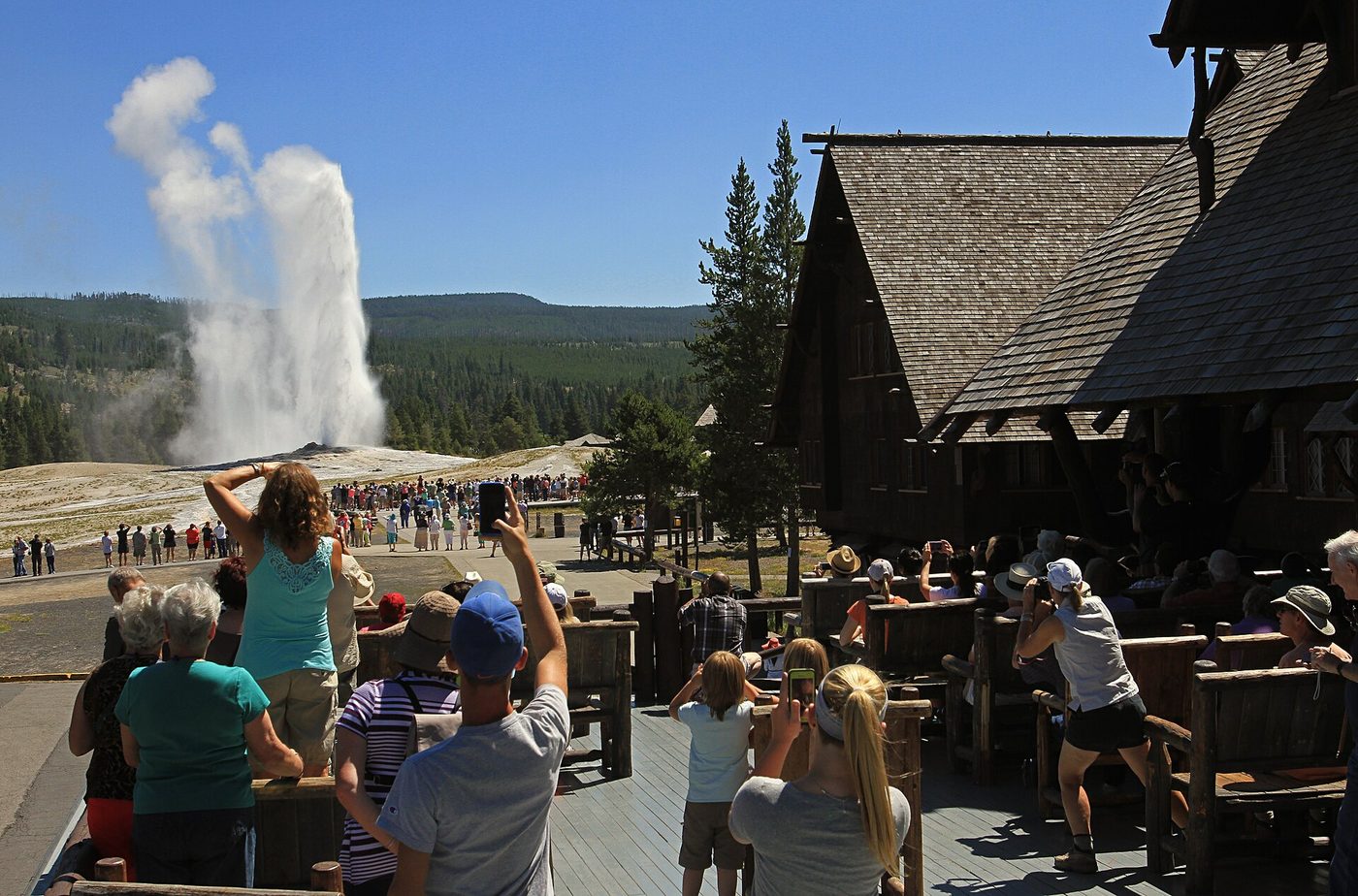
1. Old Faithful
Time needed: 45 to 90 minutes, depending on when you arrive in the prediction window. Parking: several large lots around the Old Faithful complex; you’ll almost always find a space.
Old Faithful erupts every 60 to 110 minutes or so, sending water 106 to 184 feet high for between one and a half and five minutes. Rangers predict each eruption from the length of the previous one, and the forecast is posted at the Old Faithful Visitor Education Center, on signs around the area and in the NPS app, usually good to within about ten minutes either side. Get to the benches 20 minutes before the predicted time in summer if you want a front-row seat.
Verdict: go, obviously, but don’t make it the whole visit. The eruption lasts a few minutes; the basin around it deserves the afternoon. Morning and evening eruptions draw a fraction of the midday crowd, and the low light makes the steam glow. The visitor education center is worth 20 minutes for its exhibits on how geysers work, and it’s one of the few buildings in the park open year-round.
2. The Upper Geyser Basin loop to Morning Glory Pool
Time needed: 2 to 4 hours. Parking: use the Old Faithful lots and walk.
Behind Old Faithful, boardwalks and paved paths run about 1.5 miles north to Morning Glory Pool, passing more geysers per square mile than anywhere else on the planet. Four big ones are predicted by rangers: Grand Geyser, the tallest predictable geyser in the world, which can shoot 150 to 200 feet; Castle Geyser, with its fortress-like cone, erupting roughly twice a day; Riverside Geyser, which arches over the Firehole River about every six hours; and Daisy. Between them you’ll pass Beehive, Giantess, Crested Pool, Chromatic Pool and dozens of smaller features gurgling away.
The honest trick is to check the prediction board before you set off and build the walk around whichever big geyser is due. Grand’s window can be a couple of hours wide, but when it goes it’s the best eruption you’ll see in Yellowstone.
Verdict: the best three hours in Geyser Country. Morning Glory Pool itself is a little faded from decades of coins and rubbish thrown into it, but the walk there is the point. The path is flat and mostly paved, so it works with strollers and wheelchairs for much of its length.
3. Old Faithful Inn
Time needed: 30 to 45 minutes to look around. Parking: Old Faithful lots.
The Old Faithful Inn opened in 1904 and is still the largest log building most people will ever stand inside. Its lobby rises nearly 80 feet to a ceiling of peeled logs and gnarled lodgepole branches, with a massive stone fireplace in the middle. You don’t need to be a guest to wander in, climb to the mezzanine or step out onto the upper deck, which looks straight at Old Faithful. Free historic tours of the building usually run in summer; ask at the front desk.
Verdict: worth it even if you’re staying elsewhere. Come for a coffee, watch an eruption from the deck, and read about how the place was built through a Yellowstone winter. The inn runs in summer only; our Yellowstone historic sites guide covers its story and the other buildings from the same era.
4. Observation Point
Time needed: about 45 minutes. Parking: Old Faithful lots.
A short trail leaves the boardwalk across the Firehole River from Old Faithful and climbs a couple of hundred feet in about half a mile to a viewpoint above the basin. From there you watch Old Faithful erupt with the Inn, the lodge and the whole steaming basin laid out below you, and you’ll share it with a few dozen people instead of a few thousand.
Verdict: the best way to see a second Old Faithful eruption. Not suitable for strollers. Watch your footing coming down, and go in daylight: bison wander this area.
5. Black Sand Basin
Time needed: 20 to 30 minutes. Parking: a small lot about a mile north of the Old Faithful area; it fills at midday but turns over quickly.
A compact loop past Emerald Pool, Sunset Lake and Cliff Geyser, which erupts from the edge of Iron Spring Creek. The black sand is obsidian grit, and the colors in Emerald Pool are some of the richest in the park.
Verdict: a quick, good stop on the way in or out of Old Faithful. Its neighbor, Biscuit Basin, about two miles north, has been closed since the July 2024 hydrothermal explosion and was still closed in September 2026, so ignore any list that tells you to walk from there to Mystic Falls.
6. Grand Prismatic Spring and Midway Geyser Basin
Time needed: 45 to 60 minutes. Parking: the Midway Geyser Basin lot is small for the traffic it gets, and from roughly 10 a.m. to 4 p.m. in summer you’ll queue on the highway for it.
Grand Prismatic is the largest hot spring in the United States, about 370 feet across and more than 120 feet deep, ringed in bands of orange, yellow and green made by heat-loving microbes. A boardwalk loop of under a mile climbs from the parking lot past the huge crater of Excelsior Geyser, which pours more than 4,000 gallons of hot water a minute into the Firehole, then circles the edge of the spring.
Here’s what nobody tells you: from the boardwalk you’re standing almost level with the spring, and on a cool morning the steam covers most of it. You’ll see blue water and orange runoff, but not the rainbow you’ve seen in photos. For that you need height, which is what the Fairy Falls overlook is for.
Verdict: essential, but time it. Go before 9 a.m. or after 5 p.m., on a warm dry day if you can choose. Wind helps too, pushing the steam aside. Hold onto your hat on the boardwalk; the spring is lined with them.
7. The Fairy Falls overlook (and Fairy Falls)
Time needed: 45 minutes for the overlook; 3 hours if you continue to the falls. Parking: the Fairy Falls trailhead lot, about a mile south of Midway, fills by mid-morning.
From the trailhead you cross the Firehole on an old steel bridge and follow a flat former road along the base of the hill. After about half a mile a signed spur climbs roughly 100 feet to an overlook platform built in 2017, and there is Grand Prismatic in full color. Keep going on the flat trail and you reach Fairy Falls, a 197-foot ribbon of water, in about 2.7 miles from the lot, 5.4 round trip.
Verdict: the overlook is one of the two or three best short walks in the park. Early afternoon on a sunny day gives the strongest colors, which unfortunately is also when the lot is fullest; get dropped off, or bike in along the Fountain Freight Road from Fountain Flat Drive. The falls are pretty but not special by Yellowstone standards, so continue only if you want a flat walk. Our best hikes in Yellowstone guide puts Fairy Falls in context with the others.
8. Firehole Lake Drive and Great Fountain Geyser
Time needed: 30 minutes to drive; up to 90 if you wait for Great Fountain. Parking: pullouts along the road, rarely a problem.
A three-mile one-way road loops off the Grand Loop through the Lower Geyser Basin, passing White Dome Geyser, Firehole Lake and Great Fountain Geyser. Great Fountain erupts in a series of bursts that can reach 75 to over 200 feet, typically once or twice a day, and rangers post a prediction window about two hours wide. On a lucky day you’ll see a “superburst” with the whole terrace flooding.
Verdict: underrated. Few people plan around it, so when Great Fountain goes you might share it with fifty people. Bring a book and a camp chair; the waiting is part of the experience. The drive is closed to cars in winter. More detail in our Firehole Lake Drive and Great Fountain Geyser guides.
9. Fountain Paint Pot
Time needed: 30 minutes. Parking: a medium lot that fills but turns over fast.
A half-mile boardwalk loop that shows you all four types of Yellowstone hydrothermal feature in one go: hot springs, geysers, fumaroles (steam vents) and mudpots. The paint pots themselves bubble pink and grey, thickest in late summer when the ground is dry, and Clepsydra Geyser erupts almost constantly at the far end.
Verdict: the best 30-minute stop in the park for children, or for anyone who wants the whole geyser story in one small place. Our Fountain Paint Pot page has the loop map. If you have extra time, Fountain Flat Drive across the road is a pleasant, quiet side trip.
10. Lone Star Geyser and Kepler Cascades
Time needed: 2.5 to 4 hours. Parking: a small lot at Kepler Cascades, about 2.5 miles south of Old Faithful on the road to West Thumb.
Kepler Cascades is a roadside viewing platform over the Firehole tumbling through a narrow gorge in a series of drops. Just beyond, an old paved road (closed to cars, open to bikes) runs 2.4 miles through the forest to Lone Star Geyser, which erupts 30 to 45 feet about every three hours from a pink-and-grey cone. There’s a logbook at the geyser where visitors record eruption times, which tells you roughly when to expect the next one.
Verdict: the best way to get a real geyser to yourself. The walk is flat and shaded, and it’s one of the few places in the park where biking is part of the plan. Worth it if you’ve already done the Upper Geyser Basin and want something quieter. If you’re after more stops like this, our guide to Yellowstone’s quieter corners lists 25 of them.
11. Firehole Canyon Drive
Time needed: 20 to 30 minutes. Parking: pullouts.
A two-mile one-way road just south of Madison Junction winds up a narrow canyon of dark rhyolite cliffs, passing the 40-foot Firehole Falls. It’s normally the route to the Firehole River Swim Area, which was closed in 2026 and still shut when we checked in September. All swimming questions, including which spots are legal and when, are handled on our fishing in Yellowstone page.
Verdict: a nice 20-minute detour when you’re passing Madison, not worth a special trip while the swim area is shut. See the Firehole Canyon Drive guide for the pullouts worth using.
North to Norris, Madison and the Gibbon River. North of the Firehole basins, the Grand Loop follows the Gibbon River up past waterfalls and paint pots to Norris, the most volatile thermal area in the park. Madison Junction, where the West Entrance road arrives, sits between the two, in a meadow where elk and bison graze beside the river. It isn’t a destination in itself, but the 14-mile road in from the West Entrance along the Madison River is one of the best wildlife drives on the west side, particularly at dawn in September when bull elk bugle across the water.
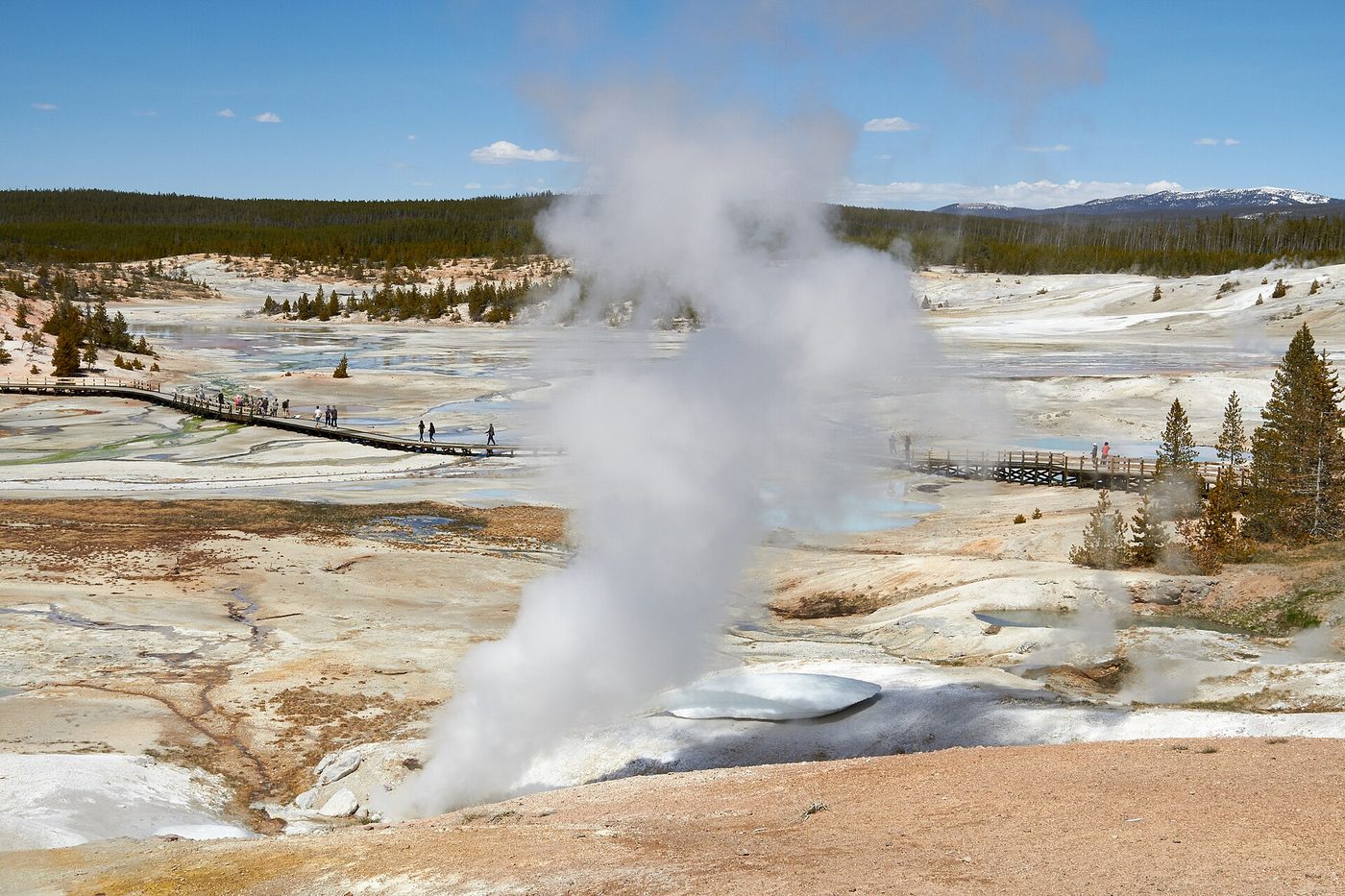
12. Norris Geyser Basin
Time needed: 1.5 to 3 hours. Parking: a decent-sized lot that fills by late morning in summer; the overflow runs along the entrance road.
Norris is the hottest, most acidic and most changeable thermal area in Yellowstone. A research drill hole here in 1929 recorded 459°F just 1,087 feet down. It has two parts: Porcelain Basin, a bleached white valley you can see from an overlook and walk in about three-quarters of a mile, and Back Basin, a wooded 1.5-mile loop that includes Steamboat Geyser. Steamboat is the tallest active geyser in the world, capable of eruptions over 300 feet, but it’s wildly irregular: gaps have ranged from days to decades. Most visitors see it steaming and splashing, not erupting. Details on its recent record are in our Steamboat Geyser guide.
The small stone-and-log Norris Geyser Basin Museum, built in 1930, sits at the trailhead and is worth ten minutes. About a mile north, the Museum of the National Park Ranger tells the story of the ranger service in a reconstructed soldier station.
Verdict: more interesting than beautiful, and many people love it more than Old Faithful because it feels raw and unpredictable. Do Porcelain Basin at minimum. Note that the Norris campground isn’t operating in 2026. Our Norris Geyser Basin guide has the full loop.
13. Artists Paintpots
Time needed: about 45 minutes. Parking: a tiny lot that overflows along the Grand Loop by mid-morning.
About four and a half miles south of Norris, a flat then briefly steep trail of about a mile round trip leads to a hillside of colorful hot springs and, at the top, some of the best mudpots in the park, thick and bubbling and occasionally splattering. It’s a small area, which is its appeal.
Verdict: good value if you catch the lot with space. If it’s jammed, don’t circle; carry on to Fountain Paint Pot instead, which gives you similar mud with far easier parking. Our Artists Paintpots page covers the loop.
14. Gibbon Falls
Time needed: 15 minutes. Parking: a roadside pullout between Madison and Norris.
An 84-foot waterfall sliding down a rock face beside the road, seen from a short walkway along the canyon rim. The cliff here marks the edge of the Yellowstone Caldera.
Verdict: a pleasant leg-stretch you’ll pass anyway. Don’t make a special trip.
15. Virginia Cascade Drive
Time needed: 20 minutes. Parking: pullouts along the road.
A 2.5-mile one-way side road off the Norris-Canyon road follows the Gibbon River to Virginia Cascade, a 60-foot fan of water dropping over a rock ledge. It’s quiet, forested and pretty.
Verdict: a nice alternative to the main road between Norris and Canyon if you’re not in a hurry. Pleasant rather than memorable.
Mammoth Country: terraces, forts and the North Entrance
The north end of the park is different in character: lower, drier and more open, with sagebrush hills and a small historic town at Mammoth Hot Springs that looks more like an old army post than a national park village. That’s because it was one. The North Entrance road from Gardiner is the only one open to cars all year, along with the road east through Lamar Valley to Cooke City, so this is also the region you can visit in January without a snowcoach. The Mammoth Hot Springs guide covers the whole area, and our things to do in Mammoth Hot Springs page gets granular.
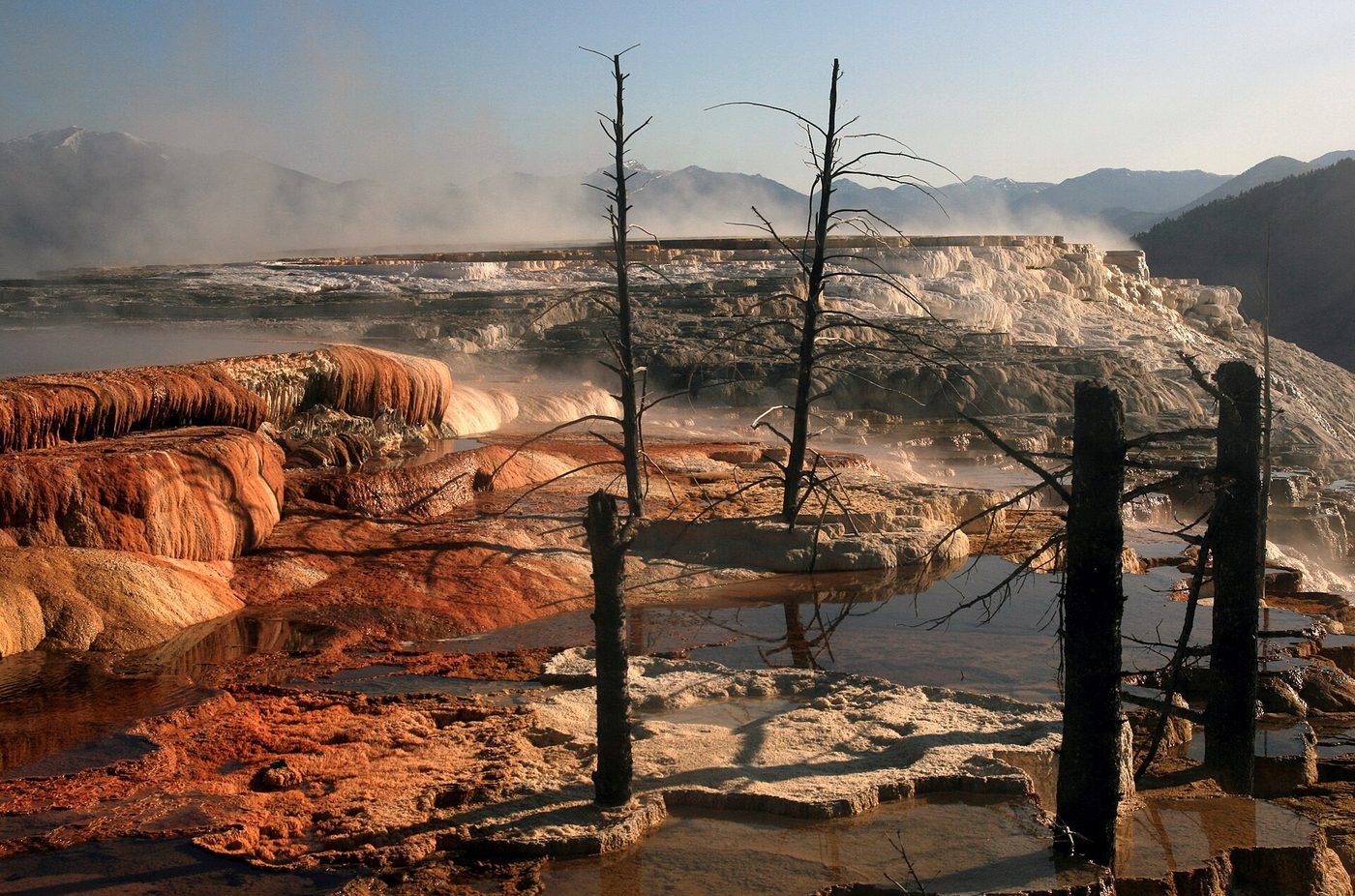
16. Mammoth Hot Springs Lower Terraces
Time needed: 1 to 2 hours. Parking: several small lots at the base of the terraces and along the road; if they’re full, park in the village and walk.
Hot water rising through limestone deposits travertine in great white and orange steps, and Mammoth’s boardwalks climb about 300 feet through them past Liberty Cap (a 37-foot dormant cone), Palette Spring, Minerva Terrace and Canary Spring. The terraces change constantly: springs switch off and on, and a terrace that’s dazzling one year can be grey and dry the next. That’s part of the fascination, and a good reason to check with rangers about which features are active.
Verdict: essential, and quite unlike anything in Geyser Country. The walk involves stairs, so it’s harder with a stroller, though the lower boardwalks are manageable. The terraces are at their best in soft light, early or late. See the Mammoth Hot Springs terraces guide for which are active this season, and why the terraces are white if you want the chemistry.
17. Upper Terrace Drive
Time needed: 30 minutes. Parking: pullouts along the loop.
A 1.5-mile one-way loop road above the main terraces, reached from the Grand Loop just south of Mammoth. It passes Orange Spring Mound, Angel Terrace and White Elephant Back Terrace, with views over the village to the mountains beyond. In winter it becomes a ski and snowshoe trail.
Verdict: worth it if you’re already at Mammoth. Canary Spring’s top platform, reachable from here, is one of the best views of active travertine in the park.
18. Fort Yellowstone and the Albright Visitor Center
Time needed: 45 minutes to an hour. Parking: easy, in the village.
The US Army ran Yellowstone from 1886 until 1918, and the stone buildings it left behind at Mammoth are still in use as park offices and housing. A self-guided walking tour takes you past the officers’ row and the old guardhouse. The Albright Visitor Center, open year-round, occupies the former bachelor officers’ quarters and has exhibits on the park’s wildlife and on the 1871 survey, including works by painter Thomas Moran and photographer William Henry Jackson, whose images helped persuade Congress to create the park.
Verdict: the best short history lesson in Yellowstone, and a good rainy-afternoon stop. It’s also elk central: in September and October bull elk rut on the lawns here, bugling and chasing rivals between parked cars. They’re magnificent and genuinely dangerous; give them 25 yards at the very least. Distance rules and what to do if an animal approaches are on our Yellowstone safety page. The park’s wider story, from the 1872 act onward, is in our Yellowstone National Park history guide.
19. Roosevelt Arch
Time needed: 15 minutes. Parking: on the streets of Gardiner or the small lot by the arch.
The stone arch at the North Entrance was dedicated in 1903, with President Theodore Roosevelt laying the cornerstone. Carved across the top: “For the benefit and enjoyment of the people.” Stand under it for a photo, then drive through; the old road entrance runs right beneath it.
Verdict: a 15-minute stop that’s worth it for history lovers and anyone arriving from the north. If you’re coming in from the west or south, don’t drive an hour out of your way for it. Gardiner itself is covered in our things to do in Gardiner, Montana guide.
20. Undine Falls and Wraith Falls
Time needed: 15 minutes for Undine; 45 for Wraith. Parking: a roadside pullout for Undine; a small lot for Wraith.
East of Mammoth on the road to Tower, Undine Falls drops about 60 feet in three steps, visible from a pullout. A couple of miles further east, a flat trail of about a mile round trip crosses a boardwalk through wetland to 79-foot Wraith Falls.
Verdict: Undine is a quick roadside stop; Wraith is a good leg-stretch for kids. Neither is a reason to drive this road by itself, but they break up the drive to Lamar nicely.
21. Blacktail Plateau Drive and Forces of the Northern Range
Time needed: 45 minutes. Parking: none needed; the drive itself is the attraction.
Blacktail Plateau Drive is a one-way gravel road of about seven miles that leaves the main road east of Mammoth and rejoins it near Tower, running through open sage country, aspen groves and small valleys that are good for elk, mule deer and the odd black bear. It’s seasonal and not suitable for large RVs. Nearby, the Forces of the Northern Range boardwalk is a half-mile loop with signs explaining how fire, wildlife and weather shape this landscape.
Verdict: the drive is a good choice for anyone who likes backroads and doesn’t mind dust. Early morning is best for animals. Skip it with a big RV or a low-slung car.
Roosevelt Country: Tower and Lamar Valley
If Geyser Country is the park’s showpiece, Roosevelt Country is its heart. This is where Yellowstone’s famous wildlife is easiest to see, especially in the broad, glacier-carved Lamar Valley, and where the park feels most like the Old West it’s often sold as. It’s also the region most people skip because it looks like a long way from everything else. It is a long way: from Canyon it’s an hour over Dunraven Pass; from Old Faithful it’s two and a half. But anyone serious about wildlife should build at least one early morning here into their trip. Our Lamar Valley guide is the full deep dive.
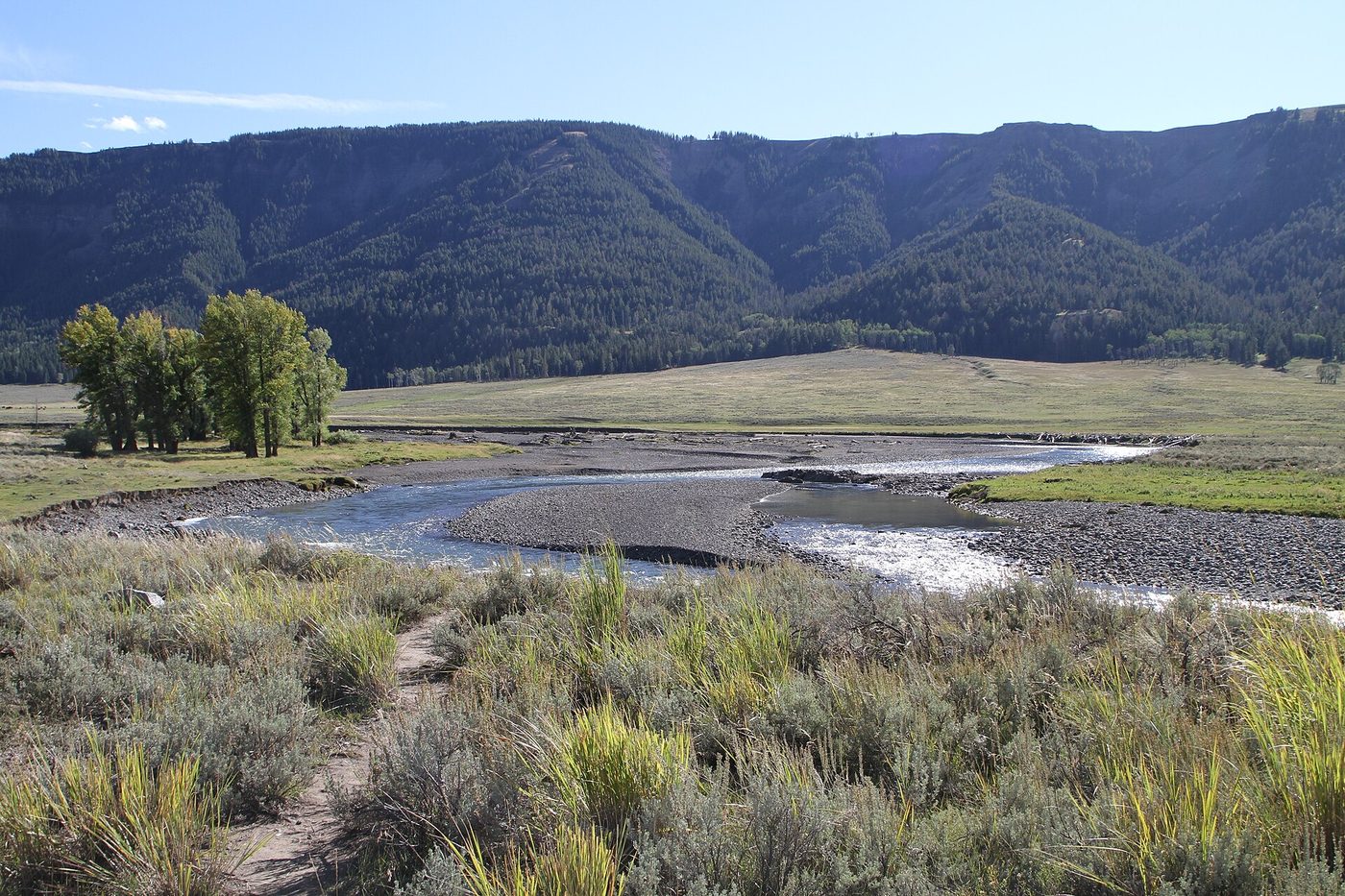
22. Lamar Valley
Time needed: 2 to 4 hours, starting at first light. Parking: pullouts along the Northeast Entrance road. At dawn the ones with a view of active wolf areas fill with spotting scopes.
The Lamar River runs through a wide, grassy valley about 12 miles east of Tower Junction, and the road follows it through the valley and up Soda Butte Creek toward the Northeast Entrance. Bison graze here in herds of hundreds. Pronghorn, elk, coyotes and bald eagles are common. Wolves, which were reintroduced to Yellowstone in 1995, are seen here more reliably than anywhere else in the world, mostly at dawn and dusk and often at a distance. Grizzly and black bears turn up in spring and early summer.
The trick is patience and optics. Get to the valley before sunrise, drive slowly and stop where you see a cluster of people with spotting scopes. Many wolf watchers are happy to let you look through theirs. Binoculars are essential, a scope is a bonus, and if you want someone who knows the packs and their current dens, a guided wildlife tour from Gardiner or Cooke City is the most efficient way to see wolves.
Verdict: the best thing in the park for many people, and a letdown for others who arrive at 11 a.m. and see a few distant bison. Timing is everything. The road is open year-round, so this is also the heart of winter wildlife watching. See wolf watching in Yellowstone and the Lamar Valley drive guide.
23. Slough Creek
Time needed: 1 to 2 hours. Parking: small lots along a gravel road of just over two miles leading to Slough Creek Campground.
A side valley north of the Lamar, with a meandering creek, one of the park’s best cutthroat trout streams, and wide meadows that wolves use in some years. The trail from the campground road follows an old wagon route into open valleys.
Verdict: a lovely quieter alternative to the main Lamar road, especially for anglers. On a morning when the valley is busy, this is where you escape to.
24. Trout Lake
Time needed: about an hour. Parking: a very small lot on the Northeast Entrance road; arrive early or late.
A short, steep trail of about 1.2 miles round trip climbs to a small lake ringed by forest and meadows, with the Absaroka peaks behind it. In early summer, cutthroat trout spawn in the inlet stream, and river otters come to hunt them.
Verdict: one of the park’s most rewarding short walks, and the best chance many visitors get at otters. Our Trout Lake guide has the seasonal timing.
25. Tower Fall and Calcite Springs
Time needed: 30 minutes. Parking: a busy lot by the Tower Fall store that turns over steadily.
Tower Fall drops 132 feet between eroded volcanic pinnacles, seen from an overlook a couple of minutes’ walk from the lot. The old trail to the base has been closed for years. Just north on the road, the Calcite Springs overlook looks down into the narrow canyon of the Yellowstone River, with columns of basalt and steaming springs along its walls.
Verdict: a good stop if you’re passing between Tower and Canyon, but no more than that. It’s a short look, not a destination. Note that the road from Tower Fall south over Dunraven Pass closes October 12, 2026; after that, Tower Fall is a dead end from the north. See the Tower Fall guide.
26. Petrified Tree
Time needed: 15 minutes. Parking: a tiny lot at the end of a narrow spur road west of Tower Junction; there’s no room to turn a trailer.
The stump of a redwood that grew here roughly 50 million years ago and was buried by volcanic debris, then turned to stone. It stands behind a fence because earlier visitors chipped away its neighbors.
Verdict: a quick curiosity. Worth it if you’re passing, and a good one to explain to kids. Otherwise skip.
27. Roosevelt Lodge, the Old West cookout and horseback rides
Time needed: 1 to 3 hours. Parking: easy at the lodge.
Roosevelt Lodge, built in 1920 near a spot where Theodore Roosevelt camped, is the park’s most rustic lodging: cabins, rocking chairs on a porch and a corral out back. In summer, the concessioner runs horseback trail rides, stagecoach rides and the Old West Dinner Cookout, where you ride out by horse or wagon to a meadow for a steak dinner cooked over an open fire.
Verdict: hokey, fun and very popular, so book well ahead. It’s the one place in Yellowstone that leans into the cowboy image. Details and other outfitters are in our horseback riding in Yellowstone guide. Lamar Valley itself is the site of the historic Lamar Buffalo Ranch, where the park saved its last wild bison in the early 1900s.
Canyon Country: the Grand Canyon of the Yellowstone and Hayden Valley
The Yellowstone River leaves Yellowstone Lake, wanders north through Hayden Valley, then drops over two big waterfalls into a canyon of yellow, pink and rust-colored rock. The Grand Canyon of the Yellowstone runs about 20 miles long and 800 to 1,200 feet deep, and it’s the center of the park both geographically and in terms of where you’ll likely spend at least one night. Our Grand Canyon of the Yellowstone guide covers every viewpoint; Canyon Village is the base.
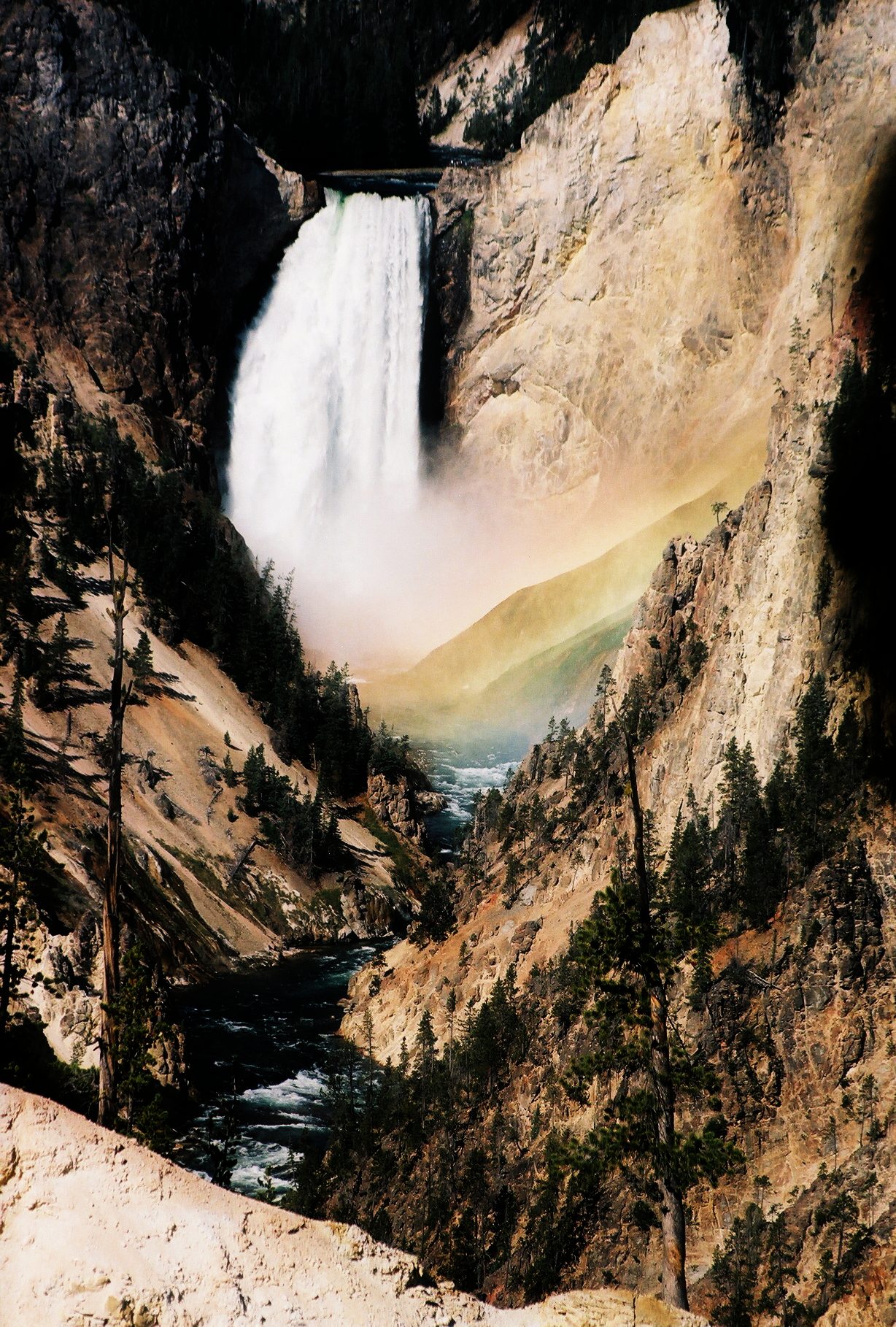
28. Artist Point
Time needed: 30 to 45 minutes. Parking: a large lot at the end of the South Rim Drive, busy from about 10 a.m. to 3 p.m., with frequent turnover.
A short paved path leads to a rock platform with the classic view up the canyon to the 308-foot Lower Falls. Mid-morning sun often throws a rainbow into the spray. Continue along the South Rim Trail past Artist Point for about a mile to Point Sublime, which almost nobody bothers to reach, for a quieter view downstream.
Verdict: essential. It is the view on every postcard, and it’s even better in person. Early morning brings the fewest people, and the late-afternoon light warms the canyon walls. Uncle Tom’s Trail, the staircase on the South Rim, has been closed since 2019. Our Artist Point guide has the best times for light.
29. The North Rim: Lookout Point, Grand View and Inspiration Point
Time needed: 1 to 2 hours. Parking: lots at each viewpoint along the North Rim Drive, a one-way loop.
The North Rim gives you several angles on the canyon. Lookout Point faces the Lower Falls from the north. From its lot, a steep trail drops about 500 feet in under half a mile to Red Rock Point, much closer to the falls. Grand View looks down the length of the canyon, and Inspiration Point, at the end of the drive, sits on a spur jutting out over the chasm.
Verdict: worth it if you have time for both rims. If you only have an hour, do Artist Point on the South Rim and the Brink of the Lower Falls on the North. For the full list of the park’s outlooks, see our best viewpoints in Yellowstone guide.
30. Brink of the Lower Falls
Time needed: 45 minutes. Parking: a medium lot on the North Rim Drive.
A paved trail switchbacks about 600 feet down in less than half a mile to a platform right at the lip of the Lower Falls, where the whole Yellowstone River pours over the edge beside you. It’s steep, and the climb back up is hard at 7,700 feet if you’re not acclimated.
Verdict: worth every step if you’re reasonably fit. You feel the falls here rather than just see them. The Brink of the Upper Falls, nearby, is a short, flat walk for anyone who can’t manage the climb. Details in our Brink of the Lower Falls trail guide.
31. Hayden Valley
Time needed: 1 to 2 hours. Parking: pullouts along the road between Canyon and Fishing Bridge.
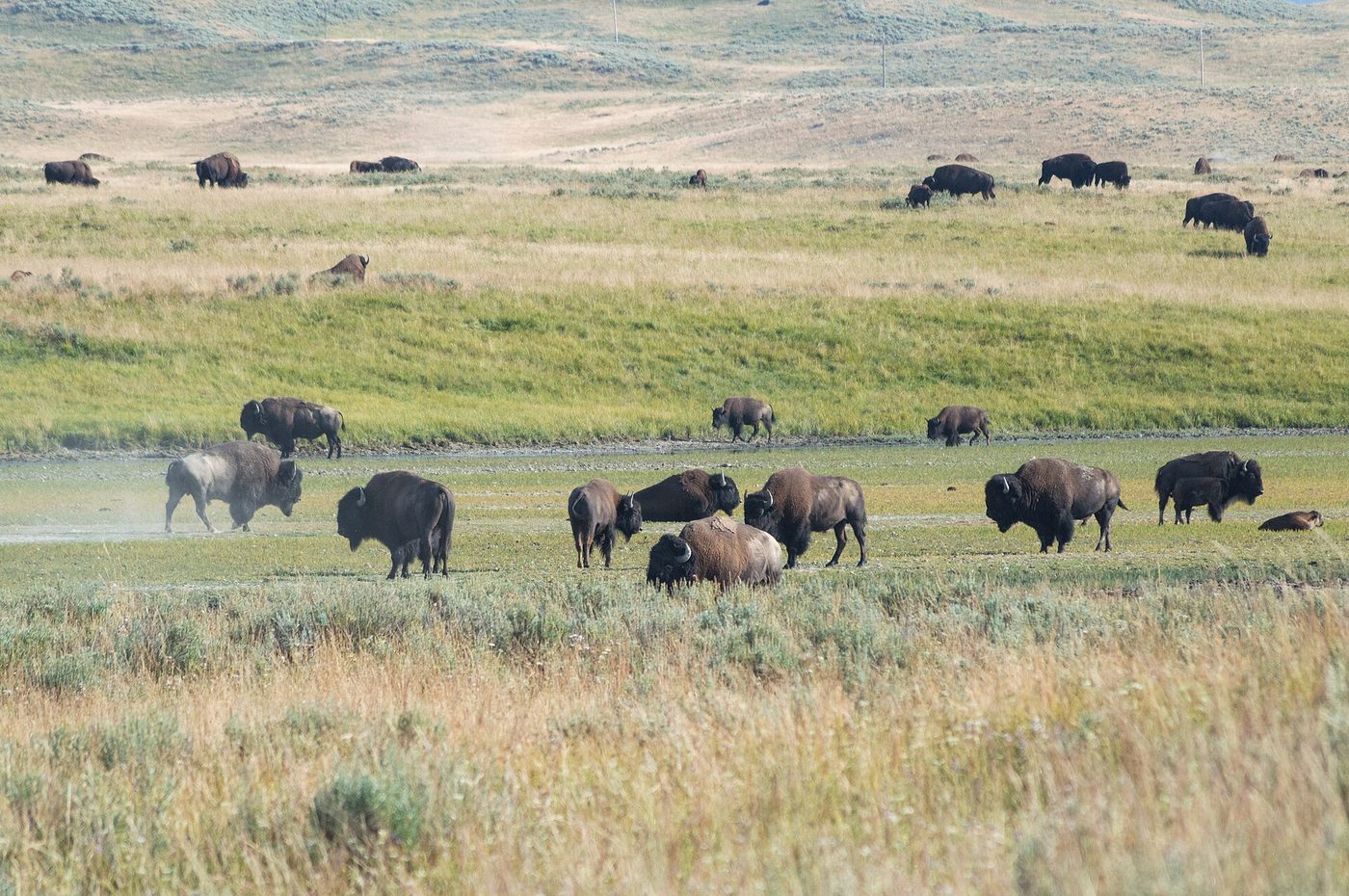
The Grand Loop runs through Hayden Valley, a broad, treeless valley of grass and sage that was once part of Yellowstone Lake. It’s prime bison country: in late July and August the rut brings hundreds of bison together, bellowing, wallowing and fighting, often right beside the road. Grizzlies are seen here in spring, and pelicans, geese and trumpeter swans use the river.
Verdict: a wildlife highlight you’ll drive through anyway, so plan time for it. The catch is that it’s also the likeliest place in the park for a bison jam. Stay in your car, leave room for animals to cross, and never walk up to a bison for a photo. Our Hayden Valley guide covers the best pullouts, and Yellowstone bison covers the animals.
32. Dunraven Pass and Mount Washburn
Time needed: 30 minutes to drive the pass; 4 to 5 hours to hike Mount Washburn. Parking: the Dunraven Pass trailhead lot fills early on summer weekends.
The road from Canyon to Tower climbs to 8,859 feet at Dunraven Pass, the highest point on the Grand Loop, with views across the Absaroka Range and down into the canyon country. From the pass, a trail of about three miles each way, with roughly 1,400 feet of climbing, leads to a fire lookout on the summit of Mount Washburn. Bighorn sheep are common near the top, and wildflowers carpet the slopes in July.
Verdict: the hike is one of the best in the park and a must for fit visitors in summer. The drive is scenic but not unmissable. The road closes for the season on October 12, 2026, so plan around it if you’re traveling in fall. Our best hikes in Yellowstone guide lists alternatives once it’s shut.
33. Canyon Visitor Education Center
Time needed: 45 minutes to an hour. Parking: the large lots at Canyon Village.
The best museum in the park, focused on the Yellowstone supervolcano: how the hot spot formed, where magma sits today and what the three giant eruptions did. The most recent caldera-forming eruption, about 631,000 years ago, left a caldera roughly 30 by 45 miles across, according to the USGS Yellowstone Volcano Observatory. The exhibits are clear, visual and genuinely good for teens.
Verdict: worth it, especially on a wet afternoon. It’s the one place in Yellowstone that explains why everything else exists. For all the park’s exhibits, see our Yellowstone museums guide.
Lake Country: Yellowstone Lake, Fishing Bridge and West Thumb
Yellowstone Lake is the largest high-elevation lake in North America, about 136 square miles at 7,733 feet, with more than 100 miles of shoreline. It’s cold, deep and huge enough to make its own weather, and its shores hold some of the park’s most underrated stops. Lake Country is quieter than Geyser Country, which is either a pro or a con depending on what you came for. Our Yellowstone Lake guide covers the lake in full, and Lake Village covers the base.
34. Mud Volcano and Dragon’s Mouth Spring
Time needed: 30 to 45 minutes. Parking: a medium lot about six miles north of Fishing Bridge; it turns over quickly.
A loop boardwalk of under a mile climbs past boiling mudpots and sulfurous springs. Dragon’s Mouth Spring surges out of a cave in rhythmic bursts, booming like something breathing inside. Mud Volcano, now a churning pit, once built a cone before blowing itself apart. Across the road, Sulphur Caldron is one of the most acidic springs in the park. Bison often lie around the lot here.
Verdict: a crowd-pleaser, especially for kids, and worth a stop on the drive between Lake and Canyon. The smell is part of it. Our Mud Volcano guide has the loop details.
35. LeHardy Rapids
Time needed: 20 minutes. Parking: a small pullout about three miles north of Fishing Bridge.
A short boardwalk leads to the edge of the Yellowstone River where it rushes over a rocky shelf. In late spring and early summer, cutthroat trout leap up the rapids on their way to spawn. Harlequin ducks sometimes ride the whitewater.
Verdict: a quick, peaceful stop. In the spawning season it’s excellent; later in summer it’s just a nice riverbank. Don’t detour for it outside June.
36. Fishing Bridge and the Fishing Bridge Visitor Center
Time needed: 30 to 45 minutes. Parking: easy.
The bridge over the Yellowstone River where it leaves the lake was once lined shoulder to shoulder with anglers. Fishing from it was banned in 1973 to protect the native cutthroat trout, and now it’s a place to watch fish and pelicans. The rustic stone-and-log visitor center, built in 1931, has a charming old-fashioned collection of bird specimens and exhibits on the lake. This is prime grizzly territory, which is why the nearby RV park allows only hard-sided vehicles.
Verdict: a pleasant short stop if you’re passing. The visitor center is worth a look for its building alone. Our Fishing Bridge guide has more.
37. Lake Yellowstone Hotel
Time needed: 45 minutes or more. Parking: easy.
The oldest hotel still operating in the park, opened in 1891 and given its yellow colonial revival facade a dozen years later. Its sunroom looks straight out over the lake, and on summer evenings there’s often live music. You don’t need to be staying to sit there with a drink.
Verdict: one of the nicest ways to spend an hour in Yellowstone. Come at sunset, bring a book or a card game, and watch the light go. The hotel runs in summer only. Our Lake Yellowstone Hotel guide covers staying and dining here.
38. Storm Point Trail and Lake Butte Overlook
Time needed: 1.5 hours for Storm Point; 30 minutes for Lake Butte. Parking: small lots on the East Entrance road.
East of Fishing Bridge, the Storm Point Trail is a flat 2.3-mile loop through meadows and forest to a rocky point on the lakeshore, often busy with yellow-bellied marmots. It’s sometimes closed for bear activity in spring and early summer. About nine miles east of Fishing Bridge, a short spur road climbs to Lake Butte Overlook, several hundred feet above the lake, with the Absaroka Range on one side and the whole lake spread out on the other.
Verdict: Storm Point is one of the best easy walks in the park. Lake Butte is the best sunset spot on the lake, and one of the most underrated viewpoints anywhere in Yellowstone. See the Lake Butte Overlook guide.
39. Natural Bridge
Time needed: about 1.5 hours. Parking: near Bridge Bay Marina.
A flat trail of about 1.2 miles each way (partly on an old road that’s open to bikes) leads through forest to a 51-foot arch of rhyolite over Bridge Creek. It’s frequently closed in late spring and early summer when grizzlies fish the spawning streams.
Verdict: a pleasant, easy walk rather than a dramatic sight. Good for families and for bikes.
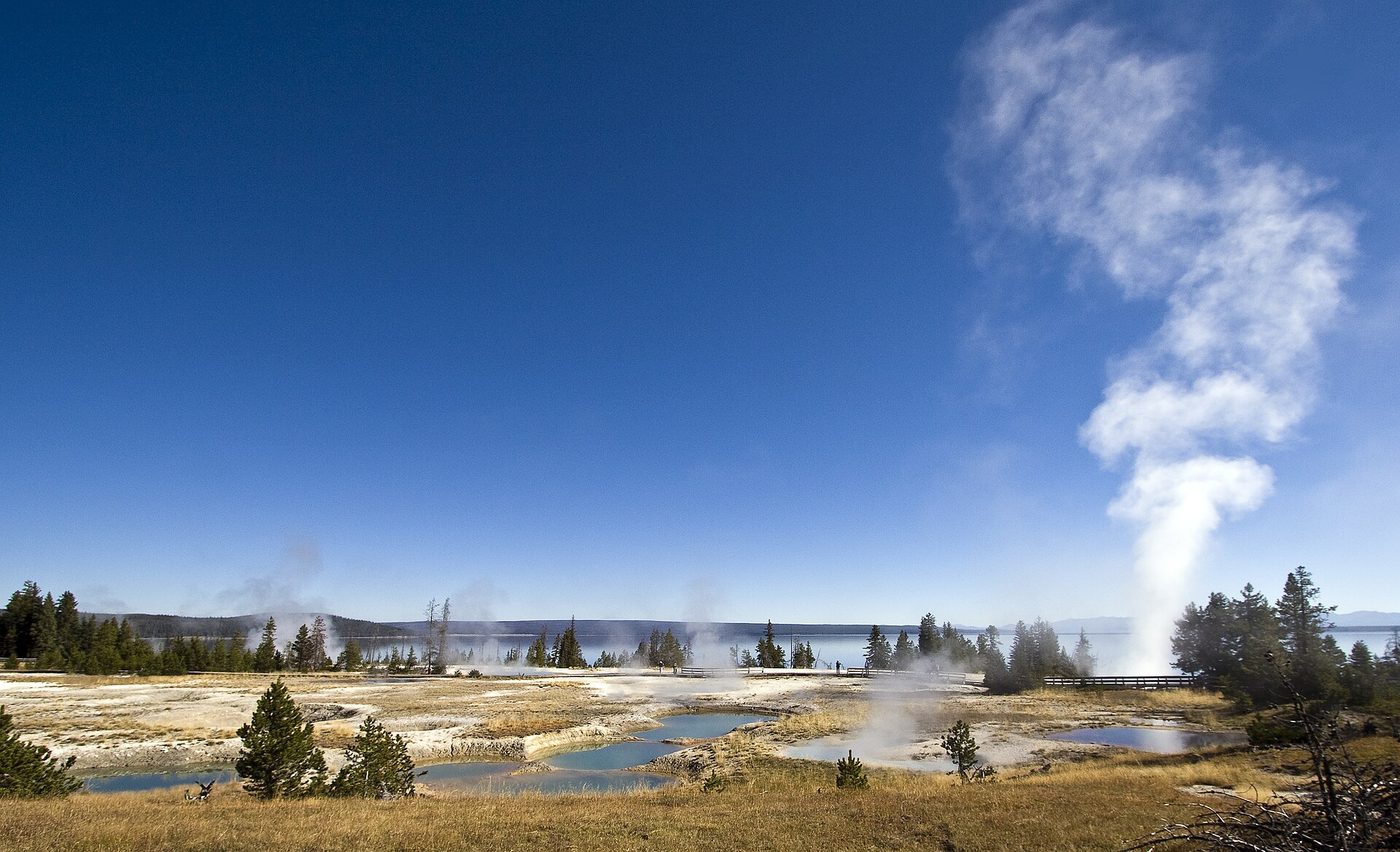
40. West Thumb Geyser Basin
Time needed: 45 minutes. Parking: a medium lot that fills at midday but moves quickly.
Hot springs and geysers along the shore of Yellowstone Lake, reached by a boardwalk loop of just over half a mile. Fishing Cone, a small cone standing in the lake itself, is famous for an old story of anglers cooking fish on the hook (don’t try it). Abyss Pool, about 53 feet deep, glows an intense blue-green. The bay itself, West Thumb, was formed by a volcanic eruption about 174,000 years ago.
Verdict: the prettiest short boardwalk in the park and a top-ten stop, especially in the morning when the lake is calm and the steam drifts over it. Pair it with Grant Village, three miles south, where the visitor center tells the story of the 1988 fires that burned about 36 percent of the park. Our West Thumb Geyser Basin guide covers the loop.
On the way south: the road to the South Entrance passes Lewis Lake and 30-foot Lewis Falls, then follows the Lewis River canyon toward Grand Teton. It’s pretty but has few stops. If you’re continuing south, our guide to Yellowstone and Grand Teton covers how to link the parks, and things to do in Grand Teton picks up where this list ends. Just west of West Thumb, the road crosses the Continental Divide twice and passes Isa Lake at Craig Pass, a lily-covered pond that drains to both oceans.
Is Yellowstone National Park worth it if you don’t hike?
Yes. Most of Yellowstone’s headline sights sit within a quarter mile of a parking lot, and boardwalks do the work at Old Faithful, Grand Prismatic, Norris, Mammoth and West Thumb. Wildlife watching in Lamar and Hayden valleys happens from pullouts. You can fill four days without walking more than two miles at a stretch.
That’s the honest answer. Yellowstone is one of the most accessible big parks in the country. The boardwalks at Old Faithful, Midway, Fountain Paint Pot, Mammoth and West Thumb are mostly flat or gently sloped, and many are wheelchair-friendly. Artist Point is a few hundred feet from the car. The best wildlife in the park is seen from the road.
What you miss without hiking: the Fairy Falls overlook view of Grand Prismatic (though it’s only a short walk), the Brink of the Lower Falls, Mount Washburn and the backcountry lakes. Also the quiet. The places that are a mile or more from a road have a small fraction of the visitors, and they’re where Yellowstone stops feeling like a theme park. If you can manage even a couple of short walks, Storm Point, Trout Lake and Lone Star Geyser are the best easy options.
If mobility is limited, the Old Faithful complex, Midway, Fountain Paint Pot, Mammoth’s lower terraces, West Thumb and Artist Point are the most accessible. Our Yellowstone with kids guide also covers stroller-friendly boardwalks, which overlap heavily with accessible routes.
How many days do you need to see the highlights?
Plan three full days to see the major sights without sprinting, four if you want dawn wildlife in Lamar Valley and a proper hike, and five or more if you’re adding Grand Teton. Two days works only if you stay inside the park and accept skipping one region entirely.
Here’s how that breaks down in practice:
- One day: doable, but only barely. Stick to the Lower Loop: Old Faithful, Grand Prismatic, Fountain Paint Pot, and either West Thumb or the canyon. You’ll spend half the day in the car.
- Two days: one day for Geyser Country, one for Canyon and Lake Country. Skip Mammoth and Lamar, or trade one for the other.
- Three days: the sweet spot for first-timers. Day one for the geyser basins; day two for the canyon, Hayden Valley and the lake; day three for Mammoth and Lamar Valley.
- Four to five days: add a real hike, a second dawn in Lamar and a slower afternoon at the lake. This is where the trip starts to feel relaxed.
- A week or more: time for the backcountry, a boat trip on the lake and a couple of days in Grand Teton.
Our Yellowstone itinerary turns each of these into a day-by-day plan, including routes from each entrance.
Things to do beyond the big sights: night skies, ranger programs, museums and history
The 40 sights above cover the park’s physical highlights, but Yellowstone has a lot more to offer if you slow down. Some of the best experiences happen after dark, inside a museum or with a ranger. Here’s where to look.
Stargazing and night
Yellowstone is far from big cities, and on a clear, moonless night away from the developed areas, the Milky Way is bright enough to cast faint shadows. Good spots include the pullouts in Hayden Valley, the shore at Lake Butte and the meadows around Madison. After dark you might hear wolves howling in Lamar Valley or bull elk bugling in September. Old Faithful keeps erupting through the night, and watching it by moonlight is something few visitors ever do. Carry a headlamp, stay on the boardwalks and watch for bison, which don’t care that it’s dark. Our stargazing in Yellowstone guide covers the best spots and the moon calendar, and things to do in Yellowstone at night covers everything else after sundown.
Ranger programs
In summer, park rangers lead free guided walks, talks and evening campfire programs at many developed areas, including Old Faithful, Madison, Canyon, Bridge Bay, Grant and Mammoth. They’re one of the most underused resources in the park: an hour with a ranger at Norris or Mammoth teaches you more than a day of reading signs. Kids can earn a Junior Ranger badge by completing an activity booklet. Schedules are posted in the park newspaper, at visitor centers and in the NPS app. Our Yellowstone ranger programs guide covers what’s typically on offer.
Museums and visitor centers
Yellowstone has ten visitor centers, information stations and museums. The best are the Canyon Visitor Education Center (the volcano), the Old Faithful Visitor Education Center (geysers), and the Albright Visitor Center in Mammoth (history and wildlife). The small trailside museums at Norris, Madison and Fishing Bridge, built between 1929 and 1931, are historic buildings in their own right. The Museum of the National Park Ranger near Norris is small and personal, and often staffed by volunteers, some of them retired rangers. The Grant Village visitor center covers the 1988 fires, and the West Thumb information station is a small stop on the boardwalk. See our Yellowstone museums guide for what each covers.
History and heritage
Yellowstone became the world’s first national park on March 1, 1872, after the Washburn expedition of 1870 and the Hayden survey of 1871 brought back reports, paintings and photographs that convinced Congress. The Army ran it from 1886 to 1918, until the National Park Service took over. The 1988 fires, the return of wolves in 1995 and the ongoing debates over bison and snowmobiles are all part of the story. Our Yellowstone National Park history guide tells it in full, and historic sites lists the buildings and places to see.
The park’s human history goes back much further. People have lived in and traveled through the Yellowstone region for more than 11,000 years, and 27 tribes have historic connections to the park. Obsidian Cliff, north of Norris, was a source of volcanic glass traded across much of North America. The Tukudika, or Sheepeater Shoshone, lived here year-round, and the Nez Perce crossed the park in their 1877 flight from the US Army. Our guide to Yellowstone’s Native American history covers these stories and where to learn more in the park.
Passport stamps, ghost stories and other small pleasures
If you collect National Park passport stamps, Yellowstone has dozens of cancellations spread across its visitor centers, museums and stores. Some are hard to find. Our Yellowstone passport stamps guide lists them all. And for a lighter evening, the Old Faithful Inn, the Lake Hotel and Fort Yellowstone all have their share of ghost stories. Take them as campfire tales, but they’re fun; our haunted Yellowstone guide collects the best.
Photography, sunrise and the best views
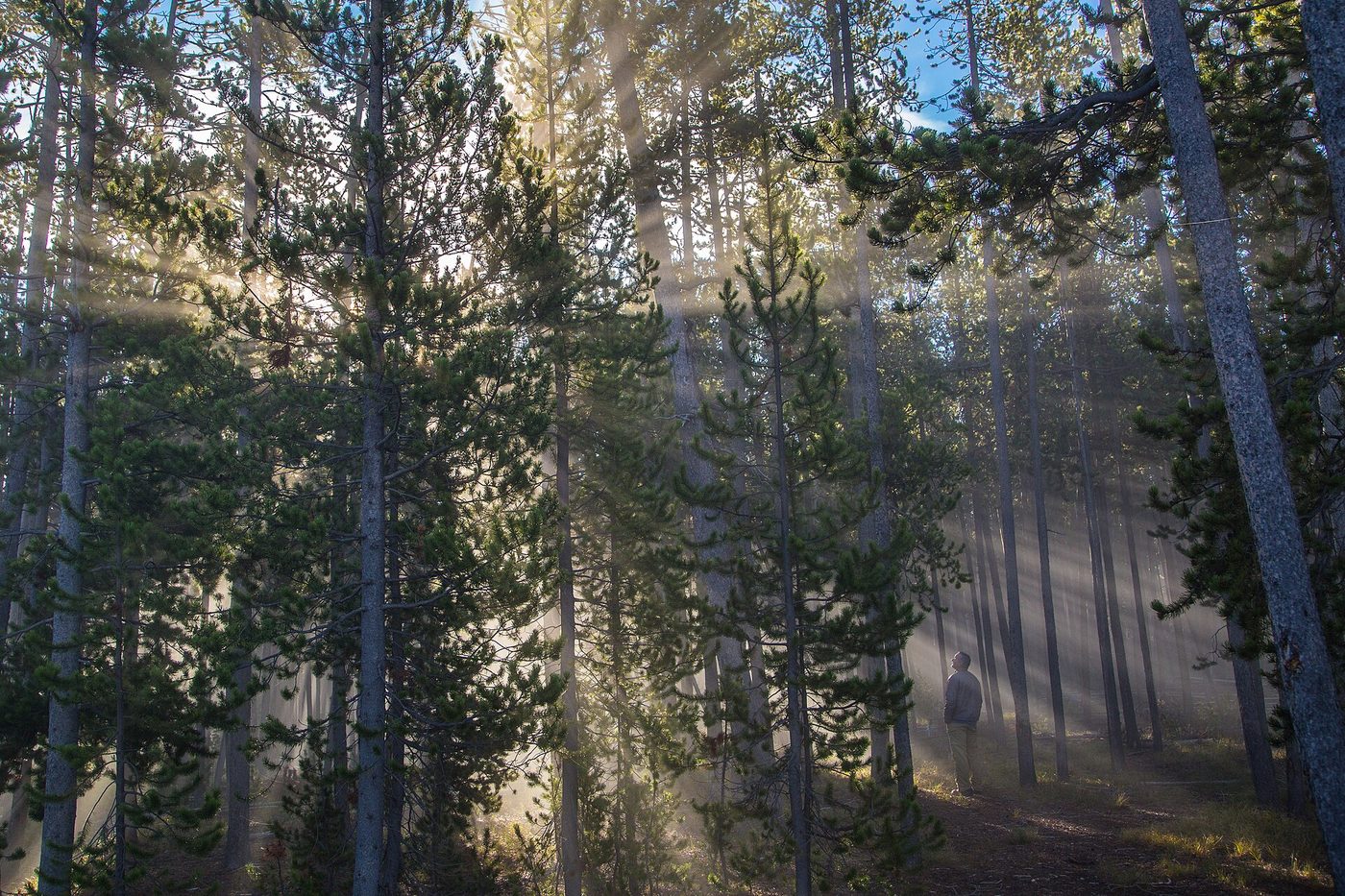
Yellowstone’s light is best early and late, which conveniently is also when the crowds are thinnest and the wildlife most active. Grand Prismatic is a midday subject; almost everything else is better at the edges of the day. For sunrise, the best spots are Hayden Valley (with mist rising off the river), Lamar Valley, Lake Butte and Artist Point. Steam from the geyser basins catches the low sun beautifully on cool mornings, and September and October bring the most dramatic steam. Our Yellowstone photography guide covers locations, lenses and timing, and best sunrise spots in Yellowstone gets specific.
Tours, boats, horses and bikes: guided things to do in Yellowstone
You don’t need a guide to see Yellowstone, but a few activities are only possible with one, and a good guide can turn a morning in Lamar Valley from a blur of distant dots into a genuine encounter with a wolf pack.
- Guided tours: the park concessioner runs bus tours from the major lodges, including rides in restored historic yellow buses from the 1930s, and wildlife tours in Lamar and Hayden valleys. Private operators run day tours from West Yellowstone, Gardiner, Jackson and Cody. Our Yellowstone tours guide compares them, and Yellowstone wildlife tours covers the best for animals.
- Boats: a scenic cruise leaves Bridge Bay Marina on Yellowstone Lake in summer, and you can rent boats or charter a fishing guide there. Private boats need a permit. See the Yellowstone Lake cruise and kayaking in Yellowstone guides.
- Fishing: Yellowstone is one of the best trout destinations in the country, with its own permit system and strict rules to protect native fish. Start with our fishing in Yellowstone guide.
- Horseback and wagons: trail rides leave from corrals at Roosevelt and Canyon in summer, along with the stagecoach rides and cookout at Roosevelt. See horseback riding in Yellowstone.
- Biking: bikes are allowed on park roads and a handful of designated trails and old roads, including the paths around Old Faithful, the Fountain Freight Road and the Lone Star Geyser road. They’re not allowed on boardwalks or backcountry trails. In spring, some roads open to bikes before cars, which is one of the best-kept secrets in the park. Our biking in Yellowstone guide covers routes and rules.
Prices and seasons for concession tours change every year, so check with the operator before you go. Winter trips by snowcoach or snowmobile are a different world, covered in our Yellowstone in winter guide.
Rainy days, kids, honeymoons and TV fans
Different trips want different lists. A few quick pointers:
Rainy days. Yellowstone gets afternoon thunderstorms regularly in summer, and a wet day isn’t a wasted one. The museums, the Old Faithful Inn and the Lake Hotel sunroom are all good shelters. Geyser basins are often better in light rain, with steam clouds more dramatic and crowds smaller. Wildlife doesn’t mind the weather either. Our rainy day things to do in Yellowstone guide has a full plan.
Kids. The best stops for young children are Old Faithful, Fountain Paint Pot, Mud Volcano, the Mammoth terraces and anywhere you can watch bison from the car. Junior Ranger badges are a big hit. The short walks to Wraith Falls, Trout Lake and Storm Point are good first hikes. Our Yellowstone with kids guide covers it all, including safety around thermal areas.
Honeymoons. Yellowstone is more romantic than its crowds suggest. Sunset at Lake Butte, a quiet dinner at the Lake Hotel, the Old Faithful Inn by firelight, and a dawn in Lamar with a thermos of coffee make for a good start. Our Yellowstone honeymoon guide suggests where to stay and when to go.
TV fans. The Paramount series Yellowstone has sent a lot of people searching for its locations, but almost none of it was filmed in the park. The ranch is a real guest ranch in Montana’s Bitterroot Valley, several hours’ drive away. Our Yellowstone TV show filming locations guide sorts out what’s where.
What’s overrated and what’s underrated
Honest verdicts, from years of watching where visitors spend their time and where they wish they’d spent it:
Overrated (or at least overrated at the wrong time):
- Grand Prismatic from the boardwalk on a cool morning. You’ll see steam. Go on a warm afternoon or use the overlook.
- Old Faithful at midday in July. Still worth doing, but you’ll stand in a crowd. Go early or late, or watch from Observation Point.
- Morning Glory Pool. Faded from years of coins and trash. The walk there is the attraction.
- Tower Fall. A short look at a nice waterfall, not a destination.
- Driving the Grand Loop in a day. You’ll see the park through a windshield.
Underrated:
- Lamar Valley at dawn. If you’ve only been at midday, you haven’t really seen it.
- Firehole Lake Drive and Great Fountain Geyser. A world-class eruption with a fraction of the crowd.
- West Thumb Geyser Basin. The prettiest short boardwalk in the park.
- Lake Butte Overlook at sunset. One of the best views in Yellowstone, and usually quiet.
- Norris Back Basin. Raw, strange and mostly empty after 5 p.m.
- The Lake Hotel sunroom. The most civilized hour in the park.
- Ranger programs. Free, excellent and mostly ignored.
When is the best time of year for things to do in Yellowstone?
Late May through mid-June and the first three weeks of September give you the most open roads with the fewest crowds. July and August have every facility running but the heaviest traffic. Winter is a different trip altogether: most roads close to cars and you travel by snowcoach or snowmobile.
Each season changes what’s on this list. Spring (May and early June) is best for bears, newborn bison calves and roaring waterfalls, though some trails are still muddy or snowbound. Summer brings every road, lodge, tour and ranger program. September is our pick for many visitors: the elk rut is on, the crowds thin after Labor Day, the light is softer and the weather is usually settled. October is quiet and beautiful, but services shut down fast and the high roads close October 12. Winter is magical but covered in its own guide.
Our best time to visit Yellowstone guide goes through all twelve months, and the best time for wildlife focuses on animals.
Frequently asked questions
What is the most famous thing in Yellowstone?
Old Faithful is the most famous single attraction in Yellowstone, but Grand Prismatic Spring, the Grand Canyon of the Yellowstone and the park’s wildlife, particularly bison, wolves and bears, are close behind. For many people the park’s reputation rests on the combination of all four.
Can you see Yellowstone in one day?
You can see a slice of it. Pick one loop, usually the Lower Loop with Old Faithful, Grand Prismatic and the canyon, and accept that you’ll spend around half the day driving. Two or three days is the realistic minimum for the highlights.
What can you do in Yellowstone without a car?
Guided bus and wildlife tours run from the major lodges inside the park and from every gateway town. With a tour and a lodge booking you can see most of the headline sights without driving. There’s no public shuttle inside the park.
Is Grand Prismatic or Old Faithful better?
They’re very different. Old Faithful is a reliable, crowd-pleasing eruption; Grand Prismatic is a still, enormous pool of color. If you only have time for one, choose Grand Prismatic on a warm, dry day and Old Faithful on a cold, steamy one. Most people see both in the same morning.
Can you swim in Yellowstone?
Very few places are legal or safe, and two of the best-known spots, the Firehole River Swim Area and Boiling River, were closed as of September 2026. Our fishing in Yellowstone guide covers every swimming question.
Are there free things to do in Yellowstone?
Once you’ve paid the entrance fee, almost everything is free: every boardwalk, trail, viewpoint, museum and ranger program. You pay only for concession activities like tours, boat rentals and horseback rides. Fees and passes are on our entrance fee guide.
What should you not miss in Yellowstone in September?
The elk rut at Mammoth and along the Madison River, early-morning steam at the geyser basins and the first fall color on aspens in the northern range. It’s also your last chance to drive Dunraven Pass and the Beartooth Highway before they close on October 12, 2026.
Do you need reservations for things to do in Yellowstone?
There’s no timed entry for the park itself. You do need to book lodging, campgrounds, concession tours, the Roosevelt cookout and horseback rides, often months ahead in summer. Boardwalks, trails and viewpoints need no reservation.
Distances here are the thing that catches people out, because the sights in this list are spread across a park the size of a small country. Our Yellowstone map and services guide shows how the Grand Loop connects them, and where to find fuel, food and restrooms along the way.
Plan around the park’s scale rather than its list of sights: the Grand Loop is about 142 miles and almost everything is 45 minutes to an hour and a half from everything else. Our guide to where Yellowstone National Park is sets out the five regions, the entrances and the drive times that shape any realistic itinerary.
Sources
- National Park Service, Yellowstone: Park roads and conditions, visitor centers, Old Faithful, current conditions, 2025 visitation release
- USGS Yellowstone Volcano Observatory: Yellowstone volcano history
- Yellowstone National Park Lodges (Xanterra): things to do
Image credits
| Photo | Credit |
|---|---|
| The Grand Canyon of the Yellowstone and its 308-foot Lower Falls, seen from the canyon rim (top of page) | Brocken Inaglory, CC BY-SA 3.0, via Wikimedia Commons |
| Norris Geyser Basin in early May, when the boardwalks across the park’s hottest ground are | Frank Schulenburg, CC BY-SA 4.0, via Wikimedia Commons |
| Hot water builds and buries the Mammoth terraces, killing the trees it reaches | Brocken Inaglory, CC BY-SA 3.0, via Wikimedia Commons |
| Soda Butte Creek, which joins the Lamar River at the east end of the valley | HaSt, CC BY-SA 4.0, via Wikimedia Commons |
| Morning sun at the right angle throws a rainbow into the Lower Falls spray | William Waterway, CC BY-SA 3.0, via Wikimedia Commons |
| A typical Hayden Valley scene between Canyon and Lake; the herd often crosses the road | Supercarwaar, CC BY-SA 4.0, via Wikimedia Commons |
| West Thumb sits right on the shore of Yellowstone Lake | Acroterion, CC BY-SA 4.0, via Wikimedia Commons |
| Low October sun through steam at Norris Geyser Basin; cool mornings make the best steam li | Yellowstone National Park from Yellowstone NP, USA, public domain, via Wikimedia Commons |