January is Yellowstone at its coldest and quietest. The interior roads to Old Faithful and the Grand Canyon are open only to snowcoaches and snowmobiles, the road across the northern range stays open to cars, and average highs sit in the upper 20s°F. Yellowstone in January is for travelers who want wolves on white snow, geysers steaming in subzero air, and a park with almost nobody in it.
It isn’t for everyone, and it’s worth being honest about that from the start. You can’t drive to most of the famous sights, the days are short, and a morning at -20°F is a real thing you’ll need to dress for. But if the idea of watching Old Faithful erupt into a sky full of ice crystals, or spotting a wolf pack crossing the Lamar Valley at dawn, sounds better than sharing a boardwalk with a thousand people in July, January might be the best month of the year to come.
This guide covers January weather and daylight, exactly what’s open for January 2027, how to reach Old Faithful and the wolves, what a trip costs, and a sample itinerary. To see how January compares with the rest of the year, start with our guide to the best time to visit Yellowstone, and for the whole winter season, see Yellowstone in winter.
Is January a good time to visit Yellowstone?
Yes, if you want wildlife, winter scenery and solitude, and don’t mind cold or organized tours. No, if it’s your first visit and you want to drive to the summer highlights, or you’re hoping for bears. January is the park’s coldest month, with some of its lowest visitor numbers, and the northern range’s wolf watching is at its best.
Crowds are the easiest part to quantify. NPS monthly counts, as compiled by the planning site More Than Just Parks, put January 2025 at about 41,000 recreation visits, while the park’s own figures show 975,109 in July 2025. Most of the January visitors are on the northern road or on a snowcoach, which means that on a weekday you can stand at many viewpoints alone.
Who January suits
- Wolf watchers and wildlife photographers. Animals are concentrated in the lower valleys, stand out against snow, and are easier to find than at any other time of year.
- People who love winter. Frost-coated trees, steaming rivers and geysers erupting into subzero air are sights you won’t get in summer.
- Skiers and snowshoers. Snow is usually deep and settled by January, and the groomed trails around Old Faithful and Mammoth are quiet.
- Return visitors. If you’ve seen Yellowstone in summer, January shows you a completely different park.
Who should pick another month
- First-time visitors with a checklist. You won’t see Grand Prismatic’s colors, Hayden Valley, Yellowstone Lake’s shore or the Grand Canyon without a long guided day. September gives you everything with fewer crowds than summer.
- Bear watchers. Grizzlies and black bears are denned up. Come in May or June instead.
- Families with very young children. It’s possible, and snowcoaches make it easier, but short days and deep cold make it hard work.
- Anyone on a tight, fixed schedule. Storms can close the northern road or cancel a tour for a day. Build in slack.
January compared with December, February and March
If you’re choosing a winter month, the differences are real. The first half of December is the dead season: the interior roads are closed to everything while the park waits for enough snow to groom, and nothing inside the park is open except around Mammoth. From December 15 the oversnow season starts, but the Christmas and New Year weeks bring the winter’s biggest crowds and highest prices.
January is the deep middle of winter: coldest, quietest outside the holiday weekends, and the best month for frost and ice on the thermal areas. February is a little warmer, noticeably sunnier and longer in the day, with the snowpack near its deepest and the wolf breeding season in full swing, but Presidents’ Day weekend (February 13-15, 2027) is busy. March is the tail end: milder, with long days, but the groomed roads start closing on March 7, and by mid-month the oversnow season is over.
Our honest ranking for a first winter trip: February, then January, then late December. For wolves and the coldest, most atmospheric conditions, January wins.
Yellowstone weather in January
January is the coldest month of the year in Yellowstone. The park’s published monthly averages give a January high of 28.6°F and a low of 9.6°F, a little colder than December and noticeably colder than February (checked September 2026). Those are averages, though, and the park’s own warning is that you should expect big swings: a sunny 35°F afternoon at Mammoth and a -25°F dawn at Old Faithful can come in the same week.
| December | January | February | |
|---|---|---|---|
| Average high | 30.5°F | 28.6°F | 34.0°F |
| Average low | 11.8°F | 9.6°F | 13.0°F |
| Daylight at Old Faithful, mid-month | About 8 hr 50 min | About 9 hr 10 min | About 10 hr 30 min |
| Oversnow roads | Open from December 15 | Open all month | Open all month |
Averages from the NPS weather page (checked September 2026); daylight figures are approximate for Old Faithful.
A few things matter more than the averages.
- Elevation. The places you’ll visit range from about 6,200 feet at Mammoth to more than 7,700 feet around Yellowstone Lake, and Mammoth is usually warmer and less snowy than Old Faithful or Canyon. The park receives about 150 inches of snow a year on average, and double that at high elevations.
- Clear nights are the coldest. Calm, clear nights let temperatures plunge, especially in the geyser basins and river valleys where cold air pools. The park’s record low is -66°F.
- Wind chill on a snowmobile. At 30 mph, a 0°F morning feels like -20°F or colder on exposed skin. Snowcoach passengers don’t have this problem.
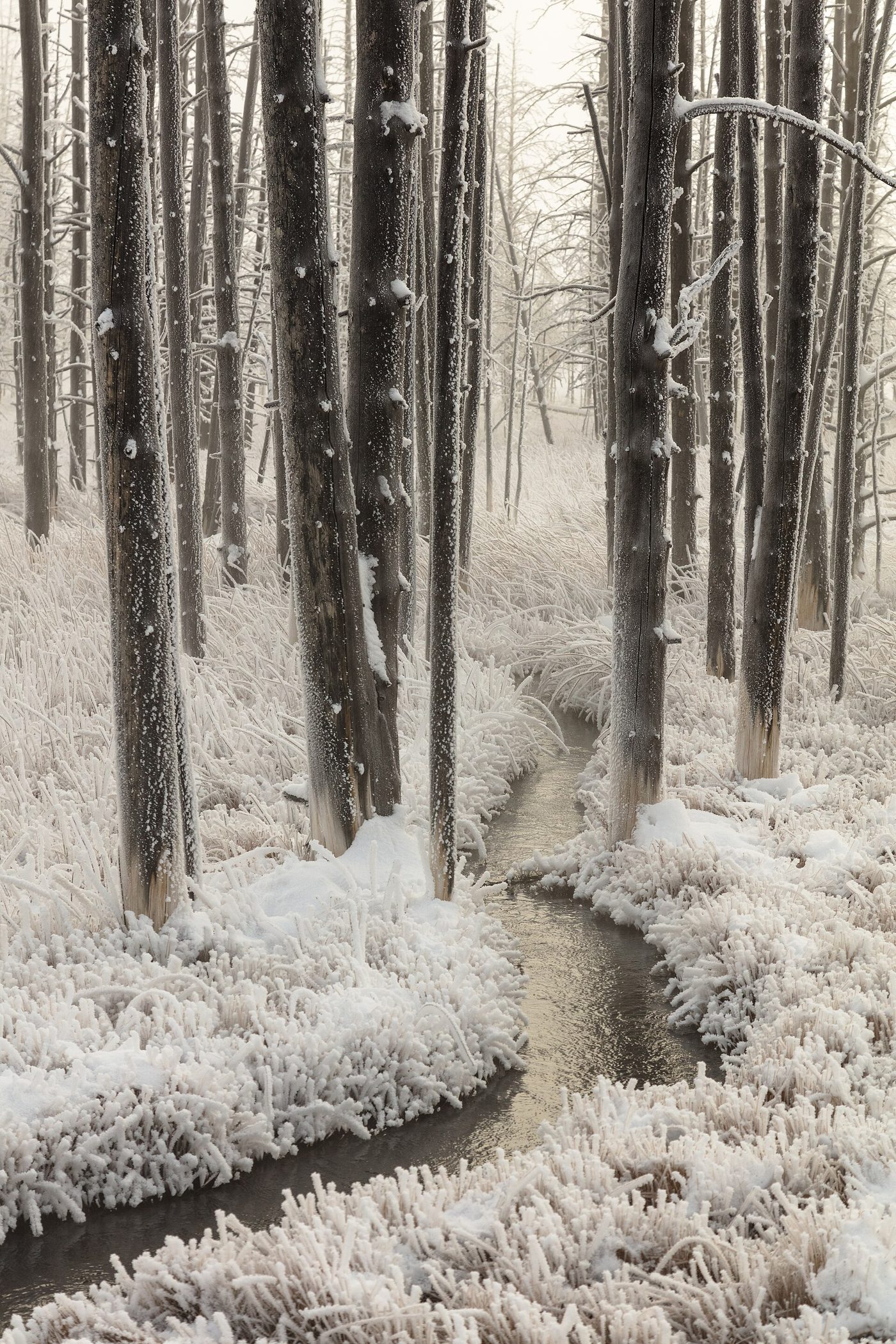
- Ice fog and diamond dust. On the coldest mornings, the steam from geysers and rivers freezes in the air and drifts across the roads as glittering ice crystals, and rime ice coats every tree near a thermal feature.
Daylight in January
Days are short but getting longer. At Old Faithful, the sun rises at about 8 a.m. and sets at about 4:55 p.m. on January 1, for just under nine hours of daylight. By January 31 sunrise is around 7:45 a.m. and sunset around 5:30 p.m., adding nearly an hour. Canyon walls and mountains shorten that in places, and the Lamar Valley’s best wildlife light is in the first hour after sunrise.
Plan your days around that light. A West Yellowstone snowcoach day usually leaves around 8 a.m. and gets back as the last light fades, and Xanterra’s afternoon snowcoach from Mammoth to Old Faithful, which leaves at 1:45 p.m. and takes about four and a quarter hours, finishes its run after dark in January. If you want to see the route, take the morning coach.
How to dress for January
Cold is manageable if you dress for it, and miserable if you don’t. The system that works is simple: a wicking base layer of wool or synthetic fabric (never cotton), an insulating layer of fleece or down, and a windproof outer shell or insulated parka. Add insulated, waterproof boots with room for thick socks, because tight boots mean cold feet. Mittens are warmer than gloves; thin liner gloves inside them let you work a camera without exposing bare skin.
Protect your face, too. A neck gaiter or balaclava and a warm hat matter most on a snowmobile or at a windy pullout, and goggles or sunglasses help against the glare off snow. Chemical hand and toe warmers are cheap insurance. Carry spare batteries and your phone in an inside pocket, since cold drains them fast. On a snowmobile tour, the outfitter usually supplies a suit, boots and helmet, but your own base layers and socks make the difference.
The biggest danger isn’t the temperature itself. It’s getting wet, from sweat on a ski or snow down a boot, and then standing still. Shed a layer before you start working hard, and put it back on the moment you stop.
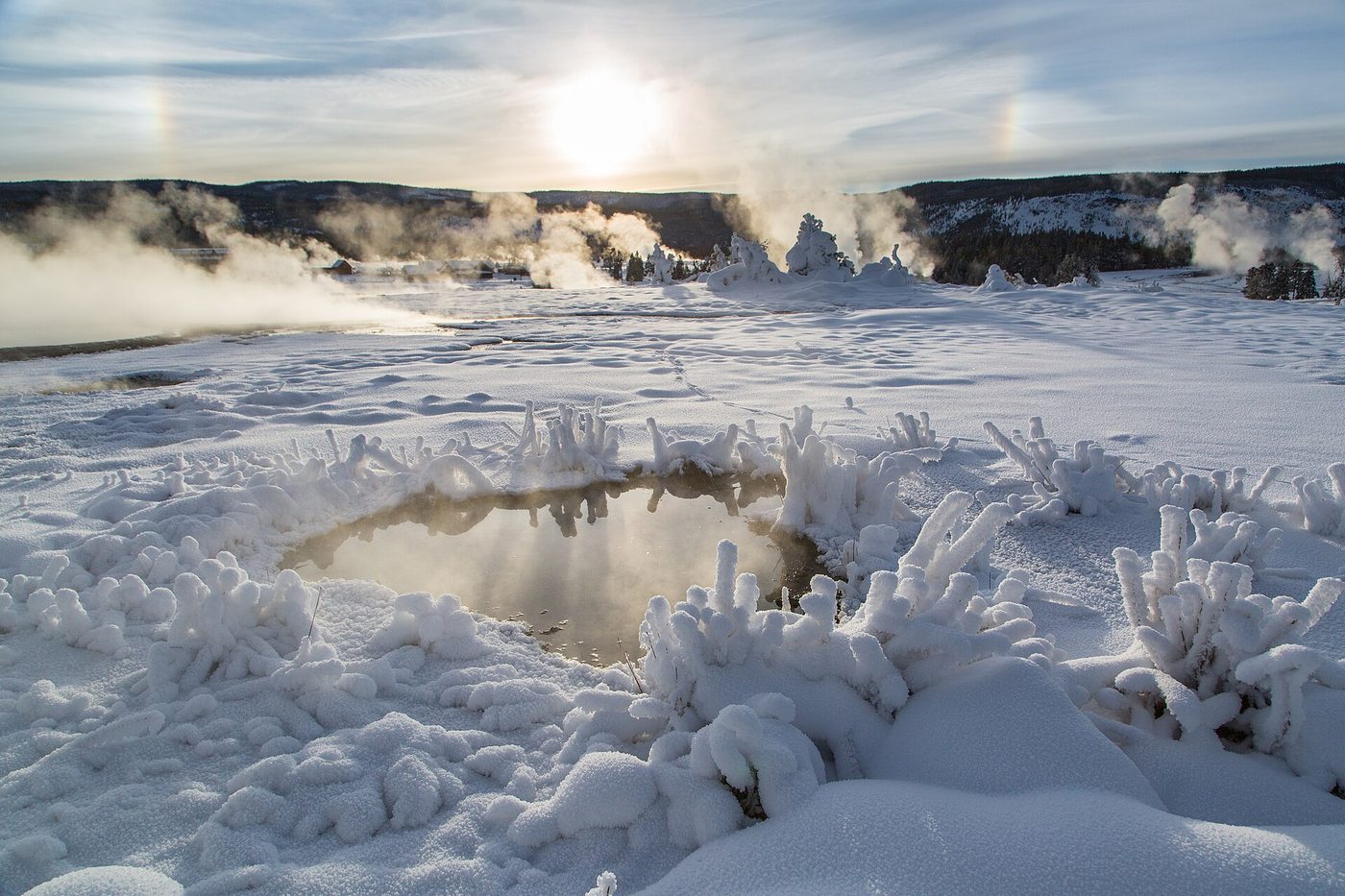
The upside of the short days is the light itself. Low sun all day, sun dogs on clear cold mornings and long blue dusks make January the favorite month of many photographers. For the whole year’s weather, see Yellowstone weather by month.
What’s open in Yellowstone in January 2027
January sits in the middle of the oversnow season, which opens on December 15, 2026 and runs until the groomed roads close in stages between March 7 and March 15, 2027 (checked September 2026). Here’s what that means on the ground.
Roads
- Open to cars: the road from the North Entrance at Gardiner through Mammoth, Tower Junction and the Lamar Valley to the Northeast Entrance and Cooke City. It’s plowed all winter, though storms can close it for a few hours or a day.
- Open to snowcoaches and snowmobiles only: the groomed roads from the West, South and East entrances to Old Faithful, Madison, Norris, Canyon, West Thumb and Fishing Bridge, plus the road from Mammoth south to Norris.
- Closed to all vehicles: the Dunraven Pass road between Canyon and Tower, and the Beartooth Highway outside the park. The East Entrance road over Sylvan Pass runs through avalanche terrain and opens to oversnow travel only on a limited basis.
The road status line is 307-344-2117. For the dates of every segment, see our Yellowstone road closures page, and for the one road you can drive, driving through Yellowstone in winter.
Lodging and camping
Only two hotels inside the park are open. Old Faithful Snow Lodge runs from December 16, 2026 to March 7, 2027 and is reachable only by snowcoach or snowmobile. Mammoth Hot Springs Hotel stays open into early March and is the only in-park hotel you can drive to. Mammoth Campground is open all year, with first-come, first-served sites at $25 a night in winter (checked September 2026). Everything else inside the park is closed. Our Yellowstone winter lodging guide compares the two lodges and the gateway towns.
Services
- Open all winter at Mammoth: the Albright Visitor Center, the Mammoth General Store, the post office and the park’s year-round medical clinic, plus the Mammoth Dining Room and Map Room Bar at the hotel.
- At Old Faithful: the Snow Lodge’s Obsidian Dining Room, Geyser Grill and Firehole Lounge, the Bear Den Ski Shop and an outdoor skating rink.
- Fuel: the stations at Tower Junction, Old Faithful, Canyon, Fishing Bridge and Grant sell fuel by card around the clock all year, but of those, only Tower Junction is on a road you can drive in January, and the park’s services page also lists year-round card fueling at Mammoth. Fill up in Gardiner or Cooke City when you can.
- Still to be confirmed in September 2026: the Old Faithful Visitor Education Center’s winter hours, the warming huts along the oversnow routes and the West Yellowstone visitor desk. The park posts these late each year.
Closed
Every other lodge, campground and restaurant in the park; the Grand Loop between Canyon and Tower; and fishing, whose general season ended on October 31 and reopens on the Saturday of Memorial Day weekend.
Old Faithful in January
Old Faithful erupts all year on much the same schedule, and in January it’s arguably at its best. The park’s most recent figure put the median interval at about 102 minutes, plus or minus 10, with intervals ranging from 54 to 118 minutes; eruptions average about 130 feet and last from a minute and a half to five minutes (checked September 2026). In subzero air, the steam from each eruption billows far higher than the water column and drifts across the basin, and on a still morning you can watch it hang there for minutes.
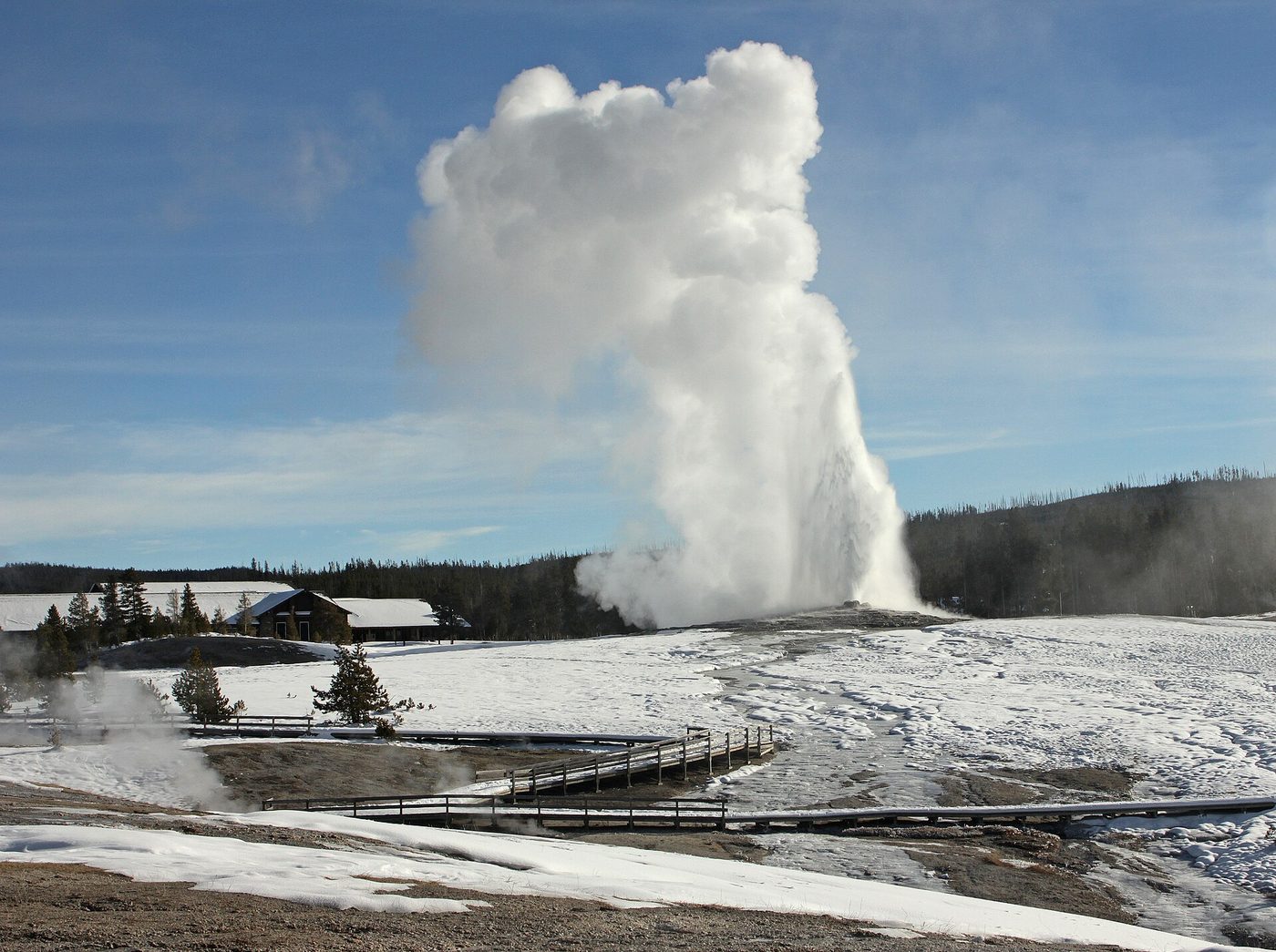
You can’t drive there. There are three ways to see Old Faithful in January:
- A day tour from West Yellowstone. Snowcoach and snowmobile days leave around 8 a.m., cover about 30 miles each way and give you a couple of hours at the geyser. It’s the most popular option and the cheapest way in.
- Xanterra’s scheduled snowcoach from Mammoth. It costs $179.45 per adult southbound and $182.90 northbound, taxes included, and takes about four and a quarter hours each way (checked September 2026).
- A night or two at Old Faithful Snow Lodge. This is the only way to see the geyser at dawn and dusk, when the day tours aren’t there. It’s the most expensive option and, for a first winter trip, the one most worth paying for.
Once you’re there, walk the boardwalks of the Upper Geyser Basin toward Castle, Grand and Riverside geysers, which are also predicted. Wear boots with traction devices, since the boardwalks are packed snow and ice, and stay on them. Bison use the same routes, often lying right beside the boardwalk in the warm ground, so give them at least 25 yards. One closure to know about: Biscuit Basin, just north of the Upper Geyser Basin, has been closed since a hydrothermal explosion in July 2024.
For eruption times and the basin in every season, see our guide to Old Faithful. Old Faithful in winter goes into the practical details, and our Yellowstone snowcoach tours guide compares the ways to get there.
Wolves and wildlife in January
This is the real reason to come. Deep snow pushes elk, bison and bighorn sheep toward the lower, wind-scoured valleys of the northern range, predators follow, and every animal is easier to see against white ground.
Yellowstone’s winter wolves
The park counted at least 108 wolves living mainly inside its boundaries in early 2025, and the packs of the northern range are the most watched wild wolves on earth. January is a particularly good month for them. Packs travel widely and hunt more visibly, their dark coats show up against the snow at great distances, and the breeding season begins late in the month, which brings more howling, more travel and sometimes more conflict between packs.
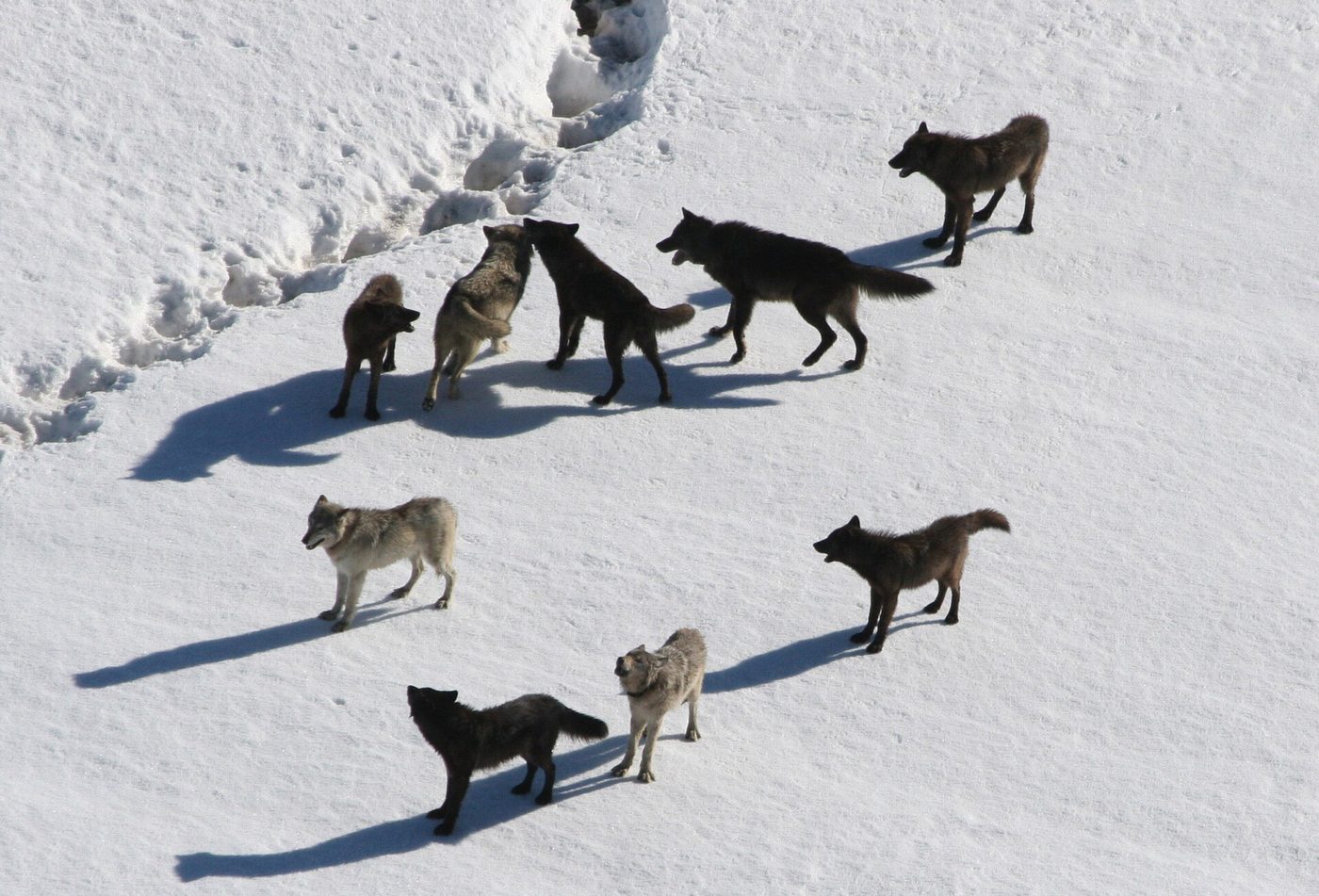
To find them, drive into the Lamar Valley before sunrise and look for groups of people with spotting scopes at the pullouts. Wolf watchers are a friendly community and will usually tell you what they’re watching. Many sightings are at a distance of half a mile or more, so a spotting scope or at least good binoculars makes all the difference. Keep at least 100 yards from wolves, even if they’re near the road, and never stop in a travel lane. Our guides to wolf watching in Yellowstone and Yellowstone winter wolf tours cover where to look and whether a guide is worth it.
A dawn in the Lamar Valley
A January wolf morning starts in the dark. If you’re staying in Gardiner or at Mammoth, you’ll leave around 6:30 a.m. for the drive east past Blacktail Plateau and Tower Junction, headlights picking out bison standing in the road and the occasional coyote trotting along the snowbank. From Cooke City or Silver Gate, the drive west is shorter. Either way, you want to be in the valley as the sky starts to lighten, which in January means a little after 7 a.m.
The first sign that something is happening is a cluster of cars at a pullout, with scopes set up on tripods and people in heavy parkas standing very still. Pull fully off the road, walk over quietly, and ask what they’re watching. You might be shown a pack bedded on a distant slope, a pair of wolves working their way along the river, or ravens circling a carcass that the pack will return to. On a good morning you’ll hear howling roll across the valley.
By mid-morning, activity usually tapers off as the wolves bed down. That’s the time to warm up, eat, and head back toward Mammoth, or to scan the cliffs for bighorn sheep on the way. Many watchers return for the last hour of light. Be patient, and don’t expect a sighting on every outing: some mornings the packs are out of view, and the best you’ll get is tracks across the snow.
Other animals to look for
- Bison plough through snow by swinging their heads from side to side, and many spend the winter near thermal areas where the ground is warmer. The park counted about 5,400 in 2024.
- Elk are fewer inside the park in winter than in summer; the park estimates fewer than 2,000 winter there, many around Mammoth and Gardiner.
- Bighorn sheep work the cliffs near Gardiner and above the Lamar Valley.
- Mountain goats cling to the cliffs near the Northeast Entrance, and moose browse the willows along Soda Butte Creek.
- Coyotes and red foxes are easy to watch hunting voles under the snow, listening and then diving headfirst.
- Bald eagles, ravens and magpies gather at carcasses, often the first sign that wolves have made a kill.
- Trumpeter swans, goldeneyes and other waterfowl winter on the stretches of river kept open by warm water.
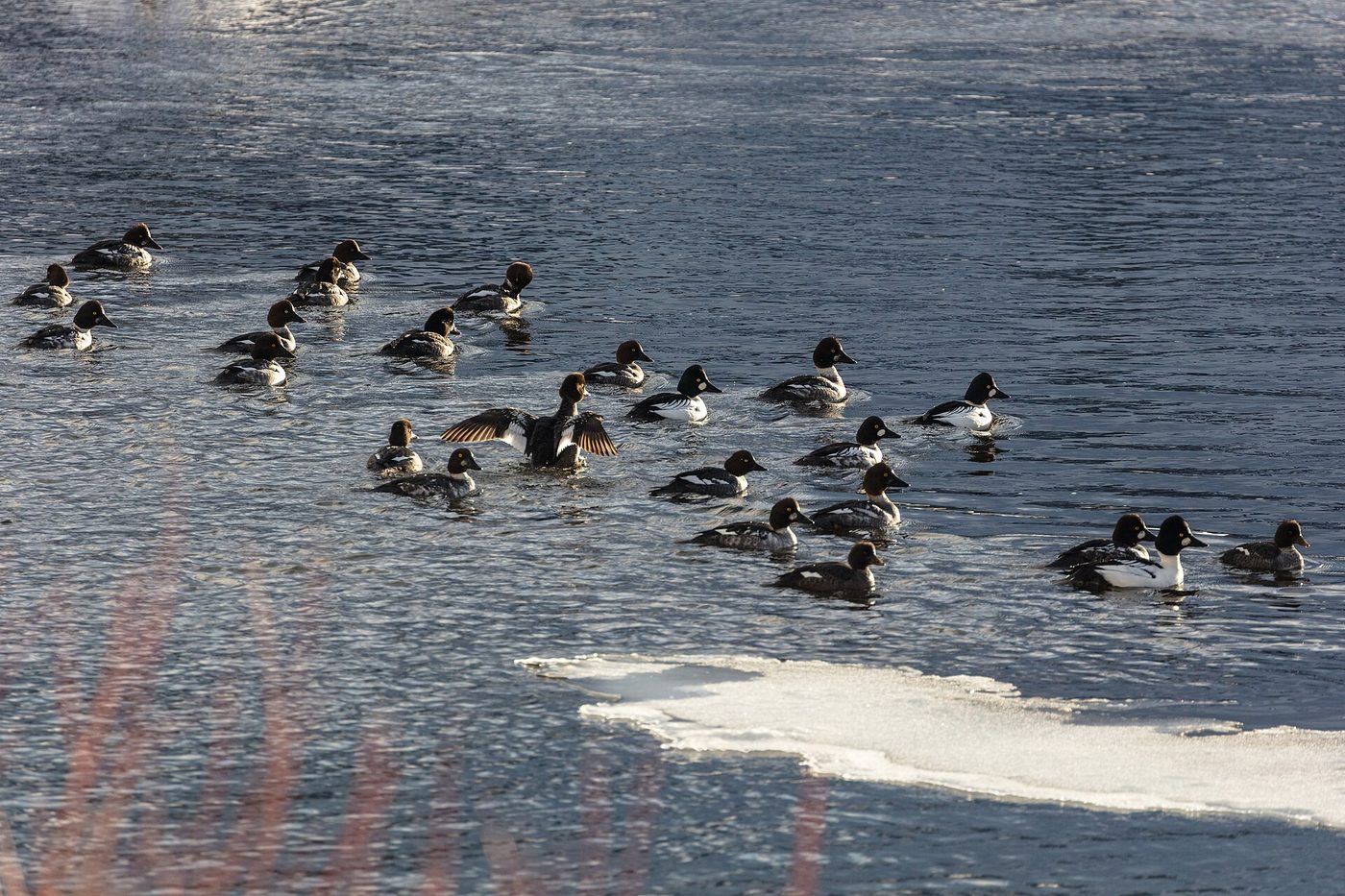
Midday is often quiet, with animals bedded down. Dawn and the last two hours of light are when things happen. For the full species list, see Yellowstone wildlife in winter, and read the park’s distance rules in our Yellowstone safety guide before you go.
Things to do in Yellowstone in January
Beyond Old Faithful and the wolves, January has plenty to fill a few days.
- Ride a snowcoach to the Grand Canyon of the Yellowstone. The 308-foot Lower Falls builds an ice cone at its base through the winter, and January is when it starts to look spectacular.
- Take a guided snowmobile day from West Yellowstone. It’s the most fun way to see the interior, if the coldest.
- Ski or snowshoe. January snow is usually deep and well settled. The Lone Star Geyser trail, 4.8 miles round trip from near Kepler Cascades, is the classic outing from the Snow Lodge, and Wraith Falls and the Beaver Ponds loop near Mammoth are open all year.
- Skate outside the Snow Lodge, where the outdoor rink comes with free skate rentals.
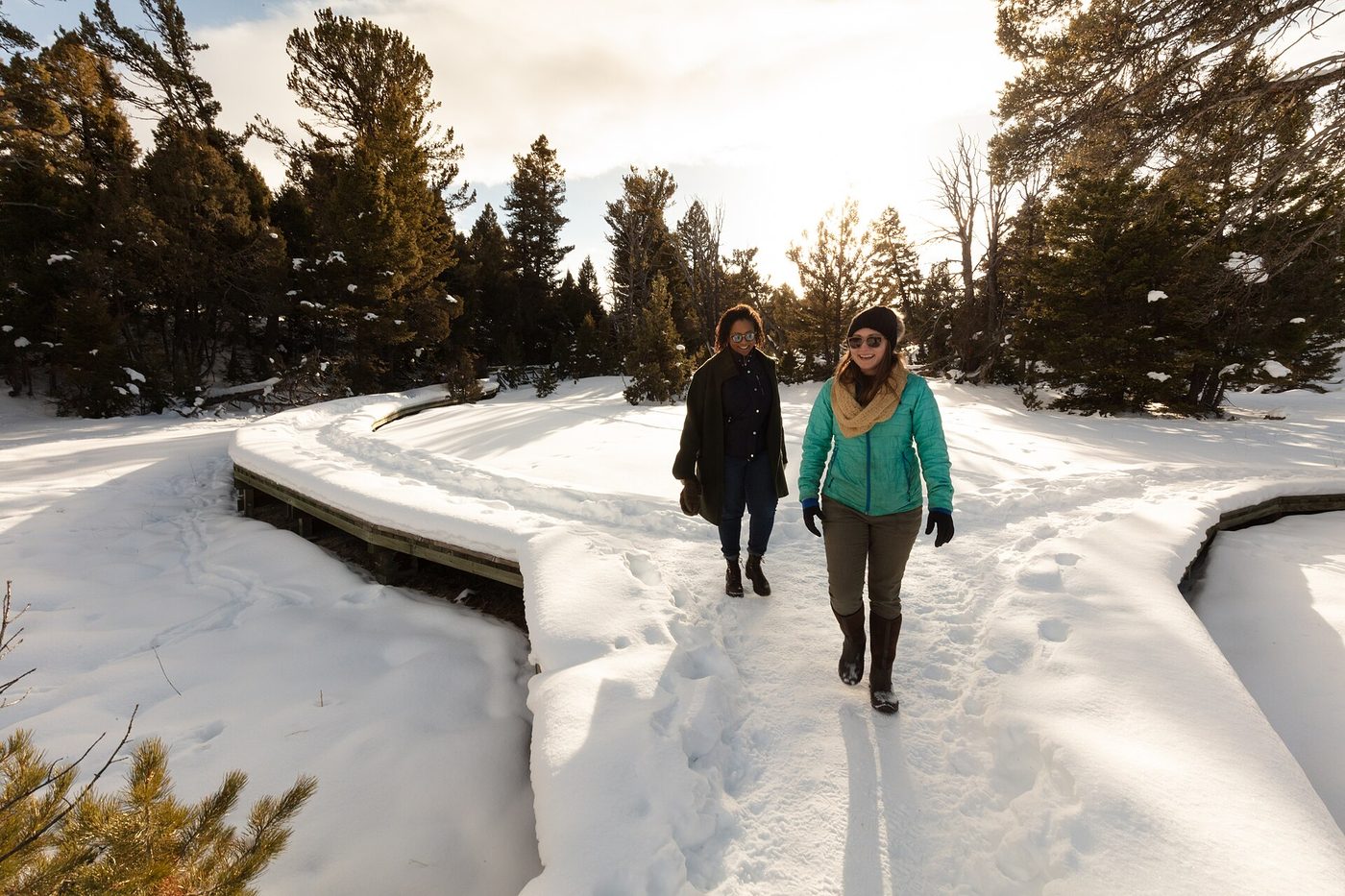
- Walk the Mammoth terraces, carefully. Most of the boardwalks aren’t maintained in winter, so wear traction devices.
- Soak in a hot spring outside the park. You can’t soak in any of Yellowstone’s thermal features, but Yellowstone Hot Springs is a few miles north of Gardiner. See Yellowstone Hot Springs near Gardiner.
- Photograph the frost. Rime-coated trees, frosted bison and sun dogs make January the best month for winter photography.
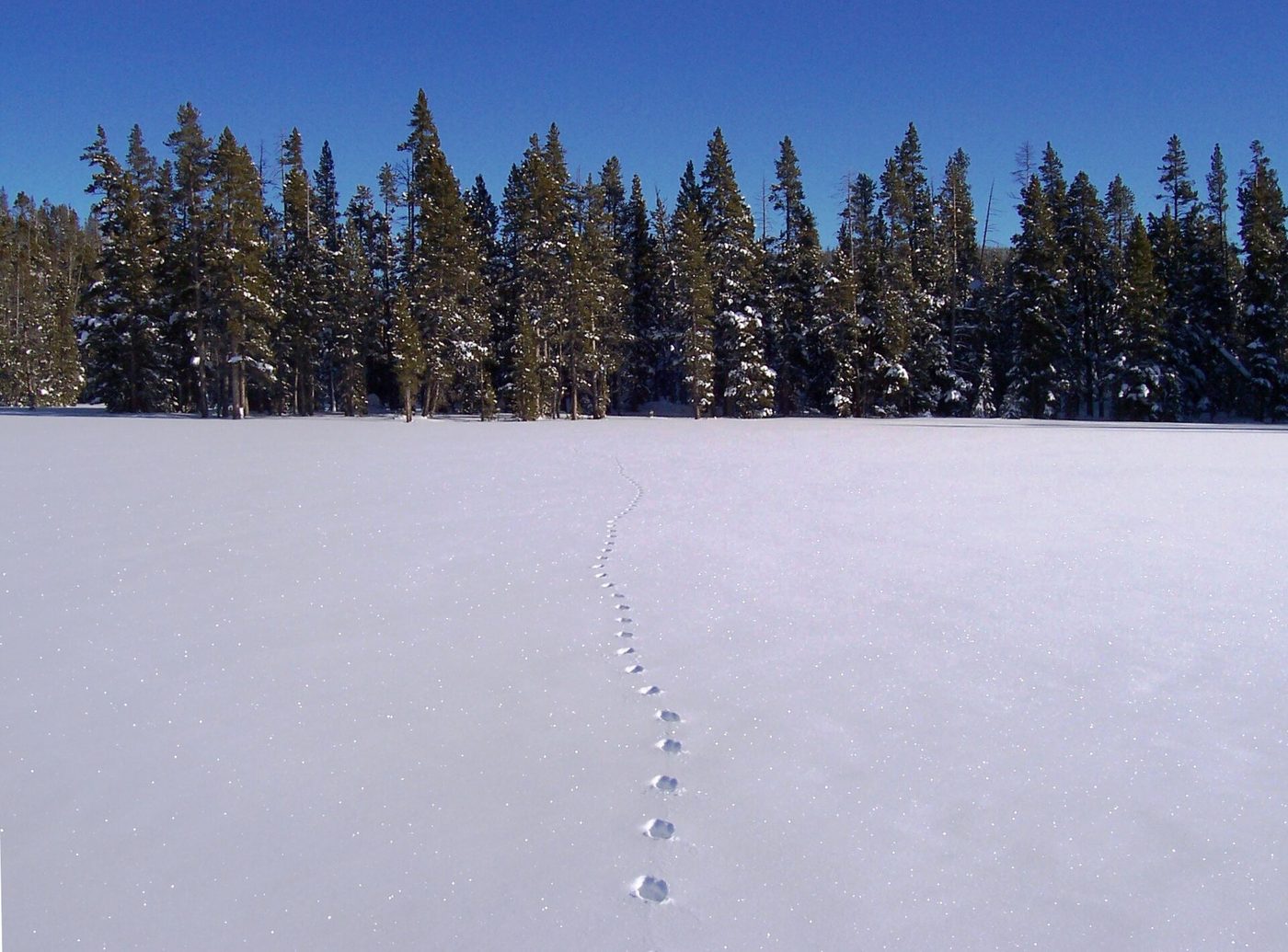
Our list of things to do in Yellowstone in winter covers 20 experiences in detail, and cross-country skiing in Yellowstone has the trails.
Photographing Yellowstone in January
January rewards photographers who plan for the cold. Snow fools camera meters into underexposing, so add one to two stops of exposure compensation for bright snow scenes, and check your histogram. For wildlife, a long lens matters more than ever, because you’ll be at a respectful distance from wolves and bison and many sightings are far away. A spotting scope with a phone adapter can work surprisingly well for distant wolves.
Condensation is the other enemy. Moving a cold camera into a warm lodge or snowcoach fogs the lens and can put moisture inside the body. Seal the camera in a bag before you go indoors and let it warm up slowly, and swap memory cards and batteries outside. Keep spare batteries warm in an inside pocket, and expect them to last half as long as usual. The best light comes in the first and last hour of the day, and the frost on trees near thermal features is thickest early, before the sun softens it. For more, see our guide to Yellowstone photography.
Getting to Yellowstone in January
Flying
West Yellowstone’s airport is closed in winter, so most January visitors fly into Bozeman, which is about 85 miles from the North Entrance and roughly 90 miles from West Yellowstone. Jackson Hole Airport, about 7 miles north of Jackson, is the other popular choice, especially for snowcoach trips through the South Entrance. Billings, Cody and Idaho Falls also have year-round service, but none is especially convenient for a winter visit.
Driving
- To Gardiner and Mammoth: I-90 east from Bozeman to Livingston, then US-89 south through Paradise Valley. This is the easiest winter drive and the only one that takes you straight into the park.
- To West Yellowstone: US-191 south from Bozeman through the Gallatin Canyon, a narrow, winding road that can be icy and is shared with trucks. Idaho Falls to West Yellowstone on US-20 is the other approach.
- To Jackson and Flagg Ranch: US-89/191 north from Jackson through Grand Teton to Flagg Ranch, where the plowed road ends.
Use proper winter tires, carry a winter emergency kit, and check conditions before you set out with the Montana and Wyoming 511 services and the park’s road line. For the drive itself, see Bozeman to Yellowstone.
Driving the northern road in January
The road through the park from Gardiner to Cooke City is plowed, but it’s a winter mountain road, not a highway. Expect packed snow and ice for long stretches, especially in shaded canyons and on the climb above Mammoth, and drive well below the posted limit. Bison use the plowed road as the easiest way through deep snow, often walking straight down the middle; wait for them or pass very slowly, and never honk or nudge. When you stop for wildlife, pull completely off the road, since stopping in a travel lane is dangerous and illegal.
Fuel up in Gardiner or Cooke City. The park lists year-round 24-hour card fueling at Mammoth and Tower Junction, but do not count on them. Cell coverage is patchy through much of the Lamar Valley, so tell someone your plans. Pack a shovel, blankets, water, food and a full charge on your phone, and turn back early if the weather turns. Our guide to driving through Yellowstone in winter goes into more detail.
Without a car
The park’s directions page lists bus service between Bozeman and West Yellowstone all year, and between Bozeman and Gardiner in winter and summer. Xanterra runs a winter-only shuttle from Bozeman’s airport to Mammoth Hot Springs Hotel, so you can fly in, sleep at Mammoth, ride the snowcoach to Old Faithful and never rent a car.
What does a January trip to Yellowstone cost?
A January trip usually costs less than summer for gateway hotels, but tours and in-park lodging add up. Expect about $180 each way for Xanterra’s snowcoach between Mammoth and Old Faithful, $322 to $490 for a guided snowmobile day, and $375 for a naturalist-led snowcoach day from Jackson, plus entrance fees (checked September 2026).
| Item | Price (checked September 2026) | Notes |
|---|---|---|
| Park entrance, private vehicle | $35 | Valid seven days; add $100 per non-US resident aged 16 and older |
| Xanterra snowcoach, Mammoth to Old Faithful | $179.45 adult, $89.72 child | Taxes included; $182.90 and $91.45 northbound |
| Guided snowmobile day to Old Faithful | $322 to $490 single rider | Operator listings; park fee sometimes extra |
| Snowcoach day from Jackson (Teton Science Schools) | $375 per person | Includes breakfast, lunch and optics; park pass extra |
| Mammoth Hot Springs Hotel | About $223 to over $600 a night | Last winter’s range as reported by National Parks Traveler |
| Escorted eight-day winter tour (Tauck) | From $6,990 per person | January and February 2027 departures |
| Mammoth Campground | $25 a night | First come, first served in winter |
A few money notes. The park’s 2026 fee-free days, now for US residents only, included none in January, so budget for the entrance fee; the details are on our Yellowstone entrance fee page. Guides expect a tip of 15 to 20 percent. And gateway-town hotels in Gardiner and West Yellowstone are usually cheaper in January than in summer, except over the holidays and Martin Luther King Jr. weekend. For how the tours compare, see our Yellowstone winter tours comparison.
The busy dates
January is quiet, but not evenly. The New Year holiday week, which ends on Sunday, January 3, 2027, and Martin Luther King Jr. weekend, January 16 to 18, 2027, are the busiest dates of the month for lodges and tours. The weekdays between them are the quietest of the whole winter.
How many days do you need in Yellowstone in January?
Three to five days is ideal. That gives you one or two dawns in the Lamar Valley for wolves, a day or two at Old Faithful, and a spare day for weather. With only two days, choose one side of the park: the northern range from Gardiner, or the geysers from West Yellowstone.
Here’s a five-day January trip that covers both, with a night at Old Faithful.
- Day 1: Bozeman to Gardiner. Fly into Bozeman, drive the 85 miles to Gardiner through Paradise Valley, and walk the Mammoth terraces in the late-afternoon light. Stay in Gardiner or at Mammoth.
- Day 2: Lamar Valley. Leave before dawn for the Lamar Valley and spend the morning with the wolf watchers. Come back for lunch, then snowshoe to Wraith Falls or soak at Yellowstone Hot Springs. Stay at Mammoth.
- Day 3: Snowcoach to Old Faithful. Take Xanterra’s 7:45 a.m. coach south by way of Norris and Madison, arriving around noon. Walk the Upper Geyser Basin in the afternoon and skate after dinner. Stay at Old Faithful Snow Lodge.
- Day 4: Old Faithful. Catch the first eruption at dawn, then ski or snowshoe to Lone Star Geyser or join the Across the Great Divide tour to West Thumb. Stay at the Snow Lodge.
- Day 5: Back to Mammoth and Bozeman. Ride the 7:45 a.m. coach north, arriving at Mammoth around midday, and drive back to Bozeman.
With three days, drop day 2 and one night at the Snow Lodge. With two days based in West Yellowstone, spend one on a snowcoach or snowmobile to Old Faithful and the other on a Grand Canyon snowcoach day. Keep in mind that the geysers and the northern range are about four hours apart by snowcoach, and roughly 170 miles apart by road if you drive round from West Yellowstone to Gardiner.
Planning the rest of your winter
If January doesn’t suit your dates, Yellowstone in December covers the start of the oversnow season and Yellowstone in February the sunnier second half of winter, when the snowpack is usually near its deepest. Roads start reopening to cars in spring, and Yellowstone in April explains when. Whatever month you pick, the Yellowstone winter packing list will keep you warm, and our month-by-month guide to the best time to visit Yellowstone puts January in context with the rest of the year.
Frequently asked questions
Is Yellowstone open in January?
Yes. The park is open every day of the year. In January the road from Gardiner through Mammoth and the Lamar Valley to Cooke City is open to cars, and the interior roads are open to snowcoaches and snowmobiles only. Two in-park hotels, Old Faithful Snow Lodge and Mammoth Hot Springs Hotel, are open.
How cold is Yellowstone in January?
It’s the coldest month of the year. The park’s monthly averages give a high of 28.6°F and a low of 9.6°F, but subzero mornings are common, especially in the geyser basins and valleys where cold air pools. The park’s record low is -66°F. Dress in layers and bring insulated boots.
Can you drive to Old Faithful in January?
No. The roads to Old Faithful are open only to oversnow vehicles from mid-December to mid-March. You can reach it on a snowcoach or guided snowmobile day tour from West Yellowstone, on Xanterra’s scheduled snowcoach from Mammoth, or by staying at Old Faithful Snow Lodge.
Is January a good time to see wolves in Yellowstone?
It’s one of the best. Wolves are easy to spot against snow, prey animals are concentrated in the lower valleys, and the breeding season begins late in the month. Drive the Lamar Valley at dawn, bring binoculars or a spotting scope, and stay at least 100 yards away.
Is Yellowstone crowded in January?
No. It’s one of the quietest months, with about 41,000 visits in January 2025 by one compilation of NPS counts, against 975,109 in July. The New Year holiday week and Martin Luther King Jr. weekend (January 16-18, 2027) are the busiest January dates.
What should you wear in Yellowstone in January?
Layers: a wicking base layer, an insulating mid-layer and a windproof, insulated outer layer, plus insulated waterproof boots, a warm hat, a neck gaiter and mittens or gloves with liners. Add traction devices for icy boardwalks. Our Yellowstone winter packing list has the full checklist.
Sources
- National Park Service, Weather in Yellowstone
- National Park Service, Park roads and winter travel
- National Park Service, Operating hours and seasons
- National Park Service, Explore Old Faithful
- National Park Service, Directions and transportation
- Yellowstone National Park Lodges (Xanterra), Snowcoach transportation
Image credits
| Photo | Credit |
|---|---|
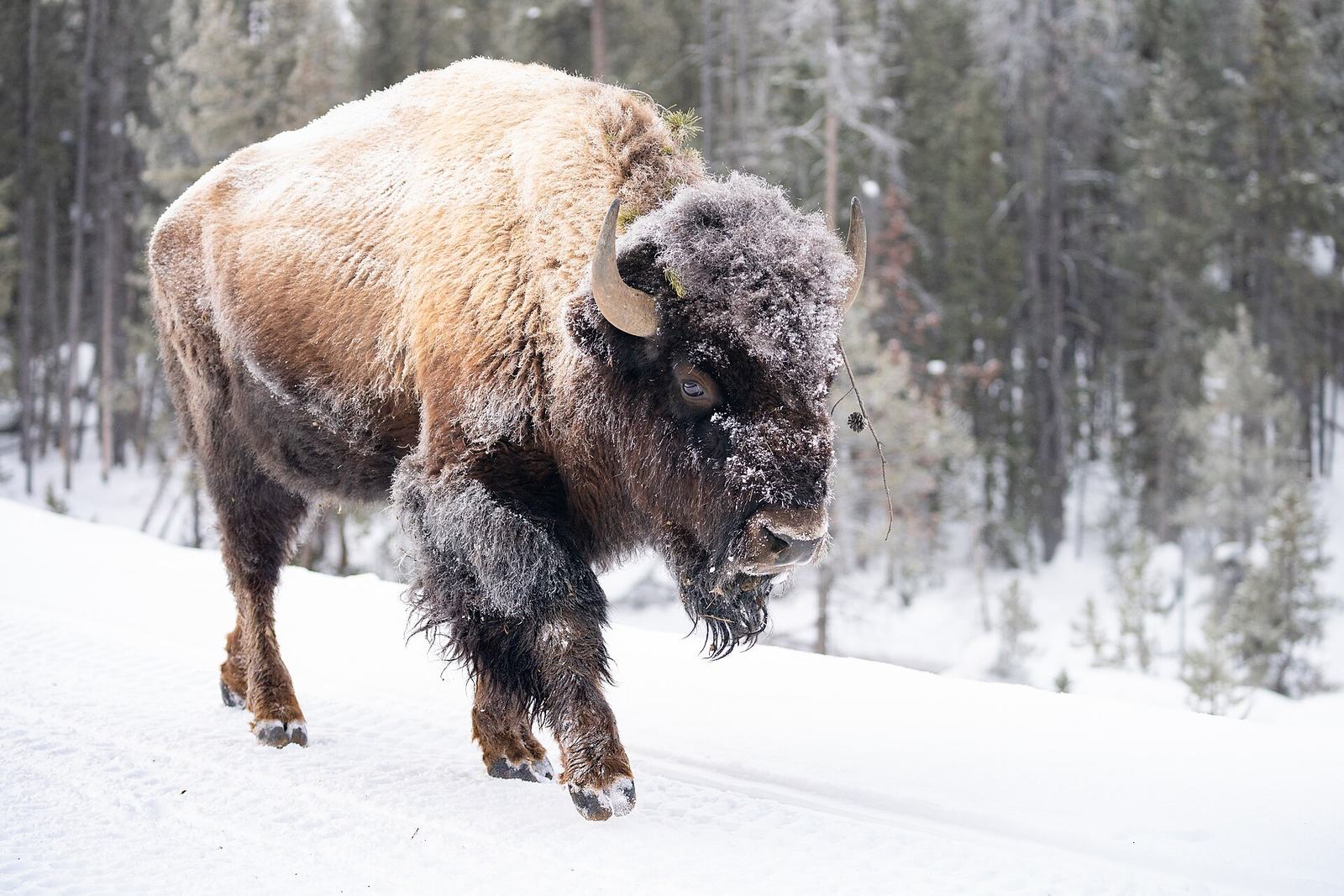
| A frost-covered bison on the road near Frying Pan Spring, between Mammoth and Norris (top of page) | Yellowstone National Park, public domain, via Wikimedia Commons |
| Hoarfrost along Tangled Creek in the Lower Geyser Basin, where warm water meets subzero ai | Yellowstone National Park, public domain, via Wikimedia Commons |
| Sun dogs and rime ice in the Upper Geyser Basin, photographed in December | Yellowstone National Park from Yellowstone NP, USA, public domain, via Wikimedia Commons |
| Mammoth’s boardwalks stay open in winter, but most aren’t cleared, so bring traction devic | Yellowstone National Park, public domain, via Wikimedia Commons |
| Old Faithful from Geyser Hill in January 2015 | Yellowstone National Park from Yellowstone NP, USA, public domain, via Wikimedia Commons |
| The Gibbon wolf pack in winter, seen from the air; from the road, most wolves are much far | Doug Smith, public domain, via Wikimedia Commons |
| Common goldeneyes on open water on the Lamar River | Jacob W. Frank, public domain, via Wikimedia Commons |
| Tracks across a snowfield, seen on a cross-country ski outing | NPS Natural Resources, public domain, via Wikimedia Commons |