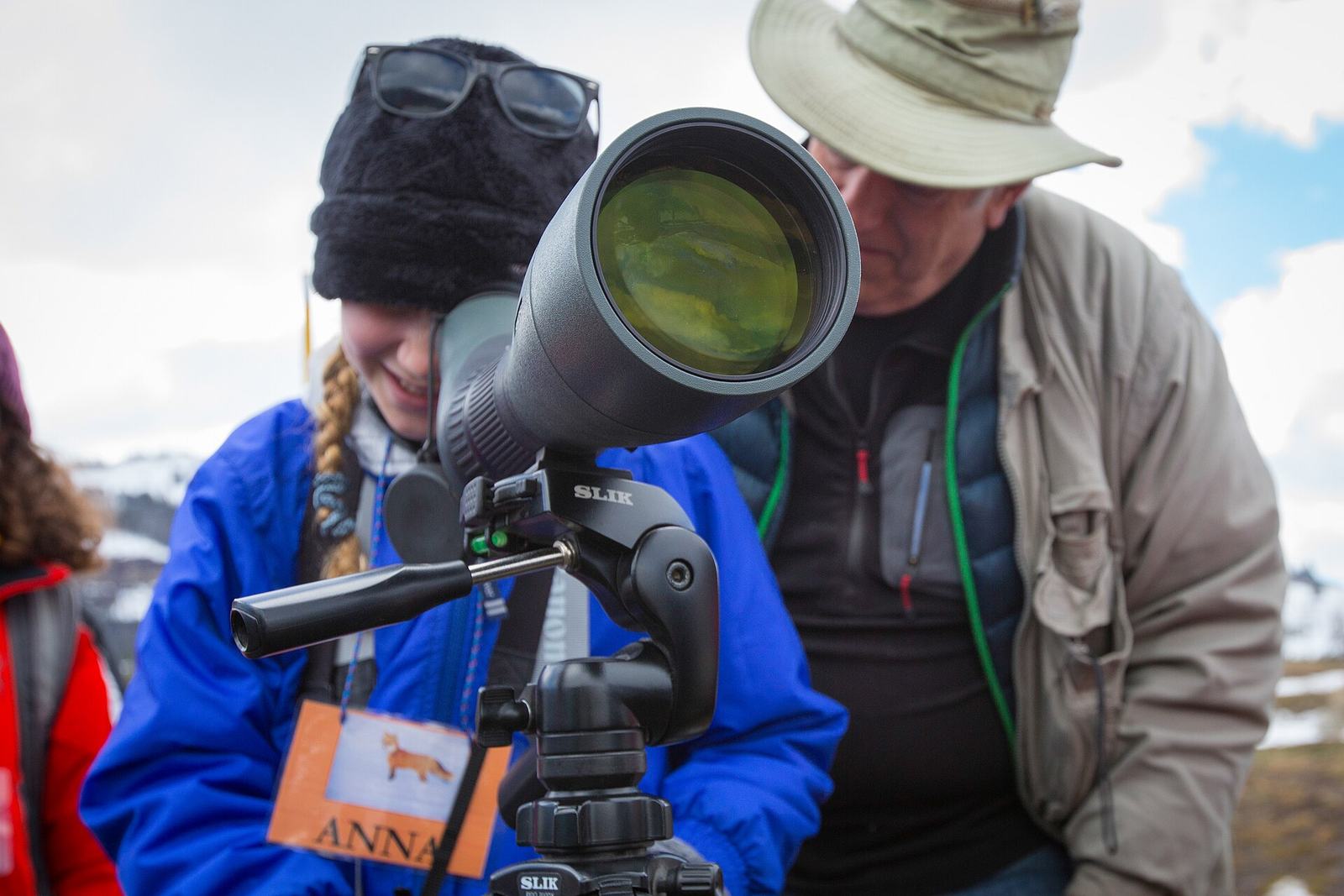
The best place for wolf watching in Yellowstone is the Lamar Valley, on the park’s northern road, and the best time is the first two hours after dawn, from December through early summer. Bring binoculars and ideally a spotting scope, look for the groups of watchers at the pullouts, and stay at least 100 yards away. Do that for a few mornings and your odds of seeing a wild wolf are good.
Wolves have been the park’s biggest wildlife story since they were brought back in 1995, and Yellowstone is still the best place in the world to watch wild wolves go about their lives. It isn’t a zoo, though. Most sightings are at a distance of half a mile or more, many mornings produce nothing but tracks, and the watchers who see the most are the ones who come early, stay patient and know what they’re looking for. This guide covers where the wolves are, when to look, how the dawn routine works, what gear makes the difference, the etiquette that keeps everyone welcome, and when a guide is worth the money. For every other species, see our guide to Yellowstone wildlife.
Where are the best places to see wolves in Yellowstone?
The Lamar Valley and the road that runs through it, from Tower Junction to the Northeast Entrance, is the best place by far, all year. Slough Creek and Blacktail Deer Plateau on the same road are next. In summer and fall, Hayden Valley between Canyon and Lake is the other reliable area. Wolves can turn up anywhere, but these are where to spend your mornings.
| Area | Open to cars in winter? | Best seasons | Notes |
|---|---|---|---|
| Lamar Valley | Yes | Winter and spring, with good chances all year | Wide open valley with long sightlines; the heart of wolf watching |
| Slough Creek and Junction Butte | Yes, along the main road | Winter and spring | Western end of the Lamar area; the Slough Creek side road isn’t plowed in winter |
| Blacktail Deer Plateau | Yes | Winter | Rolling open country between Mammoth and Tower |
| Hayden Valley | No, oversnow only | Summer and fall | Between Canyon and Lake; best early in the morning |
| Madison and Firehole rivers | No, oversnow only | Winter, occasionally | Sightings from snowcoaches and snowmobiles happen but aren’t common |
The Lamar Valley
The Lamar Valley is a broad, open valley in the park’s northeast corner, where the Lamar River meanders through grassland and sage with ridges on every side. Its wide sightlines are what make it special: from a roadside pullout you can scan miles of slopes, and a wolf crossing snow a mile away is visible in a good scope. Elk, bison and other prey winter here, the wolves follow them, and packs have denned in and around the valley for decades. It’s also on the only road in the park open to cars all year, so you can watch here in any season. Our guide to the Lamar Valley covers the valley as a whole, and the Lamar Valley map marks the pullouts.
Slough Creek and Junction Butte
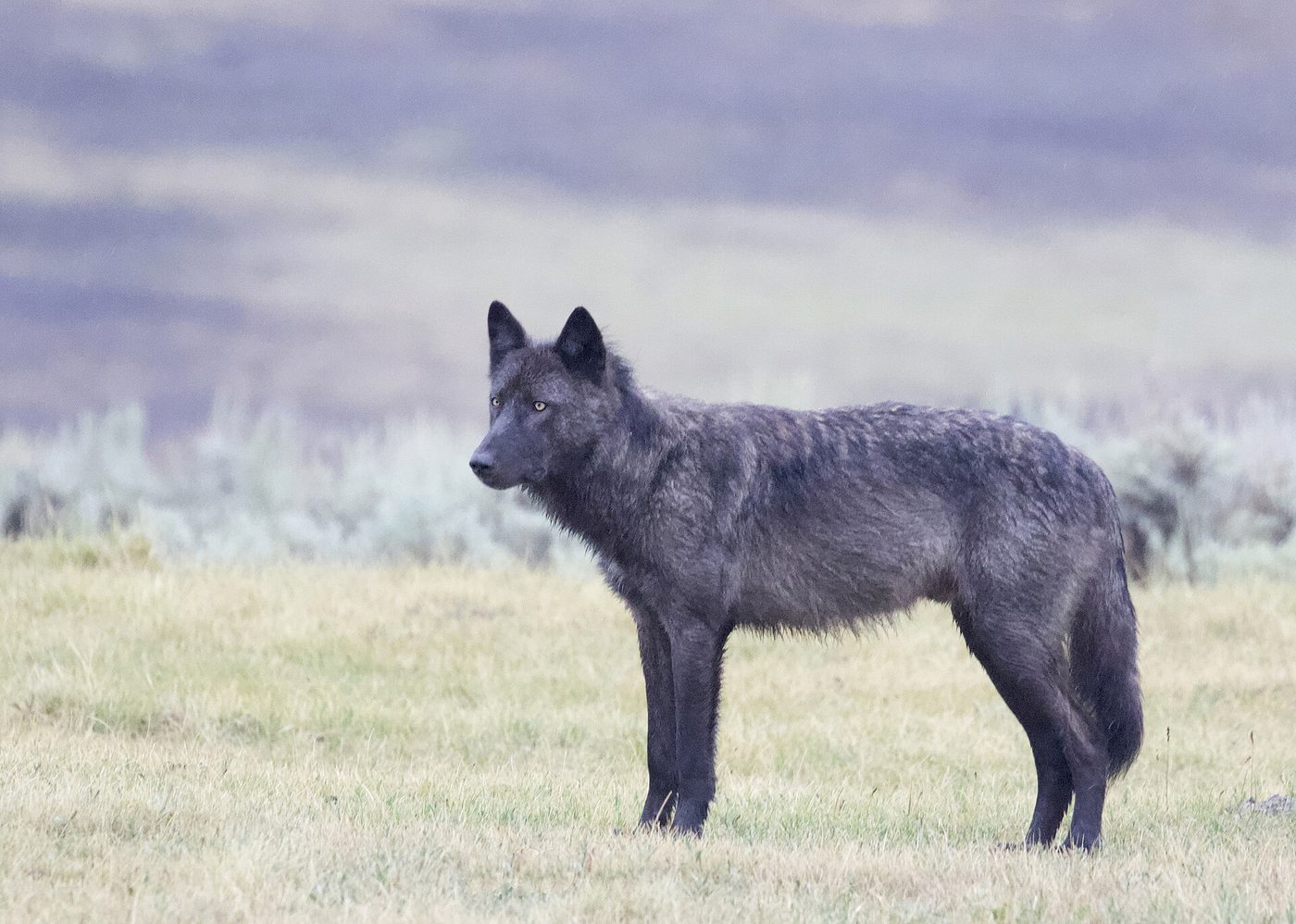
At the western end of the Lamar area, the road passes Junction Butte and the turnoff to Slough Creek. The Junction Butte pack, named for the landmark, has been one of the most watched packs in the park in recent years, and in some springs its den area has been visible from a distance. Pack territories shift over time, so ask at the pullouts which packs are active where when you visit.
Blacktail Deer Plateau and the Mammoth to Tower road
The open, rolling country of Blacktail Deer Plateau, between Mammoth and Tower Junction, is good wolf country in winter, when elk gather there. It gets less attention than the Lamar Valley, which can mean fewer people at the pullouts. It’s also the first stretch of wolf habitat you’ll reach driving from Gardiner.
Hayden Valley
In summer and fall, Hayden Valley, between Canyon Village and Lake, is the other reliable place to look. It’s home to the Wapiti Lake pack, and its open meadows along the Yellowstone River give good sightlines at dawn. Hayden Valley is closed to cars in winter, so plan it for May to October.
When is the best time to see wolves in Yellowstone?
Winter and spring, at dawn. From December through March, wolves stand out against snow and follow prey into the lower valleys; from April to June, packs are tied to their dens. Summer is hardest. Whatever the season, the first two hours after sunrise are best, and the last hour before dark is second best.
| Season | Wolf watching | What’s happening |
|---|---|---|
| Winter (December to March) | Excellent | Wolves are easy to see against snow and follow elk and bison into the valleys; breeding season starts in late January |
| Spring (April to June) | Very good | Pups are born around April; packs travel to and from their dens |
| Summer (July and August) | Fair to poor | Wolves rest through the heat of the day and range more widely; dawn is the only real window |
| Fall (September to November) | Good | Elk rut and cooler weather bring more daytime activity; Hayden Valley closes to cars at the end of October |
The time of day matters even more than the season. Wolves are most active around dawn and dusk and often bed down by mid-morning, especially in warm weather. In winter the sun rises around 8 a.m. in January, so you can be in position by first light without a 4 a.m. alarm. In June, first light comes before 5 a.m., and the most dedicated watchers are at the pullouts before that.
Why winter is the best season
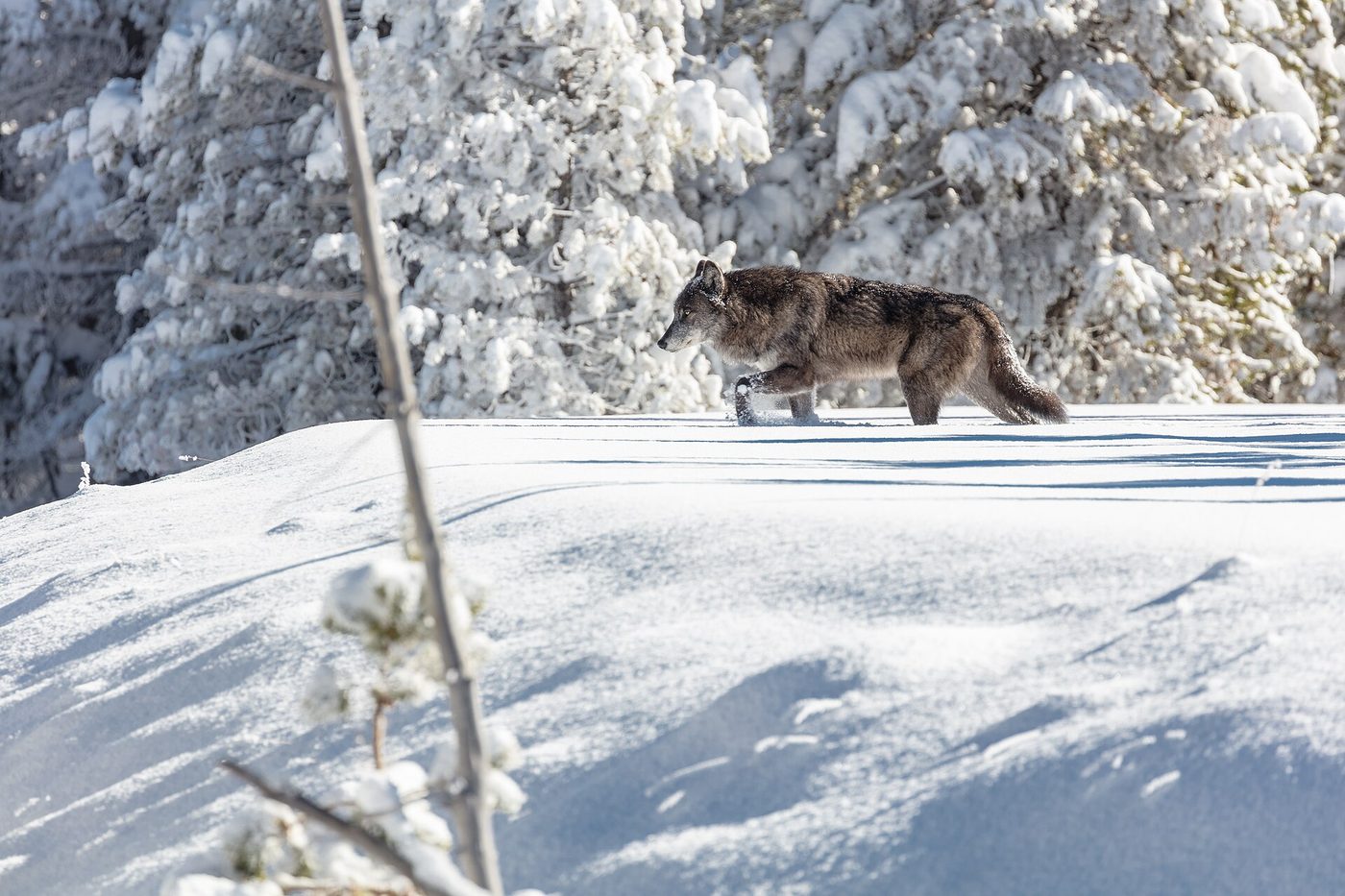
Winter tips every advantage toward the watcher. Snow buries the grass, so elk and bison move down to the lower, wind-scoured slopes of the northern range, and wolves follow them. A dark animal on a white hillside is visible from far away, and fresh snow records every track, so you can often read where a pack has been overnight. Carcasses draw wolves back to the same spot for days, with ravens and eagles marking the place. Crowds are small outside the holiday weeks, and the one road that stays open to cars in winter runs straight through the best habitat. The trade-offs are cold, short days and occasional road closures in storms, all of which are manageable with warm clothes and a flexible plan.
Spring: dens, pups and bears
Wolves breed in late winter and pups are born around April in dens, often dug into hillsides. For the next couple of months the pack’s movements revolve around the den, with adults leaving to hunt and returning to feed the pups, which makes their comings and goings more predictable. Spring also brings bears out of hibernation, newborn bison calves and elk calving, so a May morning in the Lamar Valley can be the best wildlife watching of the year. Expect more people than in winter, and respect any closures the park puts in place around dens.
For a deeper look at the cold months, see Yellowstone in January and Yellowstone wildlife in winter. For the whole year’s wildlife calendar, our guide to Yellowstone wildlife has a month-by-month view.
How to find a wolf: the dawn routine
Seeing wolves is less about luck than routine. Here’s how the regulars do it.
- Leave in the dark. From Gardiner or Mammoth, give yourself about an hour to reach the west end of the Lamar Valley; from Silver Gate or Cooke City, the east end is much closer.
- Drive slowly and look for people. The single best sign that wolves are in view is a cluster of cars at a pullout and people standing still behind spotting scopes. Pull fully off the road, walk over quietly, and ask what they’re watching.
- Scan open slopes and ridgelines. On your own, stop at pullouts with long views and sweep the slopes slowly with binoculars, then check anything interesting with a scope. Wolves often travel along ridges and across open snow.
- Watch the birds. Ravens, magpies and eagles gathered in one spot often mean a carcass, and wolves will usually return to feed. Coyotes hanging around the same spot are another clue.
- Listen. On a still morning, howling carries for miles across the valley. It’s often how watchers learn that a pack has moved.
- Stay put when it’s working. Wolves bed down and get up again. If a pack is in view, patience often pays off with a walk, a greeting or a hunt.
- Come back at dusk. If the morning is quiet, the last hour of light is your second chance.
Wolf or coyote?
Coyotes are common in the Lamar Valley and fool plenty of first-time watchers. A few pointers help:
- Size. An adult wolf is roughly two to three times the weight of a coyote, with much longer legs. Next to a raven, a coyote looks small and a wolf looks big.
- Head and ears. Wolves have a broad, blocky muzzle and relatively short, rounded ears. Coyotes have a narrow, pointed face and tall, pointed ears.
- Color. Yellowstone’s wolves come in gray, black and occasionally white. Coyotes are grayish tan. A black canid in Yellowstone is almost certainly a wolf.
- Movement. Wolves tend to travel with a steady, long-legged trot. Coyotes often move in a quicker, bouncier way and pounce on voles in the snow.
If you’re not sure, ask the nearest scope. Wolf watchers enjoy explaining the difference.
What you might see: reading wolf behavior
Once you’ve found wolves, the fun is in working out what they’re doing. A few behaviors come up again and again.
- Traveling. Packs often move in a loose single-file line, stepping in each other’s tracks through deep snow. Watching a line of dark shapes cross a white slope is the classic Lamar Valley sighting.
- Testing and hunting. Wolves approach elk or bison herds and watch how they react, looking for an animal that’s weak, young or slow. Most tests end without a chase, and most chases end without a kill.
- Feeding. At a carcass, the pack eats in shifts, with ravens, magpies, eagles and coyotes waiting their turn nearby. A pack may stay near a kill for a day or more.
- Rallies and greetings. When a pack gathers, wolves greet each other with wagging tails, play bows and nuzzling. In spring and summer, pups mob the returning adults.
- Howling. Howls keep a pack in touch and warn other packs off. A chorus rolling across the valley at dawn is one of the great sounds of the park.
- Bedding down. After a night of travel or a meal, wolves sleep for hours, often curled up in the snow or tucked into sage. A bedded pack can look like a scatter of rocks until one of them lifts its head.
- Conflict between packs. Territorial fights are a leading natural cause of death for Yellowstone’s wolves, and occasionally watchers see packs confront each other across a ridge.
A typical morning, winter and summer
In January, you might leave Gardiner at 6:30 a.m., reach the west end of the Lamar Valley as the sky lightens a little after 7, and spend the next two or three hours moving between pullouts as the watchers track a pack. By 10 or 11 the wolves have often bedded down, and it’s time to thaw out over lunch in Cooke City or back at Mammoth. Many regulars return for the last hour of light, which in January means around 4 p.m.
In June, the same routine starts much earlier. Watchers are often in position by 5 a.m., the best activity is over by 8 or 9, and the middle of the day is usually quiet. A late-evening session, after 7 p.m., can be productive, and the long light makes it easy to fit in both.
Gear: binoculars, spotting scopes and what else to bring
Good optics are the difference between watching wolves and watching dots.
- Binoculars in the 8×42 or 10×42 range are for scanning. Everyone in your group should have a pair.
- A spotting scope with a zoom eyepiece (around 20-60x) and a large objective lens (65mm or more) turns a distant speck into a wolf you can identify. If you’re serious about wolf watching, it’s the one piece of gear worth buying or borrowing.
- A sturdy tripod, because a scope at 40x is useless if it shakes in the wind. A window mount lets you watch from a warm car.
- A phone adapter for your scope lets you take record photos of distant wolves, a technique called digiscoping.
- Warm clothes and a thermos. Watching wolves means standing still at dawn, often below zero in winter. Insulated boots, mittens, a warm hat and a hot drink make the difference between staying an hour and leaving after ten minutes.
- A camera with a long lens if you want photographs, though even 600mm won’t get you close to a wolf half a mile away. See our guide to Yellowstone wildlife photography.
The honest take: without a scope, many sightings will be a moving dot that someone else tells you is a wolf. That’s still a thrill, but if you want to see behavior, bring a scope or join a tour whose guide carries one.
Wolf watching with children
Children often love wolf watching, as long as the morning is built around them. Keep outings short and warm, with snacks, hot chocolate and a way to warm up in the car between sightings. Give each child their own binoculars, and let them look through a scope as soon as there’s something to see; most watchers are happy to share. A field guide or a checklist of other animals keeps the waiting interesting, since bison, coyotes and ravens are almost guaranteed. Explain the 100-yard rule before you arrive, and pick a pullout with space to move around. For very young children, a visit to the Grizzly & Wolf Discovery Center in West Yellowstone makes a good backup, and our guide to Yellowstone with kids in winter has more ideas.
Wolf watching etiquette
The Lamar Valley works because hundreds of people share a small number of pullouts every morning. These rules and courtesies keep it that way.
- Stay at least 100 yards from wolves, and 25 yards from bison, elk and other animals. That’s the law in the park, and it applies from the roadside too. If a wolf approaches you, move away.
- Pull completely off the road. Never stop in a travel lane, never block a pullout entrance, and don’t park on the vegetation.
- Stay near the road. Don’t follow wolves on foot, and don’t walk toward a pack for a better view. Respect any closures around dens or carcasses.
- Keep it quiet. Close car doors gently, keep voices low and turn off your engine when you can. Sound carries across the snow.
- Never howl, call, bait or feed. Anything that attracts or disturbs wildlife is prohibited, and so are drones anywhere in the park.
- Share, and don’t crowd. Leave space around other people’s scopes, ask before looking through one, and pass along what you’ve seen. Most regulars are generous with their knowledge.
- Don’t publicize den sites. Posting precise locations can draw crowds that stress a pack.
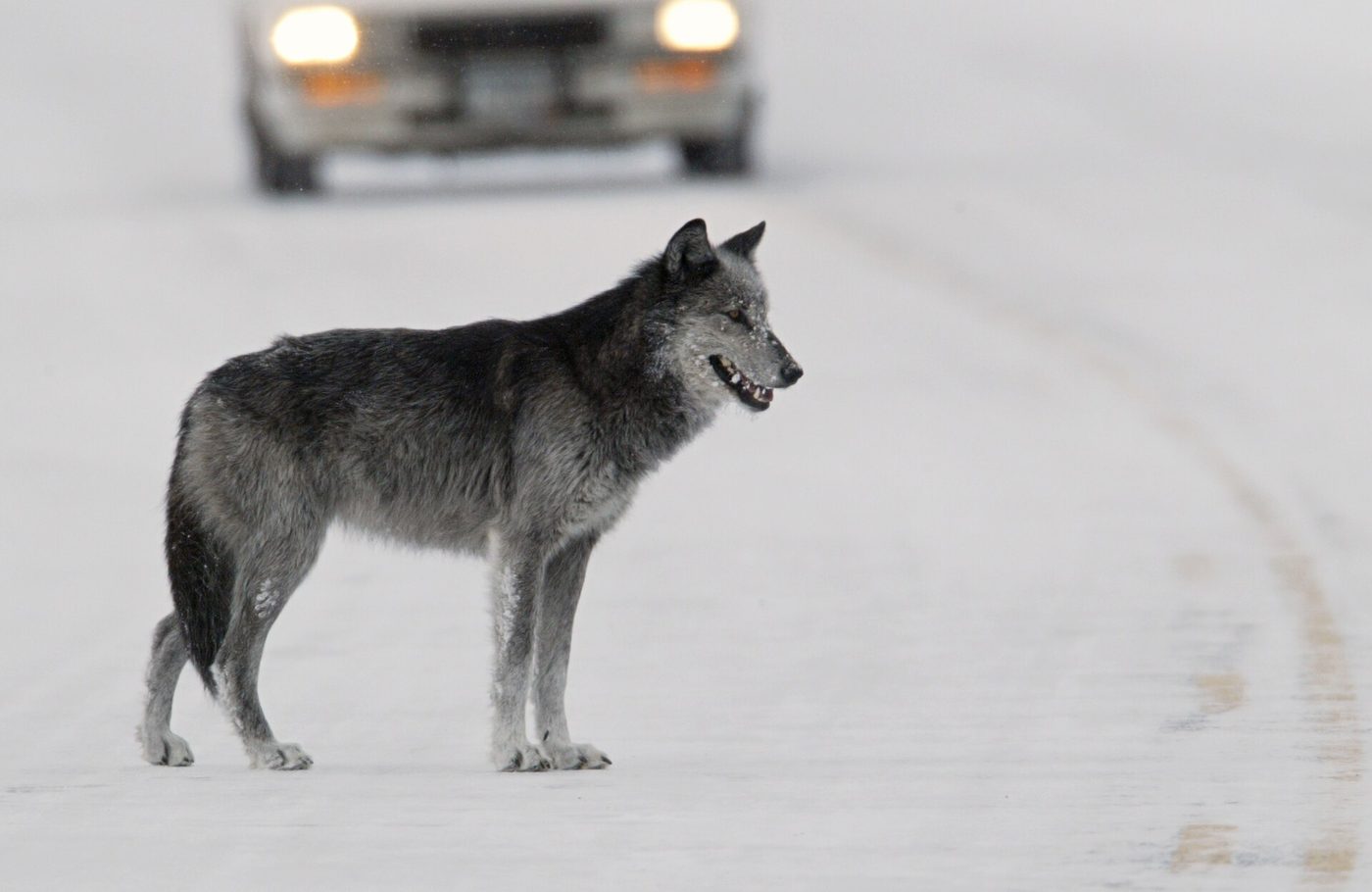
Wolves sometimes cross the road or walk along it. If that happens, stay in your car, let the wolf pass, and don’t follow it. Our Yellowstone safety guide has the park’s full wildlife rules.
Yellowstone’s wolves today: numbers and packs
Wolves were eliminated from Yellowstone early in the 20th century; the last known native wolves in the park were killed in 1926. In 1995, 14 wolves captured in Canada were released in the park after a period in acclimation pens, and 17 more followed in 1996. Our guide to Yellowstone wolf reintroduction tells the full story.
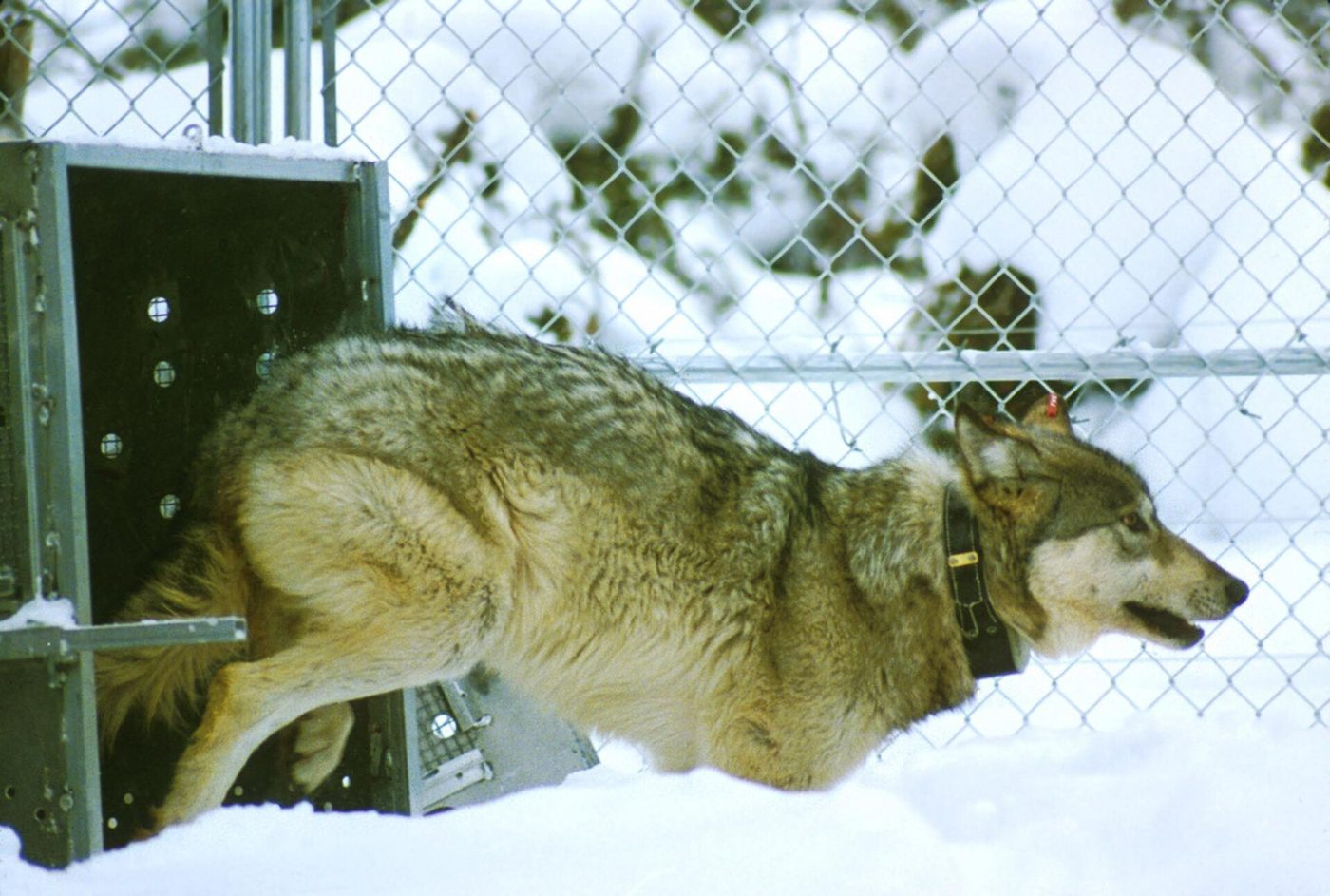
The population has risen and fallen since, driven by prey, disease and conflict between packs. The park’s mammal page gives a count of at least 108 wolves living primarily in the park as of January 2025 (checked September 2026). Secondary reports put the end-of-2025 count lower, at about 84 wolves in 8 packs; the Yellowstone Wolf Project’s annual report is the place to confirm the latest figure. Many wolves wear radio or GPS collars for that research, which is why you’ll often see a collar in photos.
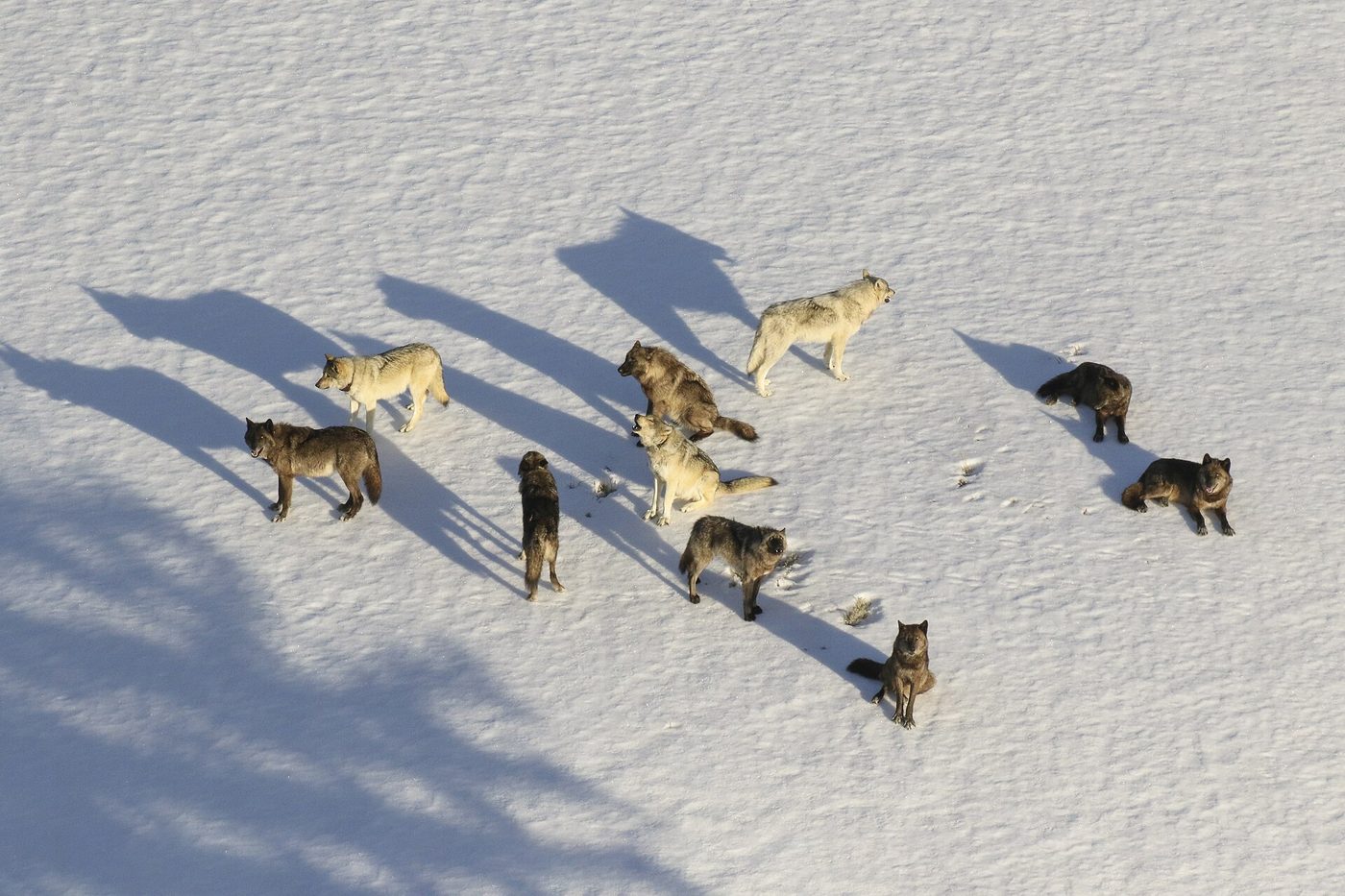
Pack names and territories change as wolves disperse, packs merge and old packs disappear. In recent years, the Junction Butte pack has been the one most associated with the Lamar Valley and Slough Creek, and the Wapiti Lake pack with Hayden Valley. Wolves that leave the park can be legally hunted in the surrounding states, which is one of the reasons a well-known wolf can vanish from the Lamar Valley between one season and the next. For current pack news, see our guide to Yellowstone wolf packs, and ask the watchers at the pullouts.
The wolves people remember
Part of what makes Yellowstone’s wolves special is that watchers get to know them as individuals over years. Wolf 21, the Druid Peak pack’s alpha male in the early 2000s, became a legend among watchers, and the Druid Peak pack as a whole was the most watched wolf family in the world for a decade. In December 2012, the Lamar Canyon pack’s alpha female, 832F, known as O-Six after the year of her birth, was shot legally by a hunter just outside the park, and her death drew worldwide attention to what happens when park wolves cross the boundary. Newer packs and wolves now carry those stories on, and a morning at the pullouts is as much about hearing them as about seeing wolves.
Should you take a wolf watching tour?
A guide is worth it if you have only a day or two, don’t own a spotting scope, or want someone to explain the behavior you’re seeing. Guides know where the packs were yesterday, carry better optics than most visitors, and are plugged into the watcher network. If you have several mornings and a scope, you can do well on your own.
Your main options:
- Private and small-group guides based in Gardiner, Bozeman, Big Sky and Cooke City run wolf and wildlife days on the northern range, usually starting before dawn. Compare what’s included, especially the quality of the scopes and the group size. See Yellowstone tours from Gardiner.
- Xanterra runs a Lamar Valley Wildlife Tour and, in winter, Wake Up to Winter Wildlife from Mammoth Hot Springs Hotel.
- Yellowstone Forever, the park’s nonprofit partner, runs field seminars, including winter courses on wolf and cougar tracking in the Lamar Valley. They’re the best choice if you want to learn, not just see.
For winter-specific options, see our guide to Yellowstone winter wolf tours, and for every kind of guided trip, our overview of Yellowstone tours.
Where to stay for wolf watching
The closer you sleep to the Lamar Valley, the easier the dawn starts. In winter, choose from Gardiner, Mammoth Hot Springs Hotel and Mammoth Campground, or Silver Gate and Cooke City at the valley’s east end. In summer, Roosevelt Lodge Cabins at Tower Junction and the small campgrounds at Slough Creek and Tower Fall put you right in wolf country; Slough Creek has just 16 sites and fills fast. Our guide to where to stay near Lamar Valley compares them, and camping in Yellowstone has every campground’s season and fees.
If you don’t see a wolf
Plenty of visitors spend a morning in the Lamar Valley and go home without a wolf. It happens, and it’s worth planning for.
- Give it several mornings. Your odds rise sharply with each dawn you spend in the valley, especially in winter and spring.
- Enjoy the rest of the cast. Bison, elk, pronghorn, bighorn sheep, coyotes, foxes, eagles and, in spring, bears are all common along the same road.
- Read the snow. In winter, tracks, kill sites and raven gatherings tell the story of what happened overnight.
- See wolves up close in West Yellowstone. The Grizzly & Wolf Discovery Center keeps wolves that can’t live in the wild and is open every day. It isn’t the same as a wild wolf, but it shows you what you’re looking for. See our Grizzly & Wolf Discovery Center guide.
Wolf watching rewards the patient. Come at dawn, bring good optics, learn from the watchers, and one of these mornings you’ll see a pack moving across the snow. For the rest of the park’s animals, and the best places and seasons to see them, head back to our complete guide to Yellowstone wildlife.
Frequently asked questions
What is the best month to see wolves in Yellowstone?
January through March is usually best, because wolves stand out against the snow and follow elk and bison into the Lamar Valley. April to June is also very good, when packs are tied to their dens. July and August are the hardest months, with wolves resting through the heat of the day.
What time of day are wolves most active in Yellowstone?
Early morning and evening. The first two hours after dawn are the best time for wolf watching all year, and the last hour before dark is second best. By mid-morning wolves often bed down, especially in summer, and midday sightings are uncommon.
Can you see wolves in Yellowstone in summer?
Yes, but it’s harder. Go at first light, which comes before 5 a.m. in June, and focus on the Lamar Valley and Hayden Valley. Wolves range more widely in summer and rest through the heat, so expect distant sightings and quieter mornings than in winter.
How close can you get to wolves in Yellowstone?
No closer than 100 yards, by park rules, whether you’re on foot or in a car at a pullout. That’s the length of a football field. If a wolf approaches you, move away. Most sightings are much farther, often half a mile or more, which is why a spotting scope helps.
How many wolves are in Yellowstone?
The park counted at least 108 wolves living primarily in Yellowstone in January 2025. Secondary reports put the end-of-2025 figure lower, at about 84 wolves in 8 packs. The Yellowstone Wolf Project publishes the official count in its annual report.
Do you need a guide to see wolves in Yellowstone?
No. Many visitors see wolves on their own by driving the Lamar Valley at dawn and joining the watchers at the pullouts. A guide improves your odds on a short trip and brings good optics and expert interpretation, which is why many first-time wolf watchers book one.
Sources
- National Park Service, Mammals of Yellowstone
- National Park Service, Safety in Yellowstone
- National Park Service, Park roads
- National Park Service, A Peak Experience: Watching Wolves in Yellowstone
- Yellowstone National Park Lodges (Xanterra), Winter tours from Mammoth Hot Springs
Image credits
| Photo | Credit |
|---|---|
| Wolf watching with a spotting scope in the Lamar Valley in late May (top of page) | Neal Herbert, public domain, via Wikimedia Commons |
| A black wolf of the Junction Butte pack in the Lamar Valley, photographed in summer | Gregory Smith, CC BY-SA 2.0, via Wikimedia Commons |
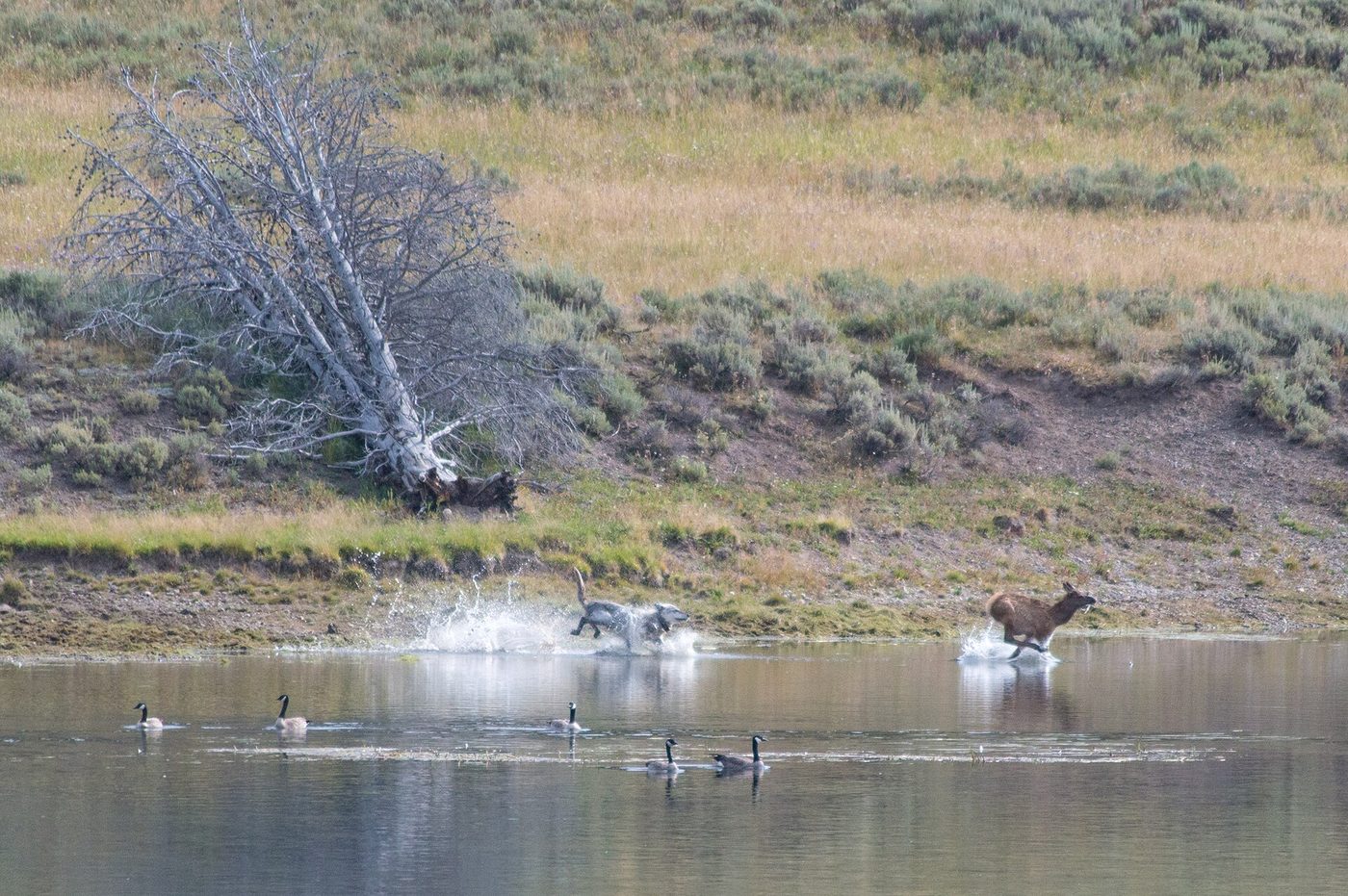
| A wolf chasing an elk through the Yellowstone River | Supercarwaar, CC BY-SA 4.0, via Wikimedia Commons |
| A wolf moving through fresh snow; in winter, wolves stand out against white slopes | Yellowstone National Park, public domain, via Wikimedia Commons |
| A Druid pack wolf known to watchers as Half Black, standing in the road near the Lamar Riv | Yellowstone National Park from Yellowstone NP, USA, public domain, via Wikimedia Commons |
| A wolf released into an acclimation pen in 1996, the second year of the reintroduction | NPS Photo, public domain, via Wikimedia Commons |
| The Junction Butte pack photographed from a Wolf Project survey plane | Yellowstone National Park, public domain, via Wikimedia Commons |
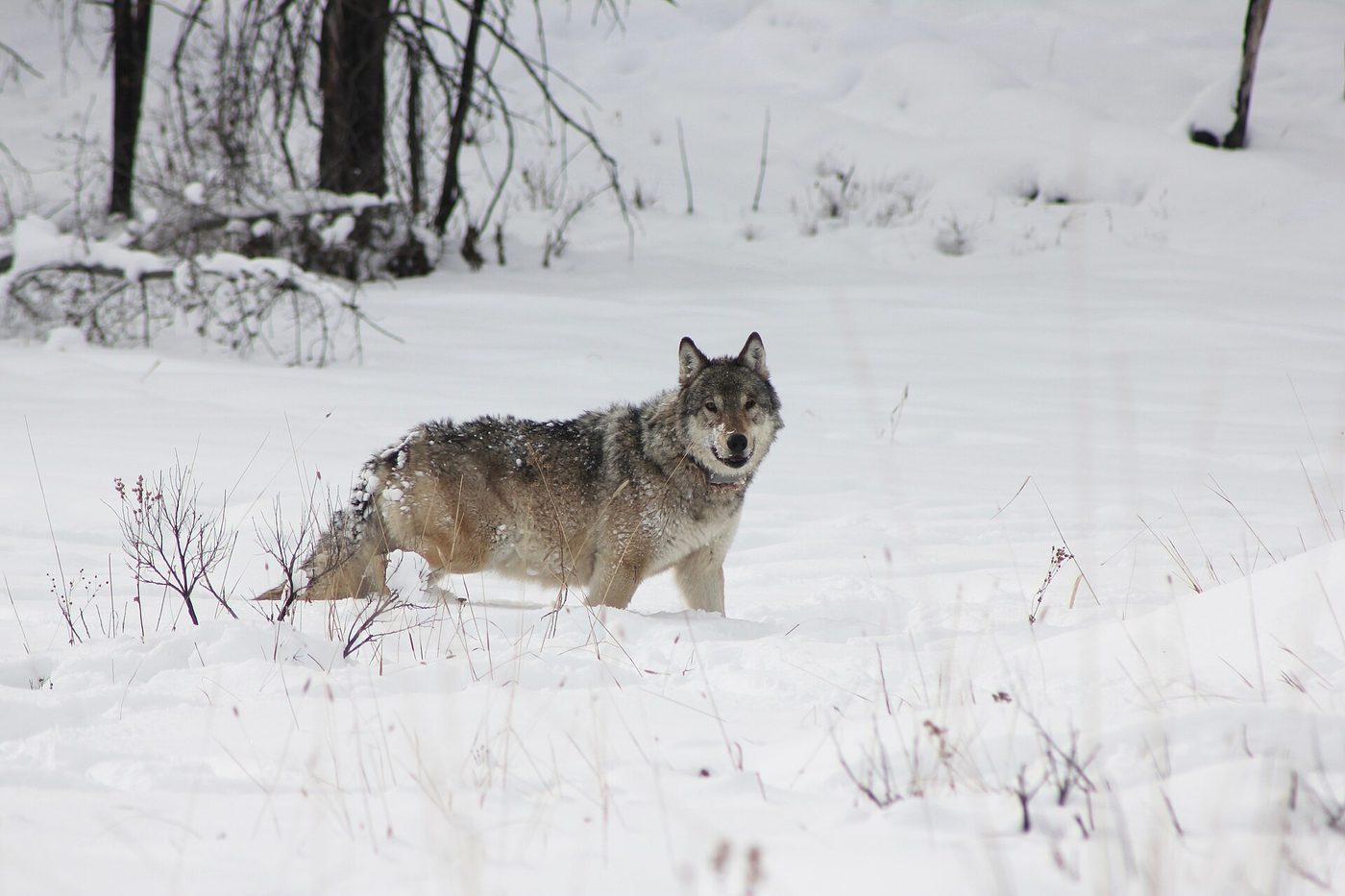
| Wolf 907F of the Junction Butte pack; park researchers identify many wolves by number | YellowstoneNPS, public domain, via Wikimedia Commons |