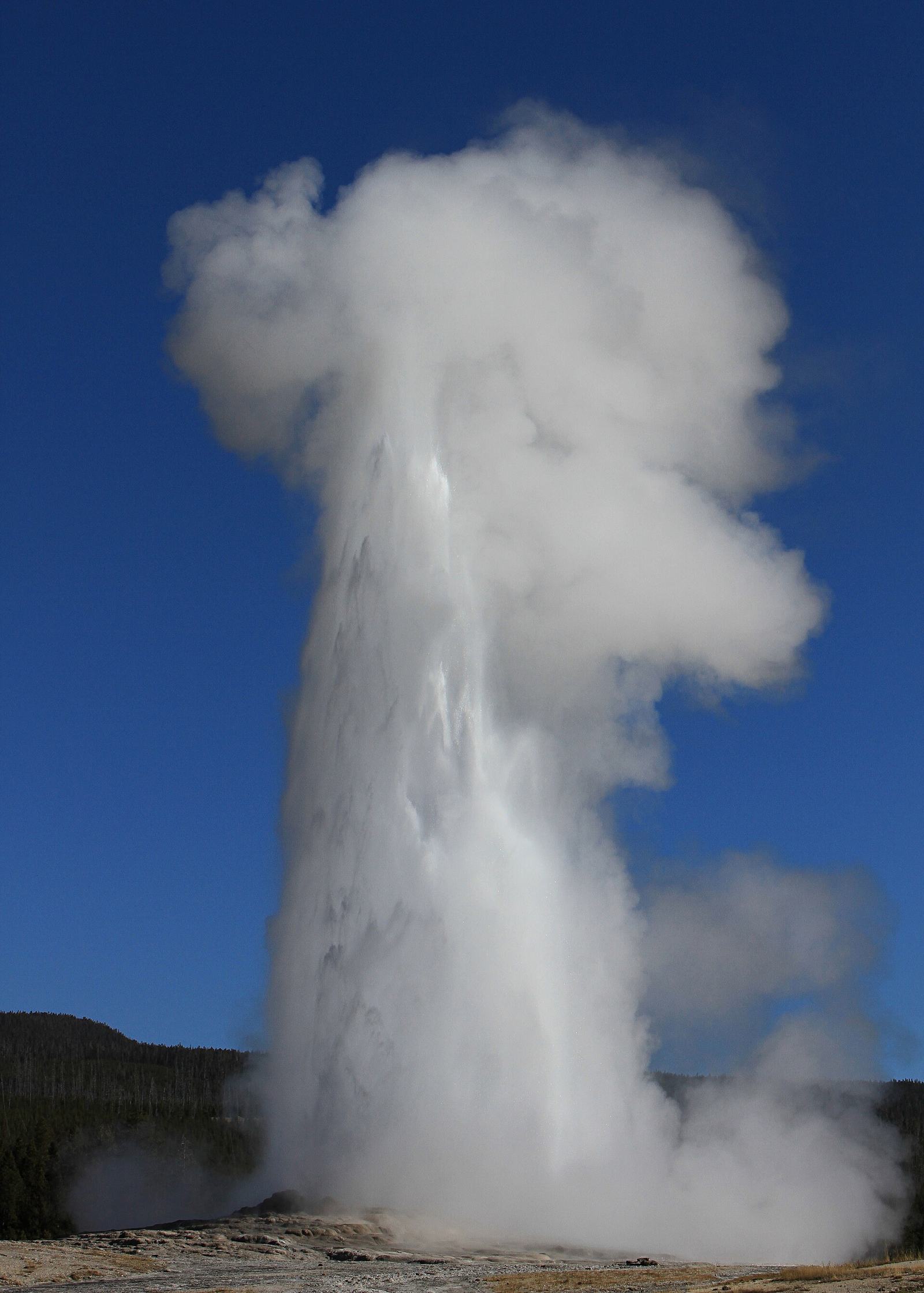
Old faithful eruption times are predicted, not scheduled. The National Park Service gives a median interval of 102 minutes plus or minus 10 as of January 2025, with actual intervals running from 54 to 118 minutes, which works out at roughly 14 eruptions a day. Rangers calculate each prediction from the length of the previous eruption, post it at the Old Faithful Visitor Education Center and publish it in the NPS app.
That is a different thing from a timetable, and it explains why you will see 74, 90, 92 and 102 minutes quoted on different websites — several of them are simply out of date. This page sets out the current figures, how the prediction is actually made, where to check it on the day, and what to do with the hour you will be waiting. For the wider area — the Inn, the Upper Geyser Basin and the walk — see our Old Faithful guide.
How often does Old Faithful erupt?
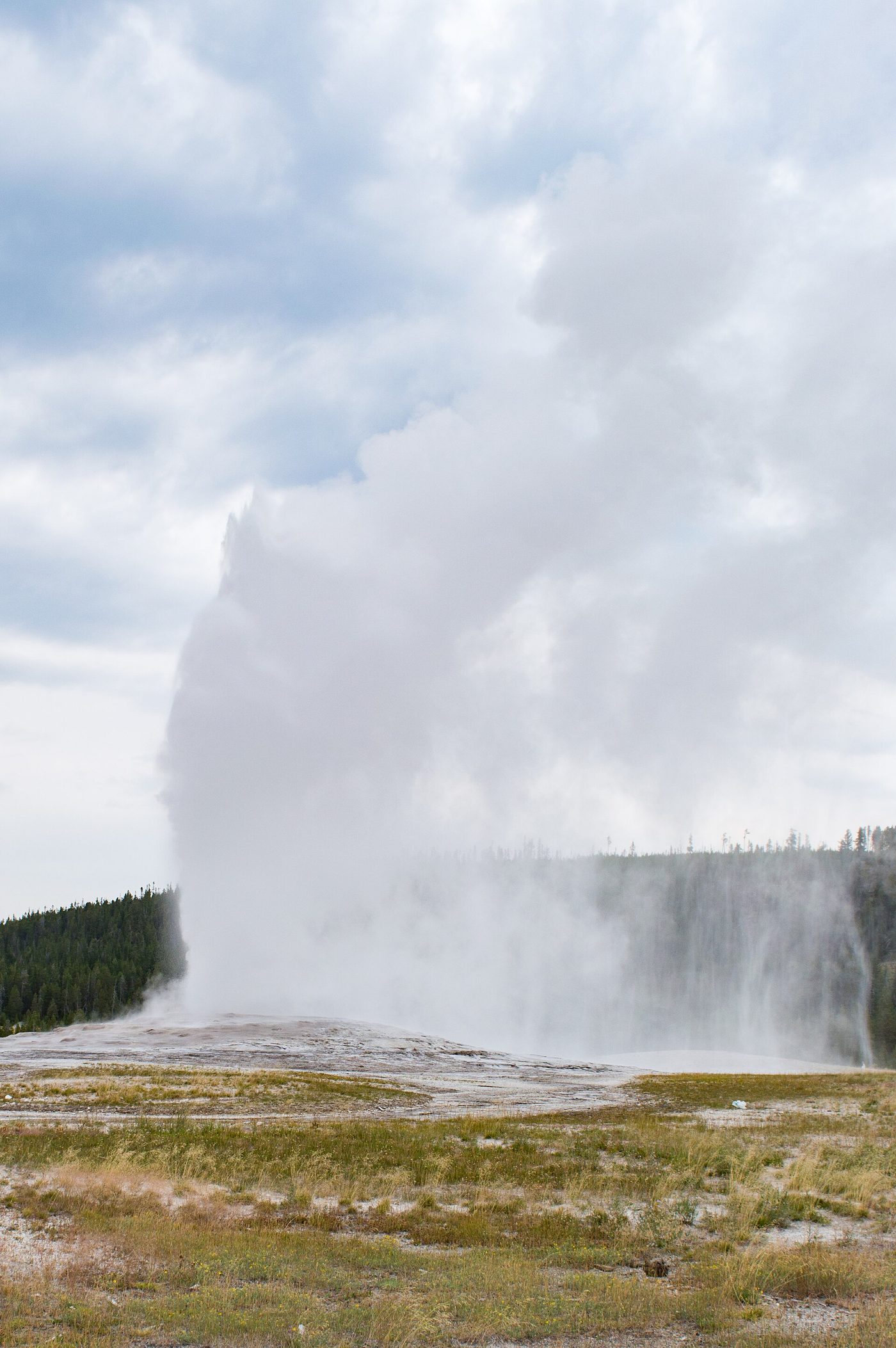
About 14 times a day. The current median interval is 102 minutes with a margin of plus or minus 10 minutes, measured as of January 2025, and individual intervals range from 54 to 118 minutes (National Park Service, checked September 2026). The gap has lengthened over the decades, which is why older sources quote much shorter averages.
The geyser is called Old Faithful for its regularity, not its frequency. Several geysers in the Upper Geyser Basin erupt more often and several erupt more dramatically. What makes this one famous is that you can be told, with useful confidence, when it will go — and that has been true since the 1870s, when the Washburn expedition named it for exactly that quality.
It is worth being precise about the word “median” too, because it is doing real work. A median of 102 minutes means half the intervals are shorter and half are longer, which is a more honest summary of a two-humped distribution than an average would be. Old Faithful effectively has two modes: a short eruption followed by a short wait, and a long eruption followed by a long wait. Averaging those together produces a number that describes almost none of the actual intervals, which is part of why the old quoted figures were misleading even when they were current.
Where to check today’s Old Faithful eruption times
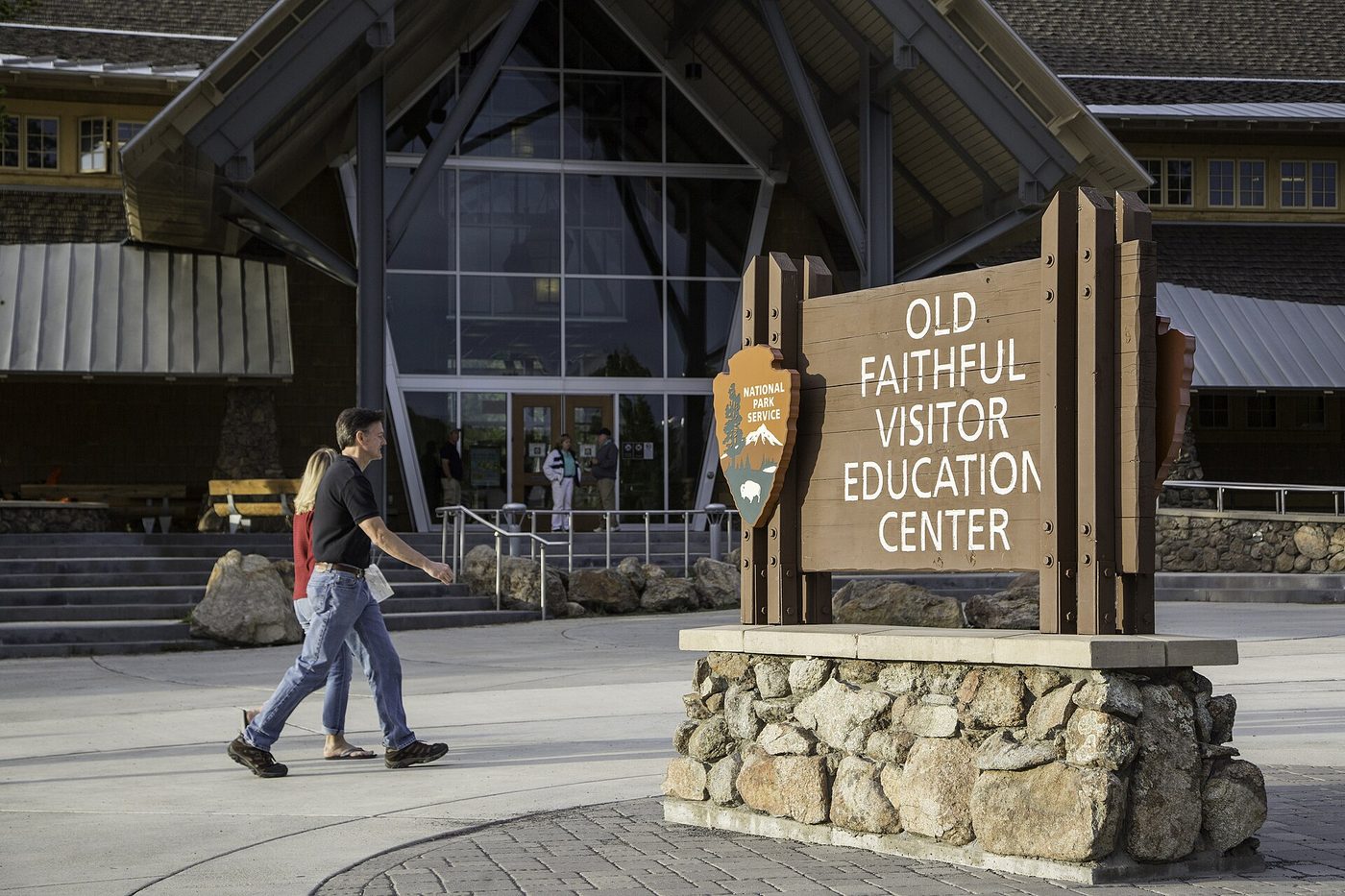
Four places, in order of usefulness:
- The Old Faithful Visitor Education Center. The prediction board inside the entrance is the authoritative source, updated after every eruption, and it also carries predictions for the other five predicted geysers.
- The NPS mobile app. Download it and the Yellowstone content before you arrive, because cell signal at Old Faithful is poor and the app needs the offline park downloaded to be useful.
- The lodges. Old Faithful Inn, Old Faithful Lodge and Old Faithful Snow Lodge all post the current predictions in their lobbies. The Inn’s board, by the fireplace, is the one most people use.
- The webcam. The National Park Service streams Old Faithful live, which is how you check from home or from a hotel the night before — see our Old Faithful webcam page.
What does not work reliably: third-party “eruption schedule” websites, which mostly republish the official prediction with a lag, and any site quoting a fixed interval. There is no schedule to look up in advance. The prediction for 3 p.m. tomorrow does not exist until tomorrow’s 1:30 p.m. eruption has finished.
How rangers actually predict the next eruption
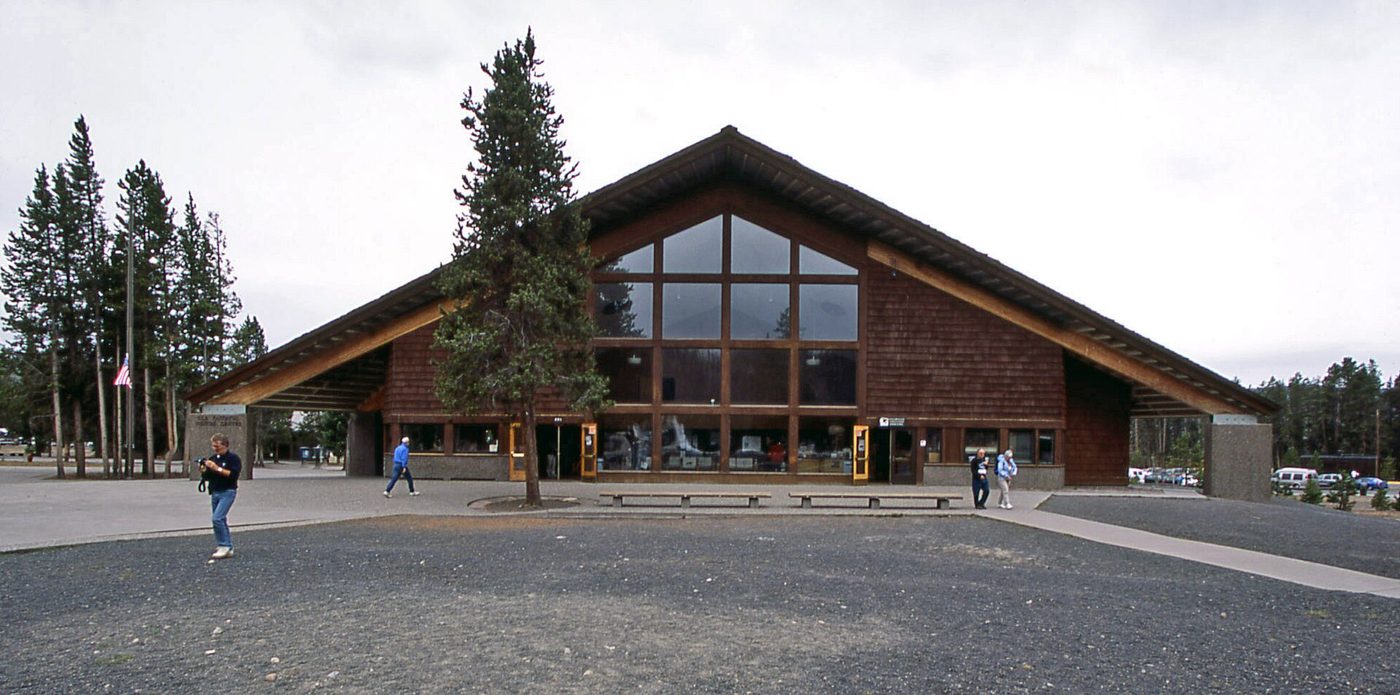
The method is simpler than most visitors expect, and it rests on one piece of physics: a longer eruption empties more water and heat from the underground reservoir, so the system takes longer to recharge.
Rangers time each eruption with a stopwatch, from the moment water begins splashing continuously out of the cone until only steam is coming out. That duration goes into the log, and the duration determines the predicted interval to the next one.
The National Park Service’s own teaching version of the rule is a two-line table (checked September 2026):
| Duration of the eruption you just watched | Predicted interval to the next |
|---|---|
| Less than 3 minutes | 68 minutes |
| More than 3 minutes | 94 minutes |
Add that interval to the start time of the eruption you watched, and you have the prediction. The park is careful to add the caveat that matters: Old Faithful is a natural feature and changes often, so any prediction may not prove to be exactly right.
Working rangers use a refined version of the same rule rather than the classroom one, with a threshold nearer 2.5 minutes and intervals tuned to recent behaviour, which is why the posted prediction is usually given as a time plus or minus ten minutes rather than a single moment. The principle is identical.
Worked example
You watch an eruption that begins at 10:12 a.m. and runs for four and a half minutes of water before it drops to steam. That is a long eruption, so the predicted interval is about 94 minutes. Add 94 minutes to 10:12 and the next eruption is predicted for around 11:46 a.m., give or take ten minutes.
In practice, arrive at 11:36 and be ready to wait until 11:56. Arriving at 11:44 is how people miss it.
Why you see 74, 90, 92 and 102 minutes quoted
This is the most common confusion about Old Faithful, and the answer is that all four numbers were true at some point.
- 74 minutes is a historical average, still repeated on several large travel sites. It has not described the geyser for decades.
- 90 to 92 minutes was the widely quoted figure through the 2000s and 2010s, and it is what most guidebooks printed.
- 102 minutes is the current median interval as of January 2025, with a plus or minus of 10 minutes (National Park Service, checked September 2026).
- 60 to 110 minutes is a common way of expressing the practical range, though the NPS’s own recorded range is wider, from 54 to 118 minutes.
The interval has genuinely lengthened. Earthquakes are the usual explanation: the 1959 Hebgen Lake and 1983 Borah Peak quakes both changed the plumbing of the Upper Geyser Basin, and smaller shifts continue. Drought and changes in groundwater are also thought to play a part.
What this means for you is practical rather than academic. Do not plan around a number you read on a website, including this one. Read the current posted prediction on the day.
When Old Faithful predictions are not available
Predictions are not posted year-round. They are typically unavailable from early November to mid-December and from mid-March to mid-April, when the Old Faithful Visitor Education Center is closed between the road seasons (checked September 2026).
That is a real gap for shoulder-season visitors, and it coincides with the period when the West, South and East entrances are closed to cars anyway — see our road closures page for the dates. In practice, if you are at Old Faithful in late November you have arrived by snowcoach or on skis and there is nobody posting times.
The geyser still erupts, of course. You simply have to watch and wait, which is what people did for the first century of the park’s existence. If you are there in that window, the webcam is still running and the eruptions are visible on it.
The other geysers that get predicted
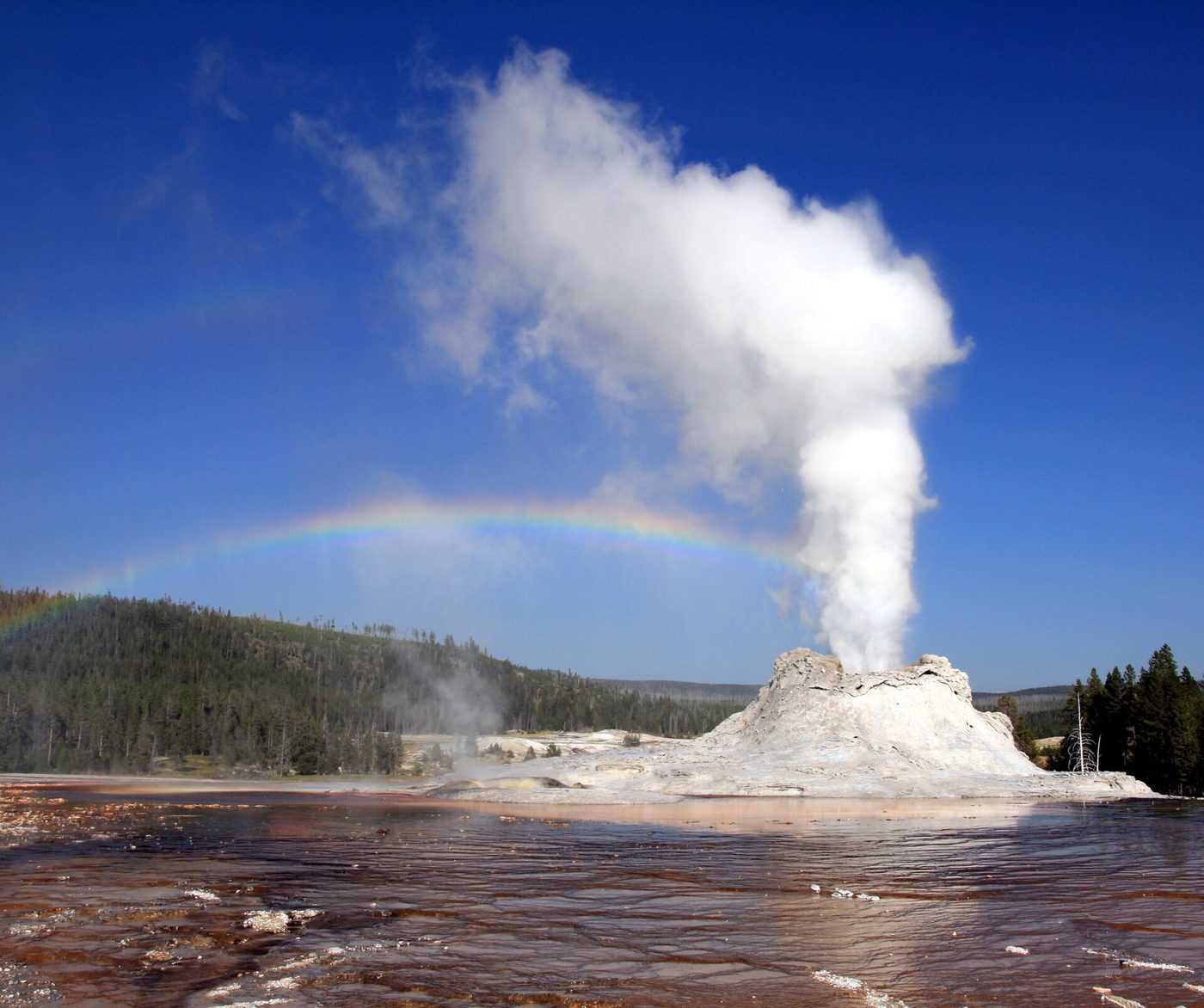
Old Faithful is one of six geysers the park predicts. If you are in the Upper Geyser Basin with an hour to fill, the prediction board is the most useful thing in the building.
| Geyser | Typical interval | Height | Duration |
|---|---|---|---|
| Old Faithful | 102 min ± 10 | 106 to over 180 ft, average 130 ft | 1.5–5 min |
| Castle | 16–17 hours | About 90 ft | ~20 min of water, then a long steam phase |
| Grand | About 6–7 hours | Up to 200 ft | 9–12 min in 1–4 bursts |
| Daisy | 110–240 min | About 75 ft, angled | 3–4 min |
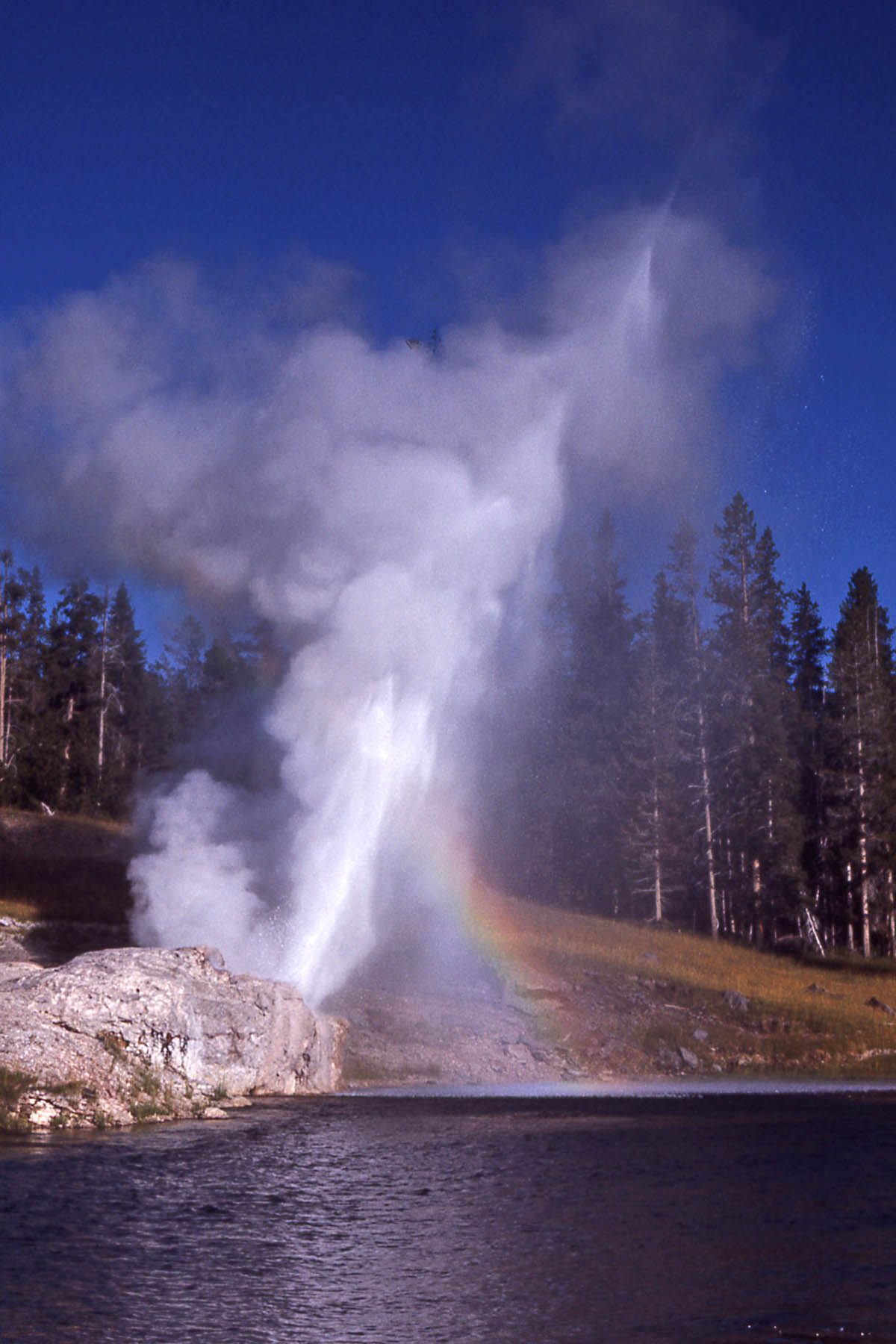
| Riverside | 5.5–7 hours | About 75 ft, arching over the river | About 20 min |
| Great Fountain | Predicted, Lower Geyser Basin | Variable, can be very tall | Long, in a series of bursts |
Figures from National Park Service pages and geyser records (checked September 2026); intervals for the less regular geysers drift and should be read off the board rather than from this table.
Two worth planning for. Grand is the tallest predictable geyser in the world and genuinely more impressive than Old Faithful, but it has a wide prediction window and is preceded by Turban erupting every 17 to 22 minutes, so watching it is a commitment of an hour or more. Riverside overflows for one to two hours before it erupts, arching across the Firehole River, and it is the most beautiful of the six.
A practical way to use the board: note the predicted times for all six, then plan a loop that catches two or three of them. Castle, Grand, Daisy and Riverside are all on or near the main basin boardwalk, so a well-timed two-hour walk can take in three eruptions plus Old Faithful. That is a far better use of a morning than sitting on a bench.
Then there is Beehive, which is not predicted but announces itself: a small vent called the Indicator starts playing 15 to 20 minutes before the main eruption, and when it does, everyone in the basin starts walking. Beehive is a narrow 200-foot jet and is the best geyser in Yellowstone when it performs. Our geyser predictions page explains how the board works across the whole park, and our best geysers in Yellowstone ranks them.
Where to stand for the eruption
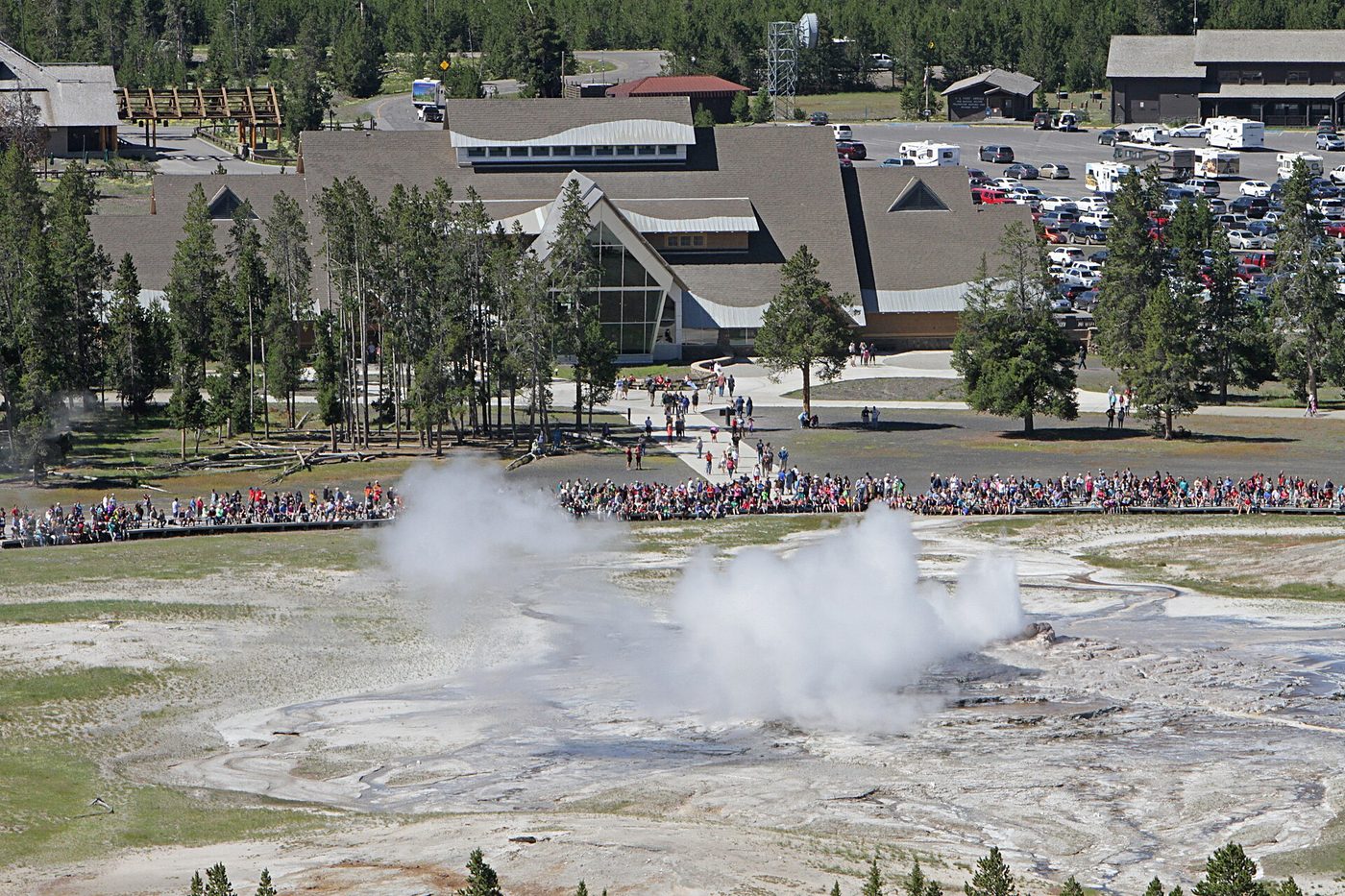
The main viewing area is the arc of benches on the boardwalk, about 300 feet from the cone. It works, it holds a lot of people, and it faces the geyser with the Inn behind you. In July it fills 20 minutes before a predicted time.
The alternatives, which most visitors never use:
- Observation Point. A 1.1-mile round trip climbing about 200 feet from the boardwalk near the Firehole River bridge. It puts you above the geyser looking down across the whole basin, and it is the best photograph available of an Old Faithful eruption. Leave 25 minutes before the predicted time.
- The Old Faithful Inn’s second-floor deck. Open to anybody, with a bar service in season, and a fine view over the cone from cover. The single best option in rain.
- The Old Faithful Lodge cafeteria windows and porch. Less scenic, entirely dry, and there is coffee.
- The far side of the boardwalk loop. Walk two minutes further round and the crowd thins dramatically for a view that is barely different.
- Geyser Hill, across the river. Slightly further, much quieter, and you can watch the basin’s other features while you wait.
Whichever you choose, do not step off the boardwalk. The ground around a geyser basin is a thin crust over near-boiling water, and people are seriously injured and occasionally killed here. Our safety page covers the thermal rules, which are the ones visitors underestimate most.
A word on the wind, which nobody mentions. The benches face roughly north-east and the prevailing wind carries the spray and steam across them often enough that on a breezy day the people directly downwind get soaked and see nothing but white. Look at where the steam from the cone is drifting before you choose a seat, and sit upwind. On a cold morning this matters more, not less: the plume is thicker and the spray is freezing.
How tall is Old Faithful, and how long does an eruption last?
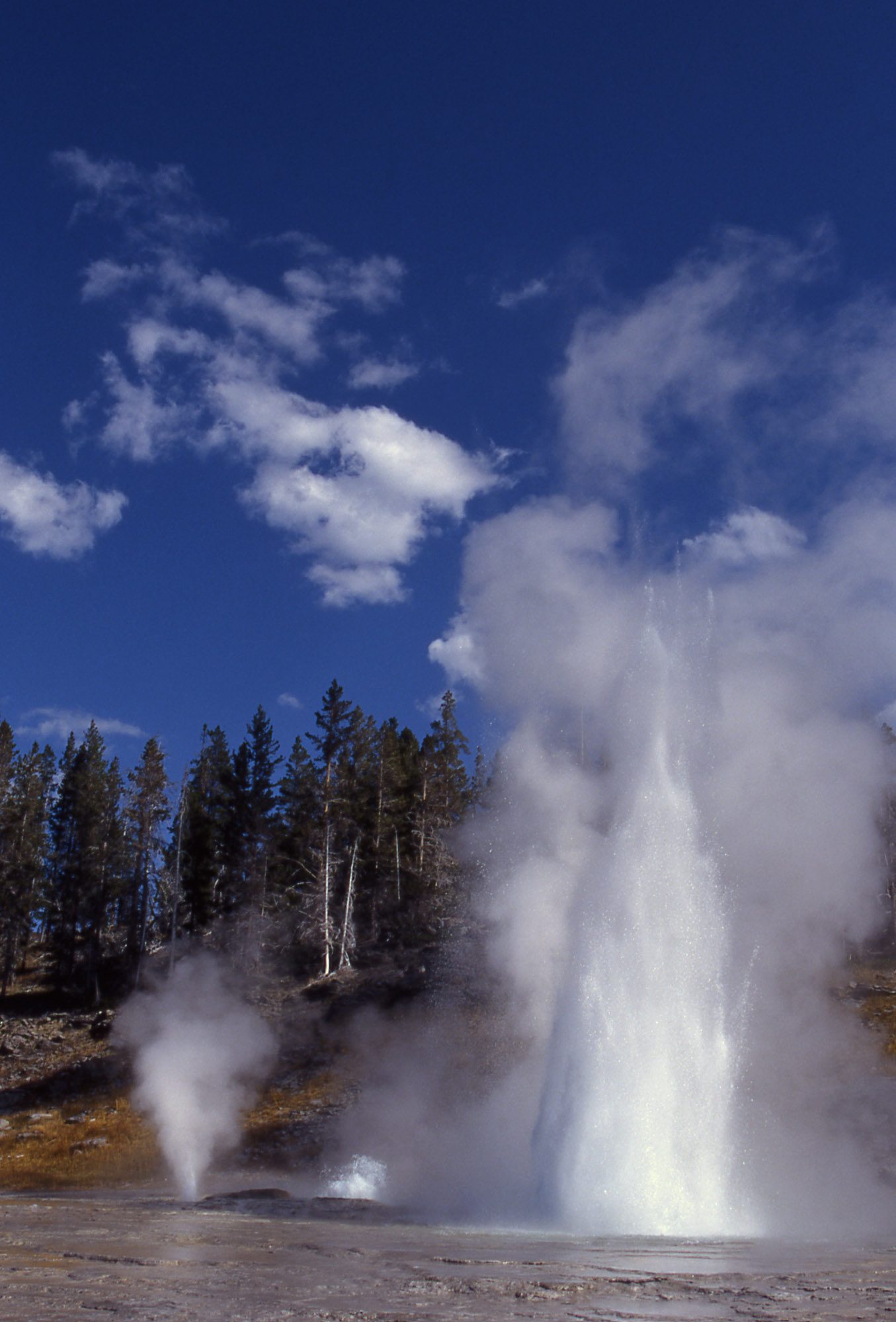
Eruptions reach between 106 and more than 180 feet, with an average of about 130 feet, and last from around 1.5 to 5 minutes. Each eruption expels roughly 3,700 to 8,400 gallons of water at about 203°F at the vent (National Park Service, checked September 2026).
A short eruption is over quickly and can feel anticlimactic if you have waited an hour for it. A long one builds, surges and holds for several minutes before collapsing into a steam phase that can continue for some time after the water stops. The steam phase is why the geyser is still worth watching on a cold morning: in September or October the plume is enormous and visible from across the basin.
Is Old Faithful worth waiting for?
Yes, once — and then walk. The eruption itself is genuinely impressive, and the ritual of a crowd of strangers all facing the same direction has its own charm. But the Upper Geyser Basin around it holds at least 150 hydrothermal features within a single square mile, and several of them are better than the famous one.
The honest verdict is this: if you have already seen Old Faithful erupt and the next prediction is 90 minutes away, do not wait for a second one. Walk the basin loop to Castle, Grand, Riverside and Morning Glory Pool instead. Most visitors do the opposite, which is why the benches are full and the far end of the boardwalk is empty.
How to use the wait
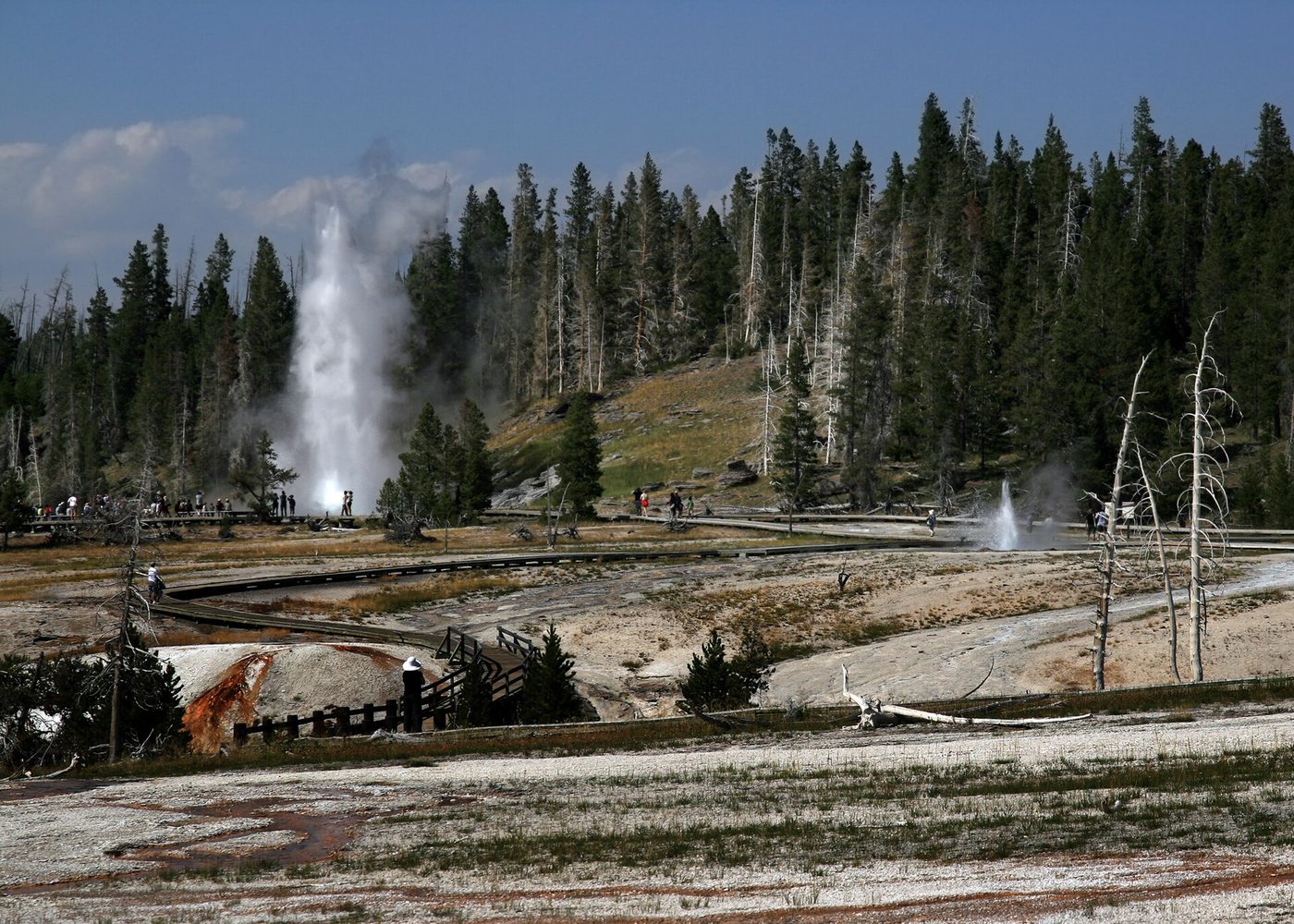
You will usually arrive with 30 to 90 minutes before the next predicted eruption. That is enough for any of these:
- Geyser Hill loop. A 30-minute boardwalk over the river taking in Beehive, Lion, Anemone and Giantess. The closest thing to a walk and the most feature-dense 30 minutes in the park.
- Morning Glory Pool. A 3-mile round trip on a flat paved path. The pool’s colours have changed over the years from coins and rubbish thrown into it, which is its own lesson.
- The Old Faithful Inn. Walk into the lobby, climb to the balcony, look at the 1904 log framing and the 500-ton rhyolite chimney. Free, open to day visitors, and one of the great buildings in the park system. Our Old Faithful Inn page has the detail.
- The Visitor Education Center. Genuinely good exhibits on how geysers work, and this is where the prediction board is anyway.
- Black Sand Basin. A five-minute drive and a 15-minute boardwalk, with Emerald Pool and Cliff Geyser. Reliably quiet.
What not to do with the wait: sit on the bench for an hour. It is the most common way visitors spend their morning at Old Faithful and the least rewarding.
Five mistakes people make at Old Faithful
Arriving at the predicted time. The window is plus or minus ten minutes, so the geyser can erupt ten minutes before the posted time. Be there at the early edge of the window.
Planning the whole day around it. Fourteen eruptions a day means you will catch one whatever you do. Treat the prediction as a constraint on your walk, not a fixed appointment.
Leaving immediately afterwards. The car park empties in a wave the moment the plume drops, and the basin becomes quiet for the next 40 minutes. That is the best time to walk it.
Expecting the webcam’s timing at home to match your watch. The stream runs with a delay, and predictions are posted in Mountain Time. Set your phone to the park’s time zone before you start doing arithmetic.
Trusting a printed interval. Old guidebooks, hotel leaflets and a surprising number of large travel sites still quote 74 or 90 minutes. Read the board on the day; everything else is history.
If you have just missed an eruption
You have somewhere between 50 and 110 minutes, which is enough for a proper walk rather than a wait. The Geyser Hill loop takes 30 minutes and crosses the Firehole to the densest cluster of features in the basin. The walk to Morning Glory Pool and back is about three miles on flat pavement and takes 90 minutes at a comfortable pace, passing Castle, Grand, Beauty, Chromatic and Riverside on the way.
If you have less appetite for walking, the Inn’s second-floor deck and the visitor education centre exhibits will absorb 40 minutes between them without any effort. The one thing not worth doing is driving somewhere else and coming back, because the parking you gave up will not be there when you return.
Old Faithful at night, in winter and off-season
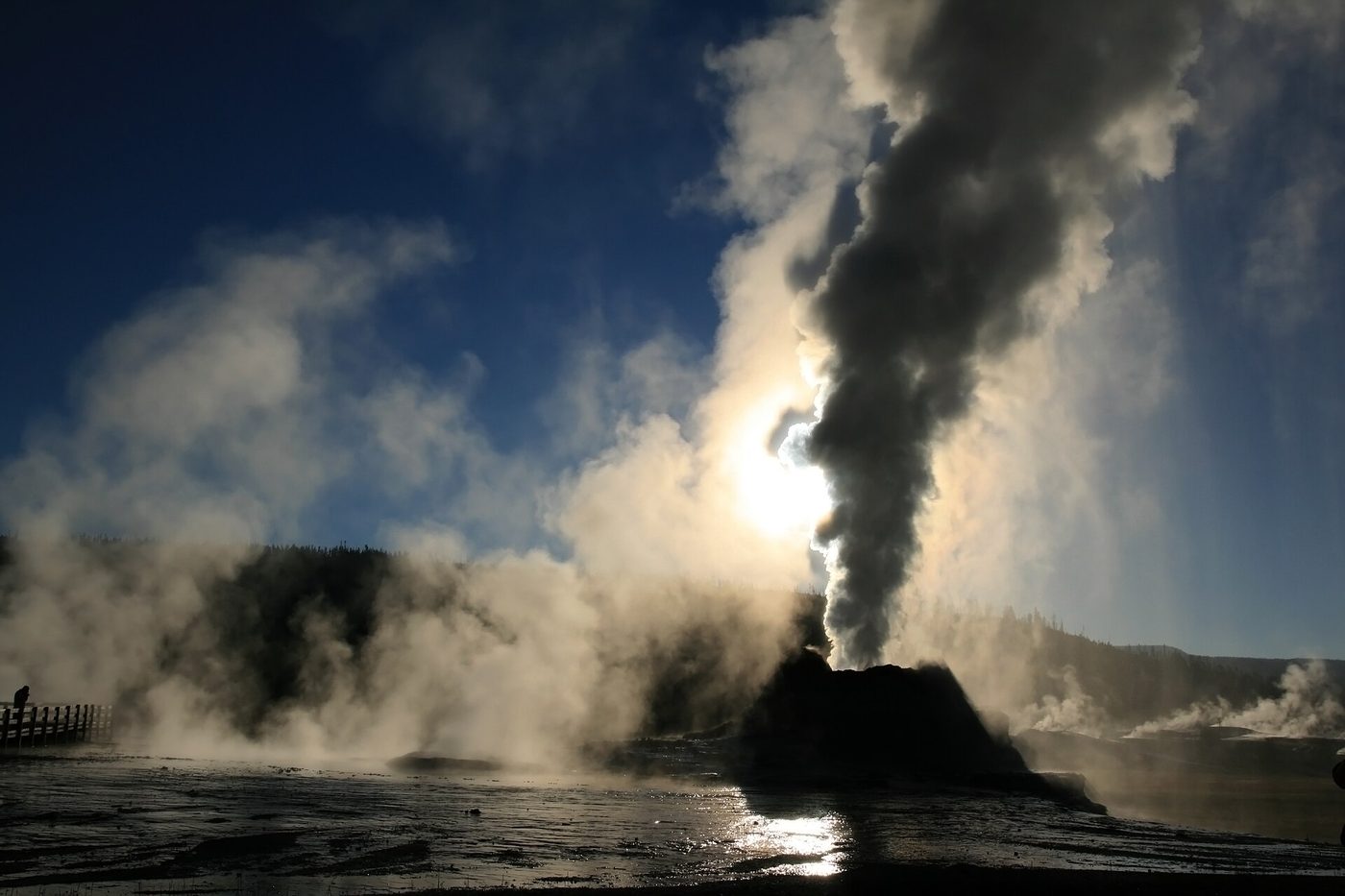
At night. The geyser erupts around the clock and the boardwalk is open. An eruption under a full moon, lit by nothing else, with a dozen people present instead of a thousand, is the best version of this sight. Take a headlamp, keep to the boardwalk and watch for bison, which use the warm ground after dark.
In winter. From mid-December the area is reachable only by snowcoach or snowmobile, and the Snow Lodge stays open. Cold air turns the eruption into a white column visible from a long way off, and the crowd is a few dozen people rather than a few thousand. Our Old Faithful in winter page covers how to get there, and Yellowstone in winter covers the access generally.
Shoulder season. Early April and early November are the quietest times at the geyser with road access, with the caveat about predictions above. September and October are the sweet spot: full access, thin crowds, cold mornings and thick steam. See Yellowstone in September.
What is happening underground between eruptions
The prediction rule makes more sense once you know what it is describing.
Beneath the cone is a narrow, irregular plumbing system of fractured rhyolite reaching down toward a body of very hot rock. Groundwater seeps into it and is heated well past the boiling point at surface pressure, but it cannot boil because the weight of the water above it holds it under pressure. As the system continues to heat, steam bubbles begin to form at depth. Eventually enough of them rise and expand to lift and spill some of the water at the top of the column.
That spill is the trigger. Removing water from the top reduces the pressure below it, the superheated water underneath flashes instantly to steam, and the whole column is driven out of the vent. The eruption continues until the reservoir has vented enough energy that the pressure drops, at which point the water stops and a steam phase carries on for a while as the last of the heat escapes.
This is why the duration rule works. A long eruption empties more of the system and vents more heat, so refilling and reheating takes longer. A short one leaves more behind and the next eruption comes sooner. Nothing about it is scheduled; it is a physical cycle of filling, heating and discharge that happens to be unusually consistent at this particular vent.
It also explains why the interval changes over decades. Anything that alters the plumbing — an earthquake shifting fractures, a change in the groundwater supply, mineral deposition narrowing a channel — changes the cycle. Old Faithful is not a machine, and it is not obliged to keep doing this.
Has Old Faithful ever stopped, or slowed down?
It has never stopped in recorded history, but it has slowed. Radiocarbon dates on wood from the geyser’s mound show it went dormant for several decades in the 13th and 14th centuries, most likely during a prolonged drought, which is a useful corrective to the assumption that it will always be there.
In the shorter term, the intervals have lengthened measurably. The average sat around 60 to 65 minutes in the early twentieth century and the current median is 102 minutes. Two earthquakes are usually cited: the magnitude 7.3 Hebgen Lake earthquake of 1959, centred just outside the park’s west boundary, and the 1983 Borah Peak earthquake in Idaho. Both changed the behaviour of features across the Upper Geyser Basin.
What that means for a visitor is modest: the geyser still erupts about 14 times a day, and the prediction is still good to ten minutes. What it means for the long run is that Yellowstone’s thermal features are dynamic. The park has seen Steamboat Geyser go from a decade of silence to dozens of eruptions a year and back to near-dormancy; it has seen Biscuit Basin close after a hydrothermal explosion in July 2024 and again after a second event in June 2026. Our Steamboat Geyser page covers the most volatile of them, and the Yellowstone geysers hub covers how the system works as a whole.
Parking, access and practicalities at Old Faithful
The Old Faithful area is the most developed part of the park, which makes it easy and busy in equal measure.
Parking. Several large lots serve the visitor education centre, the Inn, the Lodge and the Snow Lodge. They are free, and in July and August they fill from mid-morning until late afternoon. The reliable strategy is to arrive before 9 a.m. or after 4 p.m.; in between, expect to circle. RV and oversized parking is signed separately.
Accessibility. The main viewing area, the visitor education centre and the boardwalk closest to the cone are accessible, and there are accessible restrooms and designated parking. The wider basin boardwalk is largely flat and paved or planked, though the loop is long. Observation Point is not accessible — it climbs about 200 feet on a natural-surface trail.
Food and facilities. Cafeterias, a general store, restrooms, a post office and a medical clinic in summer. The Old Faithful Inn dining room takes reservations and fills; the Lodge cafeteria does not and is quicker. Our Old Faithful restaurants page covers the options.
Signal and cash. Cell coverage is unreliable and there is no free public wi-fi worth relying on. Download maps and the NPS app before you arrive, and carry a card and a little cash.
Fuel. Card-operated 24-hour fuel is available here year-round, at both the upper and lower stations.
How long to allow. Three hours minimum for the eruption and the immediate boardwalks; half a day if you walk the basin loop out to Morning Glory Pool. Our Upper Geyser Basin page covers the full walk.
Planning your visit around the eruption times
A few practical rules that make the difference between a good morning and a frustrating one.
Do not build your day around Old Faithful. It erupts about 14 times a day, so there is no hour you must be there. Plan the rest of the basin and let the eruption fall where it falls.
Check the board first, then decide. Walk into the Visitor Education Center before anything else, note the next two or three predictions and the ones for Castle, Grand, Daisy and Riverside, and plan a loop that intersects them.
Arrive ten minutes before the earliest end of the window, not at the predicted time. A prediction of 11:46 ± 10 means the geyser can go at 11:36.
Park once. The Old Faithful car parks are large and fill from mid-morning to late afternoon in summer. Arrive before 9 a.m. or after 4 p.m. and you will park easily. Our crowds page has the daily rhythm.
Give the area three hours minimum. More if you intend to walk to Morning Glory. This is the single densest area of interest in the park, and half of the visitors who come here spend 40 minutes and leave.
Come back in the evening if you are sleeping nearby. The last predicted eruption before dark, and the ones after it, draw a fraction of the daytime crowd. If you are staying at the Inn, the Lodge or the Snow Lodge, this is the single best reason to have booked in the park rather than in a gateway town.
Treat the ± as real. The most frustrated visitors at Old Faithful are the ones who arrived exactly on the posted minute and found they had missed it by eight. The margin is published for a reason, and the cost of being twelve minutes early is a bench; the cost of being eight minutes late is another 100 minutes.
If you are fitting this into a wider trip, our three-day Yellowstone itinerary puts Old Faithful in the afternoon of day one for good reasons, and our how many days in Yellowstone page explains how much time the Upper Geyser Basin really needs. For everything else about the area — the Inn, the basin loop and the walk to Morning Glory — go back to our Old Faithful hub.
Frequently asked questions
What time does Old Faithful erupt?
There is no fixed time. The geyser erupts roughly every 102 minutes, plus or minus 10, about 14 times a day. Each prediction is calculated after the previous eruption ends and posted at the Old Faithful Visitor Education Center, in the lodges and in the NPS app.
How accurate are Old Faithful predictions?
Good enough to plan around. Predictions are typically given with a ten-minute margin and the geyser usually erupts within it. The forecast is based on the duration of the previous eruption, so an unusual eruption produces a less reliable prediction.
How do rangers predict Old Faithful?
By timing the previous eruption. A longer eruption empties more of the underground reservoir, so the recharge takes longer. The park’s teaching version of the rule gives 68 minutes after an eruption under 3 minutes and 94 minutes after one over 3 minutes, added to the previous start time.
How often does Old Faithful erupt per day?
About 14 times, based on the current median interval of 102 minutes. Older sources saying 17 to 20 times a day are working from historical intervals of 65 to 74 minutes that no longer describe the geyser.
Can I see Old Faithful eruption times online before my trip?
Only for the current day, and only after the previous eruption. The National Park Service publishes the live prediction in the NPS app and streams the geyser on its webcam, but there is no schedule to look up weeks ahead because none exists.
How long does an Old Faithful eruption last?
Between about 1.5 and 5 minutes of water, followed by a steam phase. Roughly 3,700 to 8,400 gallons are expelled at around 203°F at the vent, reaching 106 to more than 180 feet, with an average of about 130 feet.
Are predictions available all year?
No. Predictions are typically unavailable from early November to mid-December and from mid-March to mid-April, when the visitor education centre is closed between seasons. The geyser still erupts; there is simply nobody posting the times.
What is the best place to watch Old Faithful?
The benches work, but Observation Point — a 1.1-mile round trip climbing about 200 feet — gives a far better view from above, and the Old Faithful Inn’s second-floor deck is the best option in poor weather. Both are far less crowded than the main viewing arc.
Sources
- National Park Service — exploring the Old Faithful area, checked September 2026.
- National Park Service — Predict Old Faithful teaching activity, checked September 2026.
- National Park Service — Yellowstone webcams and geyser predictions, checked September 2026.
- US Geological Survey — Yellowstone Volcano Observatory monthly updates, checked September 2026.
Image credits
| Photo | Credit |
|---|---|
| Eruptions reach 106 to more than 180 feet, averaging about 130, and last from 1.5 to 5 min (top of page) | Yellowstone National Park from Yellowstone NP, USA, public domain, via Wikimedia Commons |
| About 14 eruptions a day, on a median interval of 102 minutes give or take ten | Supercarwaar, CC BY-SA 4.0, via Wikimedia Commons |
| The prediction board inside the entrance is the authoritative source, updated after every | Yellowstone National Park from Yellowstone NP, USA, public domain, via Wikimedia Commons |
| Rangers time each eruption with a stopwatch, and the duration sets the interval to the nex | Jim Peaco, public domain, via Wikimedia Commons |
| Castle runs on a 16 to 17 hour cycle and is one of six geysers the park predicts | Brocken Inaglory: Brocken Inaglory, CC BY-SA 3.0, via Wikimedia Commons |
| The benches hold a lot of people | Yellowstone National Park from Yellowstone NP, USA, public domain, via Wikimedia Commons |
| Grand is the tallest predictable geyser in the world and reaches up to 200 feet | NPS/Jim Peaco, public domain, via Wikimedia Commons |
| Riverside overflows for an hour or two before it goes, and it is the prettiest of the six | NPS/S. Canter, public domain, via Wikimedia Commons |
| At least 150 hydrothermal features sit within one square mile here | Brocken Inaglory, CC BY-SA 3.0, via Wikimedia Commons |
| Cold air and low light make the winter and shoulder-season eruptions far more dramatic | Brocken Inaglory, CC BY-SA 3.0, via Wikimedia Commons |