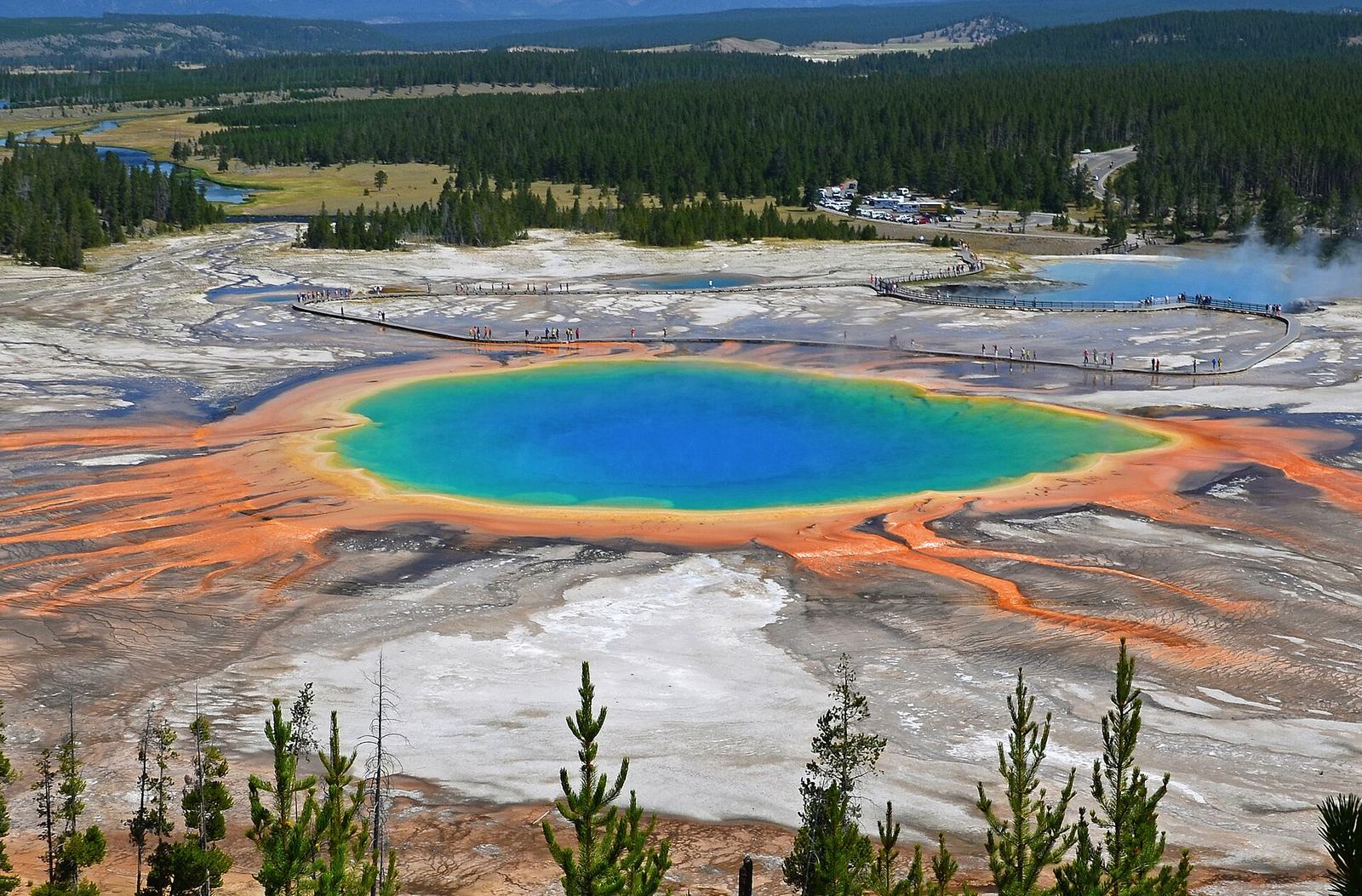
Grand Prismatic Spring is the largest hot spring in the United States, about 370 feet across and ringed in bands of blue, green, yellow, orange and red. You can see it two ways: up close from the Midway Geyser Basin boardwalk, or from above on a short trail to an overlook. For the famous colors, go on a warm, sunny afternoon and do both.
That last sentence is the whole trick, and it’s the thing most first-time visitors miss. The spring pours out so much hot water that on a cool morning it disappears under its own steam, and from the boardwalk you’re standing almost level with it, so even on a clear day you see the edge of the rainbow, not the rainbow itself. The picture on every postcard was taken from a hillside to the south, and that hillside now has a trail and a viewing platform. Knowing when the steam thins, which viewpoint to use and how to get a parking space between 10 a.m. and 4 p.m. in summer is the difference between the highlight of your trip and a quick look at a cloud.
This guide is the site’s hub for Grand Prismatic Spring and the geyser basins around it. It covers what makes the spring so colorful, a simple decision guide for the boardwalk versus the overlook, the overlook trail, the best time of day and year, both parking lots, Excelsior Geyser next door, a 90-minute route through the Lower Geyser Basin, the spring’s temperature and safety, and what to expect in winter. For the whole geyser picture across the park, see our Yellowstone geysers guide; for the basin to the south, Old Faithful.
Is Grand Prismatic Spring worth it?
Yes. It’s the largest hot spring in the United States and one of the most striking sights in North America. But what you see depends on timing: from the boardwalk on a cool morning you’ll mostly see steam, so plan for a warm, sunny afternoon, and walk up to the overlook for the colors.
The honest version is that many people come away disappointed, and almost always for the same reasons: they arrived on a cool, overcast morning, stood on the boardwalk in a cloud of steam, fought for a parking space, and drove on. Plan around the three factors that matter, which are air temperature, sunlight and viewpoint, and it’s genuinely one of the great sights of the national parks.
It’s also quick. The boardwalk loop takes 45 minutes to an hour, and the overlook about an hour. Even on a tight itinerary, there’s no reason to skip it. Our Yellowstone itinerary shows how to fit it into the geyser-basin day, and the things to do in Yellowstone guide ranks it among the park’s top sights.
Grand Prismatic Spring at a glance
| Fact | Detail |
|---|---|
| Location | Midway Geyser Basin, on the Grand Loop Road about 6 miles north of Old Faithful and about 10 miles south of Madison Junction |
| Size | About 370 feet across, the largest hot spring in the United States |
| Depth | More than 120 feet |
| Water temperature | Around 160°F in the center |
| Ways to see it | Midway Geyser Basin boardwalk (under a mile) and the Grand Prismatic Overlook Trail (1.2 miles round trip) |
| Time needed | 45-60 minutes for the boardwalk; about 1 hour for the overlook |
| Parking | Midway Geyser Basin lot for the boardwalk; Fairy Falls Trailhead lot, 1 mile south, for the overlook. Both fill in summer |
| Season | Reachable by car from mid-April to the end of October; by snowcoach or snowmobile in winter |
| Cost | Included in the park entrance fee |
| Accessibility | The boardwalk is mostly gently sloped; the overlook trail is packed dirt with a gradual climb |
Figures on size, depth and temperature vary between published sources, since the spring changes and is hard to measure. The ones above are the most widely published: NPS materials have long given about 370 feet across and more than 120 feet deep, while some reference sources put the depth at around 160 feet. We couldn’t confirm a current NPS measurement when we checked in September 2026, so treat them as approximate. The USGS describes it simply as the largest hot spring in the United States and one of the largest in the world. Entrance fees are on our Yellowstone entrance fee guide.
Why is Grand Prismatic Spring so colorful?
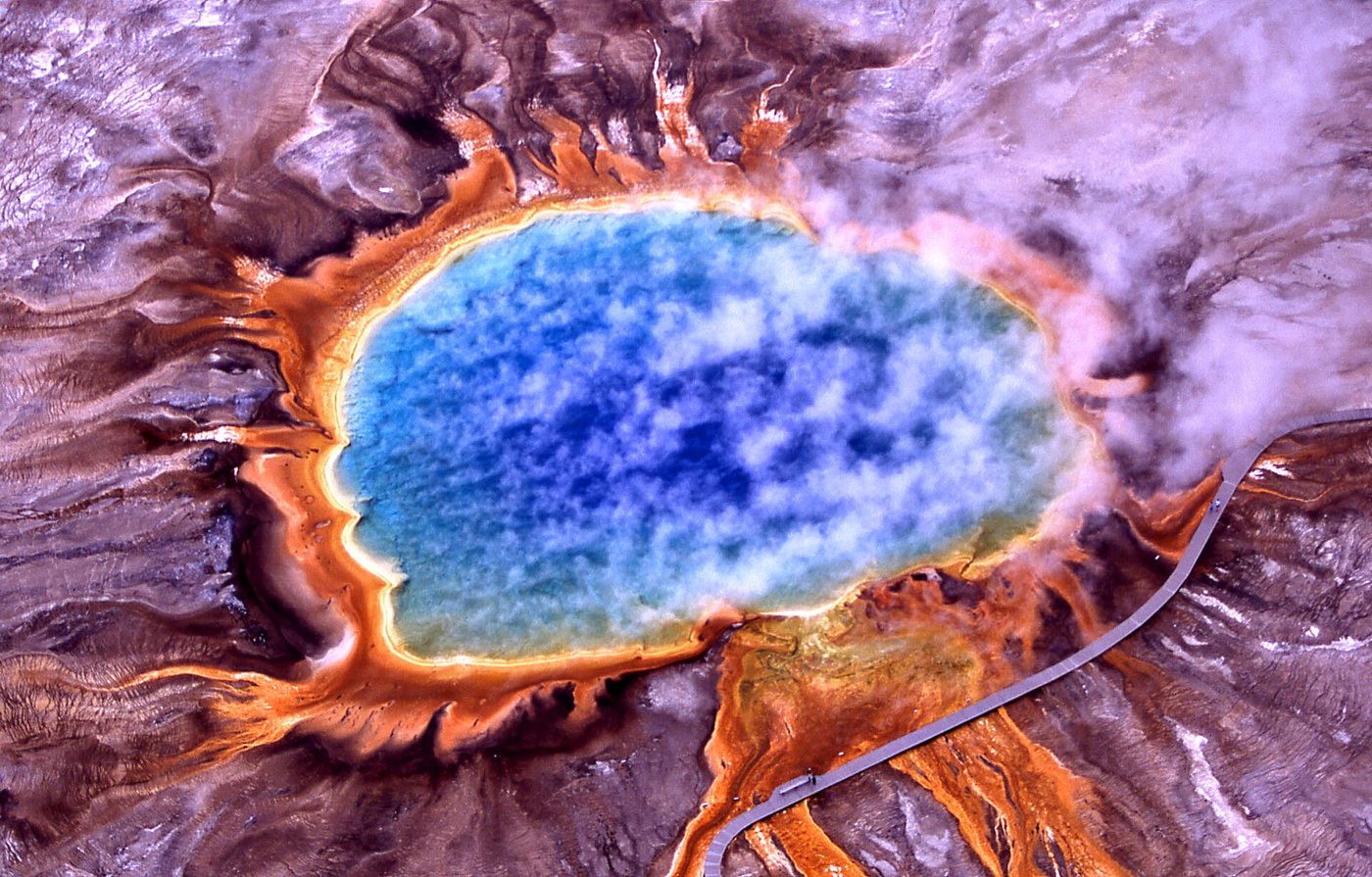
The colors come from life. Hot water rises from the center of the spring and spreads outward in a thin sheet, cooling as it goes. The center is too hot for almost anything to grow, so the water there is clear, and it looks deep blue for the same reason a deep lake does: water absorbs the red end of the spectrum and scatters the blue back to your eye.
As the water cools toward the edges, it becomes habitable for heat-loving microbes, called thermophiles, which form colorful mats. Each band of color is a different community of microorganisms, adapted to a slightly different temperature. The organisms nearest the center, where it’s hottest, tend to be yellow; further out, where the water is cooler, the mats turn orange, red and brown. The pigments help the microbes protect themselves from intense sunlight, much as sunscreen does for us.
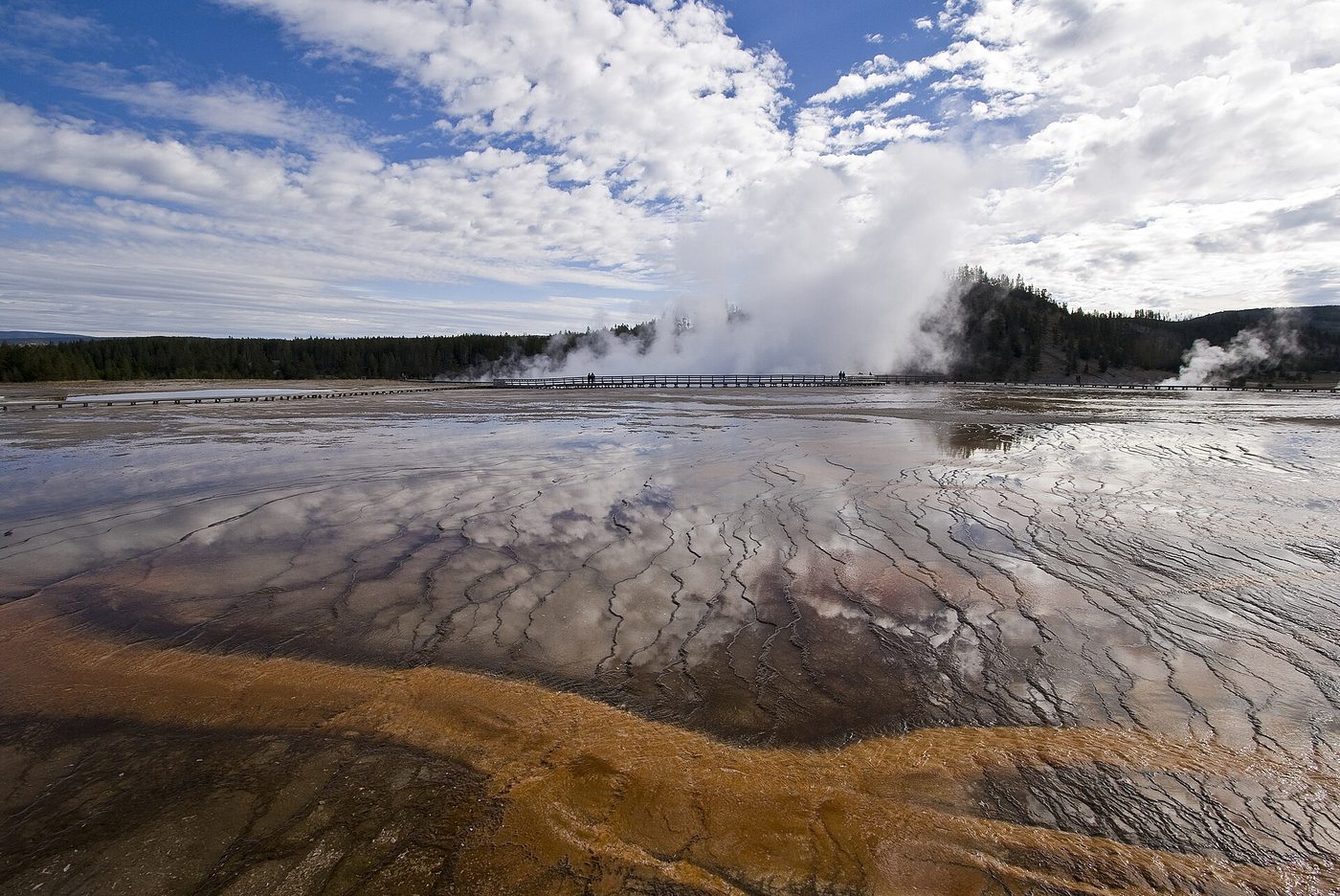
The colors aren’t fixed. They change with the seasons, since in winter, when there’s less sunlight, the mats tend to look darker and greener, and they shift over the years as the flow of hot water changes. The runoff channels leading down to the Firehole River have the most dramatic colors of all, streaked orange and rust across the white mineral crust.
This is also why the spring looks so different from the boardwalk and from above. Close up, you see the edge bands and the runoff in detail. From the overlook, you see the concentric rings as a whole, which is what makes the famous picture. For more on the science, see our guide to Grand Prismatic Spring’s temperature.
Boardwalk or overlook? How to decide
You can see the spring from two very different places, and most visitors should do both. If you can only do one, use this guide:
- Is it a warm, sunny day, and are you able to walk a gentle 1.2-mile round trip? Do the overlook. It’s the only way to see the whole rainbow of color.
- Is it cool, cloudy or early morning? Do the boardwalk, and enjoy the steam and the scale; the overlook view will be mostly cloud.
- Can’t find a space at the Fairy Falls lot? Do the boardwalk and come back to the overlook later in the afternoon.
- Traveling with someone who can’t manage the trail? The boardwalk is gentler and closer to the parking lot.
- Have time for both? Do the overlook first on a warm afternoon, then drive 1 mile north to the boardwalk.
| Midway boardwalk | Overlook trail | |
|---|---|---|
| What you see | The spring up close, Excelsior Geyser’s crater, the runoff channels | The whole spring from above, with its rings of color |
| Distance | Under a mile, loop | 1.2 miles round trip, 105-foot climb |
| Time | 45-60 minutes | About 1 hour |
| Best conditions | Any; best on warm, windy days | Warm, sunny afternoons |
| Parking | Midway lot, very busy 10 a.m. to 4 p.m. | Fairy Falls lot, 1 mile south, very limited |
| Accessibility | Gently sloped boardwalk | Packed dirt trail with a gradual climb |
The Midway Geyser Basin boardwalk
The Midway Geyser Basin is small but spectacular, a broad terrace of white sinter on the west bank of the Firehole River. From the parking lot, a bridge crosses the river, and a boardwalk loop of under a mile climbs gently past the basin’s highlights. See our Midway Geyser Basin guide for the full loop.
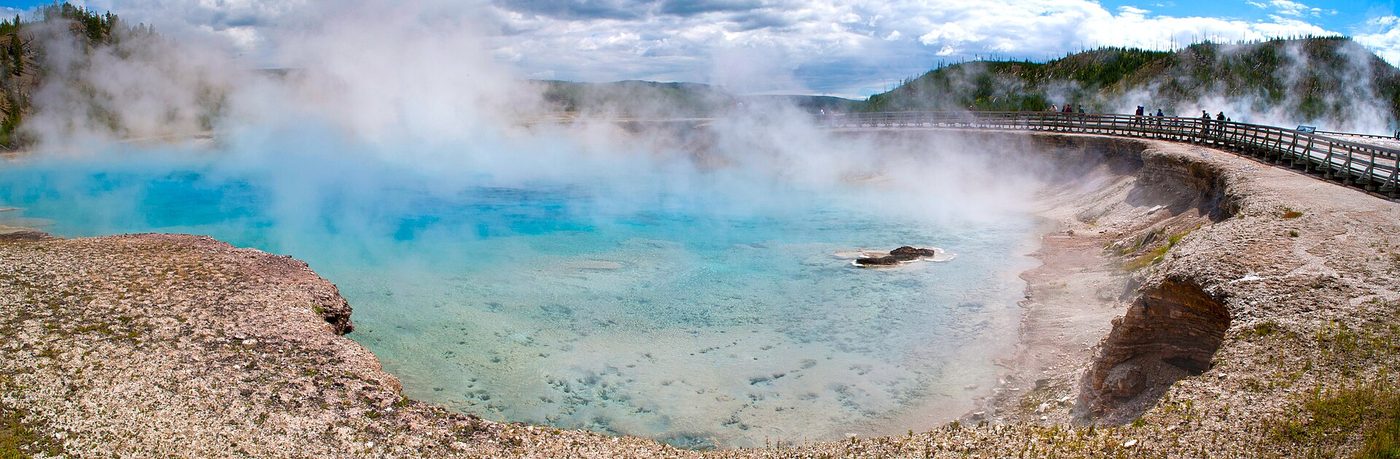
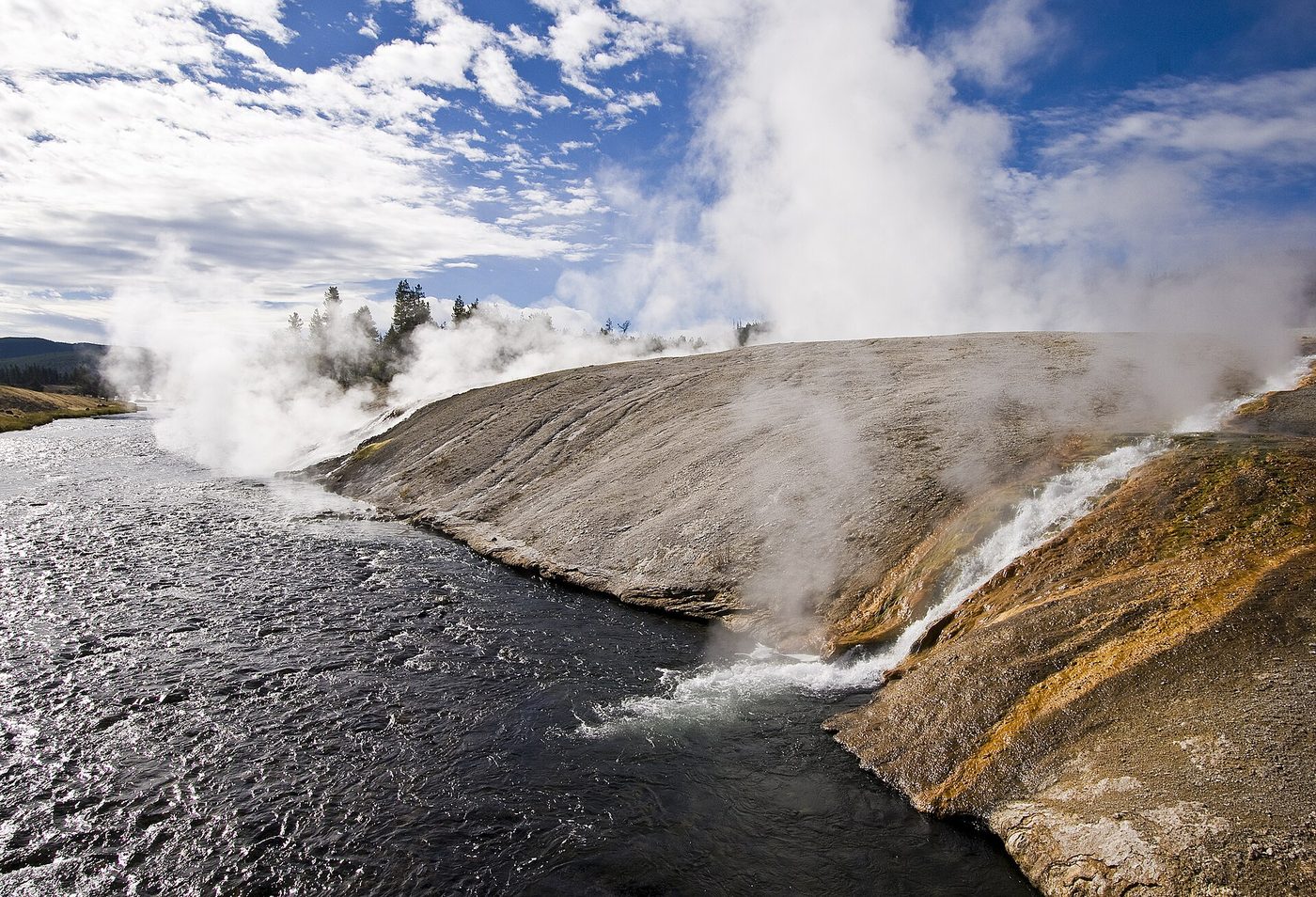
Excelsior Geyser Crater comes first: an enormous, steaming pit of brilliant blue water that pours more than 4,000 gallons of near-boiling water a minute into the Firehole River. You’ll see the hot water spilling down the bank as you cross the bridge. More on Excelsior below.
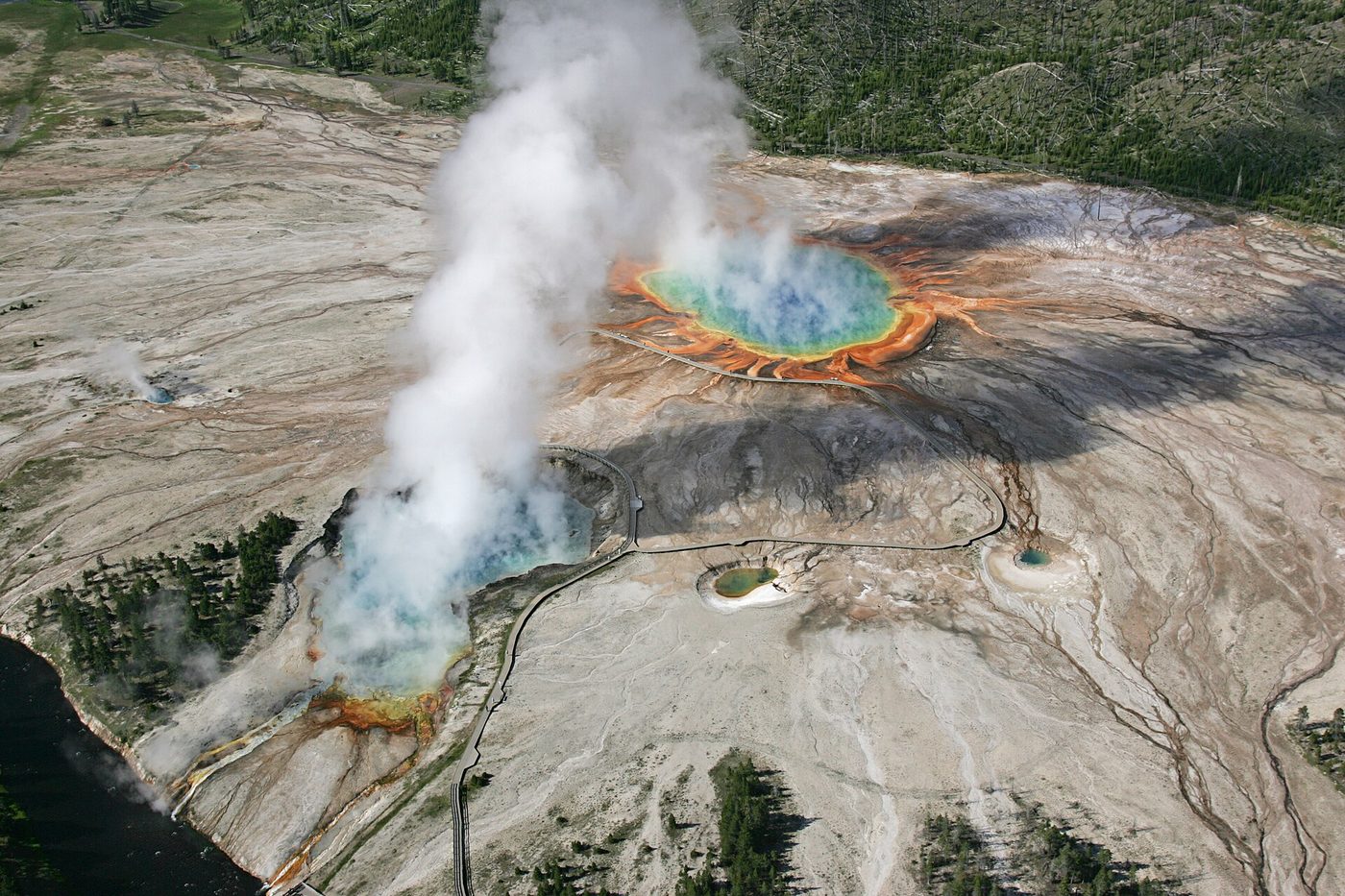
Grand Prismatic Spring is next, the boardwalk circling part of its edge. Here you get a sense of its size, the steam rolling off the surface and the vivid orange runoff underfoot. On a still, cool day, the steam can make it hard to see much; on a breezy, warm day, the wind pushes the steam aside and reveals the blue center.
Turquoise Pool and Opal Pool are smaller, quieter hot springs at the end of the loop, each with its own color.
A few practical notes:
- Hold on to your hat. The wind blowing across the basin carries hats, maps and sunglasses into the springs every summer. Never try to retrieve anything.
- Stay on the boardwalk. The crust around the springs is thin and the water is scalding.
- Watch the kids. The boardwalk has no railing on much of its length.
- No pets on the boardwalk.
- Bring sunglasses. Polarized ones cut the glare and help the colors show through the steam.
Accessibility
The Midway boardwalk is one of the more accessible thermal walks in the park. From the parking lot, a bridge crosses the Firehole River and the boardwalk climbs gently onto the terrace, with no stairs on the main loop. Wheelchair users and people with strollers can usually manage it, though the slope up from the river is noticeable and the boards can be slippery when wet or frosty. The overlook trail is a different proposition: a packed dirt path with a gradual climb of about 105 feet and no shade, which the NPS rates as easy but which isn’t paved. If the trail isn’t an option, the boardwalk on a warm, breezy afternoon, when the wind clears the steam off the surface, still gives you a real sense of the colors. See our accessible lodging in Yellowstone guide for places to stay nearby.
How do you see Grand Prismatic Spring from above?
Walk the Grand Prismatic Overlook Trail from the Fairy Falls Trailhead, 1 mile south of the Midway Geyser Basin lot. The trail gradually climbs 105 feet over 0.6 miles to a viewing platform, 1.2 miles round trip, according to the NPS. Allow about an hour, more if the parking lot is full.
The route. From the Fairy Falls Trailhead parking lot, cross the Firehole River on an old steel bridge and follow the wide, flat Fairy Falls Trail, a former road, along the base of the hill. After a short distance, a signed side trail branches left and climbs the hillside on a series of gentle switchbacks to a viewing platform. From there, Grand Prismatic lies below you in full color, with the Midway Geyser Basin and the Firehole River beyond. The walk is easy for most people, but there’s no shade, so bring water and a hat.
What to expect. The view is best when the sun is high and the air is warm. Even from above, a cool morning can leave the spring hidden in steam. The platform can be crowded in summer, but people come and go quickly, so a few minutes’ patience usually gets you a spot at the rail.
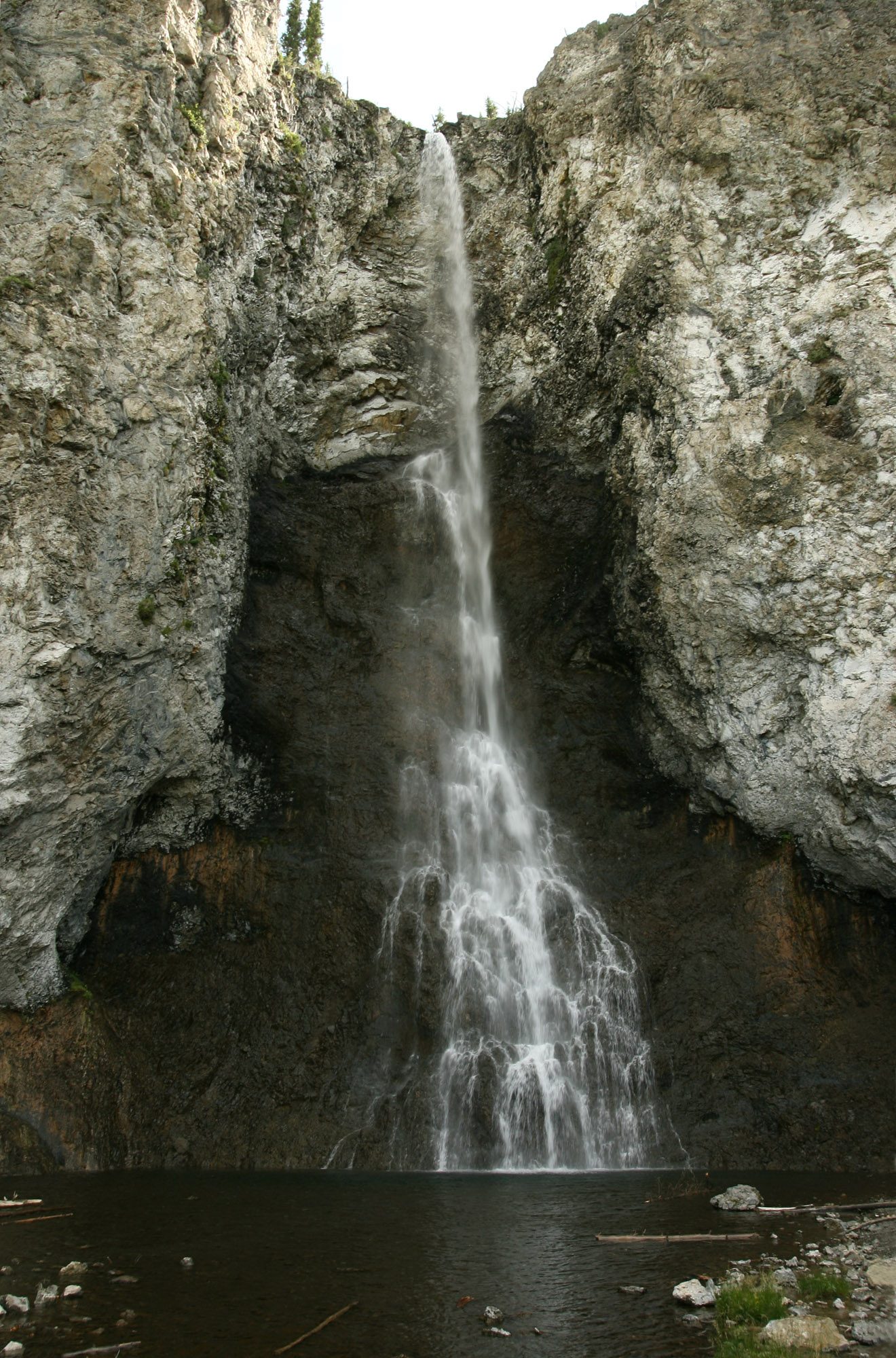
Continuing to Fairy Falls. From the overlook junction, the flat trail continues through lodgepole forest to Fairy Falls, a 197-foot ribbon of water, about 5 miles round trip from the lot in all. It’s a pleasant, easy walk, though the forest is shadeless in places. Waterfalls are covered in our Yellowstone waterfalls guide.
Rules. No pets on the trail. Bears live in the area, so carry bear spray and make noise, especially if you continue to Fairy Falls. And stay on the trail: the hillside is fragile, and cutting switchbacks damages it.
Our Grand Prismatic Overlook Trail guide has more detail, including where to stand for the best photos.
What is the best time to see Grand Prismatic Spring?
Late morning to mid-afternoon on a warm, sunny, breezy day is best, when the steam thins and the sun lights up the colors. Cool mornings bury the spring in steam. The trade-off is parking: the Midway lot is jammed from about 10 a.m. to 4 p.m. in summer.
The key is steam, and steam depends on the difference between the water temperature and the air temperature. The spring is always around 160°F; the colder the air, the more steam it makes. Here’s a rough guide:
| Air temperature | What you’ll see |
|---|---|
| Below about 40°F | Mostly steam from the boardwalk; the overlook may show some color if it’s sunny and windy |
| 40-60°F | A mix of steam and color; best in bright sun with a breeze |
| Above about 60°F | The best colors, especially from the overlook in bright sun |
Time of day. In summer, mornings are cool and steamy; by late morning, the air warms and the steam thins. The best color is usually from about 11 a.m. to 3 p.m. on a sunny day. Evenings can also be good for color on warm days, with softer light and fewer people.
Weather. Sun matters as much as temperature: overcast skies dull the colors. Wind helps, pushing the steam away from the spring. After rain, the steam can be heavy.
Season. July and August give the best combination of warm air and long days, but also the biggest crowds. June and September can be excellent on warm, sunny days, and the crowds are thinner. In spring and fall, cold mornings mean you should aim for the afternoon. Winter is almost all steam.
Our plan: do the boardwalk early, before 9 a.m., for the steam, the scale and an easy parking space, then come back to the overlook in the early afternoon on a sunny day, or on your way out of the geyser basins in the late afternoon. For more, see our best time to see Grand Prismatic Spring guide.
Mistakes to avoid
Most disappointing visits come down to the same few mistakes:
- Arriving at noon in July. You’ll queue for the Midway lot and share the boardwalk with a crowd. Go early for the boardwalk and use the afternoon for the overlook.
- Judging it from a cold morning. If all you saw was steam, you haven’t really seen it. Come back on a warm, sunny afternoon.
- Skipping the overlook. The boardwalk shows you the edge; the overlook shows you the whole thing.
- Parking on the road shoulder. It’s not allowed, it blocks traffic and it’s dangerous. Wait for a space or come back later.
- Chasing a lost hat. Anything that blows off the boardwalk is gone. Don’t step off to reach it.
- Bringing a drone. They’re banned throughout the park.
- Rushing. Ten minutes on the boardwalk isn’t enough to see the steam clear and the colors come and go. Give it the better part of an hour.
Parking: the Midway lot and the Fairy Falls lot
Parking is the single biggest challenge at Grand Prismatic Spring, and it’s worth planning.
The Midway Geyser Basin lot serves the boardwalk. It’s too small for the number of visitors in summer, and from about 10 a.m. to 4 p.m., cars back up on the Grand Loop Road waiting to get in. Waits of 20 to 30 minutes are common in midsummer. Don’t park on the road shoulders; it’s not allowed and it’s dangerous.
The Fairy Falls Trailhead lot, 1 mile south of Midway, serves the overlook and the Fairy Falls trail. The NPS describes parking there as very limited, and in July and August it often fills by mid-morning, sometimes before 9 a.m.
| Arrival time (summer) | Midway lot | Fairy Falls lot |
|---|---|---|
| Before 9 a.m. | Easy | Usually possible; can be full on busy days |
| 9-10 a.m. | Filling | Often full |
| 10 a.m.-4 p.m. | Long waits | Usually full; spaces open as hikers leave |
| After 4 p.m. | Easing | Spaces open up |
| After 6 p.m. | Easy | Easy |
Tips for getting a space:
- Go early or late. Before 9 a.m. or after 5 p.m., parking is usually easy.
- Be patient at Fairy Falls. Overlook visitors are in and out within an hour, so spaces turn over.
- Get dropped off. If you’re in a group, one person can drive while the others walk.
- Bike in. Fountain Flat Drive, north of Midway, leads to the old Fountain Freight Road, which is open to bikes and hikers and reaches the Fairy Falls trail area from the north. See our Fountain Flat Drive guide.
- Take a tour. Guided tours drop you at the door.
Our Grand Prismatic Spring parking guide has the latest tips.
Excelsior Geyser
Right next to Grand Prismatic, Excelsior Geyser Crater is a vast, steaming pit of blue water, one of the biggest thermal features in the park. It discharges an estimated 4,000 to 4,500 gallons of water at close to 199°F every minute, which pours down the bank into the Firehole River in steaming orange channels.
In the 1880s, Excelsior was one of the largest geysers in the world, with eruptions reported at about 100 feet and occasionally far higher. The eruptions were so powerful that they probably damaged the plumbing, and the geyser went quiet. It was named in 1881 by Superintendent Philetus Norris. Apart from a brief burst of small eruptions in September 1985, it has behaved as a hot spring ever since.
Today it’s an impressive sight from the boardwalk, especially on a cool morning when the crater fills with steam. See our Excelsior Geyser guide.
The Lower Geyser Basin: a 90-minute route
Just north of Midway, the Lower Geyser Basin is the largest geyser basin in the park by area, spread out on both sides of the Grand Loop Road. Most visitors drive straight past it on the way to Grand Prismatic. With 90 minutes, you can see its best sights. See our Lower Geyser Basin guide for the full picture.
Start: Fountain Paint Pot (30 minutes). A half-mile boardwalk loop shows all four kinds of thermal feature in one small area: hot springs, geysers, fumaroles and mudpots. The pink and gray mud bubbles and splatters, thickest in late summer, and Clepsydra Geyser erupts almost constantly. See Fountain Paint Pot.
Next: Firehole Lake Drive (30 to 60 minutes). A three-mile, one-way road loops through the basin past White Dome Geyser, Firehole Lake and Great Fountain Geyser. The road is closed to cars in winter. See Firehole Lake Drive.
Build it around Great Fountain Geyser. Great Fountain erupts in a series of bursts that can reach well over 100 feet, and sometimes more than 200, typically once or twice a day. Rangers post a prediction with a window of about two hours either side. If the window falls during your visit, bring a chair and a book and wait; it’s one of the best eruptions in the park, and far less crowded than the headline geysers. If it doesn’t, you can still see Fountain Paint Pot and drive the loop in about an hour. See Great Fountain Geyser.
Optional: Fountain Flat Drive. A short side road to a picnic area on the Firehole River and the start of the Fountain Freight Road, a flat route for bikes and walkers. See Fountain Flat Drive.
Swimming. The Firehole River Swim Area, further north in Firehole Canyon, was closed as of September 2026. Swimming questions are covered on our fishing in Yellowstone page, and the scenic side road on our Firehole Canyon Drive guide.
How hot is Grand Prismatic Spring?
The water in the middle of Grand Prismatic Spring is around 160°F, according to published measurements, hot enough to cause severe burns in seconds. The spring is about 370 feet across and more than 120 feet deep. The outer bands are cooler, which is why different microbes, and different colors, live there.
That heat is the reason for the boardwalks, and for the rules. People have been badly burned and killed in Yellowstone’s hot springs after leaving the boardwalks or falling through thin crust, and the ground around Grand Prismatic is some of the most fragile in the park. Rules to follow:
- Stay on the boardwalk and trails at all times.
- Never touch the water, and never throw anything into the spring.
- Don’t retrieve anything that blows in. Let it go.
- Keep children close, and hold small hands.
- No drones. Drones are prohibited throughout Yellowstone. The aerial photos you’ve seen were taken by the park service or from aircraft, not by visitors.
For more, see our Yellowstone safety page.
Visiting with kids
Children usually love Midway: the steam, the colors and the smell of the basin make a strong impression, and the loop is short enough for small legs. Set the rules before you leave the car, since much of the boardwalk has no railing. Hold small hands the whole way, keep hats in pockets on windy days, and explain that anything dropped over the edge stays there. The overlook trail is a good first hike for school-age kids, with a clear goal at the top and a view that rewards the climb, but carry water and sun hats, since there’s no shade. Pair the visit with Fountain Paint Pot, where the bubbling mud is a guaranteed hit, and pick up a Junior Ranger booklet at the Old Faithful Visitor Education Center. See our Yellowstone with kids guide for more.
A half-day plan: the spring, the overlook and the Lower Geyser Basin
If you’re based at Old Faithful or entering from West Yellowstone, this plan fits the spring, the overlook and the best of the neighboring basin into about half a day, and it works around both the steam and the parking.
| Time | Stop | Why then |
|---|---|---|
| 8:00 a.m. | Midway Geyser Basin boardwalk | The lot is easy, and the morning steam over Excelsior and the spring is at its most dramatic |
| 9:00 a.m. | Fountain Paint Pot | A half-mile loop before the tour buses |
| 9:45 a.m. | Firehole Lake Drive | Check Great Fountain Geyser’s prediction; if the window is now, stay |
| 11:00 a.m. | Lunch at Old Faithful, about 6 miles south | Food, restrooms and an eruption while the colors warm up |
| 1:00 p.m. | Fairy Falls Trailhead and the overlook | Peak color on a sunny day; be patient for a parking space |
| 2:30 p.m. | Optional: continue to Fairy Falls | Adds about 2 hours on a flat trail |
On a cloudy or cool day, swap the order: do the Lower Geyser Basin and Old Faithful first, and save the overlook for whenever the sun comes out. Our Yellowstone itinerary shows how this half day fits into a full geyser-basin day.
Getting there and nearby
Location. Grand Prismatic Spring is in the Midway Geyser Basin, on the Grand Loop Road between Old Faithful and Madison Junction, about 6 miles north of Old Faithful. From the West Entrance, it’s about 25 miles, via Madison Junction.
Road season. The road through the geyser basins is open to cars from mid-April (it opened on April 17 in 2026) to the end of October. In winter, you can reach it only by snowcoach or snowmobile. See our Yellowstone road closures page.
Nearby. To the south, Old Faithful and the Upper Geyser Basin. To the north, the Lower Geyser Basin, Fountain Paint Pot and Firehole Lake Drive. Between them, Biscuit Basin, 2 miles north of Old Faithful, remains closed after hydrothermal explosions in July 2024 and June 2026. The June 2026 explosion sent milky, sediment-laden water down the Firehole River as far as Midway, a reminder of how active this landscape is.
Facilities. There’s no food, gas or drinking water at Midway, so bring what you need. The nearest restaurants, stores, gas stations and visitor center are at Old Faithful, about 6 miles south.
Grand Prismatic Spring in winter
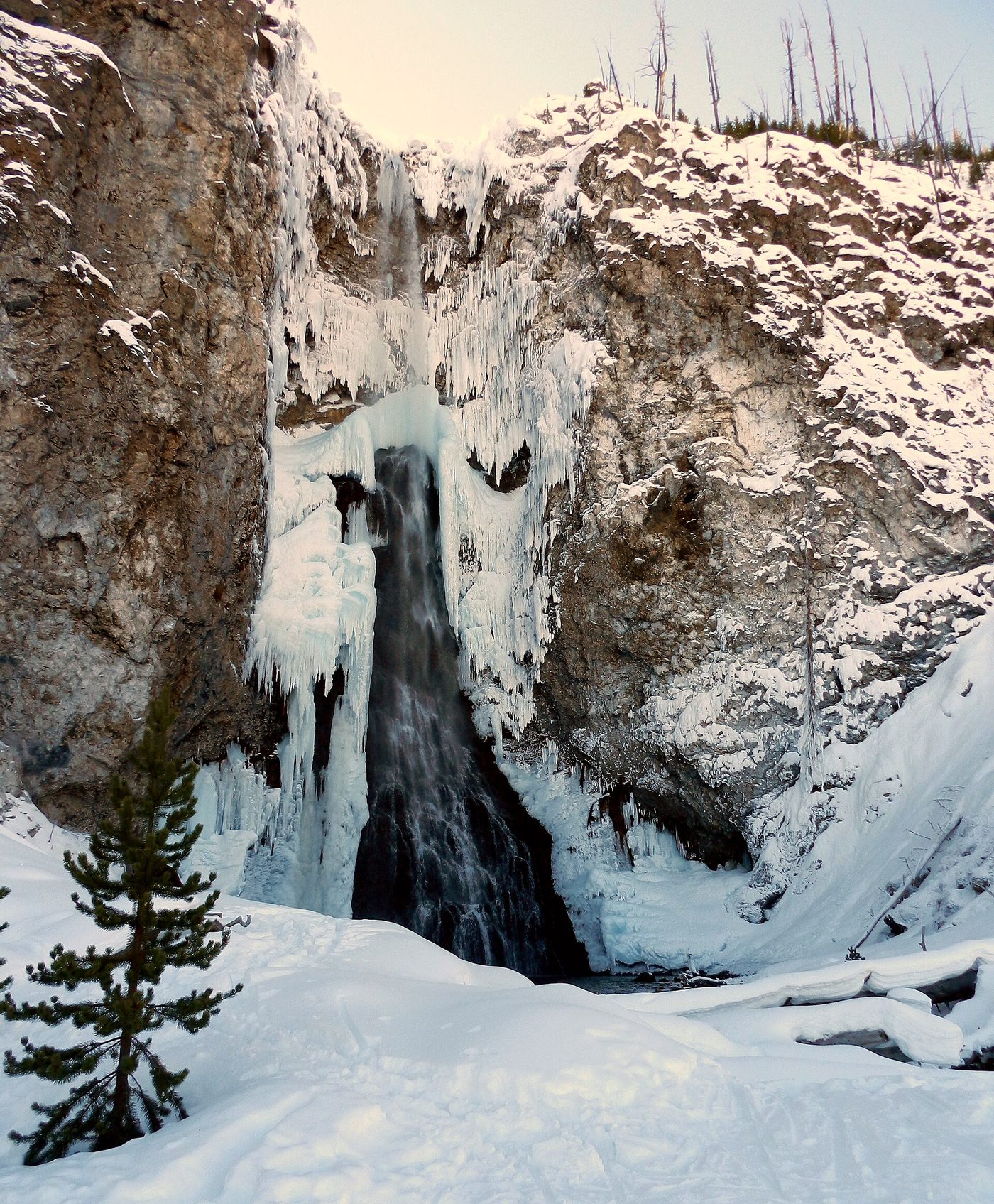
From mid-December to mid-March, the geyser basins are reachable only by guided snowcoach or snowmobile, and many tours stop at Midway on the way to Old Faithful. In winter, the spring is almost always hidden under a thick cloud of steam, so don’t expect the summer colors. What you get instead is a steaming, otherworldly landscape, frost on the boardwalks and bison grazing on the warm ground. The overlook trail is snow-covered and not maintained in winter. See our Yellowstone in winter and Old Faithful in winter guides.
Photography tips
- Use the overlook for the classic shot. A wide-angle lens captures the whole spring; a short telephoto isolates the rings and the tiny people on the boardwalk for scale.
- Shoot in bright sun. The colors need direct light. Overcast skies flatten them.
- Bring a polarizing filter. It cuts glare from the water and steam and deepens the colors.
- Work with the steam. On cooler days, wait for a gust to clear the surface, then shoot quickly.
- Get low on the boardwalk. Shooting across the runoff channels, with the orange streaks leading toward the spring, makes a strong composition.
- Keep your lens clean. Steam leaves mineral spots.
- No drones, anywhere in the park.
For more, see our Yellowstone photography guide.
Frequently asked questions
Where is Grand Prismatic Spring?
In the Midway Geyser Basin of Yellowstone National Park, Wyoming, on the Grand Loop Road about 6 miles north of Old Faithful.
How long is the walk to the Grand Prismatic overlook?
1.2 miles round trip from the Fairy Falls Trailhead, climbing 105 feet over 0.6 miles, according to the NPS. Allow about an hour.
Can you swim in Grand Prismatic Spring?
No. The water is around 160°F, hot enough to cause severe burns, and it’s illegal and extremely dangerous to enter any thermal feature in Yellowstone.
How big is Grand Prismatic Spring?
About 370 feet across, the largest hot spring in the United States.
Is Grand Prismatic Spring better in the morning or afternoon?
The afternoon, for color. Mornings are cooler and steamier. Late morning to mid-afternoon on a warm, sunny day is best.
Is there a fee to see Grand Prismatic Spring?
No extra fee. Access is included in the park entrance fee.
Can you fly a drone over Grand Prismatic Spring?
No. Drones are prohibited throughout Yellowstone National Park.
How do you get the famous aerial view of Grand Prismatic?
Take the Grand Prismatic Overlook Trail from the Fairy Falls Trailhead. It’s the only way for visitors to see the spring from above.
Why is there so much steam?
The spring’s water is far hotter than the surrounding air, so it constantly gives off vapor, and the colder the air, the more visible that vapor becomes. On cool mornings and in winter, the steam can hide the surface entirely; on warm, windy afternoons, it thins and blows away.
How long do you need at Midway Geyser Basin?
About 45 minutes to an hour for the boardwalk loop, including Excelsior Geyser Crater. Add about an hour for the overlook trail, and around two more if you continue to Fairy Falls.
Sources
- National Park Service, Yellowstone: Grand Prismatic Overlook Trail, park roads, current conditions
- USGS Yellowstone Volcano Observatory: Biscuit Basin hydrothermal explosion, June 2026
Image credits
| Photo | Credit |
|---|---|
| The view from the overlook trail, the only way for visitors to see the full rings of color (top of page) | Clément Bardot, CC BY-SA 3.0, via Wikimedia Commons |
| An NPS aerial photograph: each band of color is a different community of heat-loving micro | Jim Peaco, National Park Service. Edited by Fir0002 at English Wikipedia, public domain, via Wikimedia Commons |
| Runoff channels across the Midway terrace, looking toward the steam of Excelsior Geyser Cr | Acroterion, CC BY-SA 4.0, via Wikimedia Commons |
| Fairy Falls in July, reached on the flat trail beyond the overlook junction | Yellowstone National Park from Yellowstone NP, USA, public domain, via Wikimedia Commons |
| Excelsior Geyser Crater, which pours thousands of gallons a minute into the Firehole River | Kissmykumbaya, CC0, via Wikimedia Commons |
| Excelsior’s runoff steams as it meets the Firehole River below the parking lot bridge | Acroterion, CC BY-SA 4.0, via Wikimedia Commons |
| Midway Geyser Basin from the air, with Excelsior’s steam plume and the boardwalk loop | Yellowstone National Park from Yellowstone NP, USA, public domain, via Wikimedia Commons |
| Fairy Falls in January; in winter the whole area is reachable only on skis or by oversnow | Yellowstone National Park from Yellowstone NP, USA, public domain, via Wikimedia Commons |