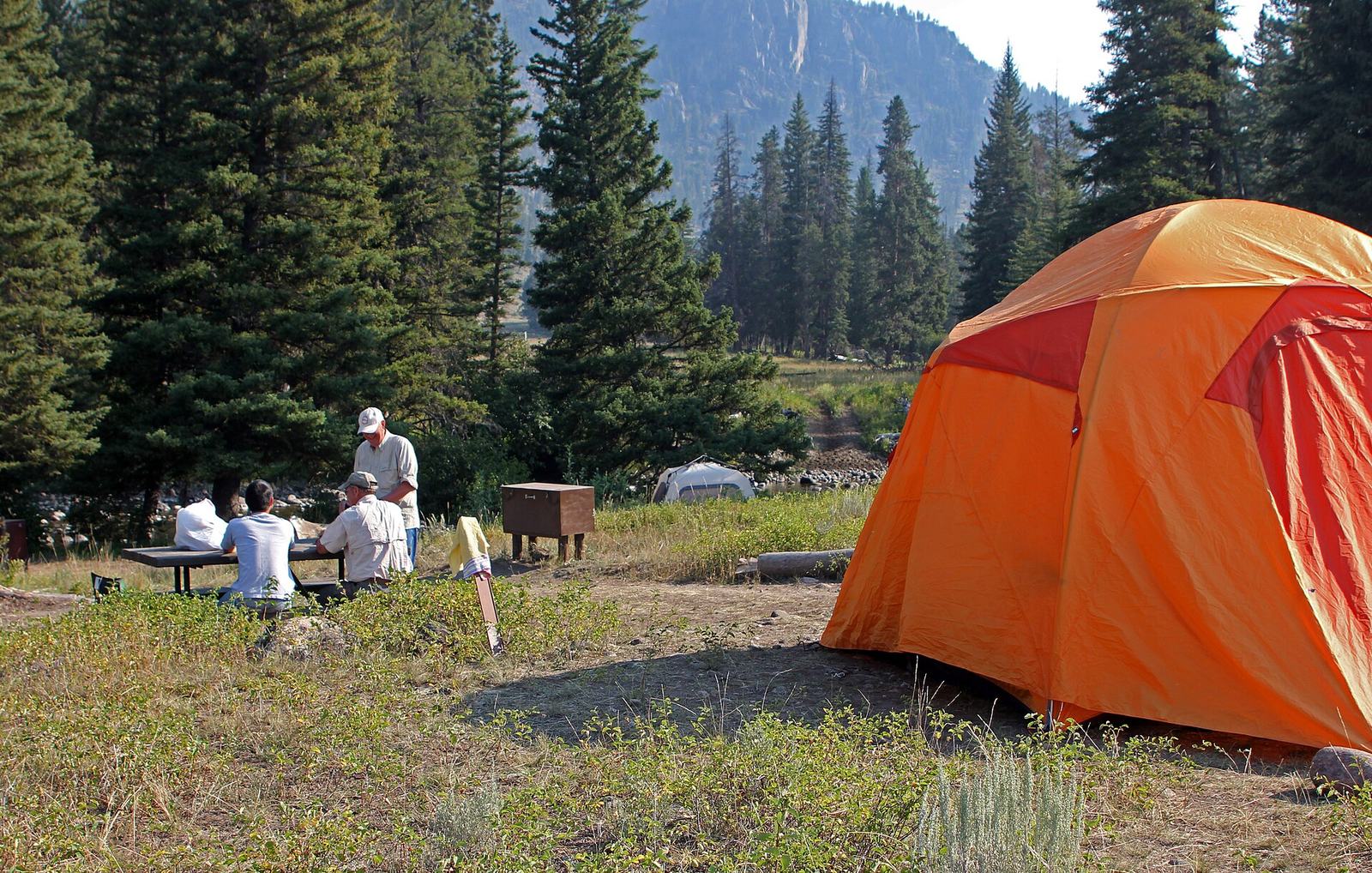
Camping in Yellowstone means choosing from 11 listed campgrounds with more than 2,000 sites, of which 10 were open in 2026. Every summer site must be reserved in advance, and nightly fees run from $20 at the small NPS-run campgrounds to $94 plus tax for full hookups at Fishing Bridge RV Park (checked September 2026).
There’s a lot more to get right than that. Two campgrounds that older guides still recommend, Pebble Creek and Norris, aren’t taking campers. Five of the biggest campgrounds switch booking systems for the 2027 season, which changes when you need to be ready to reserve. Some campgrounds ban tents, others ban generators, and one has a hairpin turn that defeats long trailers. And at nearly 8,000 feet in grizzly country, a July night can drop below freezing with a bear wandering through the loop.
This hub covers all of it: the complete 2026 campground table, how reservations work now and from 2027, what’s closed, an honest look at each campground, which one suits your trip, what to do when everything is full, backcountry permits, bear rules, costs, seasons and whether camping is worth it compared with a lodge. If you’re still deciding between camping, lodges and gateway towns, start with our guide to where to stay in Yellowstone.
Can you camp in Yellowstone?
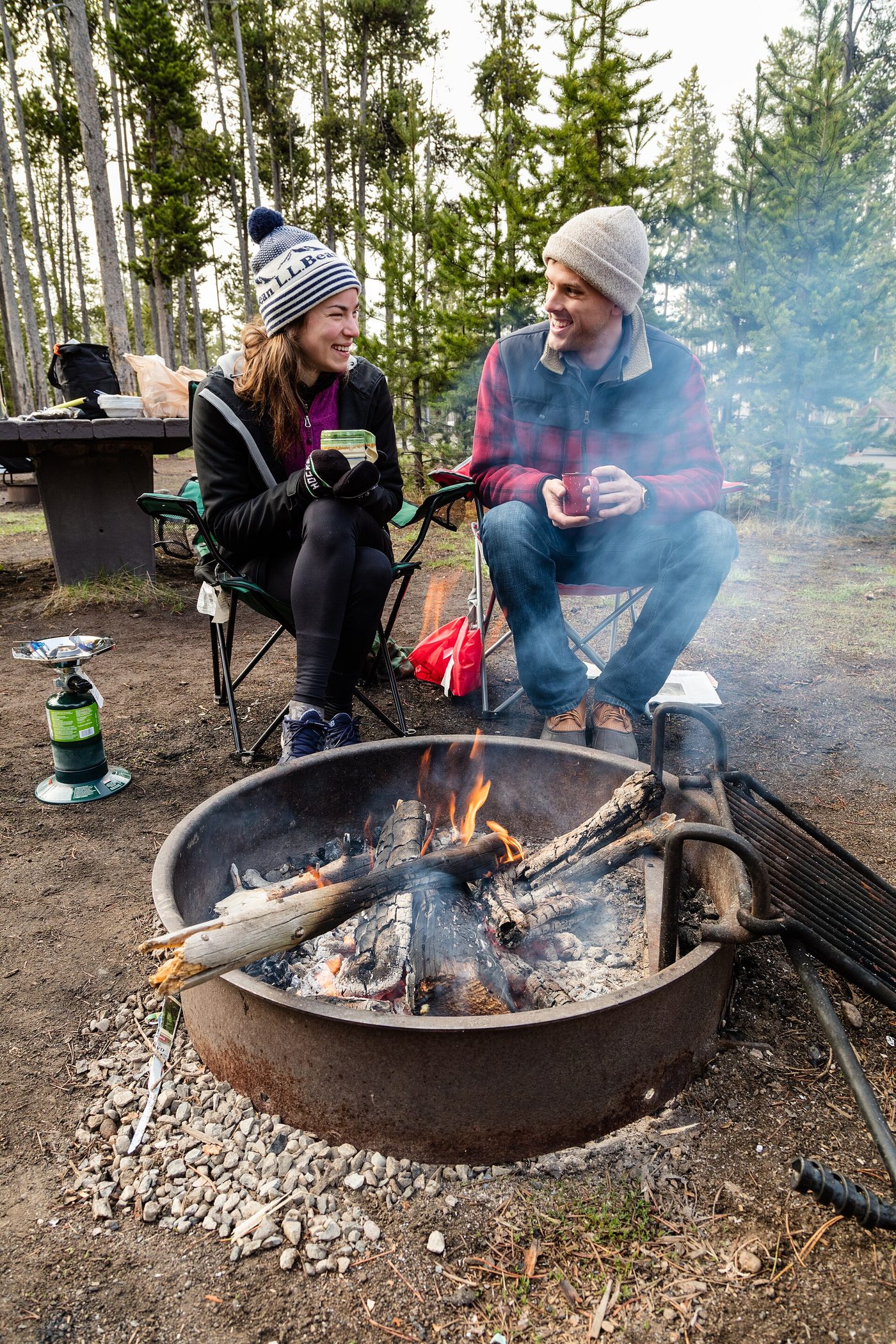
Yes, but only in designated campgrounds or at permitted backcountry sites. Yellowstone’s developed campgrounds open from May to October (Mammoth stays open all year), and nearly every summer site must be booked ahead. Sleeping in your car at a pullout, trailhead or parking lot isn’t allowed anywhere in the park.
That last rule catches a surprising number of people. Rangers patrol pullouts and parking lots at night, and “I’ll just sleep in the car” is not a Yellowstone plan. If you can’t get a campground or a room inside the park, your options are the gateway towns and the national forest land around the park, which we cover below.
The other important thing to understand is that Yellowstone’s campgrounds are run by two different operators:
- Yellowstone National Park Lodges (Xanterra), the park concessioner, runs the five biggest: Bridge Bay, Canyon, Grant Village, Madison and Fishing Bridge RV Park. These have flush toilets, dump stations and, at some, showers and laundry nearby. Generators are allowed.
- The National Park Service runs the smaller campgrounds through Recreation.gov: Indian Creek, Lewis Lake, Mammoth, Slough Creek and Tower Fall (plus Pebble Creek, which is closed). These are simpler, cheaper, quieter and don’t allow generators.
That split affects how you book, what you pay and what you’ll find when you arrive, as the rest of this guide explains.
Yellowstone campgrounds at a glance (2026)
This is the complete list as published by NPS for 2026 (checked September 2026). Fees are per site, per night. Dates and prices change each year, so confirm before you book.
| Campground | Sites | 2026 season | Fee per night | Max RV length | Hookups | Generators | Booked through (2026) | From 2027 |
|---|---|---|---|---|---|---|---|---|
| Madison | 276 | May 1-Oct 17 | $38 + tax | 60 ft | Dump station | Yes | Xanterra | Recreation.gov |
| Fishing Bridge RV Park | 310 | May 8-Oct 17 | $94 + tax | 95 ft | Full (50 amp) | Yes | Xanterra | Recreation.gov |
| Bridge Bay | 431 | May 15-Sep 13 | $38 + tax | 60 ft | Dump station | Yes | Xanterra | Recreation.gov |
| Canyon | 272 | May 29-Sep 19 | $45 + tax | 40 ft | Dump station | Yes | Xanterra | Recreation.gov |
| Grant Village | 429 | Jun 26-Sep 26 | $45 + tax | 50 ft | Dump station | Yes | Xanterra | Recreation.gov |
| Mammoth | 82 | Year-round | $25 | 30 ft winter / 45 ft summer | None | No | Recreation.gov (first-come Oct 15-Apr 1) | Recreation.gov |
| Tower Fall | 31 | May 22-Sep 27 | $20 | 30 ft | None | No | Recreation.gov | Recreation.gov |
| Indian Creek | 70 | Jun 12-Sep 14 | $20 | 35 ft | None | No | Recreation.gov | Recreation.gov |
| Slough Creek | 16 | Jun 15-Oct 12 | $20 | 30 ft | None | No | Recreation.gov | Recreation.gov |
| Lewis Lake | 84 | Jun 15-Oct 11 | $20 | 25 ft | None | No | Recreation.gov | Recreation.gov |
| Pebble Creek | 27 | Closed until further notice | — | 35 ft | None | No | — | — |
| Norris | — | Not listed for 2026 | — | — | — | — | — | Unconfirmed |
A few things jump out:
- Madison and Fishing Bridge have the longest seasons of the big campgrounds, and Mammoth is the only campground open all year.
- Grant Village opens late, at the end of June, and Canyon at the end of May, because of snow at their higher elevations.
- Lewis Lake has a 25-foot limit, the tightest in the park.
- Only Fishing Bridge has hookups, and it’s hard-sided vehicles only, with no tents or tent trailers, because it sits in prime grizzly habitat.
Our best campgrounds in Yellowstone guide ranks them; the details for each follow further down.
How do Yellowstone campground reservations work?
All summer campsites must be reserved ahead. In 2026, the five large campgrounds were booked through Yellowstone National Park Lodges, and the smaller NPS campgrounds through Recreation.gov, where sites open exactly six months before the date of your stay. From the 2027 season, all of them move to Recreation.gov on roughly the same six-month window.
Here’s what that means in practice.
The 2026 system
- Recreation.gov (NPS campgrounds): each date opens for booking exactly six months ahead. If you want July 15, it becomes available on January 15. Popular campgrounds, especially Slough Creek with only 16 sites, can sell out within minutes of opening (checked September 2026).
- Yellowstone National Park Lodges (Xanterra campgrounds): booked through the lodges’ reservation system, which releases inventory much further ahead, alongside hotel rooms. Check-in is 1 p.m. and check-out 11 a.m. at these campgrounds.
The 2027 change
This is the most important camping update in years, and most older guides don’t mention it. From the 2027 summer season, Bridge Bay, Canyon, Grant Village, Madison and Fishing Bridge RV Park move to Recreation.gov. Reservations will open about six months ahead, and you’ll be able to reserve individual sites rather than a site type (checked September 2026).
What that means for you:
- Your booking date moves. Under the old system, some people reserved a year ahead. Under the new one, the booking day for a July 2027 trip will be roughly January 2027.
- The first 2027 dates open in late 2026. If Madison again opens around May 1, its first nights would become bookable around November 1, 2026. Watch Recreation.gov from October 2026 so you know exactly when your dates go live.
- Competition gets fiercer on booking day. Everyone who wants a July site will be trying at the same moment. Log in to Recreation.gov ahead of time, have your campground and several backup sites ready, and try on a computer rather than a phone.
- Individual site choice is a plus. You can pick a riverside site at Madison or a site away from the road at Canyon, instead of taking whatever you’re assigned.
Our full Yellowstone campground reservations guide covers the booking-day strategy, cancellation tools and what to do if you miss out.
Tips for getting a site
- Be flexible about which campground. If Madison is full, Canyon or Bridge Bay may not be. Madison, Canyon, Slough Creek and Tower Fall generally go first.
- Be flexible about dates. Sunday to Thursday nights are easier than weekends, and June and September are easier than July and August.
- Watch for cancellations. People cancel constantly, especially in the final weeks before a date, as plans change. Check Recreation.gov often, or use an availability alert service.
- Split your stay. Two nights at one campground and two at another is often easier to book than four in one place, and it cuts driving anyway.
- Look at shoulder season. In late May, early June and September, sites are easier to get, although some campgrounds are closed.
A booking-day checklist
Whether you’re booking an NPS campground now or one of the big campgrounds under the 2027 system, the routine is the same:
- Create and verify your Recreation.gov account days ahead, with your payment card saved and your details up to date.
- Work out the exact opening moment for your first night. Because each date opens six months ahead, a multi-night stay becomes bookable when the first night opens, so aim for your arrival date.
- Shortlist sites in advance. Look at the campground map, note five or six sites that fit your vehicle length and tent size, and rank them.
- Log in 10 minutes early on a reliable connection. Refresh when the booking window opens, add a site to your cart and complete checkout quickly; sites in someone else’s cart are held only briefly.
- Have a Plan B campground open in another tab. If Madison is gone in 90 seconds, move immediately to Canyon or Bridge Bay rather than hoping a site reappears.
- Book first, fine-tune later. It’s easier to modify a reservation you hold than to find a new one, although modification and cancellation fees may apply. Read the terms for your campground before you pay.
If your plans change
Cancel as early as you can. Someone else is almost certainly waiting for that site, and early cancellation usually costs you less. Recreation.gov and Yellowstone National Park Lodges each set their own change and cancellation fees and deadlines, and they differ by campground type, so read the policy shown at checkout rather than relying on an older guide. For the backcountry, NPS says cancelling within 72 hours of your trip refunds the recreation fee but not the $10 reservation fee (checked September 2026).
What’s closed in 2026: Pebble Creek and Norris
Two campgrounds that appear in many older guides aren’t available.
Pebble Creek (27 sites) in the northeast corner of the park, near the Northeast Entrance road, was significantly damaged in the June 2022 floods. NPS says it “will remain closed until further notice” (checked September 2026). There’s no announced reopening date.
Norris (central, near Norris Geyser Basin) isn’t listed among the campgrounds on the NPS page for 2026, and NPS hasn’t published a reason there. Treat it as unavailable until it reappears on the list. Our Norris campground page tracks its status and the best alternatives.
What to book instead:
- Instead of Pebble Creek: Slough Creek for the same wolf country (but just 16 sites), Tower Fall, or national forest campgrounds near Cooke City outside the Northeast Entrance.
- Instead of Norris: Madison (about 14 miles southwest) or Canyon (12 miles east). Both are central.
Campground by campground: an honest look
Madison Campground
276 sites · May 1-Oct 17 · $38 + tax · up to 60 ft · generators allowed
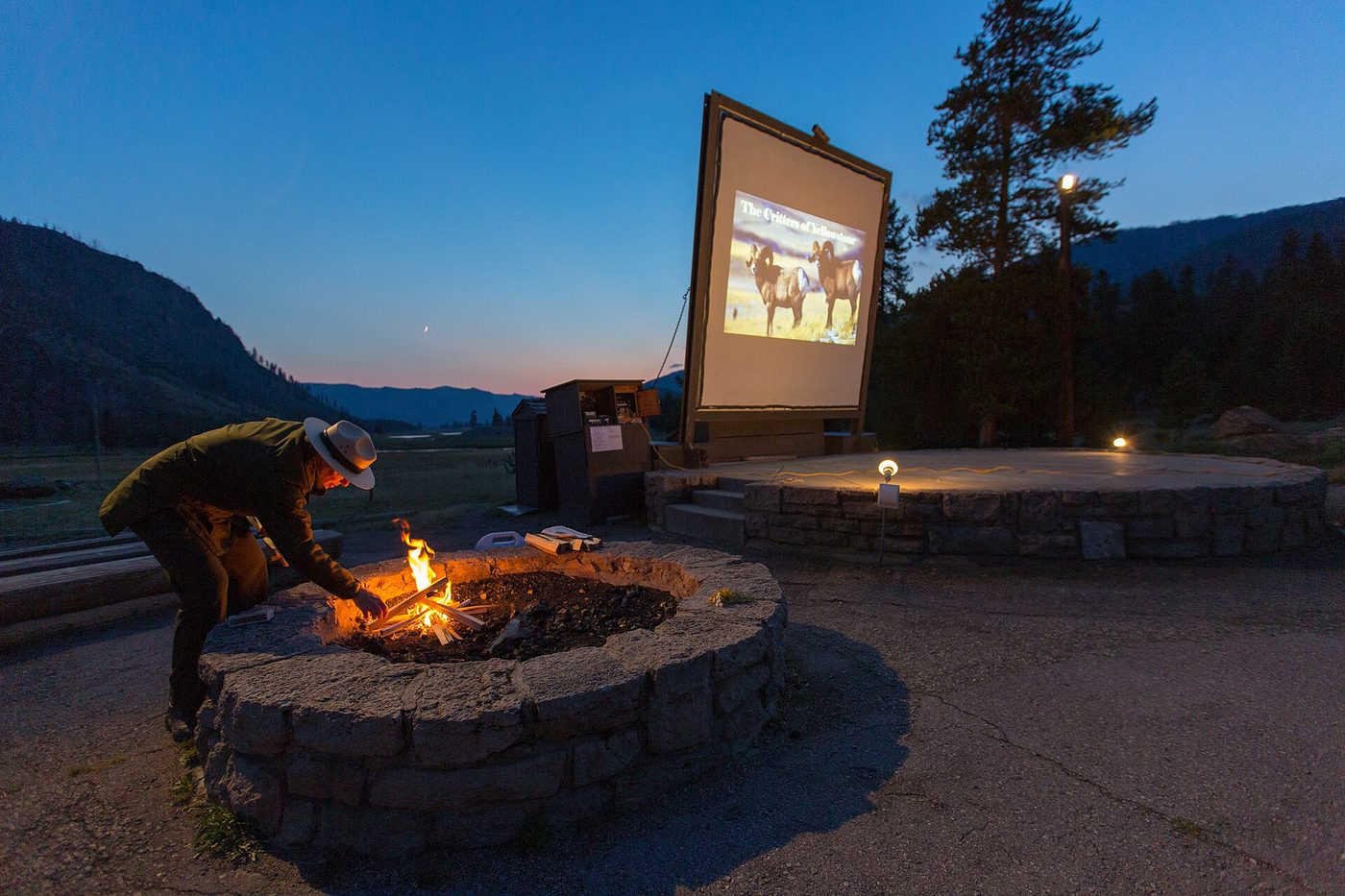
Madison sits in a lodgepole pine forest where the Gibbon and Firehole rivers join to form the Madison, about 14 miles from the West Entrance and 16 miles from Old Faithful. It’s the closest campground to the geyser basins and has one of the longest seasons. Elk and bison regularly wander through the meadows along the river beside the campground, and in September you’ll hear elk bugling through the night. There’s an amphitheater for evening ranger programs.
What to know: there are no showers or stores at Madison itself. The nearest services are in West Yellowstone or at Old Faithful. Some loops are more open and less shaded than others.
Verdict: the best campground in the park for geyser country and one of the first to sell out. Book it on day one. See our Madison Campground guide.
Canyon Campground
272 sites · May 29-Sep 19 · $45 + tax · up to 40 ft · generators allowed
Canyon is set in dense lodgepole forest a short walk from Canyon Village, which has stores, restaurants, a visitor education center and gas. It’s the most central campground in the park: the Grand Canyon of the Yellowstone is minutes away, Hayden Valley is just south, and Norris is 12 miles west. Pay showers and laundry are available at the campground. At around 7,900 feet, it’s also one of the coldest campgrounds, and frost is common even in midsummer.
What to know: the 40-foot limit rules out the biggest rigs. Bears and other wildlife are active around Canyon, so food storage rules are strictly enforced.
Verdict: the best all-round base in the park, with more services than any other campground. Pack a warm sleeping bag. See our Canyon Campground guide.
Bridge Bay Campground
431 sites · May 15-Sep 13 · $38 + tax · up to 60 ft · generators allowed
Bridge Bay is the largest campground in Yellowstone, near the marina on the west shore of Yellowstone Lake, 3 miles southwest of Lake Village. Some loops sit in open meadow with lake and mountain views, and others in the trees. It’s handy for lake cruises, boat rentals and fishing trips from the marina, and for Hayden Valley at dawn.
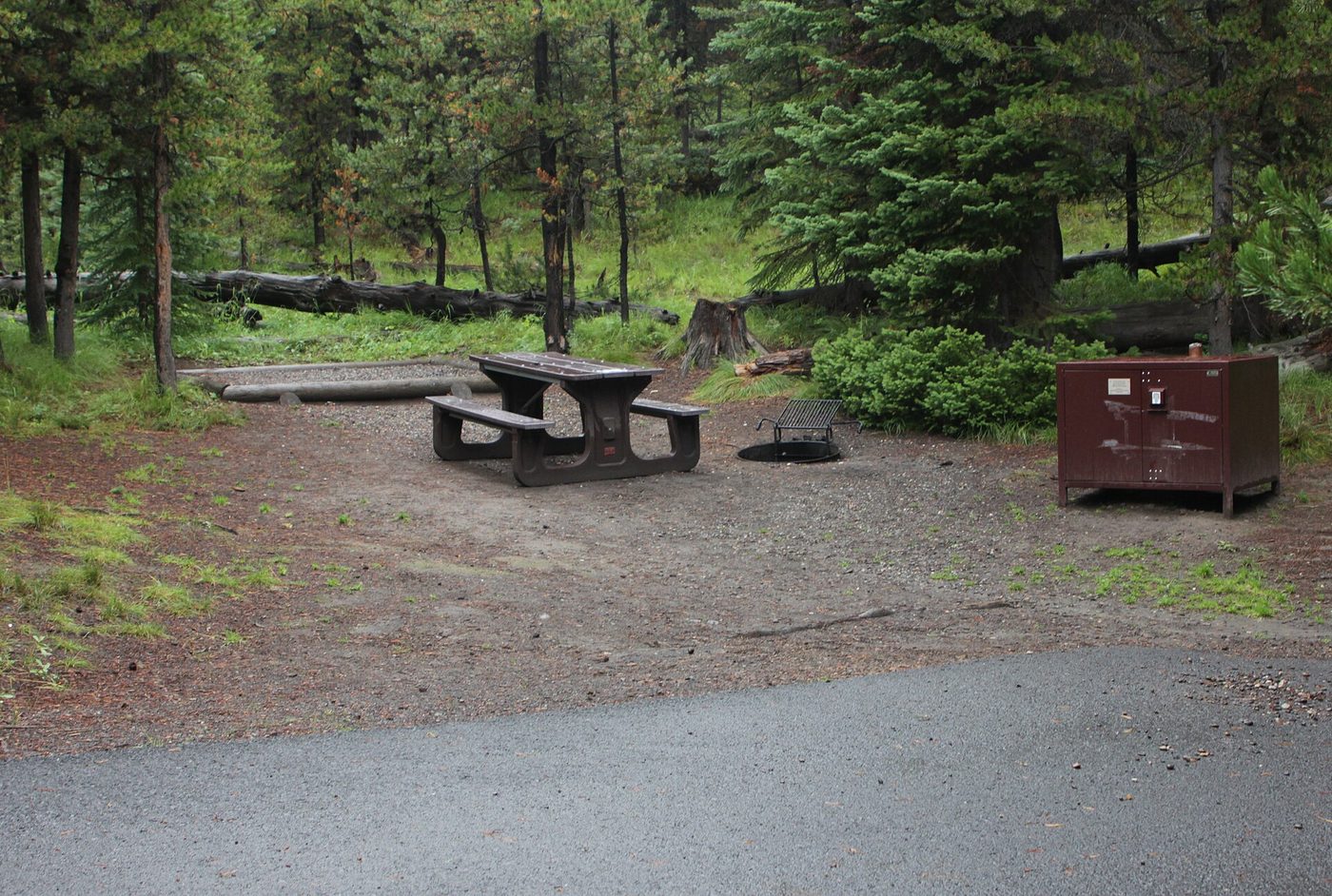
What to know: it’s big and, in some loops, has little shade or privacy. Showers and laundry aren’t in the campground; the nearest are around Lake Village and Fishing Bridge. Wind off the lake can make evenings cold.
Verdict: a solid, easier-to-book option with a great location, but it feels more like a small town than a wilderness camp. See our Bridge Bay Campground guide.
Grant Village Campground
429 sites · Jun 26-Sep 26 · $45 + tax · up to 50 ft · generators allowed
Grant Village Campground lies in forest near the West Thumb of Yellowstone Lake, close to Grant Village’s stores, restaurants, visitor center and marina. It’s the closest large campground to the South Entrance and Grand Teton, and it’s convenient for West Thumb Geyser Basin and Old Faithful (about 19 miles). Showers and laundry are available nearby.
What to know: it opens late, at the end of June, because of snow. Some sites are a longer walk from the lake than the name suggests.
Verdict: the natural first or last night on a trip that includes Grand Teton, and often easier to book than Madison or Canyon. See our Grant Village Campground guide.
Fishing Bridge RV Park
310 sites · May 8-Oct 17 · $94 + tax · up to 95 ft · full hookups (50 amp) · hard-sided vehicles only
The only campground in Yellowstone with full water, sewer and electric hookups, near the outlet of Yellowstone Lake. Because it sits in heavily used grizzly habitat, tents and soft-sided tent trailers aren’t allowed. Showers and laundry are available, and a general store is nearby.
What to know: sites are close together, and the setting is more RV park than campground. At $94 plus tax a night, it can cost close to a budget motel room in a gateway town (checked September 2026).
Verdict: worth it only if you need hookups. Otherwise, dry camp at Madison, Canyon or Bridge Bay and use the dump station. More in our Yellowstone RV camping guide.
Mammoth Campground
82 sites · year-round · $25 · up to 30 ft in winter, 45 ft in summer · no generators
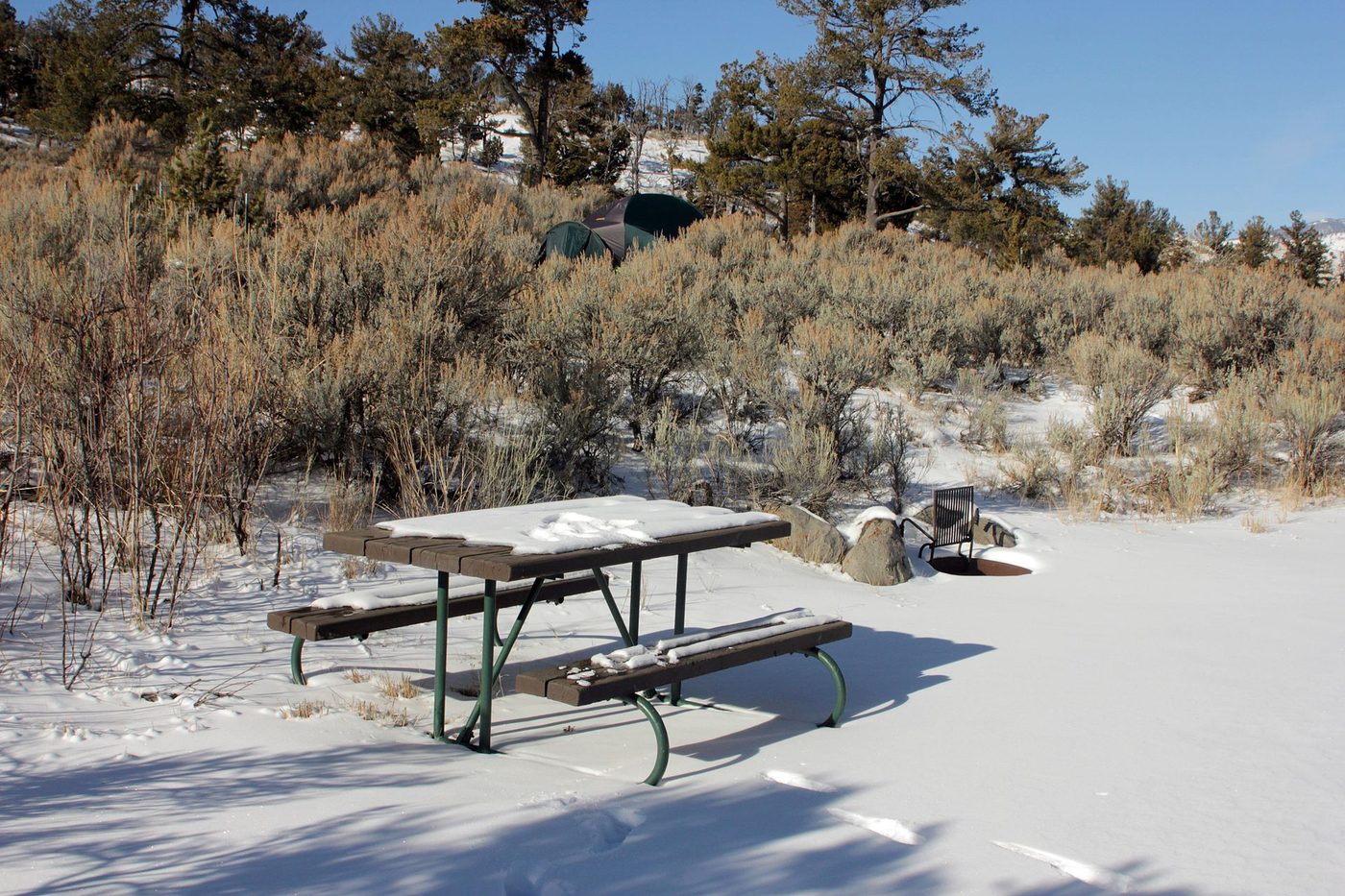
Mammoth is the only campground in the park open all year. It sits on a sagebrush hillside below Mammoth Hot Springs, about 5 miles from Gardiner and the North Entrance, at the lowest elevation of any park campground, so it’s a little warmer and drier than the rest. Elk graze through the campground, and the Mammoth terraces, restaurants, store and visitor center are a short drive or walk away. Reservations through Recreation.gov apply for most of the year, but from October 15 to April 1 sites are first-come, first-served (checked September 2026).
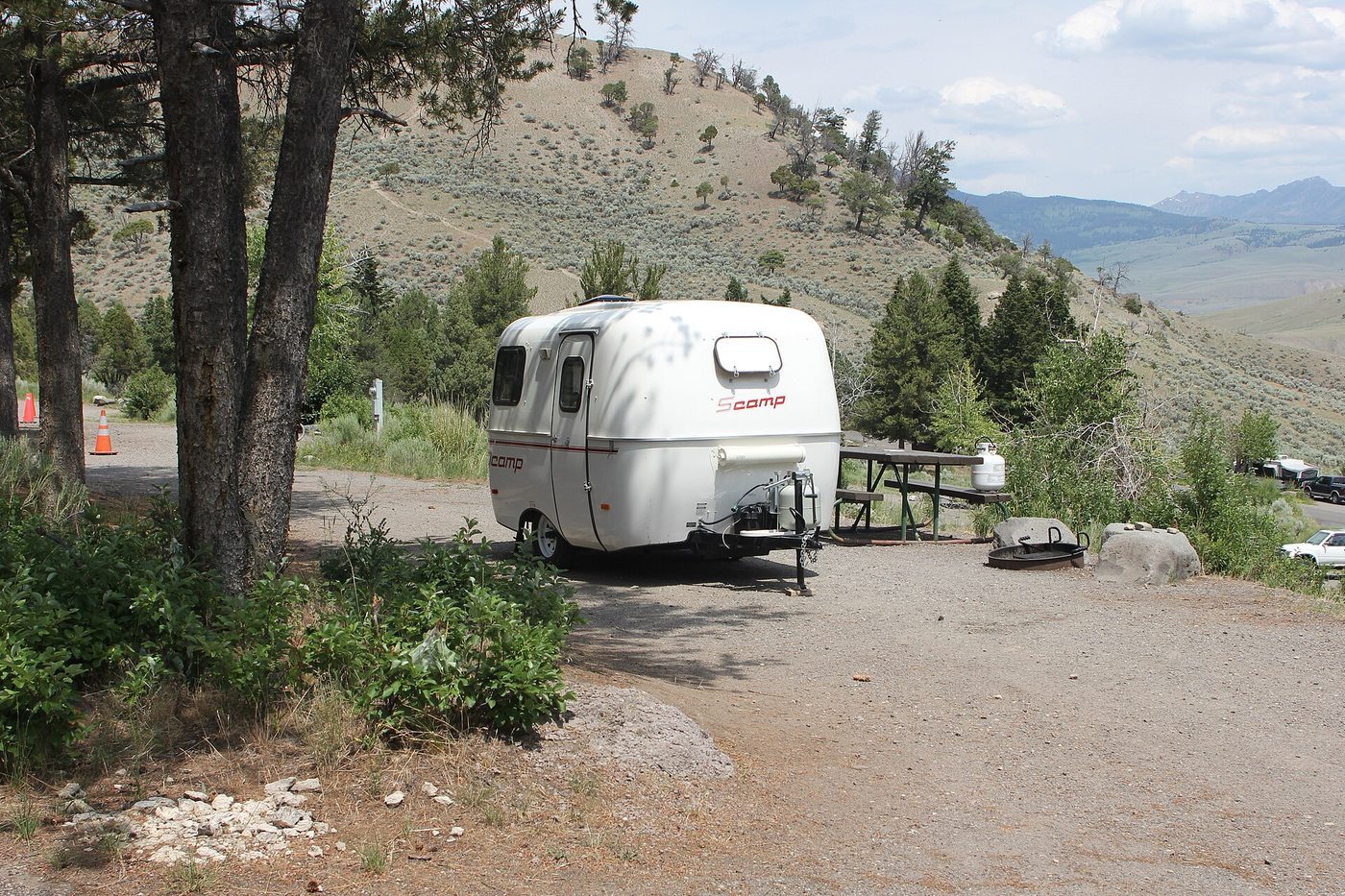
What to know: there’s little shade, and the main road between Gardiner and Mammoth runs right past it, so there’s traffic noise. The Gardner River High Bridge restriction nearby limits vehicles to under 8 feet 6 inches wide and 75 feet long through late October 2026.
Verdict: a great base for Lamar Valley and the northern range, and the only choice for winter camping. Not a peaceful forest camp. See our Mammoth Campground guide and, for winter, winter camping in Yellowstone.
Slough Creek Campground
16 sites · Jun 15-Oct 12 · $20 · up to 30 ft · no generators
Slough Creek is the most sought-after campground in Yellowstone, and it’s easy to see why. It sits at the end of a 2.5-mile gravel road off the Northeast Entrance road at the western end of Lamar Valley, beside a famous trout stream, in the heart of wolf country. Mornings often start with wolf watchers setting up spotting scopes nearby. There are vault toilets and no services.
What to know: with only 16 sites, reservations disappear within minutes of opening. NPS advises checking the road and site before bringing anything close to the 30-foot limit. There’s no cell service.
Verdict: the best campground in the park for wildlife lovers, if you can get a site. Our Slough Creek Campground guide has booking tips.
Tower Fall Campground
31 sites · May 22-Sep 27 · $20 · up to 30 ft · no generators
Tower Fall is a small, forested campground on a hill just above the Tower Fall area, near the general store and the Tower Fall overlook, 3 miles south of Tower Junction. It’s convenient for Lamar Valley, the Dunraven Pass drive to Canyon, and the Mount Washburn hike.
What to know: the access road includes a tight hairpin turn that makes it difficult for long RVs and trailers. The sites are small and close together.
Verdict: a good, central small campground for tents and small campers; not a place to bring a big rig. See our Tower Fall Campground guide.
Indian Creek Campground
70 sites · Jun 12-Sep 14 · $20 · up to 35 ft · no generators
Indian Creek sits in a quiet forested area about 8 miles south of Mammoth, near the Gardner River and close to the trailhead for the Bunsen Peak area. It’s peaceful, with vault toilets and no services, and it’s well placed for the Mammoth terraces, Norris and the northern range.
What to know: its season is short, from mid-June to mid-September. Mosquitoes can be heavy in early summer.
Verdict: an underrated, easier-to-book alternative to Mammoth and Tower Fall. Our best campgrounds ranking explains where it fits.
Lewis Lake Campground
84 sites · Jun 15-Oct 11 · $20 · up to 25 ft · no generators
Lewis Lake Campground is on the southeast shore of Lewis Lake, about 10 miles north of the South Entrance. It has a boat launch, making it the favorite base for paddlers heading up the Lewis River channel to Shoshone Lake, and it’s one of the last small campgrounds to close in fall. It’s convenient for Grand Teton visitors.
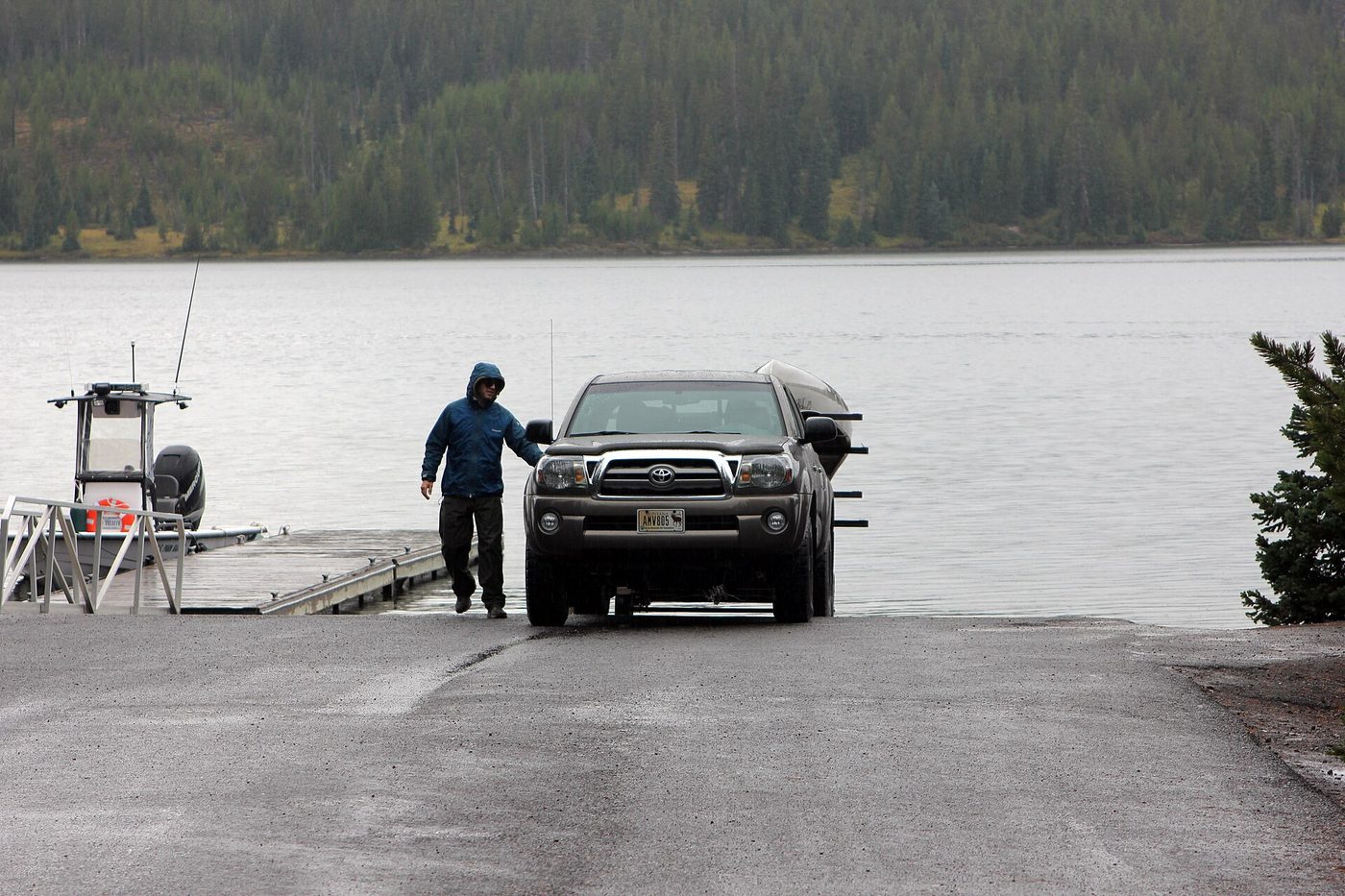
What to know: the 25-foot limit is the lowest in the park. Snow can linger into June, and nights are cold. It’s a long drive to the northern sights.
Verdict: a quiet, lovely lakeside option, especially for paddlers and anyone combining Yellowstone with Grand Teton. See our Lewis Lake Campground guide.
Which Yellowstone campground is best for your trip?
Match the campground to what you want to see first thing in the morning. Madison is best for geysers, Canyon for a central base, Slough Creek or Mammoth for wildlife, Grant Village or Lewis Lake for Grand Teton access, and Fishing Bridge only if you need full hookups.
| If you want | Book | Backup |
|---|---|---|
| Old Faithful and the geyser basins | Madison | Grant Village |
| A central base for a first visit | Canyon | Bridge Bay |
| Wolves and Lamar Valley at dawn | Slough Creek | Tower Fall, Mammoth |
| Winter camping | Mammoth (first-come Oct 15-Apr 1) | Gateway town motel |
| Yellowstone Lake, boating or fishing | Bridge Bay | Grant Village, Lewis Lake |
| Grand Teton on the same trip | Grant Village | Lewis Lake |
| Full hookups for a big RV | Fishing Bridge RV Park | Madison or Bridge Bay (dry camping, 60 ft) |
| Quiet and small | Indian Creek | Lewis Lake |
| Showers and laundry on site | Canyon, Fishing Bridge | Grant Village |
| Paddling to Shoshone Lake | Lewis Lake | Grant Village |
| The cheapest night | Tower Fall, Indian Creek, Slough Creek or Lewis Lake ($20) | Mammoth ($25) |
Our shortlist for a first camping trip: two nights at Madison, two at Canyon, and, if you’re lucky enough to get one, a night at Slough Creek. That covers the geysers, the canyon and Hayden Valley, and the wildlife of the northern range, with no more than about an hour’s drive each morning.
For a full ranking by setting, facilities and crowds, see our best campgrounds in Yellowstone guide.
Sample camping plans
These plans assume a summer trip and reservations in hand. Each keeps the morning drive short and moves you steadily around the park.
Three nights (a long weekend, entering from the west):
- Nights 1-2: Madison. Day one on the geyser basins: Grand Prismatic Spring early, Old Faithful and the Upper Geyser Basin through the day. Day two north to Norris and on to the Grand Canyon of the Yellowstone, returning via Hayden Valley at dusk.
- Night 3: Canyon. Dawn in Hayden Valley, then Yellowstone Lake and West Thumb on your way out.
Five nights (first visit, the whole park):
- Nights 1-2: Madison for the geyser basins and Norris.
- Nights 3-4: Canyon for the canyon rims, Hayden Valley at dawn and dusk, and Mount Washburn if Dunraven Pass is open.
- Night 5: Slough Creek or Tower Fall for a Lamar Valley dawn before leaving through the North or Northeast Entrance.
Seven nights (slow and complete):
- Nights 1-2: Grant Village or Lewis Lake, arriving from Grand Teton, with West Thumb, the lake and Old Faithful.
- Nights 3-4: Madison for the geyser basins at a relaxed pace.
- Nights 5-6: Canyon for the canyon and Hayden Valley.
- Night 7: Mammoth or Slough Creek for the terraces and Lamar Valley.
If you can’t get every night you want, anchor the trip with Madison and Canyon and fill the edges with whatever you can find, including a motel in West Yellowstone or Gardiner. Our Yellowstone itinerary guide has more detail on how to spend each day.
Tent camping, trailers and RVs
Tents. Tents are welcome at every campground except Fishing Bridge RV Park. The Xanterra campgrounds have flush toilets; the smaller NPS campgrounds mostly have vault toilets. Tent pads vary in size, so if you’re bringing a large family tent, check the site description when you book. Expect to sleep at 6,000 to nearly 8,000 feet, which means cold nights in every month: pack a sleeping bag rated to at least 20°F even in July, plus a sleeping pad that insulates from the ground. Our tent camping in Yellowstone guide goes through gear and site choice.
Small trailers and campervans. A campervan or small trailer under 25 feet fits every open campground, including Lewis Lake. That flexibility is a real advantage when you’re hunting for a site.
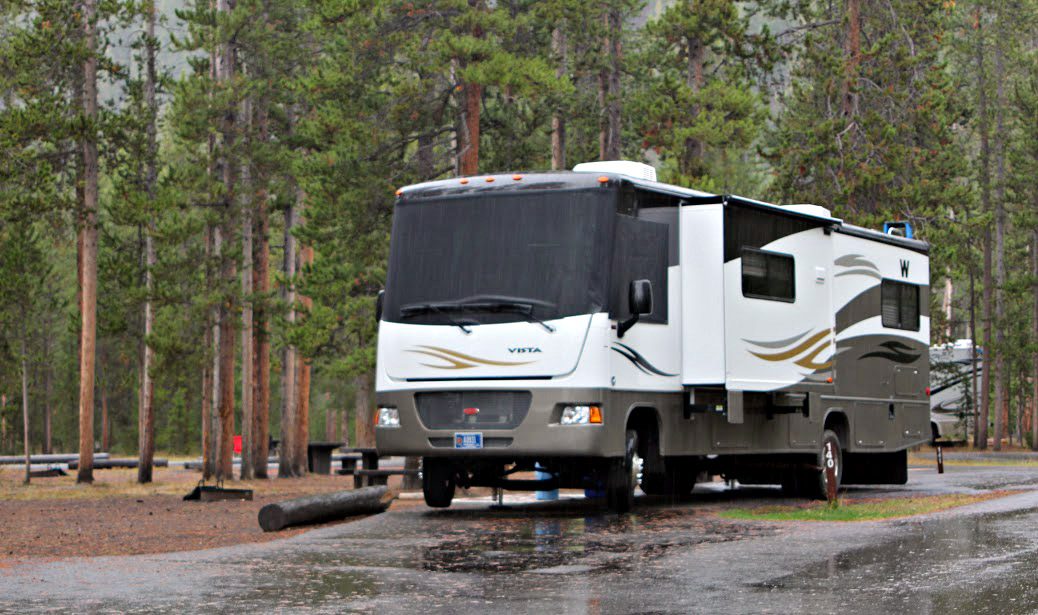
Larger RVs. Stick to Madison and Bridge Bay (60 feet), Grant Village (50 feet), Canyon (40 feet) or Fishing Bridge (95 feet, with hookups). Check your total length, including any tow vehicle, against the limit, and remember that some sites within a campground are shorter than the maximum. Avoid Tower Fall’s hairpin, and bear in mind the 2026 Gardner River High Bridge restriction near the North Entrance. Dump stations are available at the Xanterra campgrounds. Our Yellowstone RV camping hub covers routes, rentals and hookups outside the park.
Generators. Allowed only at the five Xanterra campgrounds, and only during set daytime hours. They’re not allowed at Indian Creek, Lewis Lake, Mammoth, Slough Creek or Tower Fall (checked September 2026). If you need power for medical equipment or a fridge, book accordingly.
Can you camp in Yellowstone without a reservation?
In summer, realistically, no. NPS requires all campsites to be reserved in advance. The only first-come, first-served camping in the park is at Mammoth from October 15 to April 1. Without a reservation in summer, look to national forest campgrounds, dispersed camping or motels outside the park.
Here are your options when the park is full.
National forest campgrounds
Yellowstone is surrounded by national forests, and each has developed campgrounds, many first-come, first-served:
- Custer Gallatin National Forest around West Yellowstone (on Hebgen Lake and along the Madison River), in Gallatin Canyon north of the park, and near Cooke City and Gardiner.
- Shoshone National Forest along the North Fork of the Shoshone River between Cody and the East Entrance, and along the Beartooth Highway.
- Caribou-Targhee National Forest in Island Park, Idaho, southwest of West Yellowstone.
- Bridger-Teton National Forest south and east of Grand Teton.
Several of these, especially near Cooke City and West Yellowstone, are restricted to hard-sided campers because of grizzly activity. Check the rules before you arrive with a tent. Our campgrounds near Yellowstone guide lists them by entrance.
Dispersed camping
Free, undeveloped camping away from designated campgrounds is allowed on much national forest land around the park, usually with a stay limit, no facilities and strict food storage rules. It isn’t allowed anywhere inside Yellowstone. It takes research, a vehicle that can handle forest roads, and self-sufficiency. See dispersed camping near Yellowstone.
Grand Teton campgrounds
Grand Teton’s campgrounds are another option on a two-park trip. In 2026, Jenny Lake ran from May 2 to September 27, Signal Mountain from May 8 to October 11, Colter Bay from May 21 to September 27, Gros Ventre from April 27 to October 10 and Lizard Creek from June 12 to September 13 (checked September 2026). See our Yellowstone and Grand Teton planner.
Cancellations
Sites do open up. Check Recreation.gov repeatedly, especially in the week before your dates, and consider an availability alert tool.
Honest verdict: showing up in July without a reservation and hoping for a site inside the park will almost certainly fail. Book ahead, or plan on national forest land or a motel. Our first-come, first-served campgrounds guide covers the realistic options.
Backcountry camping in Yellowstone
Beyond the roads, Yellowstone has 293 designated backcountry campsites, and many visitors say a night at one is the best experience the park offers. A permit is required year-round for every overnight stay in the backcountry. Day hiking doesn’t need one (checked September 2026).
How the permit system works (2026 figures, checked September 2026):
| Step | Details |
|---|---|
| Early Access Lottery application | March 1-20; $10 non-refundable application fee |
| Lottery winners notified | March 25 |
| Early Access booking period | April 1-25 |
| General reservations open | April 26 for the peak season (May 15-Oct 31); October 6 for non-peak (Nov 1-May 14) |
| Book at least | 3 days before your trip starts |
| Recreation fee | $5 per person, per night, plus a $10 reservation fee |
| Walk-up permits | About 25% of sites; issued first-come, first-served up to two days in advance |
| Group size | Limited to 4 to 12 people, depending on the site |
| Stay limits | 1 to 3 nights per site |
Peak-season permits are picked up up to two days before your trip at a backcountry office, where you’ll watch a safety briefing. Cancel within 72 hours of your trip and you lose the reservation fee but get the recreation fee back.
Food storage in the backcountry is serious. You must hang food and all scented items from a food pole, which needs at least 35 feet of rope, or store them in a bear-resistant container.
Good first backcountry trips: a lakeshore site on Shoshone Lake by canoe from Lewis Lake, the Heart Lake area in the south, or a short hike to a site in the Bechler region’s waterfall country in late summer. Our Yellowstone backcountry permit guide covers routes and applications, and best hikes in Yellowstone covers day hikes and overnight ideas.
Bear safety and food storage in camp
Yellowstone is grizzly country, and every campground is bear habitat. The food storage rules exist because a bear that gets human food once is likely to become a problem bear, and problem bears are often killed.
In developed campgrounds:
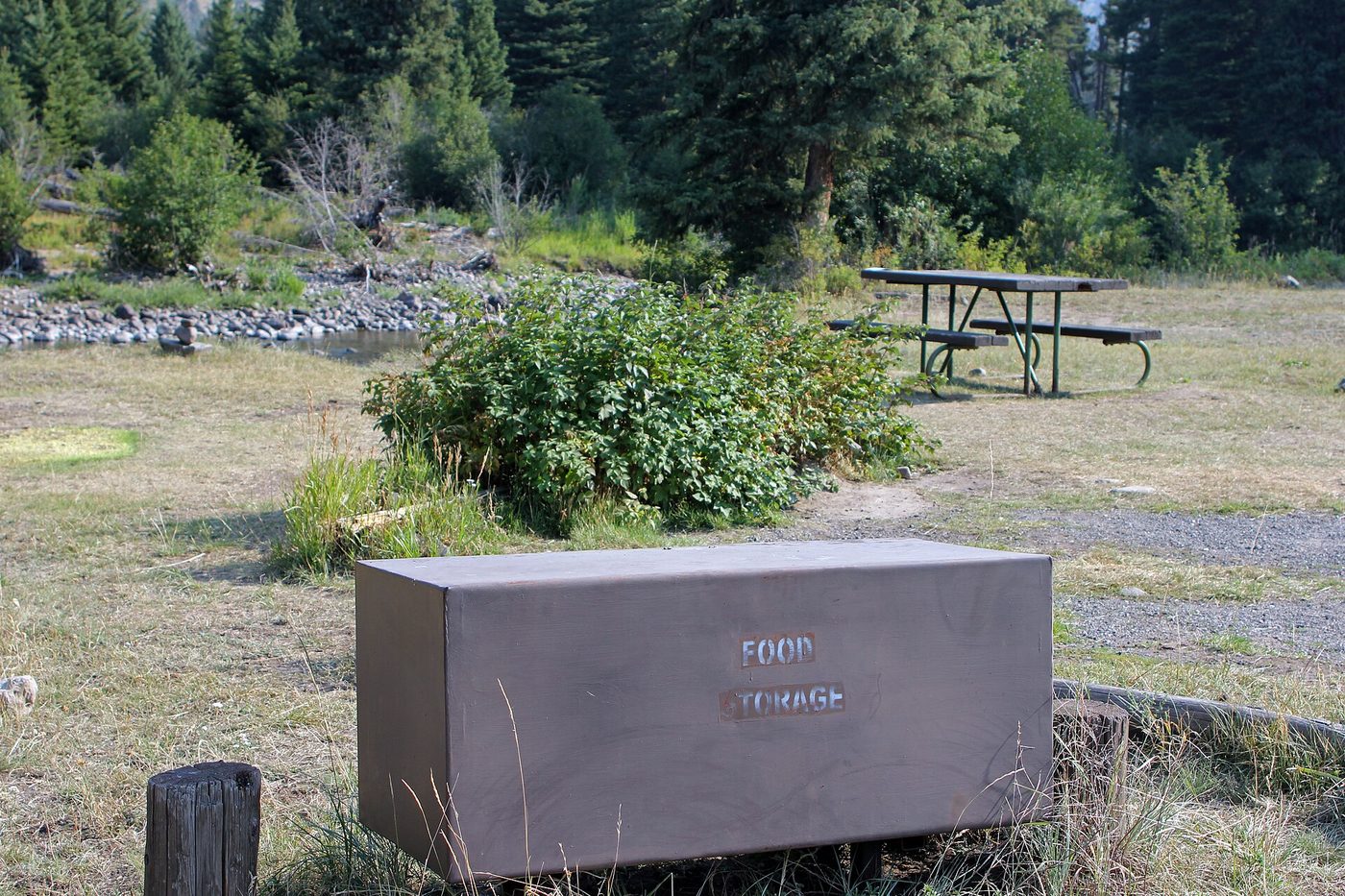
- Store all food, coolers, cooking gear, dishes, trash and scented items (toothpaste, sunscreen, deodorant, pet food) in a hard-sided vehicle with the windows closed, or in the food storage box at your site. Never leave them in a tent or out on the table.
- Never leave food unattended, even for a few minutes while you walk to the restroom.
- Put trash and recycling in the bear-resistant bins in the campground, not in a bag by your site.
- Cook and eat away from your tent where possible, and don’t sleep in clothes you cooked in.
- Tent campers without a vehicle must use the food storage boxes.
Rangers do patrol and issue citations, and an unattended cooler is the classic offense.
Carry bear spray on trails and have it accessible in camp. Know how to use it. It works at 30 to 60 feet and can explode if left in a hot car above 120°F (checked September 2026). You can rent it in gateway towns if you’ve flown in.
Wildlife distance: stay at least 100 yards from bears and wolves and 25 yards from bison, elk and other animals, including the elk that wander through Mammoth and Madison campgrounds. A bull elk in the September rut can charge.
For the full rules and what to do in an encounter, see our Yellowstone camping food storage guide and the broader Yellowstone safety guide.
Campground rules, facilities and services
Check-in and check-out. At the Xanterra campgrounds, check-in is 1 p.m. and check-out 11 a.m. (checked September 2026). Arrive with enough daylight to set up.
Toilets and water. The big Xanterra campgrounds have flush toilets and running water. The small NPS campgrounds are simpler, and several have vault toilets. None of the campgrounds except Fishing Bridge offers water or sewer hookups at the site.
Showers and laundry. Available at Canyon and Fishing Bridge, and near Grant Village. Madison, Bridge Bay and the NPS campgrounds don’t have them on site. Bring quick-dry towels and budget a little for pay showers.
Campfires. Allowed in the fire rings at developed campgrounds unless fire restrictions are in effect. In late August 2026, NPS rated fire danger as high, so check current restrictions each day. Never leave a fire unattended, and drown it completely with water before bed. Buy firewood locally rather than bringing it from far away.
Generators. Permitted only at Bridge Bay, Canyon, Fishing Bridge, Grant Village and Madison, and only during set hours. Nowhere else.
Pets. Allowed in the campgrounds, but must be on a leash no longer than 6 feet and never left unattended. Inside the park, pets can’t go on boardwalks, trails or into the backcountry, and must stay within 100 feet of roads, parking areas and campgrounds. There are no kennels in the park (checked September 2026). That makes a camping trip with a dog workable but limiting.
Stores and gas. General stores near Canyon, Grant Village, Bridge Bay/Lake, Fishing Bridge, Mammoth and Tower sell groceries, camping supplies and firewood. Gas is available at Canyon, Fishing Bridge, Grant Village, Mammoth, Old Faithful and Tower Junction, with 24-hour card pumps.
Ranger programs. Several campgrounds, including Madison, have amphitheaters with evening ranger talks in summer. They’re free and often excellent.
No camping outside campgrounds. Overnight stays in vehicles at pullouts, trailheads or parking lots aren’t allowed.
Quiet hours and courtesy. Campgrounds enforce quiet hours at night. Sound carries, and many campers are up before dawn for wildlife, so keep it down after dark.
For a printable list of what to bring, see our Yellowstone camping checklist.
Arriving late, and leaving well
Try hard not to arrive after dark. Driving park roads at night means bison and elk standing in the lane with no warning, and pitching a tent by headlamp in a strange loop is harder than it sounds. If a long travel day will put you at the campground after sunset, eat dinner in a gateway town first, have your site number and loop map saved offline, and set up the tent in daylight on another night if you can. If you do arrive late, keep engine noise, door slams and headlights to a minimum; your neighbors are likely asleep before an early start.
Leave the site better than you found it. Pack out anything the bins won’t take, pick up micro-trash such as bottle caps and twist ties, drown and stir the fire until the ashes are cold to the touch, and never dump gray water on the ground. A clean site keeps the next camper safe from a bear that has learned to check picnic tables.
What camping in Yellowstone actually feels like
It’s worth being honest about the conditions, because they surprise a lot of first-time campers.
It’s cold at night. Most campgrounds sit between about 6,200 feet (Mammoth) and roughly 7,900 feet (Canyon, Grant Village, Bridge Bay, Lewis Lake). NPS monthly averages show July lows around 47°F and August lows around 45°F, and at the higher campgrounds nights are often colder, with frost possible in any month. June and September lows are near freezing (checked September 2026). A summer sleeping bag won’t cut it.
Weather changes fast. Afternoon thunderstorms are common in July and August, and snow can fall in June and September. Pitch your tent to shed rain, bring a tarp, and keep a warm layer and rain jacket in the car.
Wildlife comes to you. Bison and elk walk through Madison and Mammoth campgrounds, ravens raid unattended picnic tables, and bears occasionally pass through loops at night. That’s part of the magic, and part of why the rules are strict.
Mosquitoes. Heavy in June and early July near water and in wet meadows, particularly at Indian Creek, Lewis Lake and Bridge Bay. They fade by August.
Days start early. The best wildlife watching and the emptiest parking lots are at dawn. Camping makes an early start easy: you’re already in the park when the gate lines form in the gateway towns.
Smoke. In some late summers, wildfire smoke from across the West settles over the park. It rarely stops a trip, but it can affect sensitive lungs.
Camping with kids
A Yellowstone camping trip can be the best vacation a kid ever has, with a little planning.
- Pick a campground with space and services. Canyon, with showers, laundry and a store nearby, is the easiest for families. Madison’s meadows, elk and ranger programs are a close second.
- Keep the gear warm and dry. Children feel cold faster. Pack a warm hat, gloves and a fleece for every child, even in July, and spare dry clothes for each day.
- Make the rules a game. Kids are often better at the “nothing on the picnic table” rule than adults. Put them in charge of checking the table and the tent before bed.
- Plan short hikes and big rewards. A boardwalk loop, a ranger program and toasting marshmallows at a legal campfire will make the day.
- Hold hands in thermal areas and near wildlife. Boardwalks exist because the ground beside hot springs can be thin crust over scalding water, and bison in campgrounds are wild animals, not scenery.
- Sign up for Junior Ranger. The program gives kids a goal for each area of the park, and the badge is a great souvenir.
How much does camping in Yellowstone cost?
Developed campsites cost $20 to $45 plus tax per night in 2026, and $94 plus tax at Fishing Bridge RV Park with full hookups. Backcountry camping costs $5 per person, per night, plus a $10 reservation fee. You’ll also pay the park entrance fee of $35 per vehicle for seven days (checked September 2026).
A realistic budget for a family of four camping for four nights in summer looks like this:
| Item | Cost (2026) |
|---|---|
| Park entrance, private vehicle, 7 days | $35 |
| 2 nights at Madison ($38 + tax) | about $80-85 |
| 2 nights at Canyon ($45 + tax) | about $95-100 |
| Firewood, ice and showers | $40-60 |
| Groceries for camp meals | varies |
| Camping and park fees total | about $250-280 plus food |
Compare that with lodging inside the park, where a single night in a basic room or cabin often costs more than that entire camping total. Camping is by far the cheapest way to sleep inside Yellowstone. Non-US residents aged 16 and over should also budget for the $100 per person nonresident fee unless entering on an annual pass. See our Yellowstone entrance fee page.
Ways to save on a camping trip
- Choose the $20 campgrounds. Tower Fall, Indian Creek, Slough Creek and Lewis Lake cost about half the price of the big campgrounds, although they’re simpler and harder to book in some cases.
- Skip hookups. Dry camping at Madison or Bridge Bay and using the dump station costs far less than a night at Fishing Bridge RV Park.
- Shop in gateway towns. Groceries, ice, firewood and bear spray cost less in West Yellowstone, Gardiner, Cody and Jackson than in park stores.
- Buy the right pass. If you’ll visit another national park this year, an America the Beautiful pass may cost less than paying separate entrance fees.
- Mix in national forest camping. A night or two at a national forest campground outside the park can be cheaper and easier to book, especially at the start or end of a trip.
Camping in Yellowstone by season
May and early June. Madison opens May 1, Fishing Bridge May 8, Bridge Bay May 15, Tower Fall May 22 and Canyon May 29 (2026 dates). It’s cold, snow is possible, and some roads and trails are still snowbound. The reward is fewer people and baby animals everywhere. Pack winter-weight gear.
Mid-June to August. Everything open, from Indian Creek on June 12 to Grant Village on June 26. The busiest and warmest period, with sites booked solid. Expect mosquitoes early and thunderstorms in the afternoons.
September. For many campers, the best month. Crisp nights, fewer families, elk bugling through Madison and Mammoth, and good availability. Several campgrounds close during the month: Bridge Bay on September 13, Indian Creek on September 14, Canyon on September 19, Grant Village on September 26 and Tower Fall on September 27.
October. Only Madison and Fishing Bridge (to October 17), Lewis Lake (to October 11), Slough Creek (to October 12) and Mammoth remain. Nights are often well below freezing. Most park roads close to cars at the end of October.
Winter. From October 15 to April 1, Mammoth Campground switches to first-come, first-served, and it’s the only place to camp in a vehicle or tent inside the park in winter. Only the road from the North Entrance through Mammoth to Cooke City stays open to cars. It’s a real winter camping trip, with overnight temperatures often below 0°F. See our winter camping in Yellowstone guide.
Is camping in Yellowstone worth it?
Yes, for most people who are comfortable outdoors. Camping puts you inside the park at dawn and dusk, when wildlife is active and the crowds are gone, for a fraction of lodge prices. It’s less worth it if you hate cold nights, need hot showers every day, or can’t book ahead.
Here’s the honest comparison:
Camping wins on:
- Price. $20 to $45 a night versus hundreds for an in-park room.
- Location. Madison, Canyon and Slough Creek put you closer to the best sights than most lodges.
- Experience. Elk bugling at night, stars without light pollution, and wolf watching from your campsite at Slough Creek are hard to beat.
- Availability. Even with the competition, campsites are often easier to get than rooms at the Old Faithful Inn.
Lodges or gateway towns win on:
- Comfort. Warm beds, showers and restaurants after long days.
- Weather-proofing. A three-day summer storm is miserable in a tent.
- Flexibility. Motels in West Yellowstone and Gardiner can sometimes be booked late; campsites rarely can.
- Simplicity. No gear to haul on a fly-in trip.
A mixed trip often works best: camp for most nights, and book a lodge or motel room for one night in the middle to shower, dry out and recharge. If you’re weighing the options, see our lodging in Yellowstone National Park guide and our overview of where to stay in Yellowstone.
Frequently asked questions
How far in advance do you need to book Yellowstone campgrounds?
For the NPS campgrounds on Recreation.gov, sites open exactly six months before your stay date, and popular ones sell out within minutes. From the 2027 season, Madison, Canyon, Bridge Bay, Grant Village and Fishing Bridge RV Park also move to Recreation.gov with about a six-month window.
Which campground is closest to Old Faithful?
Madison Campground is closest, about 16 miles north of Old Faithful and 14 miles from the West Entrance. There’s no campground at Old Faithful itself. Grant Village Campground is about 19 miles away via West Thumb.
Are there any first-come, first-served campgrounds in Yellowstone?
Only Mammoth Campground in winter, from October 15 to April 1. In summer, NPS requires all campsites to be reserved in advance. Many national forest campgrounds outside the park are first-come, first-served, although some are restricted to hard-sided campers.
Can you sleep in your car in Yellowstone?
Only in a designated campsite. Sleeping in a vehicle at pullouts, trailheads, parking lots or picnic areas isn’t allowed anywhere in the park, and rangers patrol for it. If you can’t get a campsite, look for national forest campgrounds or dispersed camping outside the park.
Which Yellowstone campgrounds have showers?
Canyon Campground and Fishing Bridge RV Park have showers and laundry, and Grant Village has them nearby. Madison, Bridge Bay, Mammoth, Tower Fall, Indian Creek, Lewis Lake and Slough Creek don’t have showers on site.
Is Pebble Creek Campground open?
No. Pebble Creek was significantly damaged in the June 2022 floods, and NPS says it will remain closed until further notice. Slough Creek and Tower Fall are the closest alternatives, along with national forest campgrounds near Cooke City.
Which Yellowstone campground is best for RVs?
Fishing Bridge RV Park is the only one with full hookups and takes rigs up to 95 feet, but it costs $94 plus tax per night. For dry camping, Madison and Bridge Bay take RVs up to 60 feet and have dump stations. Avoid Lewis Lake (25 feet) and Tower Fall’s hairpin access road.
How cold does it get camping in Yellowstone in summer?
Colder than most people expect. NPS monthly averages show July lows around 47°F, and at higher campgrounds such as Canyon and Grant Village, nights can drop near or below freezing even in summer. Bring a sleeping bag rated to 20°F and warm layers.
Sources
- National Park Service, Yellowstone: campgrounds, checked September 2026
- National Park Service, Yellowstone: backcountry camping and permits, checked September 2026
- National Park Service, Yellowstone: operating dates, checked September 2026
- Recreation.gov: Yellowstone National Park camping
- Yellowstone National Park Lodges: camping reservations, checked September 2026
- National Park Service, Grand Teton: operating hours and seasons, checked September 2026
Image credits
| Photo | Credit |
|---|---|
| Slough Creek has just 16 sites in wolf country (top of page) | Yellowstone National Park from Yellowstone NP, USA, public domain, via Wikimedia Commons |
| Warm hats in summer are normal: nights at park campgrounds are often near freezing | Yellowstone National Park, public domain, via Wikimedia Commons |
| Evening ranger programs at the Madison amphitheater are free | Yellowstone National Park from Yellowstone NP, USA, public domain, via Wikimedia Commons |
| Food storage boxes at Bridge Bay keep food and scented items away from bears | Yellowstone National Park from Yellowstone NP, USA, public domain, via Wikimedia Commons |
| Mammoth is the lowest, driest campground in the park and open all year | Yellowstone National Park from Yellowstone NP, USA, public domain, via Wikimedia Commons |
| From October 15 to April 1, Mammoth’s sites are first-come, first-served | Yellowstone National Park from Yellowstone NP, USA, public domain, via Wikimedia Commons |
| Tent campers without a vehicle must use the food storage boxes | Yellowstone National Park from Yellowstone NP, USA, public domain, via Wikimedia Commons |
| The Lewis Lake boat launch is the start point for paddles to Shoshone Lake | Yellowstone National Park from Yellowstone NP, USA, public domain, via Wikimedia Commons |
| Madison takes RVs up to 60 feet but has no hookups | Yellowstone National Park from Yellowstone NP, USA, public domain, via Wikimedia Commons |
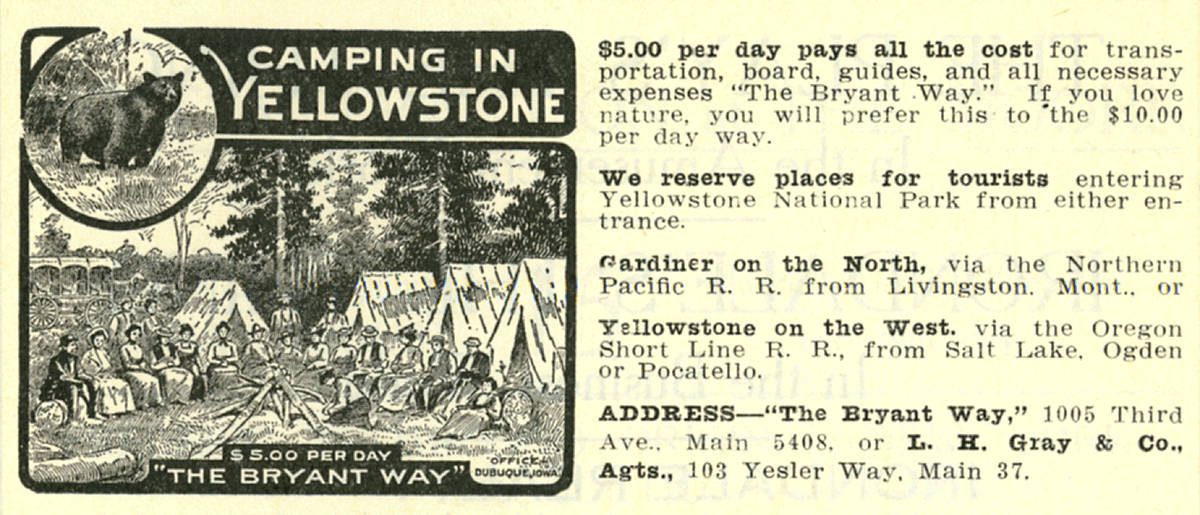
| Tent-camp tours were the budget way to see the park more than a century ago | Bryant Camping Company, public domain, via Wikimedia Commons |