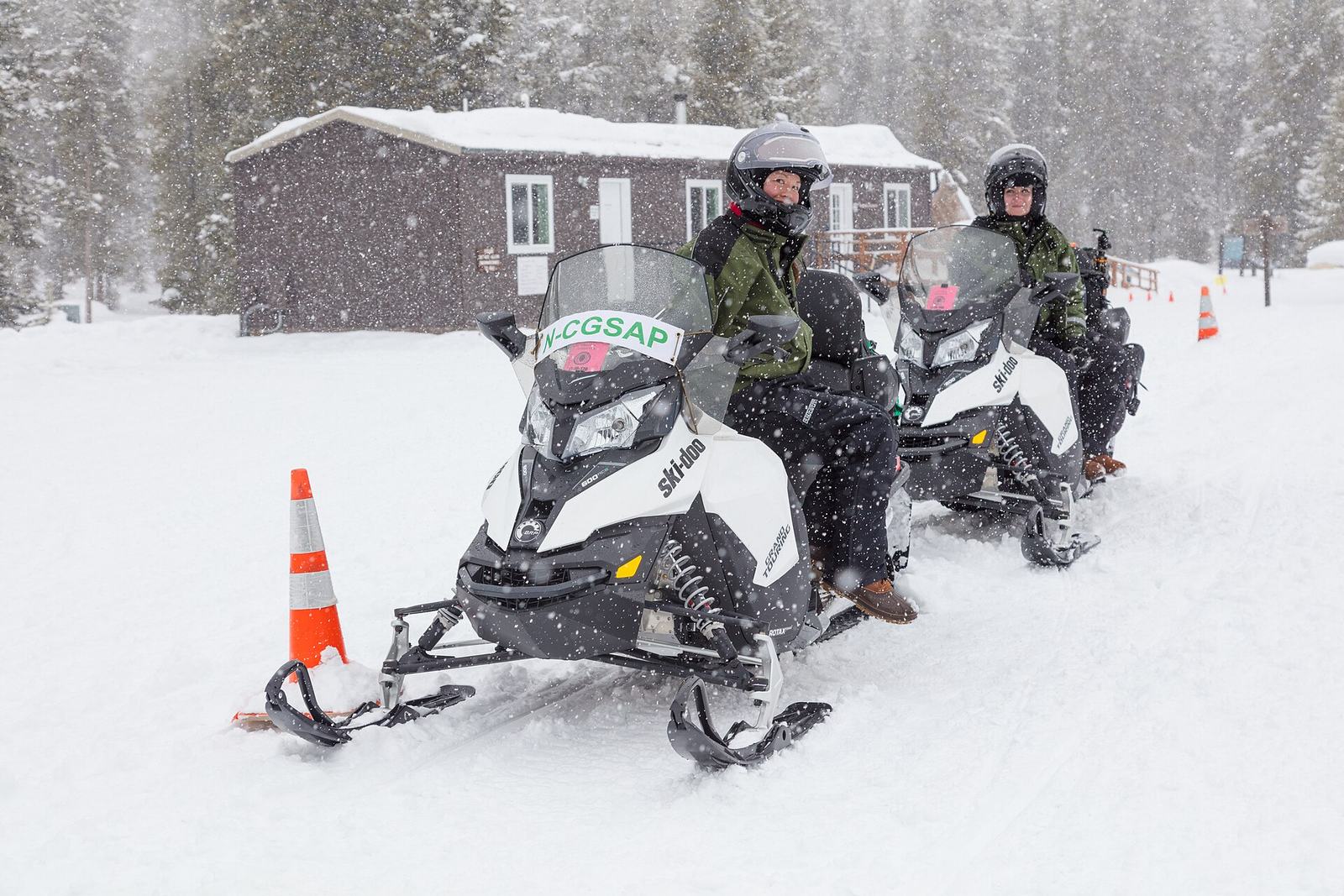
You can snowmobile Yellowstone without a commercial guide only through a small lottery, the Non-Commercially Guided Snowmobile Access Program. Up to four groups a day get in, one at each oversnow entrance, with no more than five snowmobiles each, and permits cost $40 a day plus a $6 application fee. It’s what most people mean by the Yellowstone non commercial snowmobile permit, and it’s the only way to ride the park’s groomed roads at your own pace.
The catch is that someone in your group becomes the guide. The permit holder leads the trip, sets the route and pace, and answers for the group’s safety and conduct on roads shared with bison, snowcoaches and guided tours. Every rider needs a driver’s license and a free online certification, and every machine has to meet the park’s cleanest emissions and noise standard. This guide covers how the lottery works, who qualifies, what it costs, the rules on the trail, how to plan a trip and whether it’s worth it, using the park’s own program pages (checked September 2026). For the winter season as a whole, see our guide to Yellowstone in winter.
How does the Yellowstone snowmobile lottery work?
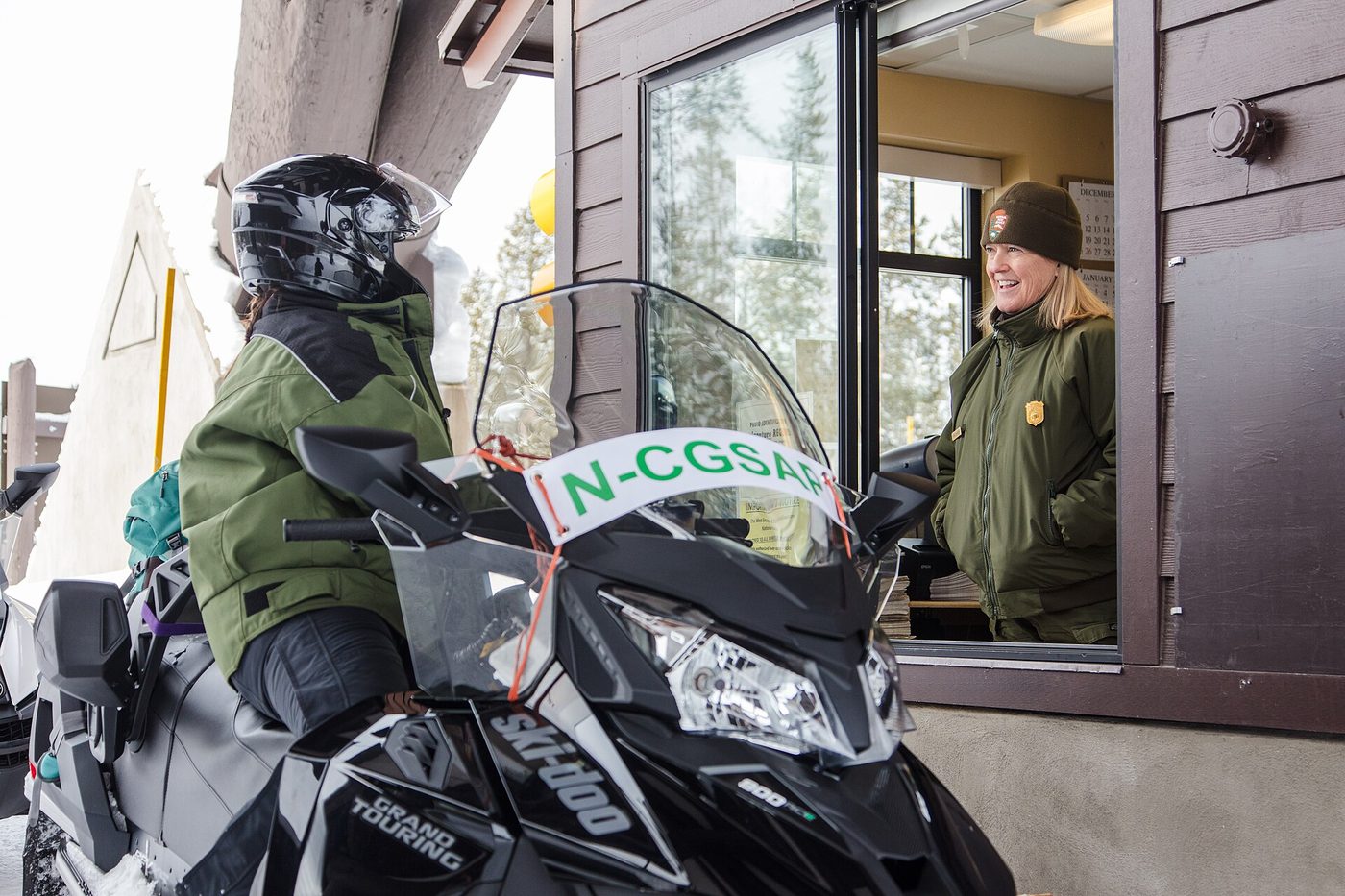
Applications open on Recreation.gov from August 1 to 31 for the coming winter, with a $6 non-refundable fee. The park awards permits by lottery in September, and any unclaimed or cancelled dates go on sale first come, first served from October 1. Each permit allows one group of up to five snowmobiles in through one entrance.
Here’s the timeline, as the park’s snowmobiling page described it when last updated in May 2025:
| Step | When | What happens |
|---|---|---|
| Lottery applications | August 1 to 31 | Apply on Recreation.gov for your preferred dates and entrance; $6 application fee |
| Awards | Mid-September | Winners are notified and pay $40 per permit day |
| First come, first served | From October 1 | Leftover and cancelled dates go on sale |
| Trips | Oversnow season, mid-December to mid-March | Up to three days and two nights per trip |
If the program follows its usual calendar, the lottery for winter 2026-27 closed on August 31, 2026, so any trip this winter depends on leftover dates from October 1. The oversnow season opens on December 15, 2026, and the groomed roads close in stages between March 7 and March 15, 2027, so check which segments your dates allow on our Yellowstone road closures page.
A few things about the allocation are worth understanding before you apply:
- One group per entrance per day. The park allows up to four non-commercially guided groups to enter daily, one at each oversnow entrance. If someone else holds the permit for your entrance on your date, you’ll need a different day or a different gate.
- Weekends and holidays are the hardest. The Christmas and New Year weeks, Martin Luther King Jr. weekend and Presidents’ Day weekend draw the most interest. Midweek dates in January and February are the easiest to get.
- Flexibility wins. Listing several dates and more than one entrance gives you more chances.
Who can get a non-commercial snowmobile permit?
The permit holder, who leads the trip as its non-commercial guide, must be at least 18 on the first day of the trip and can lead no more than two trips a winter. Every snowmobile operator must be at least 16, hold a valid driver’s license and complete the free online Yellowstone Snowmobile Education Certification.
| Requirement | Rule |
|---|---|
| Group size | Up to five snowmobiles per permit |
| Permit holder and leader | At least 18 on the first day of the trip; no more than two trips as leader per winter season |
| Snowmobile operators | At least 16 by the first day of the trip, with a valid driver’s license |
| Training | Every operator completes the Yellowstone Snowmobile Education Certification program |
| Machines | Registered and certified as meeting the park’s Best Available Technology standard; the park’s current page specifies New BAT |
| Not allowed | Tracked side-by-sides; pets |
| Trip length | Up to three days and two nights |
On the machines: the park’s rules page, last updated in January 2025, says snowmobiles must be certified BAT or New BAT, while its snowmobiling page, updated in May 2025, says New BAT. Plan on New BAT, and confirm when you book. The park notes that compliant snowmobiles can be rented from local businesses, which is how most permit holders ride; ask the rental shop to confirm in writing that the machine is certified for use in the park.
The Yellowstone Snowmobile Education Certification
Every operator in the group has to complete the Yellowstone Snowmobile Education Certification program before the trip. It’s an online course covering the park’s winter rules, wildlife, thermal areas and safety, and it’s free. Have each rider take it well before the trip, and keep proof of completion with your permit paperwork. It’s worth doing properly even if you’re an experienced rider, because the rules inside Yellowstone are stricter than on most national forest trails.
What a non-commercial snowmobile trip costs
The permit itself is cheap. The machines are where the money goes.
| Item | Cost (checked September 2026) | Notes |
|---|---|---|
| Lottery application | $6 | Non-refundable |
| Permit | $40 per day | Refundable if cancelled at least one week before the start date |
| Park entrance, snowmobiles | $30 | Covers up to two snowmobiles with up to four people for seven days |
| Nonresident fee | $100 per person | Non-US residents aged 16 and older, unless covered by an annual or America the Beautiful pass |
| Snowmobile rental | Varies by shop | Must be New BAT certified for use in the park |
| Fuel, lodging and gear | Varies | Interior fuel is sold by card; see below |
A worked example: four friends on four rented snowmobiles for a three-day trip pay $6 to apply, $120 for three permit days and $60 in entrance fees for two snowmobile passes, so $186 in park costs before rentals, fuel and lodging. Non-US residents in the group would each add $100 unless they hold a qualifying pass. Our Yellowstone entrance fee page has the current fees and passes.
For comparison, guided snowmobile days in 2026-27 were advertised at $322 to $490 per rider per day, plus fees in some cases. Even after rental prices, a non-commercial trip can cost far less than three guided days for a group of four. It also costs you something the guided day doesn’t: all the responsibility.
The rules on the trail
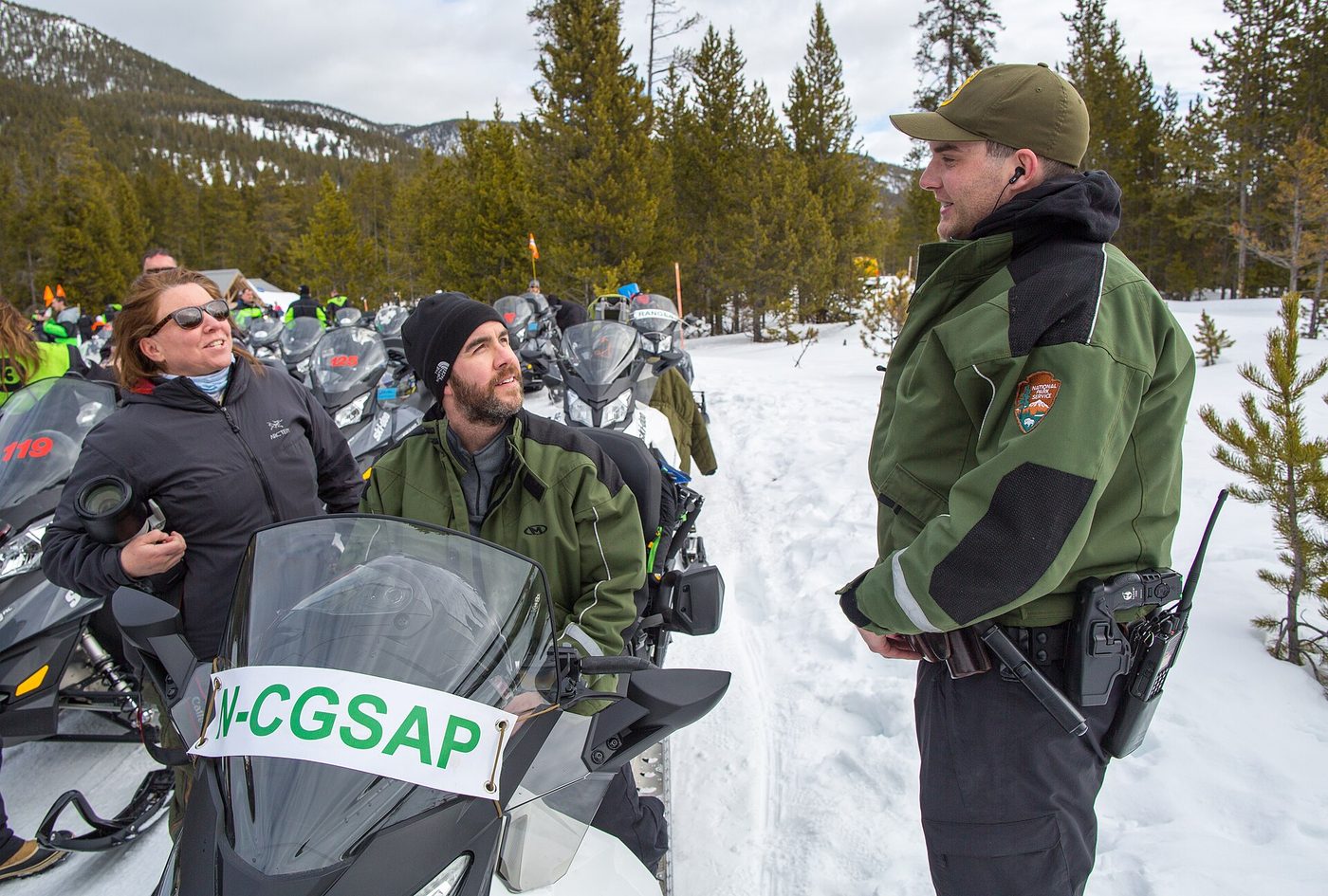
The park’s rules for non-commercially guided groups are short and specific, and rangers check them. From the program’s rules page (last updated January 2025) and snowmobiling page (last updated May 2025):
- Check in before 4 p.m. Groups must check in at the appropriate entrance station before 4 p.m.
- Carry the permit. The permit holder must keep a copy of the signed permit with them at all times.
- Display the placard. Every group must display an N-CGSAP placard.
- Stay together. The whole group must stay within a third of a mile of the lead snowmobile.
- Stay on the groomed roads. Travel only on groomed roads and in parking areas. No off-road riding.
- Obey posted speed limits.
- Lower alcohol limit for leaders. Group leaders are held to a blood alcohol limit of 0.04 percent.
- Towing. You can tow a sled with a rigid tow bar, but nobody may ride on it.
- No pets. Pets aren’t allowed into the park through the program.
What the leader is responsible for
On a commercial tour, the guide carries the weight of the day. On a non-commercial permit, that’s the permit holder’s job, and it’s worth being clear with your group about what that means:
- Knowing the rules and making sure every rider follows them, from the 4 p.m. check-in to the one-third-mile spacing.
- Choosing the route and the turnaround time, with enough daylight and fuel to get everyone back.
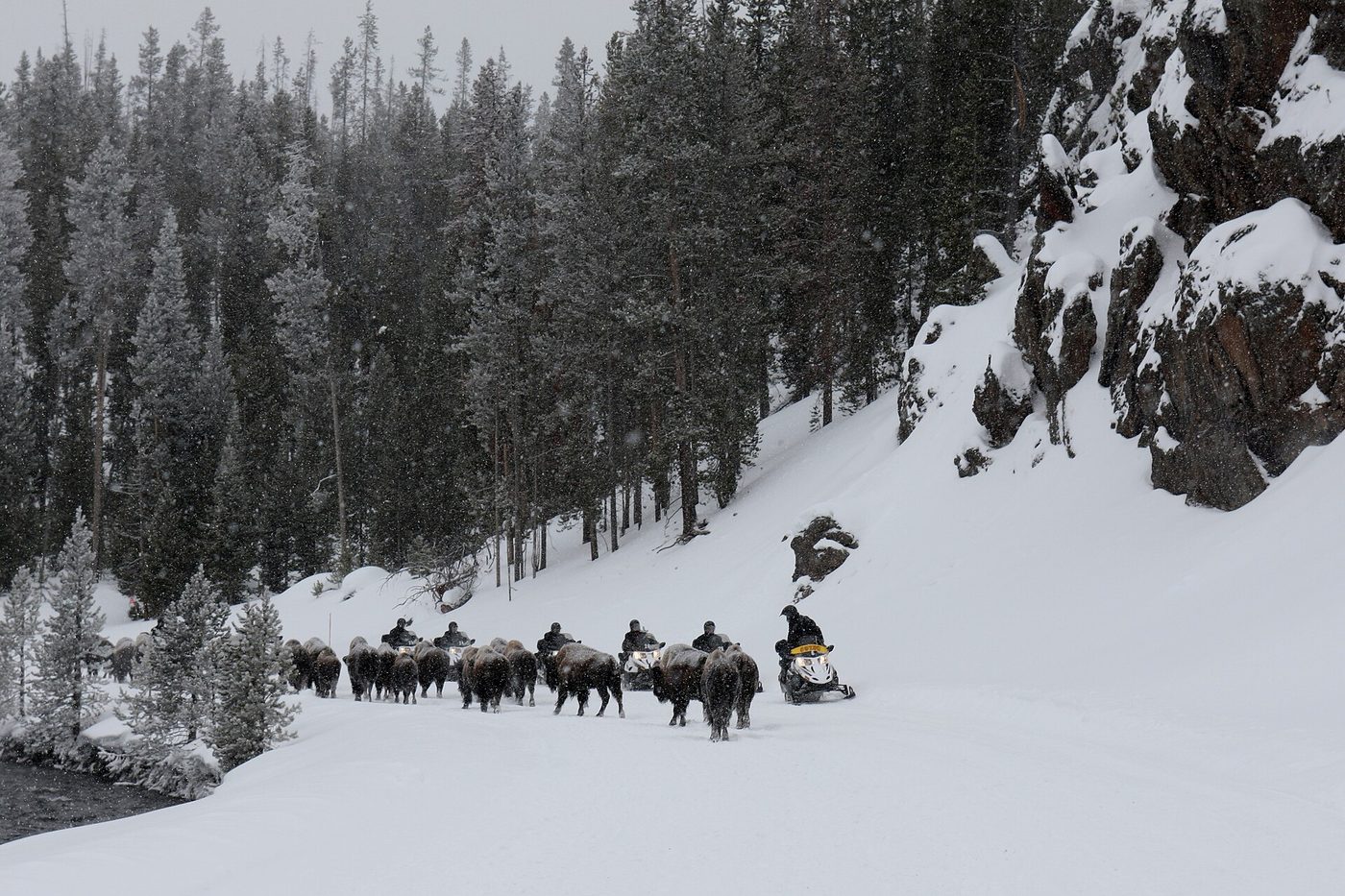
- Handling wildlife encounters, especially bison on the road, calmly and by the book.
- Watching the group, including the least experienced rider and anyone getting too cold.
- Deciding when to call it, whether that’s a storm, a breakdown or a rider who’s had enough.
- Keeping the paperwork: the signed permit, the placard and proof that everyone is certified.
If nobody in your group is comfortable carrying all of that, a guided tour is the better choice.
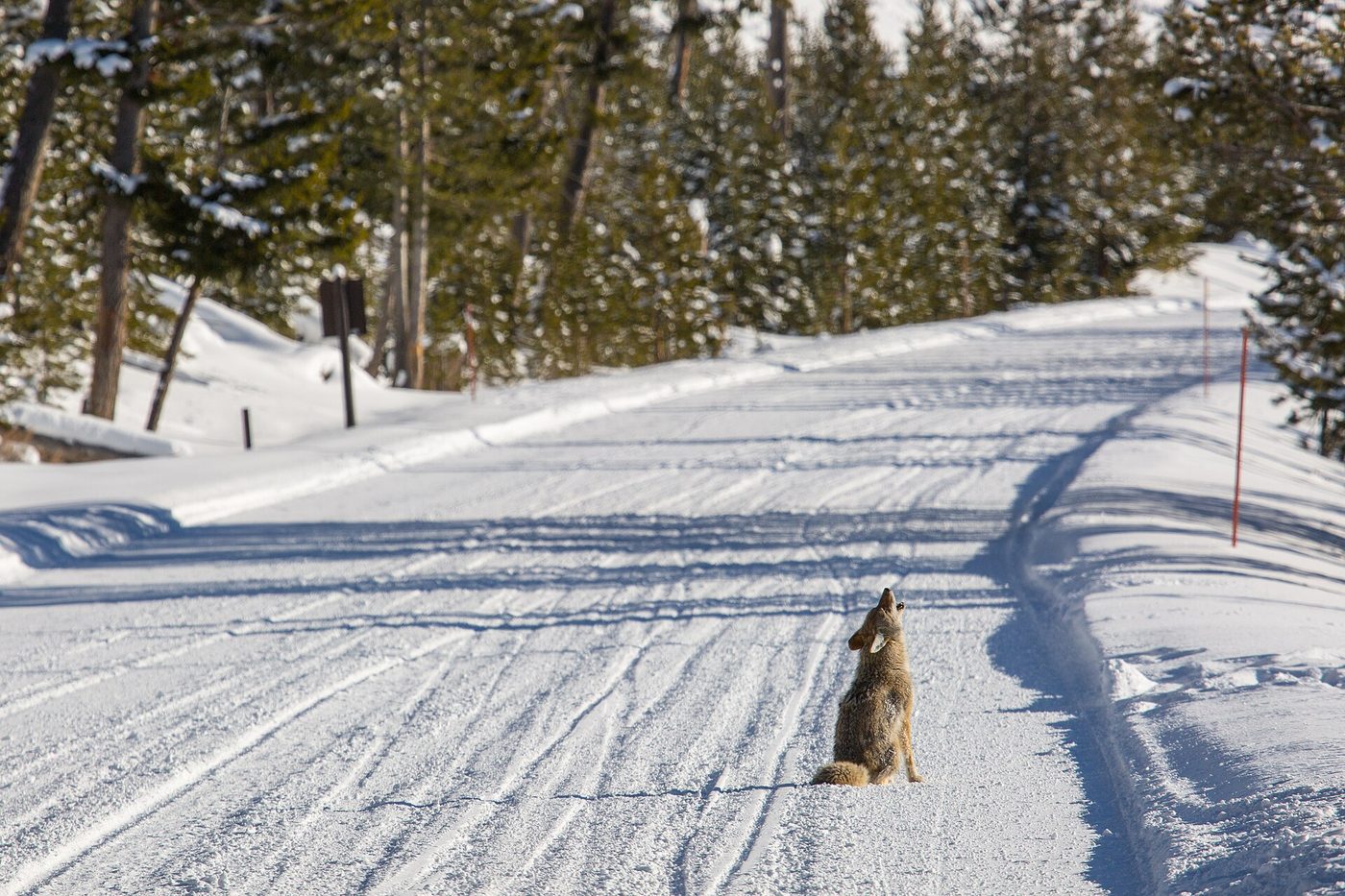
The park’s general winter rules apply too. Stay at least 25 yards from bison, elk and other animals and 100 yards from wolves and bears. When bison are on the road, stop well back, wait for them to move or pass slowly with plenty of room, and never try to push through a herd. Stay on the boardwalks in thermal areas. And remember that you’re sharing the road with snowcoaches and guided groups whose drivers do this every day; let them by where it’s safe. Our Yellowstone safety guide covers the park’s wildlife and thermal rules in full.
Planning a non-commercial snowmobile trip
With the permit in hand, the planning is up to you. Here’s what to think about.
Choosing your entrance and route
- West Entrance, from West Yellowstone. The most popular choice, with the most rental shops nearby. Old Faithful is about 30 miles away by way of Madison and the Firehole River, and Canyon is about 40 miles by way of Madison and Norris.
- South Entrance, from Flagg Ranch. About 40 miles to Old Faithful by way of West Thumb and Craig Pass, with Yellowstone Lake along the way. Handy if you’re based in Jackson.
- East Entrance, over Sylvan Pass. The road climbs through avalanche terrain and opens to oversnow travel only on a limited basis. Check conditions carefully before choosing this gate.
- From Mammoth. The road south from Mammoth to Norris, about 21 miles, is also groomed for oversnow travel in winter; confirm with the park which entry points your permit covers.
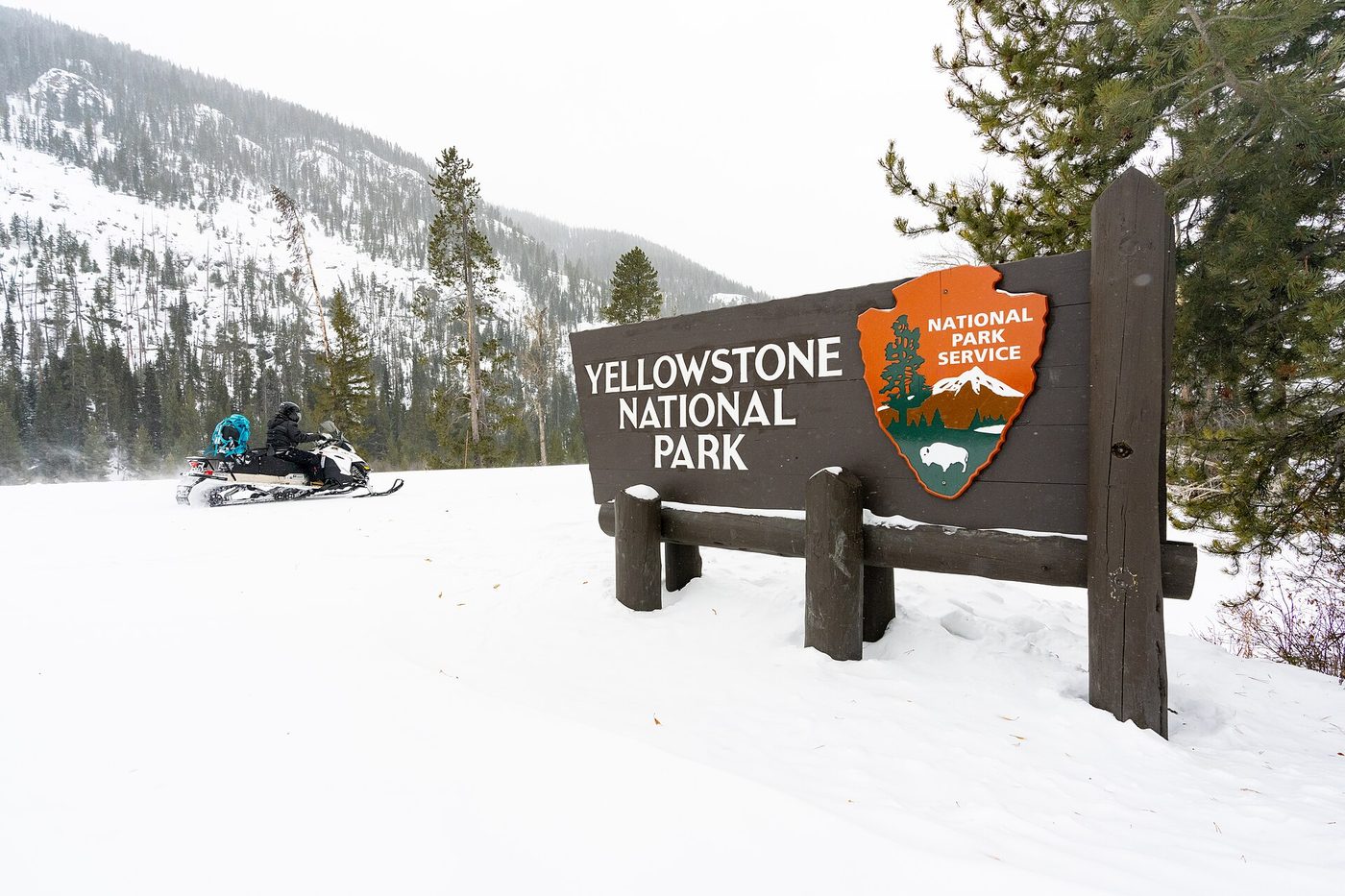
Remember that segments close in stages in March, with Mammoth to Norris first on March 7, 2027, and the West, South and East entrance roads last, on March 15.
Renting a compliant snowmobile
Most permit holders rent, and West Yellowstone, at the edge of the West Entrance, has the biggest choice of rental shops; Jackson and Flagg Ranch serve the South Entrance. When you book, ask:
- Is the machine certified New BAT for use inside Yellowstone? Get it in writing, since not every rental sled qualifies.
- Does the shop allow its machines on a non-commercial trip in the park? Some rental agreements restrict where you can ride.
- What gear is included? Helmets are essential, and many shops rent suits, boots and mittens.
- What’s the damage policy? Ask about deposits, waivers and what happens if a machine breaks down deep in the park.
- Can you pick up the evening before? An early start matters when the check-in cutoff is 4 p.m. and the sun sets around 5.
Book rentals as soon as you have your permit, especially for holiday dates, when machines sell out.
Fuel, warming huts and overnight stays
- Fuel. The park lists 24-hour card fueling all year at its stations at Old Faithful, Canyon, Fishing Bridge and Grant, so you can refuel inside the park. Still, start every day with a full tank, and know your machine’s range.
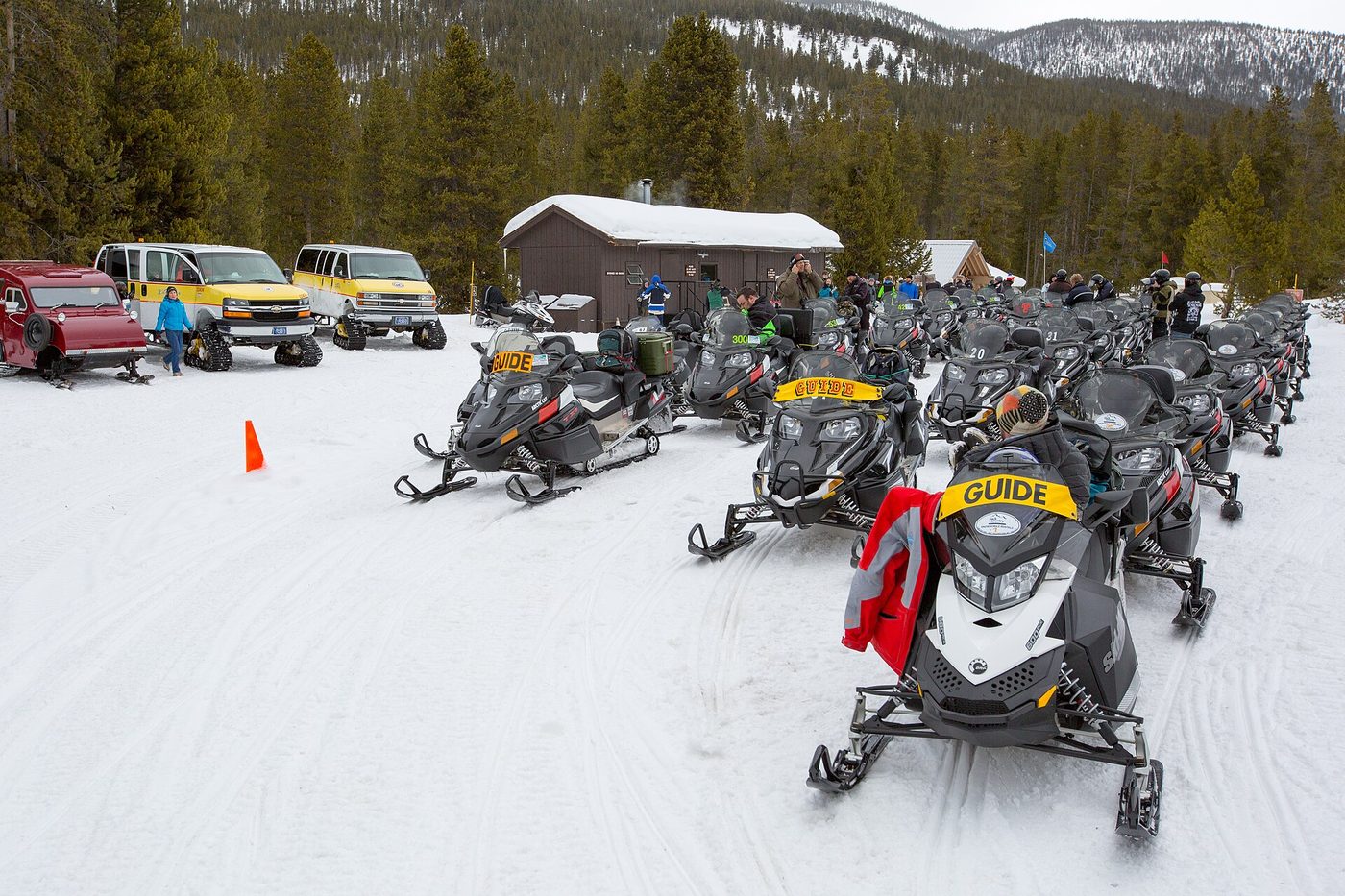
- Warming huts. In past winters the park has run warming huts at places like Madison, Canyon, West Thumb and Fishing Bridge, with shelter and restrooms. Their 2026-27 schedule was still to be confirmed in September 2026, so don’t plan your day around them.
- Overnight. Trips can last up to three days and two nights, and Old Faithful Snow Lodge, open December 16, 2026 to March 7, 2027, is the obvious place to stay: guests on their own snowmobiles can ride right in. Book the lodge early, since it’s the hardest winter room in the park. See Yellowstone winter lodging.
Safety when you’re the guide
On a guided tour, the guide handles the things that go wrong. On a non-commercial trip, you do. Plan for them.
- Weather. Check the forecast every morning and be ready to shorten the day. Whiteouts, deep new snow and extreme cold all happen.
- Daylight. In January the sun sets around 5 p.m., and the entrance check-in cutoff is 4 p.m. Plan your return with plenty of margin.
- Communication. Cell coverage is patchy in much of the park. A satellite messenger is inexpensive insurance.
- Breakdowns. Carry a basic tool kit, a tow strap, spare belt if your rental shop provides one, and a plan for a machine that won’t start.
- Clothing and first aid. Pack extra layers, hand warmers, food, water and a first-aid kit. Our Yellowstone winter packing list covers the details.
- Group discipline. Keep everyone within a third of a mile, ride at the pace of the least experienced rider, and brief the group on bison encounters before you set off.
A sample three-day trip from West Yellowstone
Here’s how a three-day, two-night permit might look for an experienced group entering at the West Entrance, based on the park’s route distances.
- Day 1: West Yellowstone to Old Faithful, about 30 miles. Pick up your rentals the evening before, check in at the West Entrance in the morning, and ride up the Madison River to Madison Junction, then south along the Firehole past the Lower and Midway geyser basins. Arrive at Old Faithful by early afternoon, park at Old Faithful Snow Lodge, and spend the rest of the day walking the Upper Geyser Basin. Our guide to Old Faithful in winter covers what you’ll see.
- Day 2: Old Faithful to the Grand Canyon of the Yellowstone and back, about 84 miles. Ride north to Madison, then along the Gibbon River past Gibbon Falls to Norris and east to Canyon, where the Lower Falls builds an ice cone through the winter. Refuel at Canyon, and head back to the Snow Lodge with plenty of daylight to spare. It’s a big day, so skip it if anyone in the group is struggling. See the Grand Canyon of the Yellowstone.
- Day 3: Old Faithful to West Yellowstone, about 30 miles. Catch Old Faithful at dawn, when the steam column is at its biggest, then ride back to West Yellowstone, stopping along the Madison for bison and swans.
A lighter plan skips Canyon and spends the middle day on shorter rides around the geyser basins, or on skis from the Snow Lodge. Either way, book the Snow Lodge early, and check the segment dates if your trip falls in March, when the Norris to Canyon road closes on March 9, 2027. For West Yellowstone itself, see West Yellowstone in winter.
Is the non-commercial snowmobile permit worth it?
For experienced snowmobilers who want to set their own pace, yes: it’s much cheaper than guided days for a group, and the freedom to linger at a geyser or turn around for a bison herd is wonderful. For first-time riders, no. A guided day is safer and easier, and the permit’s rules and responsibilities fall entirely on the leader.
The program suits:
- Groups of friends or family who ride regularly at home and want a few days in the park together.
- Photographers who want to stop wherever the light is good, without a tour schedule.
- Repeat visitors who’ve done a guided trip and know the routes.
It doesn’t suit:
- First-time snowmobilers. Learn on a guided tour first. Our Yellowstone snowmobile tours guide covers the options.
- Anyone who dislikes cold. A snowcoach is warmer and still gets you to Old Faithful. See snowcoach vs snowmobile.
- Travelers with fixed, unmovable dates. You need the lottery to fall your way, and the weather to cooperate.
The honest verdict: if you’ve got the experience and the right group, it’s one of the great winter adventures in the West. If you’re unsure, ride with a guide first and apply the following August.
How to apply, step by step
- Pick your dates and entrance. Choose several possible dates and, if you can, more than one entrance. Midweek January and February dates are easiest.
- Choose your leader. The permit holder must be at least 18 on the first day of the trip and can lead no more than two trips in the season.
- Apply on Recreation.gov between August 1 and 31. Pay the $6 application fee.
- Watch for results in September. If you win, pay for your permit days, at $40 a day.
- Missed out? Check Recreation.gov from October 1 for leftover and cancelled dates, which are sold first come, first served.
- Get everyone certified. Every operator completes the free online Yellowstone Snowmobile Education Certification.
- Reserve New BAT machines. Book rentals early and confirm they’re certified for use in the park.
- Book your lodging. If you’re staying overnight in the park, reserve Old Faithful Snow Lodge as soon as you have dates.
- On the day, check in before 4 p.m. Bring the signed permit, display the placard, and enjoy the ride.
If a trip falls through, cancel at least a week before the start date to get your permit fees back; the $6 application fee isn’t refundable. For guided alternatives, our Yellowstone winter tours comparison lines up every option, and everything else about the season, from road dates to what’s open, is in our complete Yellowstone winter guide.
Frequently asked questions
Can you snowmobile in Yellowstone without a guide?
Only with a permit from the Non-Commercially Guided Snowmobile Access Program. Up to four groups a day are allowed in, one at each oversnow entrance, with up to five snowmobiles each. Without a permit, you’ll need to join a commercially guided snowmobile tour.
When is the Yellowstone snowmobile lottery?
Applications are taken on Recreation.gov from August 1 to 31, with winners notified in September. Leftover and cancelled dates go on sale first come, first served from October 1. For winter 2026-27, the August lottery has already run if the program follows its usual calendar.
How much does a non-commercial snowmobile permit cost?
The permit costs $40 a day, plus a $6 non-refundable application fee (checked September 2026). You’ll also pay the park’s snowmobile entrance fee of $30 for up to two snowmobiles and four people for seven days, rental costs if you don’t own a New BAT machine, and the $100 nonresident fee for non-US residents aged 16 and older without a qualifying pass.
What is the Yellowstone Snowmobile Education Certification?
It’s a free online course that every snowmobile operator on a non-commercial permit must complete before the trip. It covers the park’s winter rules, wildlife encounters, thermal areas and safety. Keep proof of completion with your permit.
Can you use your own snowmobile in Yellowstone?
Yes, if it’s registered and certified as meeting the park’s New Best Available Technology standard for noise and emissions. Not every machine qualifies, so check yours before you plan around it. If yours doesn’t, local rental shops near the entrances rent compliant snowmobiles.
Can a non-commercial group stay overnight in Yellowstone?
Yes. Permits allow trips of up to three days and two nights, and Old Faithful Snow Lodge, open December 16, 2026 to March 7, 2027, is the usual base, since you can ride your own snowmobiles right to it. Winter camping inside the park is limited to Mammoth Campground; see our guide to winter camping in Yellowstone.
Do passengers need the snowmobile certification?
The park’s rules require every snowmobile operator to complete the Yellowstone Snowmobile Education Certification and hold a valid driver’s license. The rules pages we checked don’t set a separate requirement for passengers, so confirm with the park when you receive your permit.
How old do you have to be to lead a non-commercial snowmobile trip?
The permit holder, who acts as the group’s guide, must be at least 18 on the first day of the trip. Every snowmobile operator must be at least 16 with a valid driver’s license and the certification. A leader can lead no more than two trips per winter season.
Sources
- National Park Service, Snowmobiling in Yellowstone
- National Park Service, N-CGSAP rules and regulations
- National Park Service, Fees and passes
- National Park Service, Park roads
- Recreation.gov, Permits and lotteries
Image credits
| Photo | Credit |
|---|---|
| A non-commercially guided group stopped at the Madison warming hut; the N-CGSAP placard is (top of page) | Jacob W. Frank, public domain, via Wikimedia Commons |
| Checking in at the West Entrance; non-commercial groups must check in before 4 p.m | Jacob W. Frank, public domain, via Wikimedia Commons |
| Rangers check permits and placards along the groomed roads | Neal Herbert, public domain, via Wikimedia Commons |
| A coyote howling beside the West Entrance road; wildlife has the right of way on the groom | Neal Herbert, public domain, via Wikimedia Commons |
| The East Entrance, where the road over Sylvan Pass opens to oversnow travel only on a limi | Jacob W. Frank, public domain, via Wikimedia Commons |
| Snowmobiles and snowcoaches at the Madison warming hut, a common stop between the West Ent | Neal Herbert, public domain, via Wikimedia Commons |
| Snowmobilers passing bison along the Firehole River; on a non-commercial permit, the leade | Yellowstone National Park from Yellowstone NP, USA, public domain, via Wikimedia Commons |
| Hot drinks at the Madison warming hut; the huts’ 2026-27 schedule was still to be confirme | Yellowstone National Park, public domain, via Wikimedia Commons |